forked from farhoodlabs/paperclip
local
8 Commits
| Author | SHA1 | Message | Date | |
|---|---|---|---|---|
 Dotta Dotta
|
0808b388ee |
[codex] Add source-scoped recovery actions (#5599)
## Thinking Path > - Paperclip is a control plane for autonomous AI companies, where work must end with a clear disposition rather than ambiguous agent liveness. > - Recovery currently detects stalled or missing-next-step issues, but source issue recovery can become split across child recovery issues, blockers, and comments. > - That makes it harder for operators and agents to see who owns recovery and what exact action is needed on the original issue. > - Source-scoped recovery actions give the original issue a first-class active recovery state with owner, evidence, wake policy, and resolution outcome. > - This pull request adds the recovery-action data model, backend reconciliation and resolution APIs, and board UI indicators/actions. > - The benefit is clearer stalled-work recovery without losing source issue context or relying on comments as the liveness path. ## What Changed - Added the `issue_recovery_actions` schema, shared types/constants/validators, and an idempotent `0084_issue_recovery_actions` migration ordered after current `master` migrations. - Updated stranded/missing-disposition recovery to create source-scoped recovery actions, wake the recovery owner on the source issue, and avoid locking the source issue for recovery-action wakes. - Added API support for reading active recovery actions on issue detail/list surfaces and resolving them with restored, blocked, cancelled, or false-positive outcomes. - Require blocked recovery resolutions to have an unresolved first-class blocker, and removed the UI shortcut that could mark recovery blocked without a blocker selection path. - Surfaced recovery indicators/actions in the issue UI, blocker notices, active run panels, issue rows, and Storybook coverage. - Updated docs and focused tests for recovery semantics, ownership, races, stale comments, and UI behavior. ## Verification - `pnpm exec vitest run server/src/__tests__/issue-recovery-actions.test.ts server/src/__tests__/heartbeat-process-recovery.test.ts ui/src/components/IssueRecoveryActionCard.test.tsx ui/src/components/IssueBlockedNotice.test.tsx ui/src/api/issues.test.ts` — 5 files, 72 tests passed. - `pnpm --filter @paperclipai/shared typecheck` — passed. - `pnpm --filter @paperclipai/db typecheck` — passed, including migration numbering check. - `pnpm --filter @paperclipai/server typecheck` — passed. - `pnpm --filter @paperclipai/ui typecheck` — passed. - Follow-up verification after blocker-resolution guard: `pnpm exec vitest run server/src/__tests__/issue-recovery-actions.test.ts ui/src/components/IssueRecoveryActionCard.test.tsx ui/src/api/issues.test.ts` — 3 files, 27 tests passed. - Follow-up `pnpm --filter @paperclipai/server typecheck` — passed. - Follow-up `pnpm --filter @paperclipai/ui typecheck` — passed. - UI states are available in `ui/storybook/stories/source-issue-recovery.stories.tsx`; screenshot capture helper is `scripts/screenshot-recovery-card.cjs`. ## Risks - Medium: recovery behavior changes from child recovery issue ownership toward source-scoped actions, so operators may see stalled-work state in new places. - Migration risk is mitigated by using the next migration slot after `master` and making the table/constraints/index creation idempotent for anyone who previously applied the old branch-local `0082_dizzy_master_mold` migration. - Existing child recovery issue paths are still guarded for already-created recovery issues, but new source-scoped flows should be watched in CI and Greptile review. > For core feature work, check [`ROADMAP.md`](ROADMAP.md) first and discuss it in `#dev` before opening the PR. Feature PRs that overlap with planned core work may need to be redirected — check the roadmap first. See `CONTRIBUTING.md`. ## Model Used - OpenAI Codex, GPT-5 coding agent, tool use enabled for shell, Git, GitHub, and local test execution. Context window not exposed by the runtime. ## Checklist - [x] I have included a thinking path that traces from project context to this change - [x] I have specified the model used (with version and capability details) - [x] I have checked ROADMAP.md and confirmed this PR does not duplicate planned core work - [x] I have run tests locally and they pass - [x] I have added or updated tests where applicable - [x] If this change affects the UI, I have included before/after screenshots - [x] I have updated relevant documentation to reflect my changes - [x] I have considered and documented any risks above - [x] I will address all Greptile and reviewer comments before requesting merge --------- Co-authored-by: Paperclip <noreply@paperclip.ing> |
||
|
Dotta
|
e400315cbf |
Guard assigned backlog liveness (#5428)
## Thinking Path > - Paperclip orchestrates AI agents for zero-human companies > - The issue graph and liveness recovery system decide whether assigned work is executable or parked > - Assigned issues created without an explicit status could silently land in backlog, making parents look blocked with no productive wake path > - The server, shared validators, recovery analysis, and UI all need to agree on that execution semantic > - This pull request makes assigned issue creation default to `todo`, flags assigned backlog blockers, and surfaces the state in the board > - The benefit is that parked assigned work becomes intentional and visible instead of creating silent liveness stalls ## What Changed - Adds contract tests for assigned issue creation defaults. - Defaults assigned issue creation to `todo` when status is omitted while preserving explicit `backlog` parking. - Exposes `resolveCreateIssueStatusDefault` through shared validators. - Teaches liveness/blocker attention paths to distinguish assigned backlog blockers. - Adds UI notices, row/header badges, and issue detail safeguards for assigned backlog blockers. - Adds Storybook fixtures and execution-semantics documentation for the assigned-backlog behavior. ## Verification - `pnpm run preflight:workspace-links && pnpm exec vitest run packages/shared/src/validators/issue.test.ts server/src/__tests__/issue-assigned-backlog-contract-routes.test.ts server/src/__tests__/issue-blocker-attention.test.ts server/src/__tests__/issue-liveness.test.ts server/src/__tests__/heartbeat-issue-liveness-escalation.test.ts ui/src/components/IssueAssignedBacklogNotice.test.tsx ui/src/components/IssueRow.test.tsx` — 50 passed, 23 skipped. - Skipped tests were embedded Postgres suites on this host with the repo skip message: `Postgres init script exited with code null. Please check the logs for extra info. The data directory might already exist.` - Pairwise merge check against the issue-controls PR branch completed without conflicts via `git merge --no-commit --no-ff` in a temporary worktree. - Screenshots for assigned-backlog UI states: [light](docs/pr-screenshots/pr-5428/assigned-backlog-light.png), [dark](docs/pr-screenshots/pr-5428/assigned-backlog-dark.png). - Follow-up checks: `pnpm --filter /ui typecheck`; `pnpm --filter /mcp-server build`; `pnpm --filter /mcp-server test`; `pnpm exec vitest run packages/shared/src/validators/issue.test.ts`; focused UI component tests. - Remote PR checks on head `6300b3c`: policy, verify, serialized server shards 1/4-4/4, Canary Dry Run, e2e, Greptile Review, and Snyk all passed. ## Risks - Medium: changes status defaulting for assigned issue creation when the caller omits status. Explicit `backlog` remains supported, and server/shared tests cover both paths. - Medium: liveness classification changes can affect blocker attention labels; focused service and UI tests cover the new assigned-backlog state. > For core feature work, check [`ROADMAP.md`](ROADMAP.md) first and discuss it in `#dev` before opening the PR. Feature PRs that overlap with planned core work may need to be redirected — check the roadmap first. See `CONTRIBUTING.md`. ## Model Used - OpenAI Codex coding agent, GPT-5 model family (`gpt-5`), tool-enabled Paperclip heartbeat environment. Context window and internal reasoning mode are not exposed by the runtime. ## Checklist - [x] I have included a thinking path that traces from project context to this change - [x] I have specified the model used (with version and capability details) - [x] I have checked ROADMAP.md and confirmed this PR does not duplicate planned core work - [x] I have run tests locally and they pass - [x] I have added or updated tests where applicable - [x] If this change affects the UI, I have included before/after screenshots - [x] I have updated relevant documentation to reflect my changes - [x] I have considered and documented any risks above - [x] I will address all Greptile and reviewer comments before requesting merge --------- Co-authored-by: Paperclip <noreply@paperclip.ing> |
||
|
Dotta
|
57229d0f24 |
[codex] Add issue monitor liveness controls (#4988)
## Thinking Path > - Paperclip is a control plane for autonomous AI companies where work must stay observable, governable, and recoverable. > - The task/heartbeat subsystem owns agent execution continuity, issue state transitions, and visible recovery behavior. > - Waiting on an external service is not the same as being blocked when the assignee still owns a future check. > - The gap was that agents had no first-class one-shot monitor state for external-service waits, so recovery could look stalled or require ad hoc comments. > - This pull request adds bounded issue monitors that can wake the owner, clear exhausted waits, and produce explicit recovery behavior. > - It also surfaces monitor status in the board UI and documents when to use monitors versus `blocked`. > - The benefit is clearer liveness semantics for asynchronous waits without weakening single-assignee task ownership. ## What Changed - Added issue monitor fields, shared types, validators, constants, and an idempotent `0075` migration for scheduled monitor state. - Added server-side monitor scheduling, dispatch, recovery bounds, activity logging, and external-ref redaction. - Added board/agent route coverage for monitor permissions and child monitor scheduling. - Added issue detail/property UI for monitor state, a monitor activity card, and Storybook stories for review surfaces. - Documented monitor semantics and recovery policy behavior in `doc/execution-semantics.md`. - Addressed Greptile review feedback by preserving monitor state in skipped-stage builders and making board monitor saves send `scheduledBy: "board"`. ## Verification - `pnpm install --frozen-lockfile` - `pnpm run preflight:workspace-links && pnpm exec vitest run server/src/__tests__/issue-execution-policy-routes.test.ts server/src/__tests__/issue-execution-policy.test.ts server/src/__tests__/issue-monitor-scheduler.test.ts server/src/__tests__/recovery-classifiers.test.ts ui/src/components/IssueMonitorActivityCard.test.tsx ui/src/components/IssueProperties.test.tsx ui/src/lib/activity-format.test.ts` - First run passed 5 files and failed to collect 2 server suites because the worktree was missing the optional `acpx/runtime` dependency. - After `pnpm install --frozen-lockfile`, reran the 2 failed suites successfully. - `pnpm exec vitest run server/src/__tests__/issue-monitor-scheduler.test.ts server/src/__tests__/recovery-classifiers.test.ts` - `pnpm --filter @paperclipai/shared typecheck && pnpm --filter @paperclipai/db typecheck && pnpm --filter @paperclipai/server typecheck && pnpm --filter @paperclipai/ui typecheck` - `pnpm exec vitest run server/src/__tests__/issue-execution-policy.test.ts ui/src/components/IssueProperties.test.tsx` - `pnpm --filter @paperclipai/server typecheck && pnpm --filter @paperclipai/ui typecheck` - `pnpm exec vitest run ui/src/components/IssueMonitorActivityCard.test.tsx ui/src/components/IssueProperties.test.tsx` - `pnpm --filter @paperclipai/ui typecheck` - Storybook screenshot captured from `http://127.0.0.1:6006/iframe.html?viewMode=story&id=product-issue-monitor-surfaces--monitor-surfaces` with Playwright. ## Screenshots 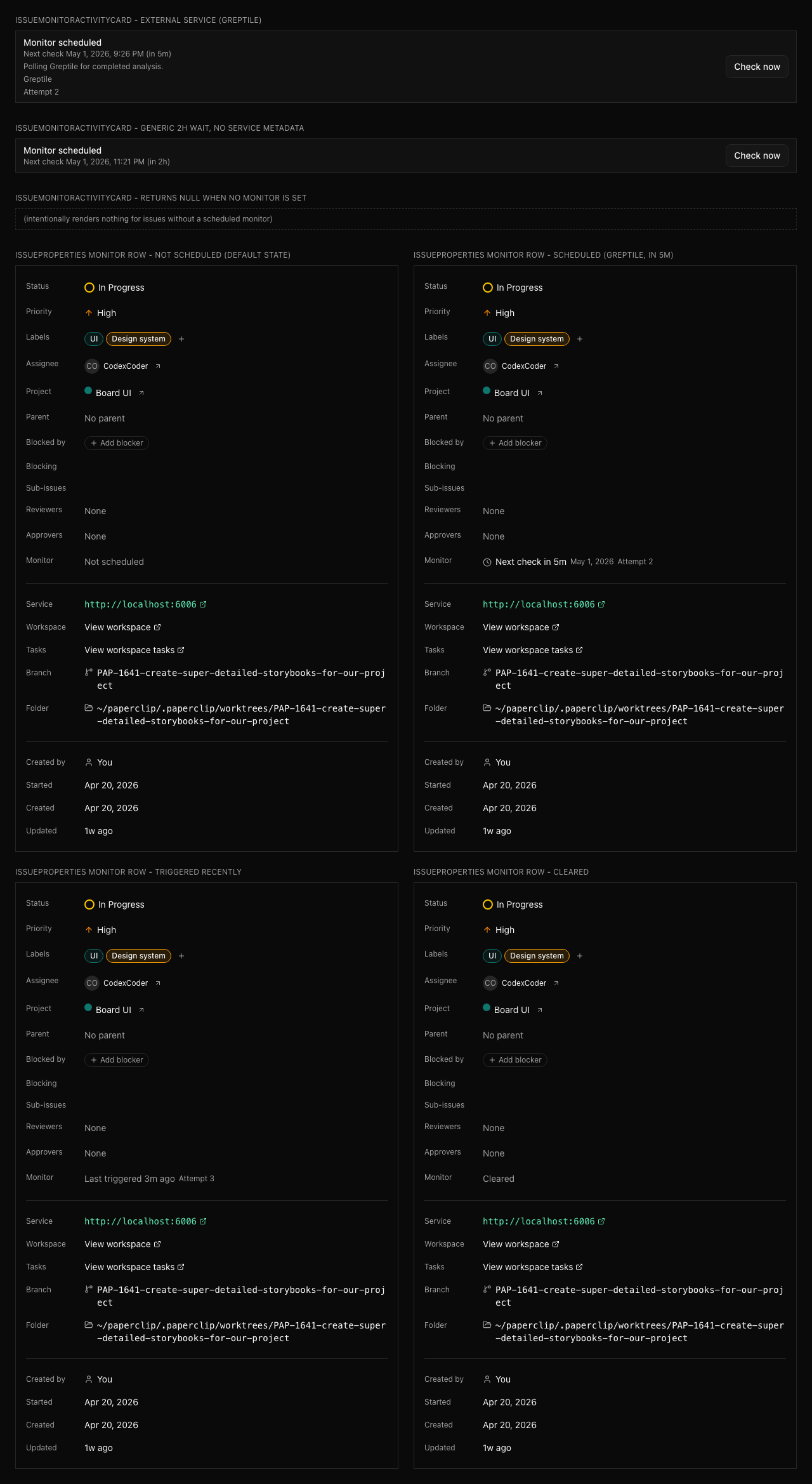 ## Risks - Medium: this changes heartbeat recovery behavior for scheduled external-service waits, so regressions could affect wake timing or recovery issue creation. - Migration risk is reduced by using `IF NOT EXISTS` for the new issue monitor columns and index. - External monitor references are treated as secret-adjacent and are intentionally omitted from visible activity/wake payloads. > For core feature work, check [`ROADMAP.md`](ROADMAP.md) first and discuss it in `#dev` before opening the PR. Feature PRs that overlap with planned core work may need to be redirected — check the roadmap first. See `CONTRIBUTING.md`. ## Model Used - OpenAI Codex, GPT-5 coding agent with repository tool use and terminal execution. ## Checklist - [x] I have included a thinking path that traces from project context to this change - [x] I have specified the model used (with version and capability details) - [x] I have checked ROADMAP.md and confirmed this PR does not duplicate planned core work - [x] I have run tests locally and they pass - [x] I have added or updated tests where applicable - [x] If this change affects the UI, I have included before/after screenshots or Storybook review surfaces - [x] I have updated relevant documentation to reflect my changes - [x] I have considered and documented any risks above - [x] I will address all Greptile and reviewer comments before requesting merge --------- Co-authored-by: Paperclip <noreply@paperclip.ing> |
||
|
Dotta
|
fda296ee4f |
[codex] Add configurable liveness auto-recovery controls (#4587)
## Thinking Path > - Paperclip orchestrates AI agents for zero-human companies. > - Heartbeat liveness recovery decides when stalled issue trees need manager-visible follow-up. > - Automatic recovery issue creation is useful, but operators need instance-level controls for how aggressive it is. > - Without controls, recovery behavior is harder to tune for local development, production operations, and noisy edge cases. > - This pull request adds configurable liveness auto-recovery settings across shared contracts, API routes, services, and the instance experimental settings UI. > - The benefit is that operators can keep liveness findings advisory or enable bounded recovery automation with explicit intervals and lookback windows. ## What Changed - Added shared types and validators for liveness auto-recovery settings. - Extended instance settings routes and services to persist and validate the new controls. - Wired heartbeat/recovery services to honor enablement, minimum interval, and lookback settings. - Added UI controls for liveness recovery under instance experimental settings. - Covered the new server behavior with instance settings and liveness escalation tests. ## Verification - `pnpm exec vitest run --project @paperclipai/server server/src/__tests__/heartbeat-issue-liveness-escalation.test.ts server/src/__tests__/instance-settings-routes.test.ts --pool=forks --poolOptions.forks.isolate=true` - `pnpm --filter @paperclipai/shared typecheck` - `pnpm --filter @paperclipai/server typecheck` - `pnpm --filter @paperclipai/ui typecheck` ## Risks - Moderate behavioral risk because recovery automation timing changes when enabled; defaults keep existing advisory behavior unless the setting is turned on. - No database migration in this PR; settings are stored through the existing instance settings path. > For core feature work, check [`ROADMAP.md`](ROADMAP.md) first and discuss it in `#dev` before opening the PR. Feature PRs that overlap with planned core work may need to be redirected — check the roadmap first. See `CONTRIBUTING.md`. ## Model Used - OpenAI Codex, `gpt-5`, coding model with tool use and local command execution; context window not exposed by the runtime. ## Checklist - [x] I have included a thinking path that traces from project context to this change - [x] I have specified the model used (with version and capability details) - [x] I have checked ROADMAP.md and confirmed this PR does not duplicate planned core work - [x] I have run tests locally and they pass - [x] I have added or updated tests where applicable - [ ] If this change affects the UI, I have included before/after screenshots - [x] I have updated relevant documentation to reflect my changes - [x] I have considered and documented any risks above - [x] I will address all Greptile and reviewer comments before requesting merge --------- Co-authored-by: Paperclip <noreply@paperclip.ing> |
||
|
Dotta
|
82e257c7ba |
Cancel stale queued heartbeats when issue graph changes (PAP-2314) (#4534)
Co-Authored-By: Paperclip <noreply@paperclip.ing> |
||
|
Dotta
|
5a0c1979cf | [codex] Add runtime lifecycle recovery and live issue visibility (#4419) | ||
|
Dotta
|
09d0678840 |
[codex] Harden heartbeat scheduling and runtime controls (#4223)
## Thinking Path > - Paperclip orchestrates AI agents through issue checkout, heartbeat runs, routines, and auditable control-plane state > - The runtime path has to recover from lost local processes, transient adapter failures, blocked dependencies, and routine coalescing without stranding work > - The existing branch carried several reliability fixes across heartbeat scheduling, issue runtime controls, routine dispatch, and operator-facing run state > - These changes belong together because they share backend contracts, migrations, and runtime status semantics > - This pull request groups the control-plane/runtime slice so it can merge independently from board UI polish and adapter sandbox work > - The benefit is safer heartbeat recovery, clearer runtime controls, and more predictable recurring execution behavior ## What Changed - Adds bounded heartbeat retry scheduling, scheduled retry state, and Codex transient failure recovery handling. - Tightens heartbeat process recovery, blocker wake behavior, issue comment wake handling, routine dispatch coalescing, and activity/dashboard bounds. - Adds runtime-control MCP tools and Paperclip skill docs for issue workspace runtime management. - Adds migrations `0061_lively_thor_girl.sql` and `0062_routine_run_dispatch_fingerprint.sql`. - Surfaces retry state in run ledger/agent UI and keeps related shared types synchronized. ## Verification - `pnpm exec vitest run server/src/__tests__/heartbeat-retry-scheduling.test.ts server/src/__tests__/heartbeat-process-recovery.test.ts server/src/__tests__/routines-service.test.ts` - `pnpm exec vitest run src/tools.test.ts` from `packages/mcp-server` ## Risks - Medium risk: this touches heartbeat recovery and routine dispatch, which are central execution paths. - Migration order matters if split branches land out of order: merge this PR before branches that assume the new runtime/routine fields. - Runtime retry behavior should be watched in CI and in local operator smoke tests because it changes how transient failures are resumed. > For core feature work, check [`ROADMAP.md`](ROADMAP.md) first and discuss it in `#dev` before opening the PR. Feature PRs that overlap with planned core work may need to be redirected — check the roadmap first. See `CONTRIBUTING.md`. ## Model Used - OpenAI Codex, GPT-5-based coding agent runtime, shell/git tool use enabled. Exact hosted model build and context window are not exposed in this Paperclip heartbeat environment. ## Checklist - [x] I have included a thinking path that traces from project context to this change - [x] I have specified the model used (with version and capability details) - [x] I have checked ROADMAP.md and confirmed this PR does not duplicate planned core work - [x] I have run tests locally and they pass - [x] I have added or updated tests where applicable - [ ] If this change affects the UI, I have included before/after screenshots - [x] I have updated relevant documentation to reflect my changes - [x] I have considered and documented any risks above - [x] I will address all Greptile and reviewer comments before requesting merge |
||
|
Dotta
|
7f893ac4ec |
[codex] Harden execution reliability and heartbeat tooling (#3679)
## Thinking Path > - Paperclip orchestrates AI agents for zero-human companies > - Reliable execution depends on heartbeat routing, issue lifecycle semantics, telemetry, and a fast enough local verification loop to keep regressions visible > - The remaining commits on this branch were mostly server/runtime correctness fixes plus test and documentation follow-ups in that area > - Those changes are logically separate from the UI-focused issue-detail and workspace/navigation branches even when they touch overlapping issue APIs > - This pull request groups the execution reliability, heartbeat, telemetry, and tooling changes into one standalone branch > - The benefit is a focused review of the control-plane correctness work, including the follow-up fix that restored the implicit comment-reopen helpers after branch splitting ## What Changed - Hardened issue/heartbeat execution behavior, including self-review stage skipping, deferred mention wakes during active execution, stranded execution recovery, active-run scoping, assignee resolution, and blocked-to-todo wake resumption - Reduced noisy polling/logging overhead by trimming issue run payloads, compacting persisted run logs, silencing high-volume request logs, and capping heartbeat-run queries in dashboard/inbox surfaces - Expanded telemetry and status semantics with adapter/model fields on task completion plus clearer status guidance in docs/onboarding material - Updated test infrastructure and verification defaults with faster route-test module isolation, cheaper default `pnpm test`, e2e isolation from local state, and repo verification follow-ups - Included docs/release housekeeping from the branch and added a small follow-up commit restoring the implicit comment-reopen helpers that were dropped during branch reconstruction ## Verification - `pnpm vitest run server/src/__tests__/issue-comment-reopen-routes.test.ts server/src/__tests__/issue-telemetry-routes.test.ts` - `pnpm vitest run server/src/__tests__/http-log-policy.test.ts server/src/__tests__/heartbeat-run-log.test.ts server/src/__tests__/health.test.ts` - `server/src/__tests__/activity-service.test.ts`, `server/src/__tests__/heartbeat-comment-wake-batching.test.ts`, and `server/src/__tests__/heartbeat-process-recovery.test.ts` were attempted on this host but the embedded Postgres harness reported init-script/data-dir problems and skipped or failed to start, so they are noted as environment-limited ## Risks - Medium: this branch changes core issue/heartbeat routing and reopen/wakeup behavior, so regressions would affect agent execution flow rather than isolated UI polish - Because it also updates verification infrastructure, reviewers should pay attention to whether the new tests are asserting the right failure modes and not just reshaping harness behavior ## Model Used - OpenAI Codex coding agent (GPT-5-class runtime in Codex CLI; exact deployed model ID is not exposed in this environment), reasoning enabled, tool use and local code execution enabled ## Checklist - [x] I have included a thinking path that traces from project context to this change - [x] I have specified the model used (with version and capability details) - [ ] I have run tests locally and they pass - [x] I have added or updated tests where applicable - [ ] If this change affects the UI, I have included before/after screenshots - [x] I have updated relevant documentation to reflect my changes - [x] I have considered and documented any risks above - [x] I will address all Greptile and reviewer comments before requesting merge --------- Co-authored-by: Paperclip <noreply@paperclip.ing> |
