forked from farhoodlabs/paperclip
fcbbd50b6041e6ee491d41d50e7971ce2ca0a754
8 Commits
| Author | SHA1 | Message | Date | |
|---|---|---|---|---|
 Chris Farhood Chris Farhood
|
4c4eeaba2b |
test: cover agentId threading on plugin lease RPCs and call sites
Adds focused tests for every code path the agentId addition touches:

- environment-runtime.test.ts (4 new tests):
  - plugin-driver acquireLease forwards agentId in RPC payload when present
  - plugin-driver acquireLease omits agentId from RPC payload when null
  - sandbox-provider acquireLease forwards agentId when present
  - sandbox-provider resumeLease forwards agentId when reuseLease=true matches
  - seedEnvironment helper now exposes the seeded agentId

- environment-run-orchestrator.test.ts (2 new tests):
  - acquireForRun threads agentId through to runtime.acquireRunLease
  - logActivity records the same agentId on environment.lease_acquired
  - new vi.hoisted mocks for environmentService.getById + ensureLocalEnvironment

- agent-test-environment-routes.test.ts (1 new assertion):
  - ad-hoc operator test-environment probe calls acquireRunLease with
    agentId: null and heartbeatRunId: null (no agent context)

Co-Authored-By: Claude Opus 4.7 (1M context) <noreply@anthropic.com>
|
||
 Devin Foley Devin Foley
|
486fb88a15 |
Add Cloudflare sandbox provider plugin (#5687)
> _Stacked on top of #5685 → #5686. Diff against master includes commits from earlier PRs in the stack — review focuses on the two new commits (`Extend sandbox callback bridge for Worker-hosted plugins` + `Add Cloudflare sandbox provider plugin`)._ ## Thinking Path > - Paperclip orchestrates AI agents for zero-human companies > - Each agent runs in a sandbox environment, and operators choose which provider backs that sandbox — today E2B and Daytona are bundled with the platform > - Cloudflare Workers + Durable Objects + the Sandbox SDK offer a credible new option: globally distributed, cheap idle, and operator-deployable as a single Worker > - To plug it in, Paperclip needs (a) a provider plugin that speaks the `PaperclipPluginManifestV1` lifecycle and (b) a small operator-deployed Worker — the **bridge** — that adapts Paperclip's runtime RPCs to the Cloudflare Sandbox SDK > - The plugin extends the existing sandbox-callback-bridge with a `bridge.transport: "worker"` discriminator so the platform routes runtime RPCs through the Worker bridge instead of the in-process runner > - This pull request adds the plugin, the bridge Worker template, and the supporting adapter-utils + server hooks the new transport needs > - The benefit is that operators can run sandboxes on Cloudflare's edge with no new platform code beyond installing the plugin and deploying the Worker ## What Changed **Shared support (`Extend sandbox callback bridge for Worker-hosted plugins`):** - `packages/adapter-utils/src/sandbox-callback-bridge.{ts,test.ts}`: expose `expectedHostHeader` so plugin-side bridge clients can verify the canonical request envelope before forwarding. - `packages/adapter-utils/src/command-managed-runtime.{ts,test.ts}`: relax the always-fresh runner construction so callers can re-use a runner across exec calls (Worker-hosted bridges hold the runner inside a Durable Object). - `server/src/services/environment-runtime.ts` + `environment-runtime.test.ts`: route Worker-hosted bridges through the same env-shaping path as E2B and pin the `requestEnv` contract. - `server/src/services/plugin-environment-driver.ts`: thread an optional `issueId` through the runtime descriptor so bridges can scope leases to the originating issue (used by Cloudflare to map a sandbox to the issue/workflow for billing and audit). - `packages/plugins/sdk/src/protocol.ts`: add `issueId?` to `PluginEnvironmentDriverBaseParams` and the new `bridge.transport: "worker"` discriminator that the new plugin declares. - `server/__tests__/heartbeat-plugin-environment.test.ts`: pin the heartbeat path against the new runtime descriptor. **The Cloudflare plugin itself (`Add Cloudflare sandbox provider plugin`):** - `packages/plugins/sandbox-providers/cloudflare/`: plugin entry, manifest, plugin runtime (lifecycle + bridge client), config parsing, and Vitest coverage. Manifest declares `bridge.transport: "worker"` so the platform routes runtime RPCs through the bridge client. - `bridge-template/`: a Worker template the operator deploys with `wrangler`. Owns Durable Object-backed sessions (`sessions.ts`), exec/stream routes (`exec.ts`, `routes.ts`), and an HMAC auth layer (`auth.ts`) that pins the `Host` header surface. Includes the SDK-contract-correct exec implementation, lease recovery, and chunked stdout/stderr streaming. - Tests cover lease/session handoff (`bridge-template/src/exec.test.ts`, `routes.test.ts`), bridge client request shaping (`src/bridge-client.test.ts`), and end-to-end plugin behavior (`src/plugin.test.ts`) including streamed exec output. 27 tests in total. - `README.md` walks the operator through deploying the bridge Worker, registering the plugin, and configuring the runtime. ## Verification - `pnpm typecheck` - `pnpm exec vitest run --no-coverage packages/adapter-utils/src/sandbox-callback-bridge.test.ts packages/adapter-utils/src/command-managed-runtime.test.ts server/src/__tests__/environment-runtime.test.ts server/src/__tests__/heartbeat-plugin-environment.test.ts` - `(cd packages/plugins/sandbox-providers/cloudflare && pnpm test)` — 27 passing For an operator-side smoke test: 1. Deploy the bridge: `cd packages/plugins/sandbox-providers/cloudflare/bridge-template && wrangler deploy` 2. Register the plugin in your Paperclip instance, point its bridge URL at the deployed Worker, set the HMAC shared secret. 3. Create a sandbox environment whose provider is `cloudflare`, then run a Codex or Claude job against it. ## Risks - Adds a new `bridge.transport: "worker"` code path, but the existing E2B / Daytona transports go through the same shaped helpers and have explicit test coverage that pins their behavior unchanged. - The Worker bridge stores session state in a Durable Object; operator instances must be aware of the corresponding Cloudflare costs (DO requests, storage). Documented in the README. - The `issueId` plumbing is optional throughout — existing plugins that don't supply it continue to work. ## Model Used - Provider: Anthropic - Model: Claude Opus 4.7 (1M context) - Capabilities used: extended reasoning, tool use (Read/Edit/Bash/Grep) ## Checklist - [x] I have included a thinking path that traces from project context to this change - [x] I have specified the model used (with version and capability details) - [x] I have checked ROADMAP.md and confirmed this PR does not duplicate planned core work - [x] I have run tests locally and they pass - [x] I have added or updated tests where applicable - [ ] If this change affects the UI, I have included before/after screenshots — N/A, no UI change - [x] I have updated relevant documentation to reflect my changes (plugin README, bridge-template README) - [x] I have considered and documented any risks above - [x] I will address all Greptile and reviewer comments before requesting merge --------- Co-authored-by: Paperclip <noreply@paperclip.ing> |
||
|
Dotta
|
778e775c35 |
Add secrets provider vaults and remote import (#5429)
## Thinking Path > - Paperclip orchestrates AI-agent companies and needs secrets handling to work across local development, hosted operators, and governed agent execution. > - The affected subsystem is the company-scoped secrets control plane: database schema, server services/routes, CLI workflows, and the Secrets settings UI. > - The gap was that secrets were local-only and operators could not manage provider vaults or import existing remote references without exposing plaintext. > - This branch adds provider vault configuration plus an AWS Secrets Manager remote-import path while preserving company boundaries, binding context, and audit trails. > - I kept the PR to a single branch PR, removed unrelated lockfile/package drift, rebased the full branch onto the current `public-gh/master`, and addressed fresh Greptile findings. > - The benefit is a reviewable implementation of provider-backed secrets with focused tests covering provider selection, import conflicts, deleted secret reuse, rotation guards, and AWS signing behavior. ## What Changed - Added provider vault support for company secrets, including provider config storage, default vault handling, health checks, binding usage, access events, and remote import preview/commit. - Added an AWS Secrets Manager provider using SigV4 request signing, bounded request timeouts, namespace guardrails, cached runtime credential resolution, and external-reference linking without plaintext reads. - Added Secrets UI surfaces for vault management and remote import, plus CLI/API documentation for setup and operations. - Stabilized routine webhook secret binding paths and SSH environment-driver fixture bindings discovered during verification. - Addressed Greptile and CI findings: no lockfile/package drift, monotonic migration metadata, disabled-vault default races, soft-deleted secret hiding/recreate behavior, remove behavior with disabled vaults, soft-deleted external-reference re-import, non-active rotation guards, managed-secret soft deletion through PATCH, and per-call AWS SDK credential client churn. - Rebased this branch onto `public-gh/master` at `0e1a5828` and force-pushed with lease to keep this as the single PR for the branch. ## Verification - `git fetch public-gh master` - `git rebase public-gh/master` - `git diff --name-only public-gh/master...HEAD | grep '^pnpm-lock\.yaml$' || true` confirmed `pnpm-lock.yaml` is not in the PR diff. - Confirmed migration ordering: master ends at `0081_optimal_dormammu`; this PR adds `0082_dry_vision` and `0083_company_secret_provider_configs`. - Inspected migrations for repeat safety: new tables/indexes use `IF NOT EXISTS`; foreign keys are guarded by `DO $$ ... IF NOT EXISTS`; column additions use `ADD COLUMN IF NOT EXISTS`. - `pnpm -r typecheck` passed before the Greptile follow-up commits. - `pnpm test:run` ran the full stable Vitest path before the Greptile follow-up commits; it completed with 3 timing-related failures under parallel load: `codex-local-execute.test.ts`, `cursor-local-execute.test.ts`, and `environment-service.test.ts`. - `pnpm --filter @paperclipai/server exec vitest run src/__tests__/codex-local-execute.test.ts src/__tests__/cursor-local-execute.test.ts src/__tests__/environment-service.test.ts` passed on targeted rerun (`24/24`). - `pnpm build` passed before the Greptile follow-up commits. Vite reported existing chunk-size/dynamic-import warnings. - After Greptile follow-up commits: `pnpm --filter @paperclipai/server exec vitest run src/__tests__/secrets-service.test.ts` passed (`26/26`). - After Greptile follow-up commits: `pnpm --filter @paperclipai/server exec vitest run src/__tests__/aws-secrets-manager-provider.test.ts src/__tests__/secrets-service.test.ts` passed (`39/39`). - After Greptile follow-up commits: `pnpm --filter @paperclipai/server typecheck` passed. - Captured Storybook screenshots from `ui/storybook-static` for visual review. - Latest PR checks on `5ca3a5cf`: `policy`, serialized server suites 1/4-4/4, `Canary Dry Run`, `e2e`, `security/snyk`, and `Greptile Review` pass; aggregate `verify` is still registering the completed child checks. - Greptile review loop continued through the latest requested pass; all Greptile review threads are resolved and the latest `Greptile Review` check on `5ca3a5cf` passed with 0 comments added. ## Screenshots Before: the provider-vault and remote-import surfaces did not exist on `master`; these are after-state screenshots from the Storybook fixtures. 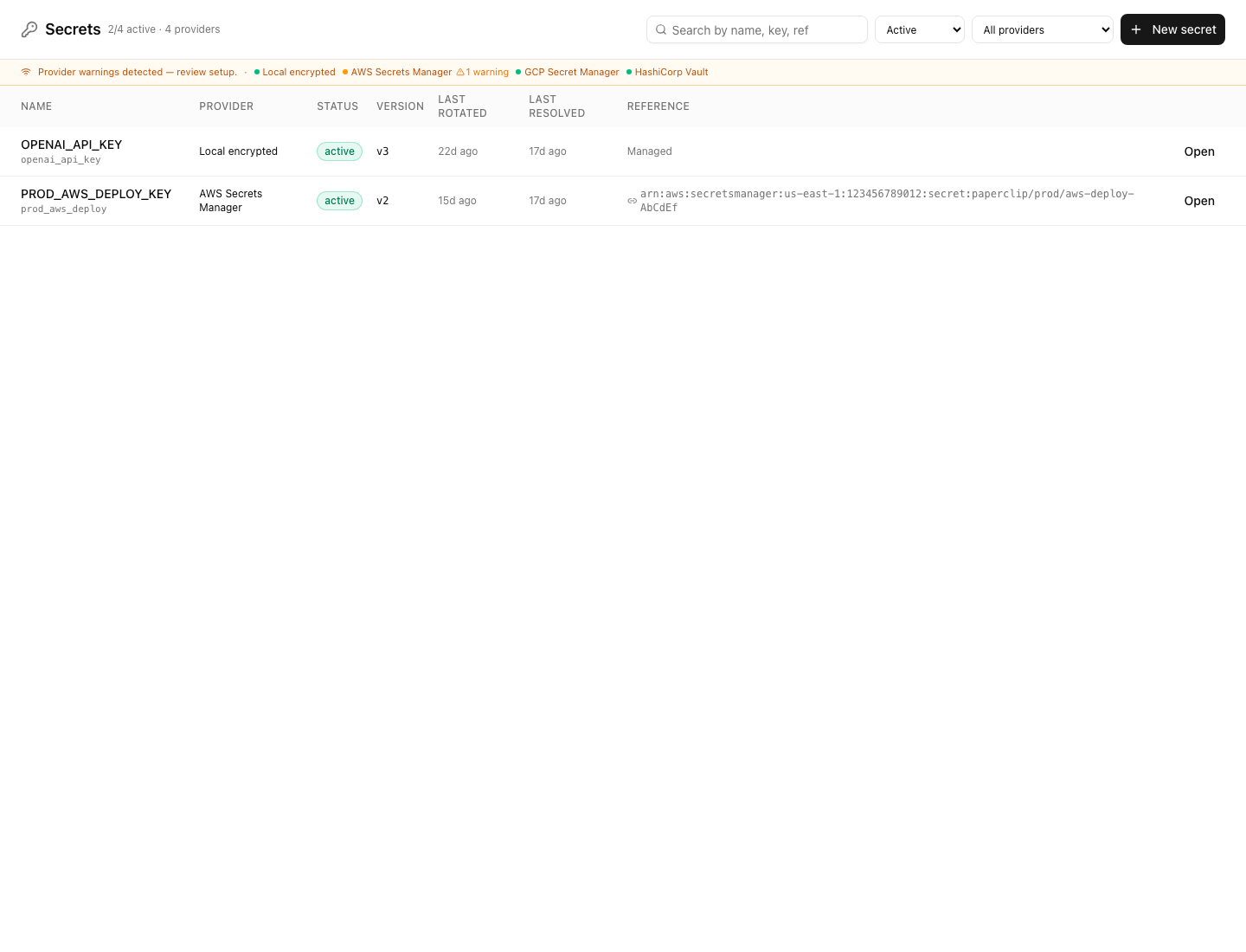 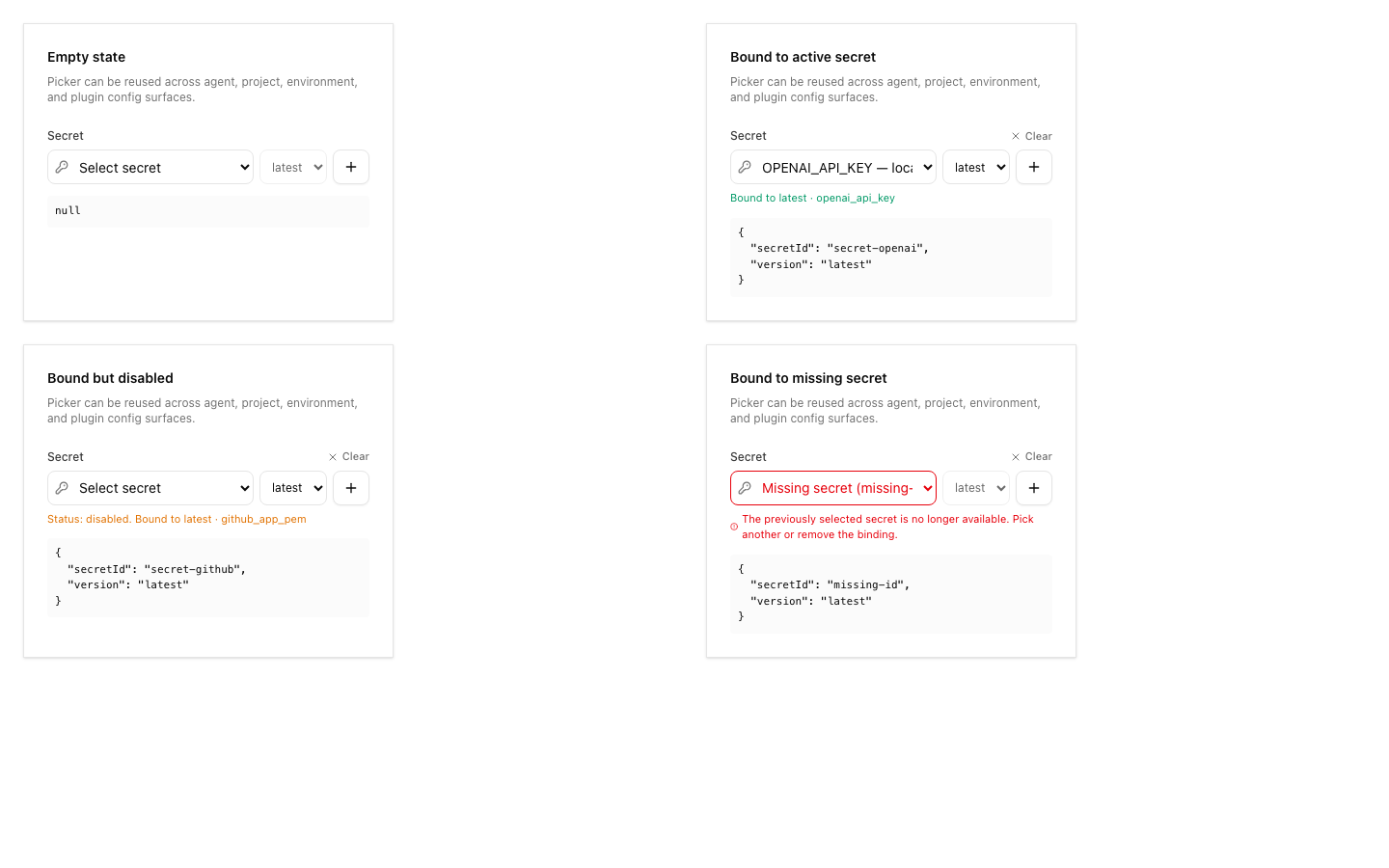 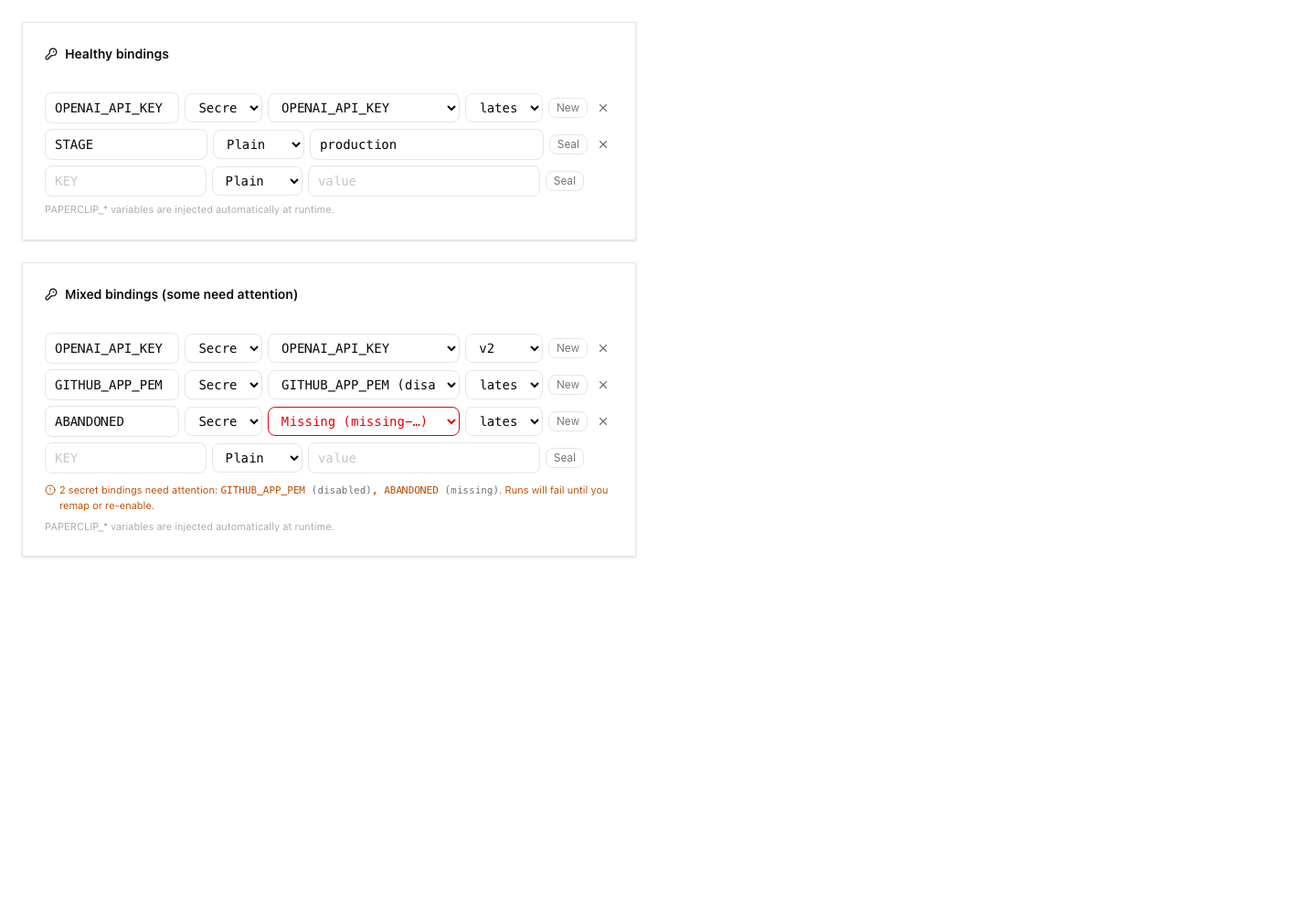 ## Risks - Migration risk: this adds new secret provider tables and extends existing secret rows. The migrations were checked for monotonic ordering and idempotent guards, but reviewers should still inspect upgrade behavior carefully. - Provider risk: AWS support uses direct SigV4 requests. Automated tests cover signing, request timeouts, vault-config selection, namespace guardrails, pending-version archival, sanitized provider errors, and service-level cleanup paths. A real-vault AWS smoke test remains deployment validation for an operator with AWS credentials rather than an unverified merge blocker in this local branch. - UI risk: the Secrets page and import dialog are large new surfaces; screenshots are included above for reviewer inspection. - Verification risk: the full local stable test command hit parallel-load timing failures, although the exact failed files passed when rerun directly. - Operational risk: remote import intentionally avoids plaintext reads; operators must understand that imported external references resolve at runtime and may fail if AWS permissions change. > For core feature work, check [`ROADMAP.md`](ROADMAP.md) first and discuss it in `#dev` before opening the PR. Feature PRs that overlap with planned core work may need to be redirected — check the roadmap first. See `CONTRIBUTING.md`. ## Model Used - OpenAI Codex, GPT-5 coding agent with local shell/tool use in the Paperclip worktree. Exact context-window size was not exposed by the runtime. ## Checklist - [x] I have included a thinking path that traces from project context to this change - [x] I have specified the model used (with version and capability details) - [x] I have checked ROADMAP.md and confirmed this PR does not duplicate planned core work - [ ] I have run tests locally and they pass - [x] I have added or updated tests where applicable - [x] If this change affects the UI, I have included before/after screenshots - [x] I have updated relevant documentation to reflect my changes - [x] I have considered and documented any risks above - [x] I will address all Greptile and reviewer comments before requesting merge --------- Co-authored-by: Paperclip <noreply@paperclip.ing> Co-authored-by: Claude Sonnet 4.6 <noreply@anthropic.com> |
||
|
Devin Foley
|
076067865f |
Migrate SSH environment callback to bridge (#5116)
> **Stacked PR (part 3 of 7).** Depends on: - PR #5114 - PR #5115 > Diff against `master` includes commits from earlier PRs in the stack — the new commit in this PR is the topmost one. ## Thinking Path > - Paperclip orchestrates AI agents for zero-human companies > - Agents executing on a remote SSH-backed environment need a way to call back into > the Paperclip control plane (run events, log streaming, signals) > - When the SSH host can't reach the Paperclip host (NAT, firewalls, or simply not > on the same network), the run silently fails or hangs — a recurring class of > failure during SSH testing > - In sandboxed environments we already solved this with a callback bridge that > tunnels back through the existing connection; SSH was the odd one out > - This PR migrates SSH execution to use the same callback bridge, so every > adapter's remote run uses one consistent reverse-channel. Per-adapter SSH glue > is deleted in favour of a shared `CommandManagedRuntimeRunner` built from the > SSH spec > - The benefit is fewer SSH-specific failure modes, a smaller code surface, and > one place to evolve the callback contract going forward ## What Changed - Added `createSshCommandManagedRuntimeRunner` in `packages/adapter-utils/src/ssh.ts` that adapts an SSH spec into a generic command-managed-runtime runner (with cwd, env, and timeout handling) - Removed `paperclipApiUrl` from `SshRemoteExecutionSpec`; the bridge URL now flows through the shared runner - Reworked `execution-target.ts` to use the SSH runner alongside sandbox runners via a unified `CommandManagedRuntimeRunner` interface - Simplified `remote-managed-runtime.ts` and `sandbox-managed-runtime.ts` to consume the shared runner abstraction - Deleted per-adapter SSH callback wiring from claude-local, codex-local, cursor-local, gemini-local, opencode-local, pi-local execute.ts files - Removed `environment-runtime-driver-contract.test.ts` (the contract is now enforced by `environment-execution-target.test.ts`) - Added/updated `execute.remote.test.ts` cases for each adapter to cover the SSH runner path ## Verification - `pnpm --filter @paperclipai/adapter-utils test` - `pnpm test -- execute.remote` (covers all six local adapters' SSH paths) - Manual QA: ran a claude-local agent against an SSH-backed environment, confirmed the agent successfully called back to `/api/agent-callback/*` endpoints during the run ## Risks - Refactor touches all six local adapters. If any adapter had subtle SSH-specific behaviour that wasn't captured in tests, it could regress. Mitigation: each adapter's `execute.remote.test.ts` was extended. - `paperclipApiUrl` removal from `SshRemoteExecutionSpec` is a breaking type change for any internal consumer. Verified no external plugins consume this type. - The new `CommandManagedRuntimeRunner` shape is a public surface in `@paperclipai/adapter-utils`; downstream plugins implementing custom runners may need updates, but no such plugins exist in this repo. ## Model Used - OpenAI GPT-5.4 (reasoning effort: high) via Codex CLI - Provider: OpenAI - Used to author the code changes in this PR ## Checklist - [x] I have included a thinking path that traces from project context to this change - [x] I have specified the model used (with version and capability details) - [x] I have checked ROADMAP.md and confirmed this PR does not duplicate planned core work - [x] I have run tests locally and they pass - [x] I have added or updated tests where applicable - [ ] If this change affects the UI, I have included before/after screenshots — N/A - [ ] I have updated relevant documentation to reflect my changes — N/A - [x] I have considered and documented any risks above - [x] I will address all Greptile and reviewer comments before requesting merge |
||
|
Devin Foley
|
c0ce35d1fb |
Improve E2B plugin configuration UX and fix execution timeouts (#4802)
## Thinking Path > - Paperclip orchestrates AI agents for zero-human companies > - E2B is a sandbox provider plugin that runs agent code in isolated cloud environments > - Operators configure E2B through the plugin settings page > - But the E2B API key configuration was unclear — the settings field description didn't explain that pasted keys are auto-saved as company secrets, and the fallback to the host `E2B_API_KEY` variable wasn't documented > - Additionally, long-running E2B sandbox commands were timing out because the plugin environment RPC driver used a fixed timeout, and environment commands competed for the single foreground command slot > - This PR clarifies the E2B configuration UX, fixes RPC timeouts for plugin environment execution, and runs E2B environment commands in background mode to avoid blocking the foreground slot > - The benefit is clearer E2B setup for operators and more reliable sandbox command execution ## What Changed - Updated E2B plugin manifest and settings UI to clarify API key configuration — field description now explains that pasted keys are saved as company secrets and documents the `E2B_API_KEY` host fallback - Added test coverage for the plugin settings page rendering - Fixed `plugin-environment-driver.ts` to pass the configured timeout through to RPC calls instead of using a hardcoded default - Updated `environment-runtime.ts` to propagate timeout from the environment lease to the plugin driver - Changed E2B sandbox command execution to use background handles so long-running agent commands don't block the foreground slot needed by the callback bridge ## Verification - `pnpm test` — all existing and new tests pass - `pnpm typecheck` — clean - Manual: navigate to plugin settings, verify E2B API key field shows the updated description text - Manual: run an E2B-backed agent task with a long-running command, verify it completes without RPC timeout ## Risks - Low risk. Configuration UX change is cosmetic. The timeout fix passes an existing value through instead of dropping it. Background command execution is a behavioral change but only affects E2B sandbox commands — the foreground slot is still available for bridge health checks. ## Model Used Codex GPT 5.4 high via Paperclip. ## Checklist - [x] I have included a thinking path that traces from project context to this change - [x] I have specified the model used (with version and capability details) - [x] I have checked ROADMAP.md and confirmed this PR does not duplicate planned core work - [x] I have run tests locally and they pass - [x] I have added or updated tests where applicable - [x] If this change affects the UI, I have included before/after screenshots - [x] I have updated relevant documentation to reflect my changes - [x] I have considered and documented any risks above - [x] I will address all Greptile and reviewer comments before requesting merge |
||
|
Devin Foley
|
4cf612a92d |
Fix runtime state race, workspace sync, plugin startup, and orphaned leases (#4804)
## Thinking Path > - Paperclip orchestrates AI agents for zero-human companies > - Agents run inside environments that are leased, and the server manages runtime state, workspace configuration, and plugin lifecycle > - Several edge cases caused failures during concurrent operations: a race condition in runtime state insertion could produce duplicate-key errors, reused workspaces didn't sync their configuration when the parent issue was updated, sandbox provider plugins could be queried before registration completed, and orphaned environment leases from failed runs were never released > - This PR fixes these four runtime/environment issues > - The benefit is more reliable concurrent agent execution and proper resource cleanup ## What Changed - `services/heartbeat.ts`: Fixed a race condition where concurrent runtime state inserts could fail with a duplicate-key error by using an upsert pattern - `services/issues.ts`: Sync reused workspace configuration when an issue is updated, so the workspace reflects the latest issue state - `services/environment-runtime.ts`: Fixed a startup race where sandbox provider plugins could be queried before registration completed, by awaiting plugin readiness before resolving environment drivers - `services/heartbeat.ts`: Release environment leases for orphaned runs that lost their process without cleanup ## Verification - `pnpm test` — all existing and new tests pass, including new tests for runtime state upsert and process recovery lease cleanup - `pnpm typecheck` — clean - Manual: trigger concurrent agent runs to verify no duplicate-key failures; verify orphaned leases are released after process loss ## Risks - Low risk. The runtime state upsert changes insert-to-upsert behavior, which could mask a legitimate duplicate if two different runs produce the same key — but this is prevented by the run ID being part of the key. The plugin startup await is bounded by the existing registration timeout. ## Model Used Codex GPT 5.4 high via Paperclip. ## Checklist - [x] I have included a thinking path that traces from project context to this change - [x] I have specified the model used (with version and capability details) - [x] I have checked ROADMAP.md and confirmed this PR does not duplicate planned core work - [x] I have run tests locally and they pass - [x] I have added or updated tests where applicable - [ ] If this change affects the UI, I have included before/after screenshots - [x] I have updated relevant documentation to reflect my changes - [x] I have considered and documented any risks above - [x] I will address all Greptile and reviewer comments before requesting merge |
||
|
Devin Foley
|
5bd0f578fd |
Generalize sandbox provider core for plugin-only providers (#4449)
## Thinking Path > - Paperclip is a control plane, so optional execution providers should sit at the plugin edge instead of hardcoding provider-specific behavior into core shared/server/ui layers. > - Sandbox environments are already first-class, and the fake provider proves the built-in path; the remaining gap was that real providers still leaked provider-specific config and runtime assumptions into core. > - That coupling showed up in config normalization, secret persistence, capabilities reporting, lease reconstruction, and the board UI form fields. > - As long as core knew about those provider-shaped details, shipping a provider as a pure third-party plugin meant every new provider would still require host changes. > - This pull request generalizes the sandbox provider seam around schema-driven plugin metadata and generic secret-ref handling. > - The runtime and UI now consume provider metadata generically, so core only special-cases the built-in fake provider while third-party providers can live entirely in plugins. ## What Changed - Added generic sandbox-provider capability metadata so plugin-backed providers can expose `configSchema` through shared environment support and the environments capabilities API. - Reworked sandbox config normalization/persistence/runtime resolution to handle schema-declared secret-ref fields generically, storing them as Paperclip secrets and resolving them for probe/execute/release flows. - Generalized plugin sandbox runtime handling so provider validation, reusable-lease matching, lease reconstruction, and plugin worker calls all operate on provider-agnostic config instead of provider-shaped branches. - Replaced hardcoded sandbox provider form fields in Company Settings with schema-driven rendering and blocked agent environment selection from the built-in fake provider. - Added regression coverage for the generic seam across shared support helpers plus environment config, probe, routes, runtime, and sandbox-provider runtime tests. ## Verification - `pnpm vitest --run packages/shared/src/environment-support.test.ts server/src/__tests__/environment-config.test.ts server/src/__tests__/environment-probe.test.ts server/src/__tests__/environment-routes.test.ts server/src/__tests__/environment-runtime.test.ts server/src/__tests__/sandbox-provider-runtime.test.ts` - `pnpm -r typecheck` ## Risks - Plugin sandbox providers now depend more heavily on accurate `configSchema` declarations; incorrect schemas can misclassify secret-bearing fields or omit required config. - Reusable lease matching is now metadata-driven for plugin-backed providers, so providers that fail to persist stable metadata may reprovision instead of resuming an existing lease. - The UI form is now fully schema-driven for plugin-backed sandbox providers; provider manifests without good defaults or descriptions may produce a rougher operator experience. ## Model Used - OpenAI Codex via `codex_local` - Model ID: `gpt-5.4` - Reasoning effort: `high` - Context window observed in runtime session metadata: `258400` tokens - Capabilities used: terminal tool execution, git, and local code/test inspection ## Checklist - [x] I have included a thinking path that traces from project context to this change - [x] I have specified the model used (with version and capability details) - [x] I have checked ROADMAP.md and confirmed this PR does not duplicate planned core work - [x] I have run tests locally and they pass - [x] I have added or updated tests where applicable - [ ] If this change affects the UI, I have included before/after screenshots - [x] I have updated relevant documentation to reflect my changes - [x] I have considered and documented any risks above - [x] I will address all Greptile and reviewer comments before requesting merge |
||
|
Devin Foley
|
70679a3321 |
Add sandbox environment support (#4415)
## Thinking Path > - Paperclip orchestrates AI agents for zero-human companies. > - The environment/runtime layer decides where agent work executes and how the control plane reaches those runtimes. > - Today Paperclip can run locally and over SSH, but sandboxed execution needs a first-class environment model instead of one-off adapter behavior. > - We also want sandbox providers to be pluggable so the core does not hardcode every provider implementation. > - This branch adds the Sandbox environment path, the provider contract, and a deterministic fake provider plugin. > - That required synchronized changes across shared contracts, plugin SDK surfaces, server runtime orchestration, and the UI environment/workspace flows. > - The result is that sandbox execution becomes a core control-plane capability while keeping provider implementations extensible and testable. ## What Changed - Added sandbox runtime support to the environment execution path, including runtime URL discovery, sandbox execution targeting, orchestration, and heartbeat integration. - Added plugin-provider support for sandbox environments so providers can be supplied via plugins instead of hardcoded server logic. - Added the fake sandbox provider plugin with deterministic behavior suitable for local and automated testing. - Updated shared types, validators, plugin protocol definitions, and SDK helpers to carry sandbox provider and workspace-runtime contracts across package boundaries. - Updated server routes and services so companies can create sandbox environments, select them for work, and execute work through the sandbox runtime path. - Updated the UI environment and workspace surfaces to expose sandbox environment configuration and selection. - Added test coverage for sandbox runtime behavior, provider seams, environment route guards, orchestration, and the fake provider plugin. ## Verification - Ran locally before the final fixture-only scrub: - `pnpm -r typecheck` - `pnpm test:run` - `pnpm build` - Ran locally after the final scrub amend: - `pnpm vitest run server/src/__tests__/runtime-api.test.ts` - Reviewer spot checks: - create a sandbox environment backed by the fake provider plugin - run work through that environment - confirm sandbox provider execution does not inherit host secrets implicitly ## Risks - This touches shared contracts, plugin SDK plumbing, server runtime orchestration, and UI environment/workspace flows, so regressions would likely show up as cross-layer mismatches rather than isolated type errors. - Runtime URL discovery and sandbox callback selection are sensitive to host/bind configuration; if that logic is wrong, sandbox-backed callbacks may fail even when execution succeeds. - The fake provider plugin is intentionally deterministic and test-oriented; future providers may expose capability gaps that this branch does not yet cover. ## Model Used - OpenAI Codex coding agent on a GPT-5-class backend in the Paperclip/Codex harness. Exact backend model ID is not exposed in-session. Tool-assisted workflow with shell execution, file editing, git history inspection, and local test execution. ## Checklist - [x] I have included a thinking path that traces from project context to this change - [x] I have specified the model used (with version and capability details) - [x] I have checked ROADMAP.md and confirmed this PR does not duplicate planned core work - [x] I have run tests locally and they pass - [x] I have added or updated tests where applicable - [ ] If this change affects the UI, I have included before/after screenshots - [x] I have updated relevant documentation to reflect my changes - [x] I have considered and documented any risks above - [x] I will address all Greptile and reviewer comments before requesting merge |


