 Dotta
778e775c35
Dotta
778e775c35
## Thinking Path > - Paperclip orchestrates AI-agent companies and needs secrets handling to work across local development, hosted operators, and governed agent execution. > - The affected subsystem is the company-scoped secrets control plane: database schema, server services/routes, CLI workflows, and the Secrets settings UI. > - The gap was that secrets were local-only and operators could not manage provider vaults or import existing remote references without exposing plaintext. > - This branch adds provider vault configuration plus an AWS Secrets Manager remote-import path while preserving company boundaries, binding context, and audit trails. > - I kept the PR to a single branch PR, removed unrelated lockfile/package drift, rebased the full branch onto the current `public-gh/master`, and addressed fresh Greptile findings. > - The benefit is a reviewable implementation of provider-backed secrets with focused tests covering provider selection, import conflicts, deleted secret reuse, rotation guards, and AWS signing behavior. ## What Changed - Added provider vault support for company secrets, including provider config storage, default vault handling, health checks, binding usage, access events, and remote import preview/commit. - Added an AWS Secrets Manager provider using SigV4 request signing, bounded request timeouts, namespace guardrails, cached runtime credential resolution, and external-reference linking without plaintext reads. - Added Secrets UI surfaces for vault management and remote import, plus CLI/API documentation for setup and operations. - Stabilized routine webhook secret binding paths and SSH environment-driver fixture bindings discovered during verification. - Addressed Greptile and CI findings: no lockfile/package drift, monotonic migration metadata, disabled-vault default races, soft-deleted secret hiding/recreate behavior, remove behavior with disabled vaults, soft-deleted external-reference re-import, non-active rotation guards, managed-secret soft deletion through PATCH, and per-call AWS SDK credential client churn. - Rebased this branch onto `public-gh/master` at `0e1a5828` and force-pushed with lease to keep this as the single PR for the branch. ## Verification - `git fetch public-gh master` - `git rebase public-gh/master` - `git diff --name-only public-gh/master...HEAD | grep '^pnpm-lock\.yaml$' || true` confirmed `pnpm-lock.yaml` is not in the PR diff. - Confirmed migration ordering: master ends at `0081_optimal_dormammu`; this PR adds `0082_dry_vision` and `0083_company_secret_provider_configs`. - Inspected migrations for repeat safety: new tables/indexes use `IF NOT EXISTS`; foreign keys are guarded by `DO $$ ... IF NOT EXISTS`; column additions use `ADD COLUMN IF NOT EXISTS`. - `pnpm -r typecheck` passed before the Greptile follow-up commits. - `pnpm test:run` ran the full stable Vitest path before the Greptile follow-up commits; it completed with 3 timing-related failures under parallel load: `codex-local-execute.test.ts`, `cursor-local-execute.test.ts`, and `environment-service.test.ts`. - `pnpm --filter @paperclipai/server exec vitest run src/__tests__/codex-local-execute.test.ts src/__tests__/cursor-local-execute.test.ts src/__tests__/environment-service.test.ts` passed on targeted rerun (`24/24`). - `pnpm build` passed before the Greptile follow-up commits. Vite reported existing chunk-size/dynamic-import warnings. - After Greptile follow-up commits: `pnpm --filter @paperclipai/server exec vitest run src/__tests__/secrets-service.test.ts` passed (`26/26`). - After Greptile follow-up commits: `pnpm --filter @paperclipai/server exec vitest run src/__tests__/aws-secrets-manager-provider.test.ts src/__tests__/secrets-service.test.ts` passed (`39/39`). - After Greptile follow-up commits: `pnpm --filter @paperclipai/server typecheck` passed. - Captured Storybook screenshots from `ui/storybook-static` for visual review. - Latest PR checks on `5ca3a5cf`: `policy`, serialized server suites 1/4-4/4, `Canary Dry Run`, `e2e`, `security/snyk`, and `Greptile Review` pass; aggregate `verify` is still registering the completed child checks. - Greptile review loop continued through the latest requested pass; all Greptile review threads are resolved and the latest `Greptile Review` check on `5ca3a5cf` passed with 0 comments added. ## Screenshots Before: the provider-vault and remote-import surfaces did not exist on `master`; these are after-state screenshots from the Storybook fixtures. 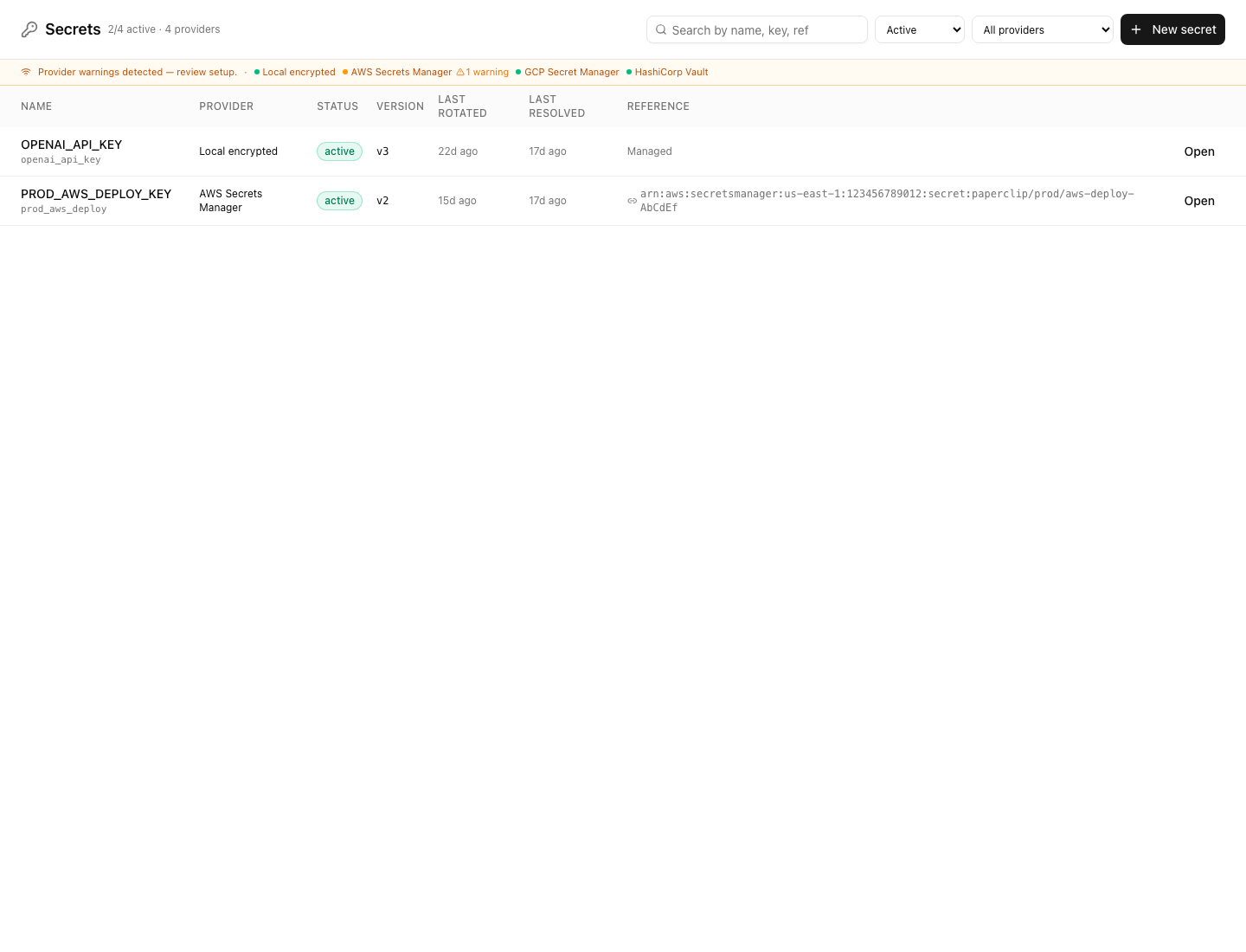 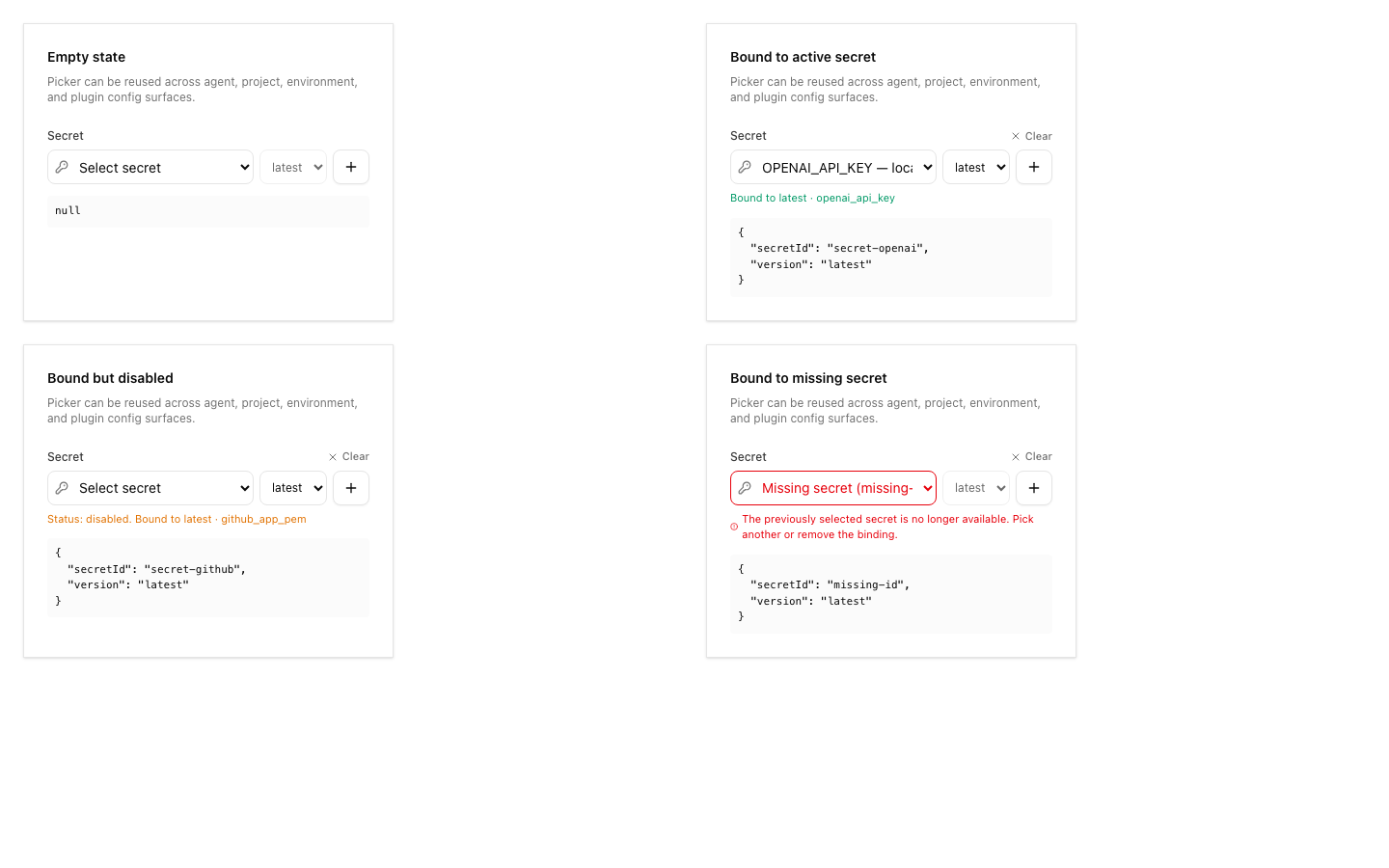 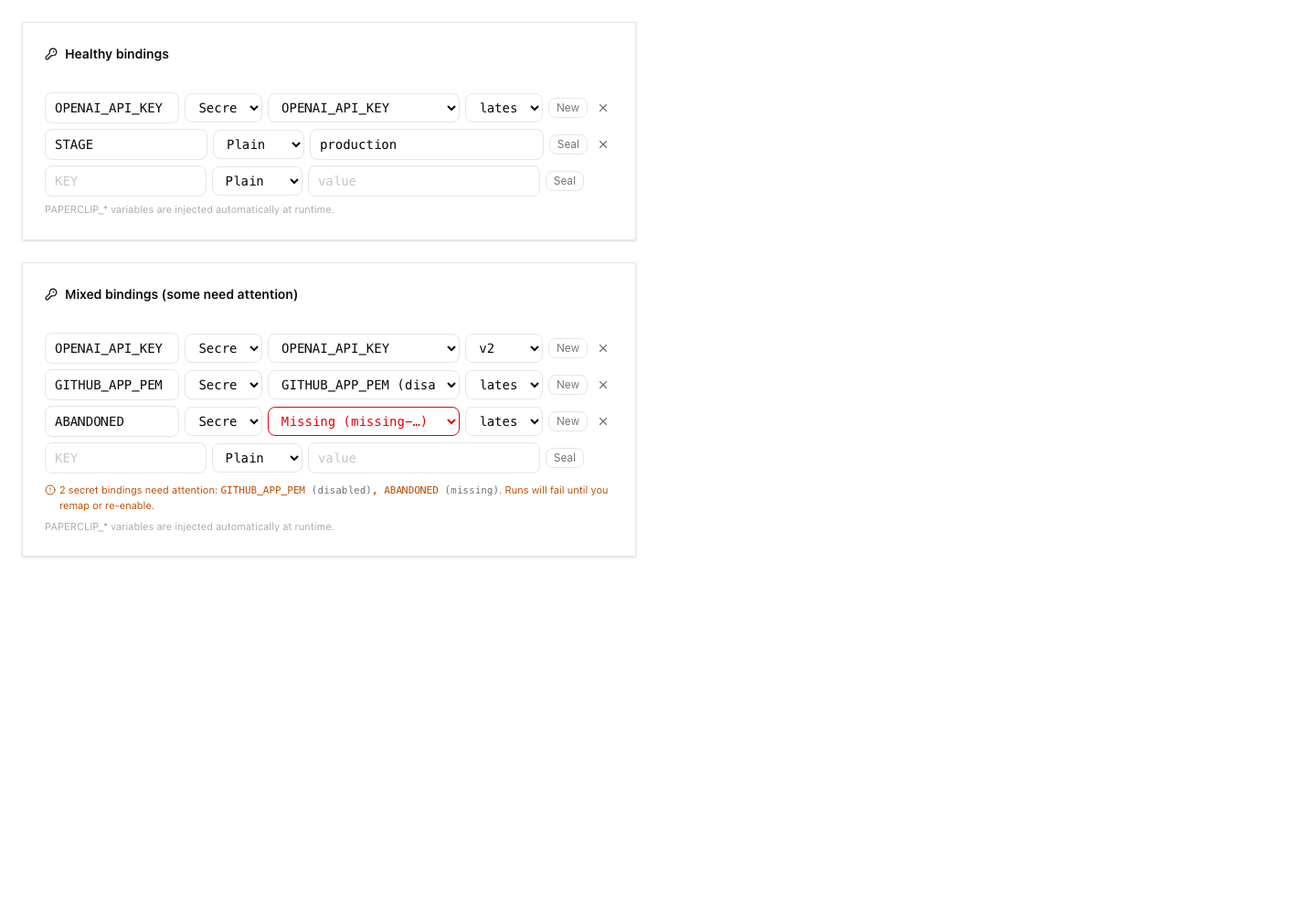 ## Risks - Migration risk: this adds new secret provider tables and extends existing secret rows. The migrations were checked for monotonic ordering and idempotent guards, but reviewers should still inspect upgrade behavior carefully. - Provider risk: AWS support uses direct SigV4 requests. Automated tests cover signing, request timeouts, vault-config selection, namespace guardrails, pending-version archival, sanitized provider errors, and service-level cleanup paths. A real-vault AWS smoke test remains deployment validation for an operator with AWS credentials rather than an unverified merge blocker in this local branch. - UI risk: the Secrets page and import dialog are large new surfaces; screenshots are included above for reviewer inspection. - Verification risk: the full local stable test command hit parallel-load timing failures, although the exact failed files passed when rerun directly. - Operational risk: remote import intentionally avoids plaintext reads; operators must understand that imported external references resolve at runtime and may fail if AWS permissions change. > For core feature work, check [`ROADMAP.md`](ROADMAP.md) first and discuss it in `#dev` before opening the PR. Feature PRs that overlap with planned core work may need to be redirected — check the roadmap first. See `CONTRIBUTING.md`. ## Model Used - OpenAI Codex, GPT-5 coding agent with local shell/tool use in the Paperclip worktree. Exact context-window size was not exposed by the runtime. ## Checklist - [x] I have included a thinking path that traces from project context to this change - [x] I have specified the model used (with version and capability details) - [x] I have checked ROADMAP.md and confirmed this PR does not duplicate planned core work - [ ] I have run tests locally and they pass - [x] I have added or updated tests where applicable - [x] If this change affects the UI, I have included before/after screenshots - [x] I have updated relevant documentation to reflect my changes - [x] I have considered and documented any risks above - [x] I will address all Greptile and reviewer comments before requesting merge --------- Co-authored-by: Paperclip <noreply@paperclip.ing> Co-authored-by: Claude Sonnet 4.6 <noreply@anthropic.com>



6.9 KiB
Database
Paperclip uses PostgreSQL via Drizzle ORM. There are three ways to run the database, from simplest to most production-ready.
1. Embedded PostgreSQL — zero config
If you don't set DATABASE_URL, the server automatically starts an embedded PostgreSQL instance and manages a local data directory.
pnpm dev
That's it. On first start the server:
- Creates a
~/.paperclip/instances/default/db/directory for storage - Ensures the
paperclipdatabase exists - Runs migrations automatically for empty databases
- Starts serving requests
Data persists across restarts in ~/.paperclip/instances/default/db/. To reset local dev data, delete that directory.
If you need to apply pending migrations manually, run:
pnpm db:migrate
When DATABASE_URL is unset, this command targets the current embedded PostgreSQL instance for your active Paperclip config/instance.
Issue reference mentions follow the normal migration path: the schema migration creates the tracking table, but it does not backfill historical issue titles, descriptions, comments, or documents automatically.
To backfill existing content manually after migrating, run:
pnpm issue-references:backfill
# optional: limit to one company
pnpm issue-references:backfill -- --company <company-id>
Future issue, comment, and document writes sync references automatically without running the backfill command.
This mode is ideal for local development and one-command installs.
Docker note: the Docker quickstart image also uses embedded PostgreSQL by default. Persist /paperclip to keep DB state across container restarts (see doc/DOCKER.md).
2. Local PostgreSQL (Docker)
For a full PostgreSQL server locally, use the included Docker Compose setup:
docker compose up -d
This starts PostgreSQL 17 on localhost:5432. Then set the connection string:
cp .env.example .env
# .env already contains:
# DATABASE_URL=postgres://paperclip:paperclip@localhost:5432/paperclip
Run migrations:
DATABASE_URL=postgres://paperclip:paperclip@localhost:5432/paperclip \
  pnpm db:migrate
Start the server:
pnpm dev
3. Hosted PostgreSQL (Supabase)
For production, use a hosted PostgreSQL provider. Supabase is a good option with a free tier.
Setup
- Create a project at database.new
- Go to Project Settings > Database > Connection string
- Copy the URI and replace the password placeholder with your database password
Connection string
Supabase offers two connection modes:
Direct connection (port 5432) — use for migrations and one-off scripts:
postgres://postgres.[PROJECT-REF]:[PASSWORD]@aws-0-[REGION].pooler.supabase.com:5432/postgres
Connection pooling via Supavisor (port 6543) — use for the application:
postgres://postgres.[PROJECT-REF]:[PASSWORD]@aws-0-[REGION].pooler.supabase.com:6543/postgres
Configure
For the application runtime, use a direct PostgreSQL connection unless the database client has explicit prepared-statement configuration for your pooling mode:
DATABASE_URL=postgres://postgres.[PROJECT-REF]:[PASSWORD]@aws-0-[REGION].pooler.supabase.com:5432/postgres
If you later run the app with a pooled runtime URL, set DATABASE_MIGRATION_URL to the direct connection URL. Paperclip uses it for startup schema checks/migrations and plugin namespace migrations, while the app continues to use DATABASE_URL for runtime queries:
DATABASE_URL=postgres://postgres.[PROJECT-REF]:[PASSWORD]@aws-0-[REGION].pooler.supabase.com:6543/postgres
DATABASE_MIGRATION_URL=postgres://postgres.[PROJECT-REF]:[PASSWORD]@aws-0-[REGION].pooler.supabase.com:5432/postgres
If your hosted database requires transaction-pooling-only connections, use a direct or session-pooled connection for Paperclip until runtime pooling support is documented in this guide. Do not edit database client source files as part of deployment setup.
Push the schema
# Use the direct connection (port 5432) for schema changes
DATABASE_URL=postgres://postgres.[PROJECT-REF]:[PASSWORD]@...5432/postgres \
  pnpm db:migrate
Free tier limits
- 500 MB database storage
- 200 concurrent connections
- Projects pause after 1 week of inactivity
See Supabase pricing for current details.
Switching between modes
The database mode is controlled by DATABASE_URL:
DATABASE_URL |
Mode |
|---|---|
| Not set | Embedded PostgreSQL (~/.paperclip/instances/default/db/) |
postgres://...localhost... |
Local Docker PostgreSQL |
postgres://...supabase.com... |
Hosted Supabase |
Your Drizzle schema (packages/db/src/schema/) stays the same regardless of mode.
Plugin database namespaces
The plugin runtime tracks plugin-owned database namespaces and migrations in plugin_database_namespaces and plugin_migrations. Hosted deployments that separate runtime and migration connections should set DATABASE_MIGRATION_URL; plugin namespace migration work uses the migration connection when present.
Backups
Paperclip supports automatic and manual logical database backups. These dumps include
non-system database schemas such as public, the Drizzle migration journal, and
plugin-owned database schemas. See doc/DEVELOPING.md for the current
paperclipai db:backup / pnpm db:backup commands and backup retention
configuration.
Database backups do not include non-database instance files such as local-disk uploads, workspace files, or the local encrypted secrets master key. Back those paths up separately when you need full instance disaster recovery.
Secret storage
Paperclip stores secret metadata and versions in:
company_secretscompany_secret_versions
For local/default installs, the active provider is local_encrypted:
- Secret material is encrypted at rest with a local master key.
- Default key file:
~/.paperclip/instances/default/secrets/master.key(auto-created if missing). - CLI config location:
~/.paperclip/instances/default/config.jsonundersecrets.localEncrypted.keyFilePath. - Backup/restore requires both the database metadata and the local master key file; either artifact alone is insufficient.
- The server best-effort enforces
0600key file permissions and provider health reports permission warnings.
Optional overrides:
PAPERCLIP_SECRETS_MASTER_KEY(32-byte key as base64, hex, or raw 32-char string)PAPERCLIP_SECRETS_MASTER_KEY_FILE(custom key file path)
Strict mode to block new inline sensitive env values:
PAPERCLIP_SECRETS_STRICT_MODE=true
You can set strict mode and provider defaults via:
pnpm paperclipai configure --section secrets
Inline secret migration command:
pnpm paperclipai secrets migrate-inline-env --company-id <company-id> --apply

# direct database maintenance fallback
pnpm secrets:migrate-inline-env --apply
Hosted AWS provider notes live in SECRETS-AWS-PROVIDER.md.