66c4aa862a6a978ee457d99e897ec1ecb30b7f60
2616 Commits
| Author | SHA1 | Message | Date | |
|---|---|---|---|---|
 Devin Foley Devin Foley
|
988689947a |
fix(release): publish modal plugin from ci (#6290)
## Thinking Path

> - Paperclip keeps its core release process declarative through
`scripts/release-package-manifest.json`, which decides which packages CI
is allowed to publish.
> - The Modal sandbox provider now exists as a first-party plugin
package under `packages/plugins/sandbox-providers/modal`.
> - The original Modal PR intentionally left `publishFromCi` disabled
until the package had been published and the registry bootstrap concern
was cleared.
> - The latest reviewer comment confirms that bootstrap step is
complete, so the remaining gap is only release automation configuration.
> - This pull request flips the Modal manifest entry to `publishFromCi:
true` so future CI-driven releases can publish
`@paperclipai/plugin-modal` the same way the other releasable packages
do.
> - The benefit is that Modal releases no longer require a manual
exception in the release pipeline.

## What Changed

- Updated the `@paperclipai/plugin-modal` entry in
`scripts/release-package-manifest.json` to set `publishFromCi` to
`true`.

## Verification

- Ran `node -e 'const
m=require("./scripts/release-package-manifest.json"); const
e=m.find(x=>x.name==="@paperclipai/plugin-modal");
if(!e||e.publishFromCi!==true){throw new Error("modal publishFromCi not
true")}; console.log(JSON.stringify(e))'`

## Risks

- Low risk. This only changes release-manifest metadata; the main
failure mode is CI attempting to publish the Modal package before
registry credentials or release conditions are ready.

## Model Used

- OpenAI Codex local agent, GPT-5-based coding model in the Codex
runtime (exact deployment model ID not exposed in this workspace), with
tool use and shell execution.

## Checklist

- [x] I have included a thinking path that traces from project context
to this change
- [x] I have specified the model used (with version and capability
details)
- [x] I have checked ROADMAP.md and confirmed this PR does not duplicate
planned core work
- [x] I have run tests locally and they pass
- [x] I have added or updated tests where applicable
- [ ] If this change affects the UI, I have included before/after
screenshots
- [x] I have updated relevant documentation to reflect my changes
- [x] I have considered and documented any risks above
- [x] I will address all Greptile and reviewer comments before
requesting merge
|
||
|
Devin Foley
|
e5a0f5debd |
fix(plugin): raise environmentProbe RPC timeout to 120s for cold-start sandboxes (#6289)
## Thinking Path

> - Paperclip orchestrates AI agents for zero-human companies
> - Companies provision execution environments via sandbox provider
plugins (Modal, Daytona, E2B, etc.)
> - At provision time, the server probes each plugin's environment /
sandbox-provider driver over a worker RPC to validate config
> - `workerManager.call()` defaults to a 30s timeout, but cold-start
sandboxes — Modal in particular — take ~31s to boot
> - Result: every fresh Modal environment probe fails with a worker RPC
timeout, blocking environment provisioning end-to-end
> - This PR passes `timeoutMs=120_000` to the two probe call sites
(`probePluginEnvironmentDriver`, `probePluginSandboxProviderDriver`)
> - The benefit is Modal — and any future provider with similar
cold-start latency — can be successfully probed without false-negative
timeout failures

## What Changed

- Pass `timeoutMs=120_000` to `workerManager.call()` in
`probePluginEnvironmentDriver`
(`server/src/services/plugin-environment-driver.ts`)
- Pass `timeoutMs=120_000` to `workerManager.call()` in
`probePluginSandboxProviderDriver` (same file)

## Verification

- Targeted unit tests:
  ```
  pnpm --filter @paperclipai/server exec vitest run \
    src/__tests__/plugin-environment-driver-seam.test.ts \
    src/__tests__/heartbeat-plugin-environment.test.ts
  ```
  5/5 tests pass.
- Manual: provision a fresh Modal sandbox environment from the UI.
Previously failed with a worker RPC timeout at ~30s; now succeeds.

## Risks

- Low risk. The change only raises a per-call timeout (default 30s →
explicit 120s) on two probe call sites. Fast providers are unaffected
since probe completes well below either bound. Worst case: a genuinely
hung worker now blocks the probe for 120s instead of 30s before giving
up — still bounded, and only on the provision-time probe path (not the
heartbeat/run path).

## Model Used

- Provider: Anthropic
- Model: `claude-opus-4-7` (Claude Opus 4.7, 1M context window)
- Capabilities: extended thinking, tool use, code execution
- Scope of AI assistance: the underlying 4-line code change was
human-authored by the committer; this PR (verification commands, message
structuring, and submission) was prepared with Claude per the
`paperclip-dev` skill.

## Checklist

- [x] I have included a thinking path that traces from project context
to this change
- [x] I have specified the model used (with version and capability
details)
- [x] I have checked ROADMAP.md and confirmed this PR does not duplicate
planned core work
- [x] I have run tests locally and they pass
- [ ] I have added or updated tests where applicable — n/a, this is a
per-call timeout configuration bump; existing tests cover the probe call
path
- [x] If this change affects the UI, I have included before/after
screenshots — n/a, no UI change
- [ ] I have updated relevant documentation to reflect my changes — n/a,
the timeout is an internal worker-RPC tuning value with no documented
contract
- [x] I have considered and documented any risks above
- [x] I will address all Greptile and reviewer comments before
requesting merge

Co-authored-by: Paperclip <noreply@paperclip.ing>
|
||
|
Devin Foley
|
4b1e92a588 |
feat(plugins): add Modal sandbox provider plugin (#6245)
## Thinking Path > - Paperclip orchestrates AI agents through company-scoped control-plane workflows and extensible runtime integrations. > - Sandbox providers are part of that extension surface because they let agents execute isolated work without baking each provider into the core server. > - Modal already offers managed sandboxes with filesystem, process, timeout, and networking controls that map onto Paperclip's sandbox provider contract. > - The repo did not have a Modal provider plugin, so teams wanting Modal-backed sandboxes had no first-party integration path. > - This pull request adds a standalone `packages/plugins/sandbox-providers/modal` plugin that implements the provider contract, worker entrypoint, docs, and tests. > - The benefit is that Modal can now be installed as a provider plugin without expanding the core control-plane surface area. ## What Changed - Added a new `packages/plugins/sandbox-providers/modal` package with the plugin manifest, worker entrypoint, and exported plugin surface. - Implemented Modal-backed sandbox lifecycle support for creation, command execution, file operations, networking options, termination, and metadata translation. - Added focused Vitest coverage for config validation, env handling, lifecycle flows, networking behavior, and error mapping. - Documented installation, configuration, and usage requirements in the plugin README. - Removed misleading `MODAL_TOKEN_*` fallback behavior so authentication relies on supported Modal credentials only. ## Verification - `pnpm -r typecheck` - `pnpm test:run` - `pnpm build` - `cd packages/plugins/sandbox-providers/modal && pnpm test` ## Risks - Low to medium risk: this is isolated to a new plugin package, but runtime behavior still depends on live Modal account credentials and service-side sandbox semantics. - Modal's current docs target a newer Node baseline than the repo default, so the first live install should confirm credential loading and sandbox startup behavior in a real Modal workspace. - No UI or schema changes are included in this PR. > For core feature work, check [`ROADMAP.md`](ROADMAP.md) first and discuss it in `#dev` before opening the PR. Feature PRs that overlap with planned core work may need to be redirected — check the roadmap first. See `CONTRIBUTING.md`. ## Model Used - OpenAI Codex via Paperclip `codex_local` agent (GPT-5-class Codex coding model; exact backend model ID is not exposed by the runtime), with tool use, shell execution, and code-editing capabilities enabled. ## Checklist - [x] I have included a thinking path that traces from project context to this change - [x] I have specified the model used (with version and capability details) - [x] I have checked ROADMAP.md and confirmed this PR does not duplicate planned core work - [x] I have run tests locally and they pass - [x] I have added or updated tests where applicable - [x] If this change affects the UI, I have included before/after screenshots - [x] I have updated relevant documentation to reflect my changes - [x] I have considered and documented any risks above - [x] I will address all Greptile and reviewer comments before requesting merge --------- Co-authored-by: Paperclip <noreply@paperclip.ing> |
||
|
Dotta
|
8f45d12447 |
docs: update plugin authoring guide for managed resources (#6261)
## Thinking Path

<!--
Required. Trace your reasoning from the top of the project down to this
  specific change. Start with what Paperclip is, then narrow through the
  subsystem, the problem, and why this PR exists. Use blockquote style.
  Aim for 5-8 steps. See CONTRIBUTING.md for full examples.
-->

> - Paperclip orchestrates AI agents for zero-human companies.
> - The plugin system is how optional capabilities extend the control
plane without adding hidden core behavior.
> - Plugin authors need accurate guidance for the current managed
capabilities model.
> - The existing docs under-described managed skills and the
routine-first pattern for durable plugin automation.
> - Content-oriented plugins such as LLM Wiki should model recurring
work with visible managed agents, projects, routines, and skills.
> - This pull request aligns the authoring guide, local development
guide, and longer plugin spec with that model.
> - The benefit is clearer plugin guidance that preserves Paperclip
visibility, budgets, pause controls, and audit trails.

## What Changed

<!-- Bullet list of concrete changes. One bullet per logical unit. -->

- Documented plugin-managed skills alongside managed agents, projects,
and routines.
- Added guidance for content-oriented plugins to use managed projects,
agents, skills, and routines instead of private daemon-like state.
- Updated the manifest/spec examples and capability lists for current
plugin-managed surfaces.
- Clarified when to use managed routines instead of plugin runtime jobs
for board-visible recurring work.
- Added a short local plugin development note pointing authors toward
routine-first automation.
- Addressed Greptile docs feedback by marking top-level `launchers` as
legacy and removing a redundant `slug` from the managed skill example.

## Verification

<!--
  How can a reviewer confirm this works? Include test commands, manual
  steps, or both. For UI changes, include before/after screenshots.
-->

- `git diff --check public-gh/master...HEAD`
- Reviewed `ROADMAP.md`; this is docs alignment for the completed plugin
system milestone and does not add roadmap-level core feature work.
- Greptile Review: success on the latest head; `3 files reviewed, 0
comments added` after follow-up fixes.
- GitHub PR checks are green on the latest head, including Build,
Typecheck + Release Registry, General tests, serialized server suites,
e2e, Canary Dry Run, policy, Snyk, and aggregate `verify`.

## Risks

<!--
  What could go wrong? Mention migration safety, breaking changes,
  behavioral shifts, or "Low risk" if genuinely minor.
-->

- Low risk: documentation-only changes.
- Main risk is documentation drift if the plugin API changes again
before these docs are reviewed.

> For core feature work, check [`ROADMAP.md`](ROADMAP.md) first and
discuss it in `#dev` before opening the PR. Feature PRs that overlap
with planned core work may need to be redirected - check the roadmap
first. See `CONTRIBUTING.md`.

## Model Used

<!--
  Required. Specify which AI model was used to produce or assist with
  this change. Be as descriptive as possible - include:
    • Provider and model name (e.g., Claude, GPT, Gemini, Codex)
• Exact model ID or version (e.g., claude-opus-4-6,
gpt-4-turbo-2024-04-09)
    • Context window size if relevant (e.g., 1M context)
• Reasoning/thinking mode if applicable (e.g., extended thinking,
chain-of-thought)
• Any other relevant capability details (e.g., tool use, code execution)
  If no AI model was used, write "None — human-authored".
-->

- OpenAI Codex, GPT-5 coding agent with shell and GitHub connector tool
use.

## Checklist

- [x] I have included a thinking path that traces from project context
to this change
- [x] I have specified the model used (with version and capability
details)
- [x] I have checked ROADMAP.md and confirmed this PR does not duplicate
planned core work
- [x] I have run tests locally and they pass
- [x] I have added or updated tests where applicable
- [x] If this change affects the UI, I have included before/after
screenshots
- [x] I have updated relevant documentation to reflect my changes
- [x] I have considered and documented any risks above
- [x] I will address all Greptile and reviewer comments before
requesting merge

---------

Co-authored-by: Paperclip <noreply@paperclip.ing>
|
||
|
Dotta
|
32605b71ad |
Remove planning badge from inbox issue rows (PAP-9691) (#6269)
## Summary - Removes the amber "Planning" pill from inbox / issue-list rows in `IssueRow` - Updates the focused IssueRow test to assert the badge is no longer rendered - Per [PAP-9691](https://paperclip.ing/PAP/issues/PAP-9691): user just doesn't want to see the badge in list rows The underlying `issue.workMode === "planning"` data, the issue detail composer toggle, and the server/plugin/heartbeat work-mode contract introduced in #5353 are all untouched. Planning mode still functions; the list-row indicator is just gone. ## Test plan - [x] `pnpm exec vitest run --project @paperclipai/ui ui/src/components/IssueRow.test.tsx` (11 passed) - [ ] Visual: open `/PAP/inbox` with a planning-mode issue assigned and confirm no amber Planning pill on the row 🤖 Generated with [Claude Code](https://claude.com/claude-code) --------- Co-authored-by: Paperclip <noreply@paperclip.ing> Co-authored-by: Claude Opus 4.7 <noreply@anthropic.com> |
||
|
github-actions[bot]
|
85510f0e5b |
chore(lockfile): refresh pnpm-lock.yaml (#6263)
Auto-generated lockfile refresh after dependencies changed on master. This PR only updates pnpm-lock.yaml. Co-authored-by: lockfile-bot <lockfile-bot@users.noreply.github.com> |
||
|
Dotta
|
5071c4c776 |
[codex] Add workspace diff viewer plugin (#6071)
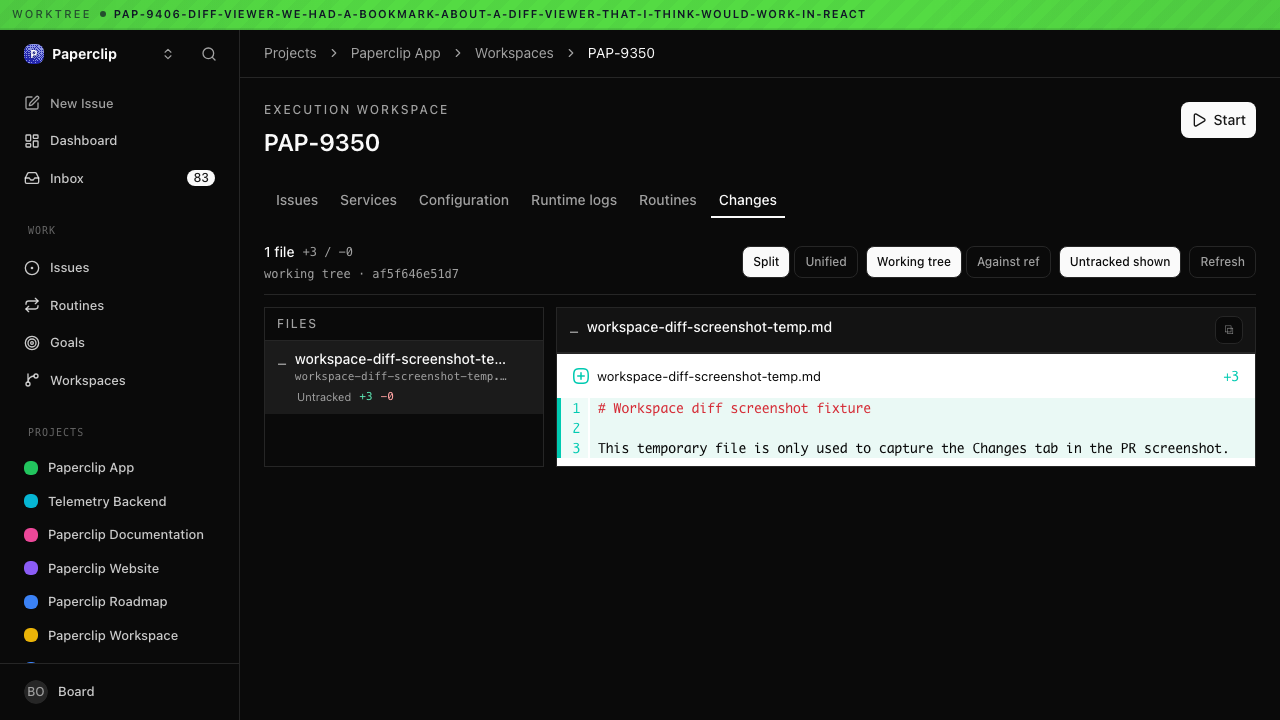
## Thinking Path > - Paperclip orchestrates AI agents for zero-human companies. > - Operators need to inspect what agents changed inside execution and project workspaces. > - The existing workspace detail views did not provide a first-party rich diff surface for staged, unstaged, head, renamed, binary, oversized, and untracked changes. > - The plugin system is the intended extension point for optional rich UI surfaces. > - This pull request adds a workspace diff plugin plus host services and shared contracts so Changes tabs can render workspace diffs through plugin slots. > - The diff-renderer dependency should stay owned by the plugin package rather than the core UI app. > - The dependency surface must stay aligned with repository PR policy, including intentionally omitting `pnpm-lock.yaml` from the PR. > - The benefit is a more reviewable workspace surface without hard-coding the renderer into every page. ## What Changed - Added `@paperclipai/plugin-workspace-diff`, including diff normalization, plugin manifest/worker/UI entrypoints, and focused plugin tests. - Kept `@pierre/diffs` scoped to `@paperclipai/plugin-workspace-diff`; removed the core UI lab diff-renderer surface and direct UI package dependency. - Added shared workspace diff types and validators, plus plugin SDK surface for workspace diff host services. - Added server workspace diff service support and route coverage for execution/project workspace diff flows. - Wired Execution Workspace and Project Workspace Changes tabs to load the diff plugin, including loading/error fallback behavior. - Added UI tests and fixtures for the Changes tabs and plugin bridge behavior. - Added the new plugin package manifest to the Docker deps stage so PR policy can validate dependency coverage. - Addressed review hardening around empty untracked patches, workspace path exposure, project workspace read capability checks, and default base refs. ## Verification - `pnpm --filter @paperclipai/plugin-workspace-diff test` - `pnpm exec vitest run packages/shared/src/validators/workspace-diff.test.ts server/src/__tests__/workspace-diff-service.test.ts ui/src/pages/ProjectWorkspaceDetail.test.tsx ui/src/pages/ExecutionWorkspaceDetail.test.tsx` - `pnpm exec vitest run ui/src/plugins/bridge.test.ts server/src/__tests__/workspace-runtime-routes-authz.test.ts` - `pnpm --filter @paperclipai/shared typecheck` - `pnpm --filter @paperclipai/plugin-workspace-diff typecheck` - `pnpm --filter @paperclipai/server typecheck` - `pnpm --filter @paperclipai/ui typecheck` - `node ./scripts/check-docker-deps-stage.mjs` - Browser screenshot captured from the local worktree dev server: https://files.catbox.moe/ofdpsp.png - Confirmed branch is rebased onto `public-gh/master`, `.github/workflows/pr.yml` is not included in the PR diff, `ui/package.json` is not included in the PR diff, and `pnpm-lock.yaml` is not included in the PR diff. ## Risks - Medium UI integration risk: the Changes tab depends on the plugin slot and host diff service path. - Medium dependency risk: this adds `@pierre/diffs` in the plugin package, but `pnpm-lock.yaml` is intentionally omitted per packaging instructions because repository automation manages lockfile updates. - Current CI blocker: downstream frozen installs fail until the repository policy path for new plugin package dependencies is chosen. - Diff rendering edge cases are covered for common working-tree and head diff states, but very large repositories may still expose performance limits. - No migrations are included. > For core feature work, check [`ROADMAP.md`](ROADMAP.md) first and discuss it in `#dev` before opening the PR. Feature PRs that overlap with planned core work may need to be redirected — check the roadmap first. See `CONTRIBUTING.md`. ## Model Used - OpenAI Codex, GPT-5 class coding model, tool-enabled local execution environment. Exact context window was not exposed by the runtime. ## Checklist - [x] I have included a thinking path that traces from project context to this change - [x] I have specified the model used (with version and capability details) - [x] I have checked ROADMAP.md and confirmed this PR does not duplicate planned core work - [x] I have run tests locally and they pass - [x] I have added or updated tests where applicable - [x] If this change affects the UI, I have included before/after screenshots - [x] I have updated relevant documentation to reflect my changes - [x] I have considered and documented any risks above - [x] I will address all Greptile and reviewer comments before requesting merge --------- Co-authored-by: Paperclip <noreply@paperclip.ing> |
||
|
Devin Foley
|
242a2c2f2b |
fix(cli): stop worktree init --force from wiping repo worktrees/ (#6240)
## Thinking Path

> - Paperclip orchestrates AI agents for zero-human companies
> - Each working tree gets an isolated Paperclip instance; the CLI's
`paperclip worktree init` is what bootstraps that instance and writes
`<repo>/.paperclip/config.json` + `.env`
> - When `--force` was passed, the init path tried to "start clean" by
recursively removing the entire `<repo>/.paperclip/` directory before
rewriting those two files
> - But `<repo>/.paperclip/` also holds `worktrees/`, which contains
every repo-managed worktree checkout (70+ on this machine). The
recursive rm silently nuked all of them.
> - This PR narrows the `--force` reset so it only deletes the two files
it's about to rewrite (`config.json`, `.env`), instead of wiping the
whole `repoConfigDir`
> - It also adds a regression test that drops a sentinel file into
`<repoConfigDir>/worktrees/` and asserts it survives a `--force` init
> - The benefit is that `worktree init --force` becomes safe to run from
inside the main repo without destroying every sibling worktree checkout

## What Changed

- `cli/src/commands/worktree.ts`: in the `--force` branch of
`runWorktreeInit`, replace `rmSync(paths.repoConfigDir, { recursive:
true, force: true })` with targeted removals of `paths.configPath` and
`paths.envPath`. `paths.instanceRoot` removal is unchanged — that path
is per-instance and safe to wipe.
- `cli/src/__tests__/worktree.test.ts`: new regression test that seeds a
fake `worktrees/<name>/` checkout inside the repo's `.paperclip/` and
verifies `runWorktreeInit({ force: true, ... })` does not delete it.

## Verification

- `pnpm --filter @paperclip/cli test -- worktree` — the new regression
test fails on the old code and passes on the fix
- Manual: from a repo checkout, `npx paperclipai worktree init --force
…` no longer removes `<repo>/.paperclip/worktrees/`; only `config.json`
and `.env` are rewritten

## Risks

- Low. The change strictly narrows what `--force` removes. Any caller
that depended on `--force` also wiping unrelated files under
`<repo>/.paperclip/` (there shouldn't be any — it's documented as just
config + env) would see those files persist. `instanceRoot` cleanup is
unchanged.

## Model Used

- Claude (Anthropic), model `claude-opus-4-7`, ~200K context,
extended-thinking + tool-use enabled, run via the Paperclip
`claude_local` adapter.

## Checklist

- [x] I have included a thinking path that traces from project context
to this change
- [x] I have specified the model used (with version and capability
details)
- [x] I have checked ROADMAP.md and confirmed this PR does not duplicate
planned core work
- [x] I have run tests locally and they pass
- [x] I have added or updated tests where applicable
- [ ] If this change affects the UI, I have included before/after
screenshots (N/A — CLI-only fix)
- [x] I have updated relevant documentation to reflect my changes (no
doc surface affected)
- [x] I have considered and documented any risks above
- [x] I will address all Greptile and reviewer comments before
requesting merge

Co-authored-by: Paperclip <noreply@paperclip.ing>
|
||
|
Devin Foley
|
734385102c |
Fix new secret form textarea overflow (PAPA-348) (#6222)
## Thinking Path > - Paperclip orchestrates AI agents for zero-human companies > - Operators manage per-company secrets through the Secrets page in the web UI > - A long secret value pasted into the "New secret" textarea blew out the form's width, which pushed the Create/Cancel buttons off-screen and made the form unusable > - Root cause: the shadcn `Textarea` primitive sets `w-full` but does not constrain `min-width`, so a flex parent honors the textarea's intrinsic content width when a long unbreakable string is present > - This pull request adds `min-w-0 max-w-full` to the shared `Textarea` primitive and `min-w-0 overflow-x-hidden break-all` on the secret-value usage so a long token wraps inside the form bounds > - The benefit is the Create/Cancel buttons stay reachable regardless of pasted token length, and every other `Textarea` consumer also gets the flexbox-friendly width constraint ## What Changed - `ui/src/components/ui/textarea.tsx`: added `min-w-0 max-w-full` to the base shadcn `Textarea` so it cannot exceed its flex parent - `ui/src/pages/Secrets.tsx`: added `min-w-0 overflow-x-hidden break-all` on the new-secret value `Textarea` so long opaque tokens wrap instead of pushing the form - `ui/src/pages/Secrets.render.test.tsx`: new regression test that opens the New Secret dialog and asserts the value textarea carries the width-constraint classes ## Verification - `cd ui && npx vitest run src/pages/Secrets.render.test.tsx` — 3/3 pass - Manual: open the Secrets page, click "New secret", paste a long unbroken string (e.g. a 500-char token) into the value field. The form stays within its dialog and the Create/Cancel buttons remain in view. Before: <img width="1772" height="1432" alt="image" src="https://github.com/user-attachments/assets/cb31a290-f82a-41dc-9346-91d18cbb5911" /> After: <img width="672" height="734" alt="Screenshot 2026-05-17 at 5 39 38 PM" src="https://github.com/user-attachments/assets/a08800c2-b09b-43be-b0e8-114d9149b8f5" /> After: the value field wraps with `break-all` inside the dialog; Create/Cancel stay clickable. Covered by the new render test which asserts `min-w-0`, `overflow-x-hidden`, and `break-all` are present on `#new-secret-value`. ## Risks - Low risk. The base `Textarea` change adds `min-w-0 max-w-full`, which only affects layouts where a textarea was previously allowed to grow past its parent — those cases were already buggy. `break-all` on the secret-value textarea is the right behavior for opaque tokens; it would be wrong for prose, but this field is explicitly a secret token. ## Model Used - Provider: Anthropic Claude - Model: claude-opus-4-7 (Opus 4.7) - Mode: standard Claude Code agent, tool use enabled ## Checklist - [x] I have included a thinking path that traces from project context to this change - [x] I have specified the model used (with version and capability details) - [x] I have checked ROADMAP.md and confirmed this PR does not duplicate planned core work - [x] I have run tests locally and they pass - [x] I have added or updated tests where applicable - [x] If this change affects the UI, I have included before/after screenshots - [ ] I have updated relevant documentation to reflect my changes - [x] I have considered and documented any risks above - [x] I will address all Greptile and reviewer comments before requesting merge |
||
|
Dotta
|
d734bd43d1 |
[codex] Roll up May 17 branch changes (#6210)
## Thinking Path > - Paperclip is the control plane for autonomous AI companies, so agent work needs visible ownership, recovery, and operator controls. > - This local branch had accumulated several related control-plane reliability and operator-experience fixes across recovery actions, watchdog folding, model-profile defaults, mentions, markdown editing, plugin launchers, and small UI polish. > - The branch needed to be converted into a PR against the current `origin/master` without losing dirty work or including lockfile/workflow churn. > - The safest standalone shape is a single rollup PR because the recovery/server/UI files overlap heavily across the local commits and splitting would create avoidable conflicts. > - This pull request replays the local branch onto latest `origin/master`, preserves the uncommitted work as logical commits, and adds a Zod 4 validator compatibility fix found during verification. > - The benefit is that the May 17 local branch can be reviewed and merged as one coherent, conflict-free branch under the 100-file Greptile limit. ## What Changed - Rebased the local May 17 branch work onto current `origin/master` in a dedicated worktree. - Preserved and committed previously dirty changes for recovery retry handling, plugin/sidebar launcher polish, and `.herenow` ignores. - Added recovery-action behavior for returning source issues to `todo` when retrying source-scoped recovery. - Included the existing local recovery/liveness/watchdog fold, Codex cheap-profile, markdown/mention, duplicate-agent, and UI polish commits from the branch. - Normalized shared validator `z.record(...)` schemas to explicit string-key records for Zod 4 compatibility. - Confirmed the PR has no `pnpm-lock.yaml` or `.github/workflows/*` changes and stays below the 100-file Greptile limit. ## Verification - `pnpm install --frozen-lockfile --ignore-scripts` - `npm run install` in `node_modules/.pnpm/sqlite3@5.1.7/node_modules/sqlite3` to build the local native sqlite3 binding after installing with scripts disabled - `pnpm exec vitest run packages/shared/src/validators/issue.test.ts packages/shared/src/project-mentions.test.ts packages/adapter-utils/src/server-utils.test.ts server/src/__tests__/heartbeat-model-profile.test.ts server/src/__tests__/issue-recovery-actions.test.ts server/src/__tests__/issue-agent-mutation-ownership-routes.test.ts server/src/__tests__/heartbeat-active-run-output-watchdog.test.ts server/src/__tests__/plugin-local-folders.test.ts ui/src/components/IssueRecoveryActionCard.test.tsx ui/src/components/Sidebar.test.tsx ui/src/components/SidebarAccountMenu.test.tsx ui/src/components/IssueProperties.test.tsx ui/src/components/MarkdownEditor.test.tsx ui/src/components/MarkdownBody.test.tsx ui/src/lib/duplicate-agent-payload.test.ts ui/src/pages/Routines.test.tsx` - First pass: 13 files passed with 201 passing tests; 3 server files failed before sqlite3 native binding was built. - After rebuilding sqlite3: `server/src/__tests__/heartbeat-model-profile.test.ts`, `server/src/__tests__/issue-recovery-actions.test.ts`, and `server/src/__tests__/heartbeat-active-run-output-watchdog.test.ts` passed/loaded; embedded Postgres tests were skipped by the local host guard. - `pnpm --filter @paperclipai/shared typecheck` - `pnpm --filter @paperclipai/adapter-utils typecheck` - `pnpm --filter @paperclipai/server typecheck` - `pnpm --filter @paperclipai/ui typecheck` ## Risks - Medium risk: this is a broad rollup PR across recovery semantics, server tests, shared validators, and UI surfaces. - Some embedded Postgres tests skipped locally due the host guard, so CI should provide the stronger database-backed signal. - UI changes were covered by component tests, but no browser screenshot was captured in this PR creation pass. - This branch may overlap with existing recovery/liveness PR work; merge this PR independently or restack/close overlapping branches rather than merging duplicate implementations together. > For core feature work, check [`ROADMAP.md`](ROADMAP.md) first and discuss it in `#dev` before opening the PR. Feature PRs that overlap with planned core work may need to be redirected — check the roadmap first. See `CONTRIBUTING.md`. ## Model Used - OpenAI Codex, GPT-5-based coding agent, tool-enabled local repository and GitHub workflow, medium reasoning effort. ## Checklist - [x] I have included a thinking path that traces from project context to this change - [x] I have specified the model used (with version and capability details) - [x] I have checked ROADMAP.md and confirmed this PR does not duplicate planned core work - [x] I have run tests locally and they pass - [x] I have added or updated tests where applicable - [ ] If this change affects the UI, I have included before/after screenshots - [x] I have updated relevant documentation to reflect my changes - [x] I have considered and documented any risks above - [x] I will address all Greptile and reviewer comments before requesting merge --------- Co-authored-by: Paperclip <noreply@paperclip.ing> |
||
|
Dotta
|
705c1b8d81 |
[codex] Add routine env secrets support (#6212)
## Thinking Path > - Paperclip orchestrates AI agents for zero-human companies. > - Scheduled routines are the control-plane path for recurring agent work. > - Routines already had dispatch/history, but their runtime environment did not carry routine-owned secret bindings through execution. > - Operators need routine-specific secrets that can override project/agent env without exposing secret values in history, logs, or access events. > - This pull request adds the routine env runtime contract, wires it into execution, and makes the routine UI/history surfaces show safe secret metadata. > - The benefit is that routine executions can use scoped secret refs predictably while preserving company boundaries and auditability. ## What Changed - Added routine env persistence/runtime support, including `routines.env`, `routine_runs.routine_revision_id`, revision snapshots, and idempotent migration `0086_routine_env_runtime_contract`. - Resolved routine env during heartbeat adapter config assembly with precedence `agent < project < routine` and secret access events recorded against the routine consumer. - Added secret binding synchronization for routine create/update/restore flows and guarded cross-company, missing, disabled, and deleted secret cases. - Added a Secrets tab to routine detail, env/secret history diff rendering, and Storybook coverage for the new UI states. - Added server/UI regression tests, including an embedded-Postgres QA path for routine secret execution and restore behavior. - Updated implementation/database docs for routine env and secret-binding behavior. ## Verification - `pnpm install --frozen-lockfile` after rebasing onto `public-gh/master` to refresh workspace links for the newly-added upstream Grok adapter package. - `pnpm exec vitest run server/src/__tests__/heartbeat-project-env.test.ts server/src/__tests__/routines-service.test.ts server/src/__tests__/secrets-service.test.ts server/src/__tests__/qa-routine-secrets-e2e.test.ts ui/src/components/RoutineHistoryTab.test.tsx` passed: 5 files, 92 tests. - `pnpm -r typecheck` passed across the workspace. - `pnpm build` passed. Vite emitted the existing large-chunk/dynamic-import warnings. - UI screenshots were captured locally during QA in `artifacts/pap-9521/` and `artifacts/pap-9522/`; generated screenshots are not committed to avoid adding binary artifacts to the repo. ## Risks - Migration risk is limited by `IF NOT EXISTS` guards for the new columns, FK, and index, and the migration is ordered as `0086` immediately after upstream `0085`. - Runtime behavior changes env precedence for routine executions by adding routine env as the highest-precedence layer; tests cover agent/project/routine precedence. - Secret handling is security-sensitive; tests cover value-free manifests/events/errors, disabled/missing/deleted secrets, and cross-company rejection. - UI history now renders routine env/secret diffs; tests and Storybook stories cover the main rendering paths. > For core feature work, check [`ROADMAP.md`](ROADMAP.md) first and discuss it in `#dev` before opening the PR. Feature PRs that overlap with planned core work may need to be redirected — check the roadmap first. See `CONTRIBUTING.md`. ## Model Used - OpenAI Codex coding agent based on GPT-5, with shell/tool use and medium reasoning effort. ## Checklist - [x] I have included a thinking path that traces from project context to this change - [x] I have specified the model used (with version and capability details) - [x] I have checked ROADMAP.md and confirmed this PR does not duplicate planned core work - [x] I have run tests locally and they pass - [x] I have added or updated tests where applicable - [x] If this change affects the UI, I have included before/after screenshots - [x] I have updated relevant documentation to reflect my changes - [x] I have considered and documented any risks above - [x] I will address all Greptile and reviewer comments before requesting merge --------- Co-authored-by: Paperclip <noreply@paperclip.ing> |
||
|
Dotta
|
3e6610fb93 |
docs(skills): add release-changelog-discord-message skill (#6152)
## Summary

Adds `.agents/skills/release-changelog-discord-message/SKILL.md` — the
companion to `.agents/skills/release-changelog/`. The changelog skill
produces `releases/vYYYY.MDD.P.md`; this one turns that into the single
copy-pasteable Discord post in dotta's voice and attaches it as the
`discord_announcement` document on the release issue.

Includes:

- dotta's instructions near-verbatim from PAP-3687 ("This is for discord
— try to follow my format. If I have a section where I think about the
future, pull from recent issues we're working on etc.")
- The three previous Discord announcements (v2026.403.0, v2026.416.0,
v2026.427.0) **verbatim** as canonical voice references
- Format template + language tips (ALL CAPS for excitement,
emoji-shortcode-per-highlight, first-person voice, opener/closer brand
bookends)
- Workflow tied to the existing release issue + `discord_announcement`
document
- Review checklist (version match, contributor list dedup, real "what's
next" themes, no invented work)

Resolves PAP-9524.

## Test plan

- [ ] dotta eyeballs voice + structure against the three prior posts
- [ ] On the next release, run this skill end-to-end and confirm the
`discord_announcement` document on the release issue matches the format

Co-authored-by: Paperclip <noreply@paperclip.ing>
|
||
|
Dotta
|
7bbdfb69df |
[codex] Enable Grok adapter canary publishing (#6154)
## Thinking Path > - Paperclip publishes its CLI, server, UI, and adapter packages through the shared release workflow. > - Canary releases are driven by the GitHub release workflow on pushes to `master`. > - The release workflow does not publish every public package automatically; it uses `scripts/release-package-manifest.json` as the CI enrollment source of truth. > - The Grok adapter is public and already present in the manifest, but its `publishFromCi` flag was still disabled. > - Because of that flag, normal canary publishes skipped `@paperclipai/adapter-grok-local` even when the main package received a canary. > - This pull request enables Grok in the release manifest so future canary runs include it. > - The benefit is that Grok adapter canaries stay aligned with the rest of the package release set. ## What Changed - Set `packages/adapters/grok-local` / `@paperclipai/adapter-grok-local` to `publishFromCi: true` in `scripts/release-package-manifest.json`. ## Verification - `node ./scripts/release-package-map.mjs check` - `node ./scripts/release-package-map.mjs list | grep '@paperclipai/adapter-grok-local'` - `pnpm test:release-registry` ## Risks - Low risk: this is a release manifest-only change. - Future canary releases will attempt to publish `@paperclipai/adapter-grok-local`; this assumes the package remains publishable and trusted publishing/package access are correctly configured for the existing npm package. > For core feature work, check [`ROADMAP.md`](ROADMAP.md) first and discuss it in `#dev` before opening the PR. Feature PRs that overlap with planned core work may need to be redirected — check the roadmap first. See `CONTRIBUTING.md`. ## Model Used - OpenAI Codex, GPT-5-based coding agent with shell, git, and GitHub tool use. ## Checklist - [x] I have included a thinking path that traces from project context to this change - [x] I have specified the model used (with version and capability details) - [x] I have checked ROADMAP.md and confirmed this PR does not duplicate planned core work - [x] I have run tests locally and they pass - [x] I have added or updated tests where applicable - [x] If this change affects the UI, I have included before/after screenshots - [x] I have updated relevant documentation to reflect my changes - [x] I have considered and documented any risks above - [x] I will address all Greptile and reviewer comments before requesting merge Co-authored-by: Paperclip <noreply@paperclip.ing> |
||
|
Dotta
|
93cd933f79 |
docs: add v2026.517.0 release changelog (#6150)
## Thinking Path > - Paperclip is the control plane for autonomous AI companies. > - Stable releases need a reviewer-readable changelog artifact that summarizes what changed for operators and contributors. > - The last stable release tag is `v2026.513.0`, and the requested release date is 2026-05-17. > - The release changelog skill maps that date to stable version `2026.517.0` and requires the range `v2026.513.0..origin/master`. > - I reviewed the commits, PR metadata, migration/API surfaces, and contributor attribution in that range. > - This pull request adds the `releases/v2026.517.0.md` changelog for human release sign-off. > - The benefit is a stable release note artifact that is ready to review before publishing the release. ## What Changed - Added `releases/v2026.517.0.md` for the 2026-05-17 stable release. - Summarized user-facing highlights, improvements, fixes, and contributor attribution from `v2026.513.0..origin/master`. - Omitted Breaking Changes and Upgrade Guide sections after checking for destructive migrations, removed API surfaces, and breaking-change commit signals. ## Verification - `./scripts/release.sh stable --date 2026-05-17 --print-version` -> `2026.517.0`. - `git tag --list 'v*' --sort=-version:refname | head -10` confirmed `v2026.513.0` is the latest stable tag. - `git log v2026.513.0..origin/master --oneline --no-merges` reviewed the 16 release-range commits. - `git diff --name-only v2026.513.0..origin/master -- .changeset` returned no changeset files. - `git log v2026.513.0..origin/master --format='%s' | rg -n 'BREAKING CHANGE|BREAKING:|^[a-z]+!:' || true` returned no breaking-change signals. - `git diff --name-only v2026.513.0..origin/master -- packages/db/src/migrations packages/db/src/schema server/src/routes server/src/api server/src` reviewed the DB/API/server touchpoints; only an additive document-lock migration appeared in the DB schema/migration path. - `test -f releases/v2026.517.0.md` passed. - `rg -n -- '-canary|canary/' releases/v2026.517.0.md || true` returned no canary filename/title language. - `git diff --cached --check` passed before commit. ## Risks - Low risk: docs-only release changelog addition. - Changelog grouping is editorial; reviewers may want wording or prioritization changes before release publication. - Contributor attribution intentionally excludes bot accounts and Paperclip founders from the Contributors section per the release changelog skill. > Checked [`ROADMAP.md`](ROADMAP.md); this is release documentation, not new roadmap-level core feature work. ## Model Used - OpenAI Codex, GPT-5 coding agent via Paperclip `codex_local`, with shell, git, GitHub CLI, and repository file editing enabled. Exact backend sub-version and context window were not surfaced by the Paperclip runtime. ## Checklist - [x] I have included a thinking path that traces from project context to this change - [x] I have specified the model used (with version and capability details) - [x] I have checked ROADMAP.md and confirmed this PR does not duplicate planned core work - [x] I have run tests locally and they pass - [x] I have added or updated tests where applicable - [x] If this change affects the UI, I have included before/after screenshots - [x] I have updated relevant documentation to reflect my changes - [x] I have considered and documented any risks above - [x] I will address all Greptile and reviewer comments before requesting merge |
||
|
Devin Foley
|
573e9ec909 |
fix(grok-local): restore turn boundaries in streaming reasoning text (#6142)
## Thinking Path > - Paperclip orchestrates AI agents for zero-human companies > - The `grok-local` adapter streams reasoning text to the issue "Working..." panel as the grok CLI runs > - The `grok` CLI's `--output-format streaming-json` mode silently drops the `\n` separator between reasoning turns around tool calls > - Consecutive `thought` chunks (e.g. `` "`" `` followed by `"The"`) arrive with no intervening whitespace event, so the UI's `delta: true` concatenator merged them into run-on text like `"…planningGreat, now I have the issue descriptionThe only co"` > - This PR adds a small turn-boundary helper that detects sentence boundaries in the upstream `thought` stream and inserts a single `\n` only when the previous chunk ended with sentence punctuation (or a balanced closing backtick) AND the next chunk begins a new uppercase sentence > - The benefit is readable streaming reasoning in the UI without changing how completed messages are stored ## What Changed - Added `packages/adapters/grok-local/src/shared/turn-boundary.ts` with per-stream state (last chunk + backtick parity) and a `restoreTurnBoundary()` helper that inserts `\n` only between balanced, sentence-terminated `thought` chunks - Wired the helper into `parseGrokJsonl` (server) and added a new `createGrokStdoutParser` factory used by `grokLocalUIAdapter` for the live "Working..." panel - Added focused tests in `shared/turn-boundary.test.ts`, plus regression assertions in `server/parse.test.ts` and `ui/parse-stdout.test.ts` ## Verification - `pnpm --filter @paperclip/grok-local test` — 23/23 adapter tests pass - `pnpm --filter @paperclip/grok-local typecheck` and UI typecheck — clean - Replayed an actual broken `grok 0.1.210` stream from the report; previously-merged boundaries (`` `ls`The ``, `returned:Confirmed`) now render with a separating newline; chunks inside un-closed backtick spans are left alone ## Risks - Low risk. Boundary insertion only fires when prev ends with `.`/`!`/`?`/balanced `` ` `` and next begins with an uppercase ≥2-char word, with no whitespace on either side. Worst case: a rare missed split or a misplaced newline inside reasoning — both purely cosmetic and confined to the live streaming panel. ## Model Used - Claude Opus 4.7 (claude-opus-4-7), Anthropic, extended thinking + tool use via Claude Code ## Checklist - [x] I have included a thinking path that traces from project context to this change - [x] I have specified the model used (with version and capability details) - [x] I have checked ROADMAP.md and confirmed this PR does not duplicate planned core work - [x] I have run tests locally and they pass - [x] I have added or updated tests where applicable - [ ] If this change affects the UI, I have included before/after screenshots - [x] I have updated relevant documentation to reflect my changes - [x] I have considered and documented any risks above - [x] I will address all Greptile and reviewer comments before requesting merge --------- Co-authored-by: Paperclip <noreply@paperclip.ing> |
||
|
Devin Foley
|
81d18f2d77 |
ci: speed up PR verify workflow (#6137)
## Thinking Path

> - Paperclip orchestrates AI agents through a control-plane repo that
relies on GitHub Actions as part of its release and verification safety
net.
> - The PR workflow in `.github/workflows/pr.yml` is the core CI path
protecting pull requests before merge.
> - Baseline measurement work in [PAPA-335](/PAPA/issues/PAPA-335)
showed the old single `verify` job was the critical-path bottleneck,
with general tests and build serialized together.
> - Follow-up implementation in [PAPA-338](/PAPA/issues/PAPA-338) and
[PAPA-339](/PAPA/issues/PAPA-339) split that work into parallel lanes
and removed redundant clean-runner prebuild work.
> - [PAPA-340](/PAPA/issues/PAPA-340) now needs real post-change PR
workflow evidence, not local inference, to compare against the May 15,
2026 baseline and decide whether phase-2 work is still justified.
> - This pull request publishes the already-implemented CI speedup
branch so GitHub can run the actual `PR` workflow against it.
> - The benefit is that CI timing decisions are based on measured runs
from the exact workflow shape we intend to ship.

## What Changed

- Split the PR workflow so `policy` fans out into separate `Typecheck +
Release Registry`, grouped `General tests`, and `Build` jobs.
- Kept the serialized server matrix, canary dry run, and e2e jobs intact
while removing the old monolithic `verify` bottleneck.
- Reworked grouped general-test execution in
`scripts/run-vitest-stable.mjs` so the workflow can run balanced
non-serialized lanes.
- Replaced redundant clean-runner prebuild gates with the idempotent
`ensure-build-deps` path used by the relevant CI entrypoints.

## Verification

- `ruby -e "require 'yaml'; YAML.load_file('.github/workflows/pr.yml');
puts 'yaml-ok'"`
- `node scripts/run-vitest-stable.mjs --mode general --dry-run`
- `node scripts/run-vitest-stable.mjs --mode general --group
general-server --dry-run`
- `node scripts/run-vitest-stable.mjs --mode general --group
general-workspaces-a --dry-run`
- `node scripts/run-vitest-stable.mjs --mode general --group
general-workspaces-b --dry-run`
- `pnpm test:run:general -- --group general-workspaces-b`
- `pnpm test:run:general -- --group general-workspaces-a`
- `pnpm test:run:general -- --group general-server`
- `pnpm run typecheck:build-gaps`
- `pnpm --filter @paperclipai/plugin-hello-world-example typecheck`

## Risks

- Required-check and branch-protection settings may still reference the
old single `verify` job name.
- Parallel CI lanes can expose hidden ordering assumptions or
clean-runner bootstrap gaps that local grouped dry-runs did not surface.
- Because the branch is behind current `master`, merge conflicts or
unrelated upstream drift could affect the measured runtime until the
branch is rebased.

> Checked `ROADMAP.md`; this work is CI throughput maintenance for the
existing PR verification path, not duplicate feature work.

## Model Used

- OpenAI Codex via Paperclip `codex_local`, GPT-5-class coding agent
with repository read/write, shell execution, and GitHub CLI/tool use.
The runtime does not expose a more specific backend model ID in-session.

## Checklist

- [x] I have included a thinking path that traces from project context
to this change
- [x] I have specified the model used (with version and capability
details)
- [x] I have checked ROADMAP.md and confirmed this PR does not duplicate
planned core work
- [x] I have run tests locally and they pass
- [x] I have added or updated tests where applicable
- [ ] If this change affects the UI, I have included before/after
screenshots
- [ ] I have updated relevant documentation to reflect my changes
- [x] I have considered and documented any risks above
- [x] I will address all Greptile and reviewer comments before
requesting merge

---------

Co-authored-by: Paperclip <noreply@paperclip.ing>
|
||
|
github-actions[bot]
|
9b6d2e6b79 |
chore(lockfile): refresh pnpm-lock.yaml (#6136)
Auto-generated lockfile refresh after dependencies changed on master. This PR only updates pnpm-lock.yaml. Co-authored-by: lockfile-bot <lockfile-bot@users.noreply.github.com> |
||
|
Devin Foley
|
ab8b471685 |
Add built-in grok_local adapter (#6087)
## Thinking Path > - Paperclip orchestrates AI agents for zero-human companies, so adapter quality directly affects what runtimes the control plane can supervise. > - Local CLI adapters are one of the core execution surfaces because they turn real coding tools into Paperclip-managed employees with heartbeats, transcripts, and reviewability. > - Grok Build was installed on the Paperclip host, but Paperclip had no built-in `grok_local` adapter, so the runtime could not be configured through the normal server/UI/CLI adapter path. > - That gap needed to be closed with the same built-in registry, environment diagnostics, transcript parsing, and skill/instructions behavior that the other local adapters already rely on. > - After the initial adapter landed, a real follow-up run showed that Grok streaming text was being rendered one fragment per line, which made transcripts harder to read even though the runtime itself was working. > - This pull request adds the built-in `grok_local` adapter end-to-end and then fixes the transcript parser so streamed Grok output is coalesced into readable assistant/thinking blocks. > - The benefit is that Grok Build becomes a first-class Paperclip runtime with a usable operator experience instead of a partially wired runtime with noisy transcript output. ## What Changed - Added a new built-in `@paperclipai/adapter-grok-local` package with server, UI, and CLI entrypoints. - Implemented Grok execution, session handling, environment diagnostics, config building, skill syncing, and parser coverage inside the new adapter package. - Registered `grok_local` across the built-in adapter inventories and capability/display metadata in server, UI, CLI, and shared constants. - Added adapter route coverage for the new built-in type. - Fixed Grok transcript readability by emitting streamed `text` and `thought` fragments as deltas so the shared transcript builder coalesces them into readable message blocks. - Added regression tests for the Grok parser and transcript coalescing behavior. ## Verification - `pnpm vitest run packages/adapters/grok-local/src/ui/parse-stdout.test.ts ui/src/adapters/transcript.test.ts` - `pnpm --filter @paperclipai/adapter-grok-local build` - Manual runtime verification on the Paperclip host during implementation and follow-up review: - confirmed the Grok CLI was installed and authenticated - confirmed the worktree dev server could be restarted cleanly and health-checked after the parser follow-up - No screenshots attached. This change is primarily adapter plumbing plus transcript formatting behavior; reviewers can verify via the Grok-backed run surfaces directly. ## Risks - This adds a new built-in adapter, so any missed registration surface could create inconsistencies between server, UI, and CLI behavior. - The adapter depends on Grok Build's current event/output shape; if upstream Grok streaming JSON changes, transcript parsing or session extraction may need follow-up updates. - The transcript readability fix intentionally changes how Grok fragments are grouped, so any downstream code that implicitly expected one entry per fragment would behave differently. > For core feature work, check [`ROADMAP.md`](ROADMAP.md) first and discuss it in `#dev` before opening the PR. Feature PRs that overlap with planned core work may need to be redirected — check the roadmap first. See `CONTRIBUTING.md`. ## Model Used - OpenAI Codex via Paperclip `codex_local` agent runtime. - GPT-5-class coding model with tool use, shell execution, file editing, and repo inspection enabled. - Exact backend model ID/context window were not surfaced to the agent in this Paperclip session. ## Checklist - [x] I have included a thinking path that traces from project context to this change - [x] I have specified the model used (with version and capability details) - [x] I have checked ROADMAP.md and confirmed this PR does not duplicate planned core work - [x] I have run tests locally and they pass - [x] I have added or updated tests where applicable - [ ] If this change affects the UI, I have included before/after screenshots - [ ] I have updated relevant documentation to reflect my changes - [x] I have considered and documented any risks above - [x] I will address all Greptile and reviewer comments before requesting merge |
||
 Chris Farhood Chris Farhood
|
55faea456f |
Merge pull request #16 from farhoodlabs/dev
Dev |
||
|
Chris Farhood
|
329ba3fd2e |
Merge pull request #15 from farhoodlabs/feat/portability-git-backend-agnostic
refactor(portability): migrate to git-source; delete github-fetch.ts |
||
|
Chris Farhood
|
bf251188df |
test(portability): cover resolveSource orchestration via previewImport
Closes the coverage gap on the actual migrated function. Mocks the
two network-touching git-source exports (resolveGitRef, openRepoSnapshot)
while keeping parseGitSourceUrl real so the parseGitHubSourceUrl shim
contract stays honest. Adds 5 cases:

- happy path: opens one snapshot, calls listFiles, readFileOptional
  on COMPANY.md, readFile on candidate paths
- ref fallback: when openRepoSnapshot('main') rejects, falls back to
  'master' and emits the expected warning
- COMPANY.md absent everywhere: throws "missing COMPANY.md"
- referenced logo: readBinary is called for the logoPath from
  .paperclip.yaml
- logo read failure: warning emitted, no throw

57/57 portability tests passing; existing 52 unchanged via shim.

Co-Authored-By: Claude Opus 4.7 (1M context) <noreply@anthropic.com>
|
||
|
Chris Farhood
|
80f7d8270c |
refactor(portability): migrate to git-source; delete github-fetch.ts
Mirrors the skills refactor: company-portability was the second user of
the per-host REST shim (its own parallel parseGitHubSourceUrl + fetch
helpers + raw.githubusercontent URL builder), so importing a company
package from a non-github URL hit the same Gitea 404 the skills path did.

- Extend git-source.ts:
  - parseGitSourceUrl: also recognises query-string shape
    (?ref=...&path=...) used by portability URLs, with precedence over
    path-style segments when both are present.
  - RepoSnapshot: add readBinary (Uint8Array for the company logo
    fetch) and readFileOptional (null on NotFoundError, for the
    COMPANY.md probe + main->master fallback).
- Rewrite resolveSource in company-portability.ts to open a single
  in-memory snapshot per import and serve all reads (COMPANY.md,
  candidate tree, includes, logo) from it. Drops fetchText/fetchJson/
  fetchBinary/fetchOptionalText.
- parseGitHubSourceUrl stays exported with its original return shape
  ({hostname, owner, repo, ref, basePath, companyPath}) so the existing
  test suite passes unchanged. It now delegates URL parsing to
  parseGitSourceUrl and layers companyPath derivation on top.
- Delete server/src/services/github-fetch.ts: zero remaining callers.

Test coverage:
- 7 new git-source tests (query-string parse variants, query-string
  precedence over path style, readBinary, readFileOptional NotFound
  null + non-NotFound rethrow) — 34/34 passing.
- 52 existing company-portability tests still pass via the
  parseGitHubSourceUrl shim contract.
- Smoke-tested end-to-end against https://git.farh.net/.../?ref=main:
  ref resolves, snapshot opens, readFile/readBinary/readFileOptional
  all return expected results.

Note: two pre-existing failures in company-skills-routes.test.ts
("does not expose a skill reference...") exist on dev too and are
unrelated to this change.

Co-Authored-By: Claude Opus 4.7 (1M context) <noreply@anthropic.com>
|
||
|
Chris Farhood
|
5703fa225c |
Merge dev into local; drop dead assemble-local workflow
- Resolves the duplicate-SHA conflict on the gitea/skills commits by taking dev's versions (canonical after PR #13 superseded the original shim with the git-source refactor). - Deletes .github/workflows/assemble-local.yml -- the workflow triggered on master push but lived on local, so it never fired automatically; promotion happens via dev->local PRs instead. Co-Authored-By: Claude Opus 4.7 (1M context) <noreply@anthropic.com> |
||
|
Chris Farhood
|
4317d2a3b4 |
Merge pull request #13 from farhoodlabs/feat/skills-git-backend-agnostic
refactor(skills): backend-agnostic git via wire protocol (fixes Gitea/Forgejo) |
||
|
Chris Farhood
|
d30afdb1b2 |
test(skills): add vitest coverage for git-source module
27 tests covering the surface that had none: - parseGitSourceUrl: bare URLs (github/gitea/gitlab), tree/blob/src shapes, subpaths, file paths, trailing .git stripping, https-only enforcement, malformed/missing-segment rejection. - resolveGitRef: 40-hex SHA passthrough (no network call), default branch via HEAD symref, named branch, peeled annotated tag, lightweight tag, ref-not-found, network/401/404 error translation, onAuth callback shape (token-as-username, x-oauth-basic) and absence. - openRepoSnapshot: clone args (singleBranch/depth=1/noCheckout), tree walk filtering trees vs blobs, readFile path, SHA fallback when tracking ref is null, 404 translation. Mocks at the isomorphic-git boundary; verifies our adaptation logic, not isomorphic-git itself. Known limit surfaced by a test (not fixed here): gitea URLs with slash-containing branch names like /src/branch/feature/x are ambiguous without server-side disambiguation. The test uses a single-segment branch; the multi-segment case needs a separate fix (refCandidates from longest-to-shortest, resolved against listServerRefs output). Co-Authored-By: Claude Opus 4.7 (1M context) <noreply@anthropic.com> |
||
|
Dotta
|
63821bfe4c |
[codex] Add full locale catalog (#6070)
## Thinking Path > - Paperclip orchestrates AI agents through a board-facing control plane. > - The UI is the operator surface where onboarding and company creation flows need to remain understandable across languages. > - The i18next foundation now supports locale resource loading and validation, but only English was present on `master`. > - The branch exists to populate that foundation with the supported language catalog without changing routing, data contracts, or runtime behavior. > - This pull request adds locale JSON resources for the current non-English language set. > - The benefit is that future locale selection work has validated message catalogs ready for the first translated onboarding strings. ## What Changed - Added 39 localized message catalogs under `ui/src/i18n/locales/` for the existing no-companies onboarding strings. - Kept the PR rebased onto current `master` so it only contains the all-languages layer on top of the already-merged i18next foundation. ## Verification - `pnpm exec vitest run ui/src/i18n/locale-validation.test.ts` - Checked `ROADMAP.md`; this is scoped locale catalog follow-up work and does not duplicate a listed roadmap feature. - No before/after screenshots included because this PR only adds resource JSON files and does not change rendered layout or visible default-English UI behavior. ## Risks - Low risk: static JSON resource additions validated against the English reference schema. - Translation quality may need native-speaker review before enabling visible locale switching broadly. > For core feature work, check [`ROADMAP.md`](ROADMAP.md) first and discuss it in `#dev` before opening the PR. Feature PRs that overlap with planned core work may need to be redirected — check the roadmap first. See `CONTRIBUTING.md`. ## Model Used - OpenAI Codex CLI, GPT-5 family coding agent, tool-enabled repository access, medium reasoning effort. ## Checklist - [x] I have included a thinking path that traces from project context to this change - [x] I have specified the model used (with version and capability details) - [x] I have checked ROADMAP.md and confirmed this PR does not duplicate planned core work - [x] I have run tests locally and they pass - [x] I have added or updated tests where applicable - [x] If this change affects the UI, I have included before/after screenshots - [x] I have updated relevant documentation to reflect my changes - [x] I have considered and documented any risks above - [x] I will address all Greptile and reviewer comments before requesting merge --------- Co-authored-by: Paperclip <noreply@paperclip.ing> |
||
|
Chris Farhood
|
0fd4e9c4d1 |
refactor(skills): replace per-host REST shims with git wire protocol
The skill import/update/file-read pipeline talked to host-specific REST
APIs (GitHub /commits/{ref}, /git/trees/{sha}, raw.githubusercontent.com)
and the recent Gitea support was a parallel shim on top of the same
pattern. The result was multiple ref-resolution shapes that needed
per-host branching, and on Gitea the /commits/{ref} endpoint returns
404 outright -- so even public Gitea/Forgejo repos failed to import.

Replace with a single git-source module backed by isomorphic-git +
memfs. It speaks the smart-HTTP protocol any sane git server already
serves:

- resolveGitRef: one listServerRefs call, no host API. Handles default
  branch (symref on HEAD), named branches, annotated/lightweight tags,
  and SHA passthrough.
- openRepoSnapshot: shallow singleBranch clone into an in-memory fs;
  listFiles via git.walk, readFile via git.readBlob. No tempdirs, no
  execFile, no per-host endpoints.
- Universal auth via onAuth (token-as-username) covering GitHub PATs,
  GitLab PATs, Gitea/Forgejo tokens.
- parseGitSourceUrl recognises github tree/blob, gitea src/branch|
  commit|tag, gitlab /-/tree, bitbucket /src/{ref} URL shapes plus
  bare clone URLs.

Stored skill metadata is unchanged (hostname/owner/repo/ref/trackingRef/
repoSkillDir), so existing rows keep working -- the clone URL is
derived at fetch time.

company-portability.ts still imports github-fetch.ts (same broken
pattern, separate feature). Left as a follow-up.

Co-Authored-By: Claude Opus 4.7 (1M context) <noreply@anthropic.com>
|
||
|
Dotta
|
4c47eb46c3 |
[codex] Add multilingual issue preservation coverage (#6069)
## Thinking Path > - Paperclip orchestrates AI agents for autonomous companies. > - Agents and board operators coordinate through company-scoped issues, comments, documents, and heartbeat wake payloads. > - Chinese, Japanese, and Hindi text needs to survive the full issue lifecycle without normalization or prompt serialization damage. > - The riskiest paths are board issue creation, server issue/comment/document round-tripping, and scoped wake prompt rendering. > - This pull request adds focused regression coverage across those surfaces. > - The benefit is higher confidence that multilingual operators and agents can create, search, comment on, complete, and wake on issues using non-Latin text. ## What Changed - Added adapter-utils wake payload and prompt rendering coverage for Chinese, Japanese, and Hindi issue/comment text. - Added UI New Issue dialog coverage proving multilingual title and description text is submitted unchanged. - Added server route coverage that round-trips multilingual issue text through create, search, comments, documents, completion comments, and heartbeat context. - Addressed Greptile feedback by using a typed storage mock and splitting the server route integration path into smaller ordered assertions. ## Verification - `pnpm exec vitest run packages/adapter-utils/src/server-utils.test.ts ui/src/components/NewIssueDialog.test.tsx server/src/__tests__/multilingual-issues-routes.test.ts` - Result: 3 test files passed, 51 tests passed. ## Risks - Low risk: this PR adds regression coverage only and does not change runtime behavior. - The new server test uses embedded Postgres support and skips on unsupported hosts using the existing helper pattern. - No migrations are included. - No `pnpm-lock.yaml` changes are included. > For core feature work, check [`ROADMAP.md`](ROADMAP.md) first and discuss it in `#dev` before opening the PR. Feature PRs that overlap with planned core work may need to be redirected - check the roadmap first. See `CONTRIBUTING.md`. ## Model Used - OpenAI Codex, GPT-5 based coding agent, with shell, git, Vitest, and GitHub connector/CLI tool use. ## Checklist - [x] I have included a thinking path that traces from project context to this change - [x] I have specified the model used (with version and capability details) - [x] I have checked ROADMAP.md and confirmed this PR does not duplicate planned core work - [x] I have run tests locally and they pass - [x] I have added or updated tests where applicable - [x] If this change affects the UI, I have included before/after screenshots - [x] I have updated relevant documentation to reflect my changes - [x] I have considered and documented any risks above - [x] I will address all Greptile and reviewer comments before requesting merge |
||
|
Dotta
|
e2d7263b07 |
[codex] Add minimal i18next i18n foundation (#5943)
## Thinking Path

> - Paperclip orchestrates AI-agent companies through a web control
plane.
> - The UI currently renders operator-facing copy directly from React
components.
> - Internationalization needs a smallest-possible starting point before
broader locale work can proceed.
> - The package declarations for `i18next` and `react-i18next` landed
separately, so this PR can stay focused on the implementation slice.
> - The implementation keeps the first surface English-only and
deliberately tiny while using the established `i18next` +
`react-i18next` runtime.
> - Future language contributions should be able to add a single locale
JSON file, with validation guarding key shape, interpolation parity,
suspicious payloads, and string length.
> - Locale strings must remain display-only UI copy and must not flow
into prompts, agent instructions, tool calls, shell commands, issue
content, approvals, adapter config, or other LLM-visible control paths.

## What Changed

- Initialized `i18next` behind the existing `@/i18n` boundary with fixed
English resources, fallback English, no detector plugin, no backend
plugin, no language picker, and no rich-text translation component.
- Kept `ui/src/i18n/locales/en.json` as the English source locale and
converted the validated JSON locale registry into i18next resources
before app rendering.
- Routed the no-companies start page title, description, and button
through `t(key, { defaultValue })` while preserving unchanged rendered
English copy.
- Added locale validation and focused Vitest coverage for missing/extra
keys, non-string leaves, interpolation parity, suspicious
executable/link payloads, and length caps.
- Addressed Greptile i18n review feedback: case-insensitive
event-handler detection, multi-violation diagnostics,
future-locale-friendly registration test, surfaced i18next init errors,
and removed the redundant side-effect import.
- Rebasing note: rebased onto current `public-gh/master` after the
package-only PR landed; this PR no longer changes `ui/package.json` or
`pnpm-lock.yaml`.

## Verification

- `pnpm install --no-lockfile --ignore-scripts` to install local
dependencies without reading or writing `pnpm-lock.yaml`.
- `pnpm --filter @paperclipai/ui exec vitest run
src/i18n/locale-validation.test.ts` -> passed, 7 tests.
- `pnpm --filter @paperclipai/ui typecheck` -> passed.
- `git diff --name-only public-gh/master...HEAD` shows only i18n
implementation files and the touched App copy call site; no package
manifest or lockfile changes remain in this PR.
- Visual impact is intentionally unchanged for the touched no-companies
copy because the English translations match the previous literal
strings.

## Risks

- Locale validation reduces prompt-injection risk, but the main safety
invariant is architectural: locale strings must remain display-only and
must never be used as LLM-visible control text.
- This intentionally does not add non-English locales, a language
picker, browser detection, HTTP/backend locale loading, server
localization, adapter localization, broad copy migration, or new package
scripts.
- Repository-wide CI may still depend on the separate lockfile-refresh
workflow for the already-merged package declaration, but this PR no
longer introduces package manifest or lockfile changes itself.

> For core feature work, check [`ROADMAP.md`](ROADMAP.md) first and
discuss it in `#dev` before opening the PR. Feature PRs that overlap
with planned core work may need to be redirected — check the roadmap
first. See `CONTRIBUTING.md`.

## Model Used

- OpenAI Codex, GPT-5, tool-enabled coding agent in medium reasoning
mode.

## Checklist

- [x] I have included a thinking path that traces from project context
to this change
- [x] I have specified the model used (with version and capability
details)
- [x] I have checked ROADMAP.md and confirmed this PR does not duplicate
planned core work
- [x] I have run tests locally and they pass
- [x] I have added or updated tests where applicable
- [x] If this change affects the UI, I have included before/after
screenshots, or documented why screenshots are not applicable because
there is no intended visual change
- [x] I have updated relevant documentation to reflect my changes, or
confirmed no docs changed because behavior/commands did not change
- [x] I have considered and documented any risks above
- [x] I will address all Greptile and reviewer comments before
requesting merge

---------

Co-authored-by: Paperclip <noreply@paperclip.ing>
|
||
|
Emad Ibrahim
|
afb73ba553 |
Scale issue kanban board for high-volume columns (#5309)
## Thinking Path > - Paperclip is a control plane for autonomous AI-agent companies, and the board UI needs to keep operator visibility clear as company work scales. > - The involved subsystem is the Issues page board mode, specifically the Kanban rendering path for issue status columns. > - The current board keeps the classic Kanban model, but high-volume columns can become tall, slow, and hard to scan when hundreds of issues are loaded. > - We explored alternatives and chose the conservative Scaled Kanban direction: preserve status lanes and drag/drop, but bound visible cards and collapse low-signal lanes. > - This pull request adds UI-only density controls and high-volume defaults rather than introducing schema or API changes. > - The benefit is a board that remains usable with large issue inventories while keeping active workflow lanes visible. ## What Changed - Added scaled Kanban behavior with compact cards, collapsed cold-lane rails, per-column visible-card limits, and per-column "show more" reveal controls. - Added persisted board density preferences to the Issues page view state, scoped through the existing company-specific localStorage path. - Added board toolbar controls for compact cards, collapsed cold lanes, cards-per-column page size (`10`, `25`, `50`), and density reset. - Added a design spec and implementation plan under `doc/plans/`. - Added focused Vitest coverage for `KanbanBoard` and `IssuesList` high-volume board behavior. ## Verification - `pnpm exec vitest run ui/src/components/IssuesList.test.tsx ui/src/components/KanbanBoard.test.tsx` — pass, 35 tests. - `pnpm -r typecheck` — pass. - `pnpm build` — pass before the upstream merge; not rerun after docs/assets cleanup. - `curl -fsS http://127.0.0.1:3100/api/health` — pass against restarted local dev server after applying pending migration `0078_white_darwin.sql`. - `pnpm test:run` — previously failed in unrelated Cursor remote-sandbox server tests: - `server/src/__tests__/cursor-local-adapter-environment.test.ts`: expected probe status `pass`, received `fail`. - `server/src/__tests__/cursor-local-execute.test.ts`: two remote sandbox execution cases exited `127` instead of `0`. Local dev server for manual UI inspection: `http://127.0.0.1:3100`. Screenshots were captured for review and attached in the PR thread rather than committed to source. ## Risks - Low schema/API risk: this is UI-only and uses the existing issue data path. - Board users may need to notice the new density controls if they want to override high-volume defaults. - Collapsed cold lanes remain valid drop targets, so status moves can happen without expanding the destination lane. - Very large remote columns can still hit the existing 200-item per-column query cap; this PR improves rendering, not server-side board pagination. > For core feature work, check [`ROADMAP.md`](ROADMAP.md) first and discuss it in `#dev` before opening the PR. Feature PRs that overlap with planned core work may need to be redirected — check the roadmap first. See `CONTRIBUTING.md`. ## Model Used - OpenAI Codex coding agent based on GPT-5, with repository tool use, shell execution, local test/build execution, and inline implementation planning. No subagents were used. ## Checklist - [x] I have included a thinking path that traces from project context to this change - [x] I have specified the model used (with version and capability details) - [x] I have checked ROADMAP.md and confirmed this PR does not duplicate planned core work - [x] I have run tests locally and they pass - [x] I have added or updated tests where applicable - [x] If this change affects the UI, I have included before/after screenshots - [x] I have updated relevant documentation to reflect my changes - [x] I have considered and documented any risks above - [x] I will address all Greptile and reviewer comments before requesting merge |
||
|
github-actions[bot]
|
7e1a27c8ec |
chore(lockfile): refresh pnpm-lock.yaml (#6062)
Auto-generated lockfile refresh after dependencies changed on master. This PR only updates pnpm-lock.yaml. Co-authored-by: lockfile-bot <lockfile-bot@users.noreply.github.com> |
||
|
Dotta
|
d5ba3348a9 |
[codex] Add UI i18n runtime packages (#6058)
## Thinking Path

> - Paperclip orchestrates AI-agent companies through a web control
plane.
> - The UI i18n slice needs `i18next` and `react-i18next` available as
runtime packages before the implementation PR can stay focused on code
changes.
> - The implementation PR should not mix package declaration work with
Greptile-driven i18n code feedback.
> - This pull request isolates only the package manifest additions
requested by the maintainer.
> - The benefit is a tiny dependency-declaration PR that can be reviewed
and merged independently before rebasing the i18n implementation PR.

## What Changed

- Added `i18next` to `ui/package.json` dependencies.
- Added `react-i18next` to `ui/package.json` dependencies.
- Intentionally did not change `pnpm-lock.yaml`, matching the repository
policy that PRs do not commit lockfile changes.

## Verification

- `node -e
"JSON.parse(require('fs').readFileSync('ui/package.json','utf8'));
console.log('ui/package.json valid JSON')"`
- `git diff --name-only public-gh/master...HEAD` shows only
`ui/package.json`.
- `npm view i18next version` -> `26.2.0`.
- `npm view i18next@26.1.0 version` -> `26.1.0`.
- `npm view react-i18next version` -> `17.0.8`.
- `npm view react-i18next@17.0.7 version` -> `17.0.7`.
- Did not run `pnpm install --frozen-lockfile` because this PR
intentionally changes only `ui/package.json` and leaves lockfile
handling to the repository's separate lockfile workflow.

## Risks

- CI jobs that run `pnpm install --frozen-lockfile` may fail until the
repository lockfile workflow handles these package declarations.
- Low behavioral risk: this PR does not import or execute the packages
and changes no runtime code.

> For core feature work, check [`ROADMAP.md`](ROADMAP.md) first and
discuss it in `#dev` before opening the PR. Feature PRs that overlap
with planned core work may need to be redirected — check the roadmap
first. See `CONTRIBUTING.md`.

## Model Used

- OpenAI Codex, GPT-5, tool-enabled coding agent in medium reasoning
mode.

## Checklist

- [x] I have included a thinking path that traces from project context
to this change
- [x] I have specified the model used (with version and capability
details)
- [x] I have checked ROADMAP.md and confirmed this PR does not duplicate
planned core work
- [x] I have run the applicable local validation for this manifest-only
change
- [x] I have added or updated tests where applicable
- [x] If this change affects the UI, I have included before/after
screenshots, or documented why screenshots are not applicable because
there is no runtime UI change
- [x] I have updated relevant documentation to reflect my changes, or
confirmed no docs changed because behavior/commands did not change
- [x] I have considered and documented any risks above
- [x] I will address all Greptile and reviewer comments before
requesting merge

Co-authored-by: Paperclip <noreply@paperclip.ing>
|
||
|
Dotta
|
eb38b226c2 |
Fix LLM Wiki package and migration validation (#6010)
## Thinking Path > - Paperclip orchestrates AI agents for zero-human companies. > - Plugins extend the control plane with optional capabilities such as LLM Wiki. > - LLM Wiki needs its package assets and plugin-owned database migrations to work when installed from the packaged plugin. > - The bundled spaces migration used validation-hostile dynamic SQL, and the packaged plugin could omit non-dist runtime assets. > - This pull request makes the LLM Wiki package include its required assets and cuts the spaces migration over to explicit, idempotent SQL that passes the production plugin database validator. > - The benefit is a simpler plugin install path that validates and applies the bundled LLM Wiki migrations without adding plugin-specific legacy handling to Paperclip core. ## What Changed - Added the LLM Wiki package asset allowlist so agents, migrations, skills, templates, dist output, and README are included when packaged. - Renamed the bootstrap `.gitignore` template to `gitignore.template` and updated the runtime lookup so package tooling does not drop the hidden template file. - Relaxed plugin migration validation to allow namespace-scoped `INSERT`/`UPDATE` backfills and `CREATE INDEX` statements while continuing to reject destructive or cross-namespace SQL. - Replaced the LLM Wiki spaces migration's dynamic constraint-drop DO block with explicit `DROP CONSTRAINT IF EXISTS` statements. - Replaced fragile regex-source dispatch in SQL reference extraction with explicit capture-group descriptors. - Added regression coverage that applies the bundled LLM Wiki migrations through the production validator and checks the expected constraints. ## Verification - `pnpm exec vitest run --project @paperclipai/server server/src/__tests__/plugin-database.test.ts --pool=forks --poolOptions.forks.isolate=true` - `pnpm --filter @paperclipai/plugin-llm-wiki build` - `git diff --check` - Confirmed `pnpm-lock.yaml` is not included in the branch diff. ## Risks - Low migration risk for current users: LLM Wiki spaces are new, so this intentionally cuts over the plugin migration instead of adding legacy handling in core. - Validator behavior is broader than before, but still requires fully qualified plugin namespace targets, blocks deletes/destructive DDL, and keeps public table access read-only and allowlisted. > Checked [`ROADMAP.md`](ROADMAP.md); this is a targeted plugin packaging/migration fix and does not duplicate planned core feature work. See `CONTRIBUTING.md`. ## Model Used - OpenAI Codex, GPT-5 based coding agent, tool-enabled local repo access, reasoning mode managed by the Paperclip/Codex runtime. Exact context window was not surfaced in this session. ## Checklist - [x] I have included a thinking path that traces from project context to this change - [x] I have specified the model used (with version and capability details) - [x] I have checked ROADMAP.md and confirmed this PR does not duplicate planned core work - [x] I have run tests locally and they pass - [x] I have added or updated tests where applicable - [x] If this change affects the UI, I have included before/after screenshots - [x] I have updated relevant documentation to reflect my changes - [x] I have considered and documented any risks above - [x] I will address all Greptile and reviewer comments before requesting merge --------- Co-authored-by: Paperclip <noreply@paperclip.ing> |
||
|
Dotta
|
dfcebf082b |
[codex] Refresh issue documents from live updates (#6005)
## Thinking Path > - Paperclip orchestrates AI agents for zero-human companies. > - The board UI keeps issue pages responsive by subscribing to live activity events and invalidating TanStack Query caches. > - Issue documents are first-class issue artifacts, but document activity events were not refreshing the document list, active document, or revision caches. > - That meant a user could update a document on an issue and another open board would keep showing stale document content until a page reload. > - This pull request routes issue document activity events through the same live invalidation path used for issue and comment updates. > - The benefit is that issue document changes become visible automatically on active issue pages without forcing operators to reload the board. ## What Changed - Added live-update cache invalidation for `issue.document_created`, `issue.document_updated`, `issue.document_restored`, and `issue.document_deleted` activity events. - Invalidated the issue document list, the active document cache, and document revisions for both issue id and identifier references when the activity payload includes a document key. - Added regression coverage for document activity events so active issue pages refetch document caches without inactive-only behavior. - Simplified the document invalidation test mock after Greptile feedback so the test only models the cache reads it actually uses. ## Verification - `git rebase public-gh/master` reported the branch was up to date after fetching `public-gh/master`. - `pnpm run preflight:workspace-links` passed. - `pnpm exec vitest run --project @paperclipai/ui ui/src/context/LiveUpdatesProvider.test.ts` passed: 1 file, 16 tests. - `pnpm --filter @paperclipai/ui typecheck` passed. - PR checks passed on `eecd19f7b0355490f17314c94bffa06aada8f9e3`: `policy`, `verify`, `e2e`, all 4 serialized server shards, `Canary Dry Run`, `security/snyk`, and `Greptile Review`. - Greptile completed with `5/5` confidence and no unresolved review threads. ## Risks - Low risk. This expands cache invalidation for existing live activity events and does not change API contracts, database schema, migrations, or document persistence behavior. - No migrations or `pnpm-lock.yaml` changes are included. > For core feature work, check [`ROADMAP.md`](ROADMAP.md) first and discuss it in `#dev` before opening the PR. Feature PRs that overlap with planned core work may need to be redirected — check the roadmap first. See `CONTRIBUTING.md`. ## Model Used - OpenAI Codex, GPT-5 coding agent, tool-enabled local repository workflow. ## Checklist - [x] I have included a thinking path that traces from project context to this change - [x] I have specified the model used (with version and capability details) - [x] I have checked ROADMAP.md and confirmed this PR does not duplicate planned core work - [x] I have run tests locally and they pass - [x] I have added or updated tests where applicable - [x] No visible UI layout changed; screenshots are not applicable for live cache invalidation behavior - [x] No documentation changes were needed for this internal UI cache refresh fix - [x] I have considered and documented any risks above - [x] I will address all Greptile and reviewer comments before requesting merge --------- Co-authored-by: Paperclip <noreply@paperclip.ing> |
||
|
Dotta
|
03ad5c5bea |
[codex] Add issue document locking (#6009)
## Thinking Path > - Paperclip orchestrates AI-agent companies through company-scoped issues, comments, and issue documents. > - Issue documents are the durable place where plans, handoffs, and other work artifacts are revised over time. > - Some documents need to be preserved as operator-approved snapshots while agents continue working on the same issue. > - Without document locking, a later board or agent write can overwrite the document key that reviewers expected to remain stable. > - This pull request adds board-managed issue document locks and makes agent writes to locked keys create a derived document instead of mutating the locked document. > - The benefit is safer document handoffs: approved or frozen issue documents stay immutable until the board explicitly unlocks them. ## What Changed - Added `locked_at`, `locked_by_agent_id`, and `locked_by_user_id` document fields plus migration `0085_tranquil_the_executioner.sql`. - Added document lock/unlock service behavior, route endpoints, activity events, and locked-document write protections. - Made agent document writes to locked keys create a new derived key such as `plan-2` rather than overwriting the locked document. - Surfaced lock state through shared issue document types, UI API methods, document header lock controls, and activity formatting. - Added server and UI tests for lock/unlock behavior, locked document immutability, and UI action visibility. - Updated `doc/SPEC-implementation.md` with the V1 document lock contract and endpoints. ## Verification - `git rebase public-gh/master` completed cleanly after committing the branch changes. - `git diff --check` passed before commit. - `pnpm run preflight:workspace-links && pnpm exec vitest run server/src/__tests__/documents-service.test.ts server/src/__tests__/issue-agent-mutation-ownership-routes.test.ts ui/src/components/IssueDocumentsSection.test.tsx ui/src/components/IssueContinuationHandoff.test.tsx ui/src/lib/document-revisions.test.ts` passed: 5 files, 32 tests. ## Risks - Medium risk because this changes the document persistence contract and adds a migration. - The migration uses `ADD COLUMN IF NOT EXISTS` and guarded foreign-key creation so it remains safe for users who may have already applied an earlier copy of the migration. - Locked documents intentionally reject board edits/deletes/restores until unlocked; any existing workflows that expected direct overwrite need to unlock first. - Agent writes to locked keys now create derived documents, which may create extra issue documents when agents retry locked writes. ## Model Used - OpenAI Codex coding agent based on GPT-5, with tool use and local code execution in the Paperclip worktree. ## Checklist - [x] I have included a thinking path that traces from project context to this change - [x] I have specified the model used (with version and capability details) - [x] I have checked ROADMAP.md and confirmed this PR does not duplicate planned core work - [x] I have run tests locally and they pass - [x] I have added or updated tests where applicable - [ ] If this change affects the UI, I have included before/after screenshots - [x] I have updated relevant documentation to reflect my changes - [x] I have considered and documented any risks above - [x] I will address all Greptile and reviewer comments before requesting merge --------- Co-authored-by: Paperclip <noreply@paperclip.ing> |
||
|
Devin Foley
|
901c088e14 |
fix: propagate projectId into wakeup context and support identifier lookup (#6026)
## Thinking Path > - Paperclip orchestrates AI agents for zero-human companies > - The server's heartbeat/wakeup pipeline resolves which project workspace an agent run should bind to > - `enqueueWakeup` resolves an issue (and therefore a project) before scheduling a run, but the resolved `projectId` was never written back into `enrichedContextSnapshot.projectId`, so `resolveWorkspaceForRun` always saw `contextProjectId === null` > - When the `issueProjectRef` DB lookup also returned null (e.g. identifier-style id like `ENV-13`, not a UUID), workspace resolution fell through to the `agent_home` fallback instead of the correct project workspace > - Surfaced while running the QA matrix on sandbox/SSH — runs were ending up in the wrong workspace > - This pull request stores the resolved `projectId` back into context and replaces the raw UUID-only DB query with `issuesSvc.getById`, which accepts both UUIDs and identifiers and canonicalizes `context.issueId` / `context.taskId` to the UUID on identifier hits > - The benefit is that wakeups triggered with identifier-style ids correctly bind to their project workspace instead of silently degrading to `agent_home` ## What Changed - In `enqueueWakeup`, after the issue resolves, write `projectId` back into `enrichedContextSnapshot.projectId` so downstream workspace resolution can use it. - Replace the raw UUID-only DB query for the issue with `issuesSvc.getById`, which handles both UUIDs and identifiers (e.g. `ENV-13`). - On an identifier hit, canonicalize `context.issueId` and `context.taskId` to the resolved UUID. ## Verification - Trigger a wakeup with an identifier-style id (`ENV-13`) on the dev instance and confirm the run binds to the correct project workspace instead of `agent_home`. - Confirm UUID-style wakeups still resolve to the same project workspace as before. ## Risks - Low risk. Scope is a single function in `server/src/services/heartbeat.ts` (+20/-7). Failure mode if regressed is the prior behavior (fallback to `agent_home`). ## Model Used - Claude (Anthropic), `claude-opus-4-7`, via Claude Code / Paperclip `claude_local` adapter. ## Checklist - [x] I have included a thinking path that traces from project context to this change - [x] I have specified the model used (with version and capability details) - [x] I have checked ROADMAP.md and confirmed this PR does not duplicate planned core work - [ ] I have run tests locally and they pass - [ ] I have added or updated tests where applicable - [x] If this change affects the UI, I have included before/after screenshots - [ ] I have updated relevant documentation to reflect my changes - [x] I have considered and documented any risks above - [x] I will address all Greptile and reviewer comments before requesting merge --------- Co-authored-by: Paperclip <noreply@paperclip.ing> |
||
|
Chris Farhood
|
8dbe99e32e |
feat(skills): support Gitea/Forgejo git hosts end-to-end
The skills source pipeline was hardcoded to GitHub conventions, so even
though the UI now accepts non-GitHub URLs, the server couldn't actually
fetch from anywhere else.

- github-fetch.ts: dispatch by host family (github.com → GitHub API +
  raw.githubusercontent.com; everything else → Gitea/Forgejo API v1 +
  /api/v1/repos/.../media for raw content).
- parseGitHubSourceUrl: also accept Gitea/Forgejo web URLs
  (/{owner}/{repo}/src/{branch|commit|tag}/{ref}/{path}).
- routes/company-skills.ts: drop the hostname='github.com' gate in
  deriveTrackedSkillRef so non-GitHub skills are still tracked.
- Generalize user-facing strings ('GitHub PAT' → 'PAT', 'GitHub source URL'
  → 'Source URL', etc.).

GitHub Enterprise (was assumed by '/api/v3') is no longer a special case —
non-github.com hosts are treated as Gitea/Forgejo. If GHE support is needed
later, add a per-source host-family override.
|
||
|
Chris Farhood
|
818a8eade8 |
feat(skills): support Gitea/Forgejo git hosts end-to-end
The skills source pipeline was hardcoded to GitHub conventions, so even
though the UI now accepts non-GitHub URLs, the server couldn't actually
fetch from anywhere else.

- github-fetch.ts: dispatch by host family (github.com → GitHub API +
  raw.githubusercontent.com; everything else → Gitea/Forgejo API v1 +
  /api/v1/repos/.../media for raw content).
- parseGitHubSourceUrl: also accept Gitea/Forgejo web URLs
  (/{owner}/{repo}/src/{branch|commit|tag}/{ref}/{path}).
- routes/company-skills.ts: drop the hostname='github.com' gate in
  deriveTrackedSkillRef so non-GitHub skills are still tracked.
- Generalize user-facing strings ('GitHub PAT' → 'PAT', 'GitHub source URL'
  → 'Source URL', etc.).

GitHub Enterprise (was assumed by '/api/v3') is no longer a special case —
non-github.com hosts are treated as Gitea/Forgejo. If GHE support is needed
later, add a per-source host-family override.
|
||
|
Chris Farhood
|
9e854e33d9 |
fix(skills): drop GitHub-only regex gate on PAT input
The PAT input on the skill import flow was hidden by a regex that matched
github.com or org/repo shorthand. Self-hosted Gitea/Forgejo/GitLab sources
got no auth field at all. Always show the input when a source is entered,
and label it generically ('Personal access token') instead of 'GitHub PAT'.

UI only — backend already accepts any token via /skills/:id/auth and
/companies/:companyId/skills POST {source, authToken}.
|
||
|
Chris Farhood
|
26e814a426 |
fix(skills): drop GitHub-only regex gate on PAT input
The PAT input on the skill import flow was hidden by a regex that matched
github.com or org/repo shorthand. Self-hosted Gitea/Forgejo/GitLab sources
got no auth field at all. Always show the input when a source is entered,
and label it generically ('Personal access token') instead of 'GitHub PAT'.

UI only — backend already accepts any token via /skills/:id/auth and
/companies/:companyId/skills POST {source, authToken}.
|
||
|
Chris Farhood
|
fccbc7e39e |
feat(ci): install gitea tea CLI in fork Dockerfile
Adds the official Gitea 'tea' CLI (v0.14.0) alongside the existing forgejo CLIs (fj, fj-ex, fgj). Useful when interacting with Gitea instances whose API surface is covered by tea but not by the forgejo variants. |
||
|
Chris Farhood
|
729ef021e9 |
feat(ci): install gitea tea CLI in fork Dockerfile
Adds the official Gitea 'tea' CLI (v0.14.0) alongside the existing forgejo CLIs (fj, fj-ex, fgj). Useful when interacting with Gitea instances whose API surface is covered by tea but not by the forgejo variants. |
||
|
Dotta
|
333a16b035 |
Fix company export with missing run logs (#5960)
## Thinking Path > - Paperclip is the control plane for autonomous AI companies. > - Company export/import lets operators move company state, including issue threads and agent execution context, between Paperclip instances. > - Issue comments can be enriched by nearby heartbeat run logs so exported threads preserve useful agent/run attribution metadata. > - Some local instances can have heartbeat run database rows whose local log files were deleted or never copied into the current workspace. > - The export path should still include the original user comments instead of failing because optional run-log metadata is unavailable. > - This pull request makes comment run-log metadata derivation tolerate missing local log files, logs the missing-file condition for operators, and adds a regression test. > - The benefit is safer company exports for real instances with incomplete local run-log storage. ## What Changed - Treat missing local heartbeat run logs as absent optional metadata while listing issue comments. - Emit a structured warning with `runId` and `logRef` when optional comment-attribution log content is missing. - Preserve the existing error behavior for non-404 run-log read failures. - Added a regression test proving user comments still list when a candidate attribution run has a missing local log reference. ## Verification - `pnpm exec vitest run server/src/__tests__/issues-service.test.ts -t "candidate attribution run log is missing"` passed: 1 selected test passed, 47 skipped. - `pnpm --filter @paperclipai/server typecheck` passed. - Greptile Review passed with Confidence Score 5/5 and zero unresolved threads on commit `f68cac02bf98d7d31e7831e5bdfa95cffa85e254`. - GitHub PR workflow run succeeded: `policy`, `verify`, four serialized server suites, `e2e`, and `Canary Dry Run` all passed. - `security/snyk (cryppadotta)` passed. - Confirmed this branch is on top of `public-gh/master` and `pnpm-lock.yaml` is not in the PR diff. ## Risks - Low risk. The change only softens optional comment metadata derivation for 404/missing local log files; other log read errors still throw. - Exported comments in this edge case may lack derived run metadata, but they remain visible/exportable instead of failing the request. - Operators may see new warnings when historical run-log references point to missing local files; those warnings indicate degraded optional metadata, not data loss. ## Model Used - OpenAI Codex, GPT-5 coding agent in this Paperclip heartbeat, with shell/git/GitHub CLI tool use. ## Checklist - [x] I have included a thinking path that traces from project context to this change - [x] I have specified the model used (with version and capability details) - [x] I have checked ROADMAP.md and confirmed this PR does not duplicate planned core work - [x] I have run tests locally and they pass - [x] I have added or updated tests where applicable - [x] If this change affects the UI, I have included before/after screenshots - [x] I have updated relevant documentation to reflect my changes - [x] I have considered and documented any risks above - [x] I will address all Greptile and reviewer comments before requesting merge --------- Co-authored-by: Paperclip <noreply@paperclip.ing> |
||
|
Devin Foley
|
1bd44c8a0d |
Harden Cloudflare sandbox execution (#5967)
## Thinking Path > - Paperclip orchestrates AI agents for zero-human companies. > - Remote-managed adapters need sandbox/environment execution to behave like real agent runs, not just local host probes. > - The Cloudflare sandbox path was the weakest leg in the SSH + Cloudflare QA matrix because bridge execution could truncate output, time out long-running installs, and under-provision the worker instance. > - That made several adapters fail for reasons unrelated to their actual business logic, which blocks confidence in Paperclip's non-local environment model. > - This pull request hardens the Cloudflare bridge/runtime path and adjusts sandbox probe budgets so adapter verification matches the measured behavior of the fixed environment. > - It also corrects the Pi sandbox install command so the QA matrix exercises a real, supported install path. > - The benefit is a materially more reliable SSH + Cloudflare adapter matrix with fewer false negatives and clearer failure boundaries. ## What Changed - Switched the Cloudflare bridge worker instance type to `standard-2` for the QA-matrix execution path. - Raised Cloudflare bridge/plugin-worker timeout budgets and added SSE keepalives so long-running install/exec calls can complete instead of dying at the transport layer. - Fixed Cloudflare bridge-channel command handling to avoid dropped final stdout chunks on short-lived execs. - Made Claude, OpenCode, and Cursor sandbox probe timeouts configurable/sandbox-aware, then tightened the defaults to the measured post-fix range. - Updated the Pi sandbox install command to use the package currently installed by the official `pi.dev` installer, pinned to a specific npm version. - Added/updated tests around Cloudflare bridge behavior and adapter sandbox probe paths. ## Verification - `pnpm --filter @paperclipai/adapter-claude-local typecheck` - `pnpm --filter @paperclipai/adapter-opencode-local typecheck` - `pnpm --filter @paperclipai/adapter-cursor-local typecheck` - `pnpm vitest run packages/adapters/cursor-local packages/adapters/claude-local packages/adapters/opencode-local packages/adapters/pi-local packages/plugins/sandbox-providers/cloudflare server/src/services/__tests__/plugin-worker-manager.test.ts` - Manual QA on the dedicated dev instance using the SSH + Cloudflare environment matrix (`ENV-29` through `ENV-40`). Clean end-to-end passes: SSH `claude_local`, `codex_local`, `cursor`, `gemini_local`; Cloudflare `claude_local`, `codex_local`, `cursor`, `gemini_local`. ## Risks - Cloudflare sandbox cost increases because the bridge worker now runs on `standard-2` instead of `lite`. - Higher timeout ceilings can delay surfacing truly hung Cloudflare bridge calls, even though they remove transport-level false negatives. - The manual heartbeat matrix still exposed follow-on execution/sync/disposition bugs in `opencode_local` and `pi_local`; those are not fixed by this PR. ## Model Used - OpenAI `gpt-5.4` via Paperclip `codex_local`, reasoning effort `high`, tool use enabled, repo search enabled. ## Checklist - [x] I have included a thinking path that traces from project context to this change - [x] I have specified the model used (with version and capability details) - [x] I have checked ROADMAP.md and confirmed this PR does not duplicate planned core work - [x] I have run tests locally and they pass - [x] I have added or updated tests where applicable - [x] If this change affects the UI, I have included before/after screenshots (not applicable) - [x] I have updated relevant documentation to reflect my changes (not applicable) - [x] I have considered and documented any risks above - [x] I will address all Greptile and reviewer comments before requesting merge --------- Co-authored-by: Paperclip <noreply@paperclip.ing> |
||
|
Dotta
|
9b275c332a | fix(plugin): fail fast on upload protocol drift | ||
|
Dotta
|
9035b70aa9 | fix(plugin): close timed out kubernetes exec sockets | ||
|
Dotta
|
1eccb71213 | fix(plugin): guard kubernetes upload edge cases | ||
|
Dotta
|
f8b8303089 | fix(plugin): harden kubernetes exec upload parsing | ||
|
Dotta
|
3e998bda97 | fix(plugin): close kubernetes exec timeout edges | ||
|
Dotta
|
40e8638aa3 | fix(plugin): harden kubernetes fast upload edges |