8014445b238531a00a6b91e79e94de6be9981f59
928 Commits
| Author | SHA1 | Message | Date | |
|---|---|---|---|---|
 Dotta Dotta
|
772fc92619 |
Add issue controls and retry-now recovery (#5426)
## Thinking Path > - Paperclip orchestrates AI agents for zero-human companies > - Issue operators need clear controls for execution settings, model overrides, and recovery retries > - Existing issue properties hid useful adapter override state and did not expose a board-triggered retry for scheduled heartbeat recovery > - Scheduled retries also need to respect the same safety gates as normal execution instead of bypassing budget, review, pause, dependency, or terminal-state checks > - This pull request adds the issue property controls and retry-now surfaces together because they share the issue details/properties UI > - The benefit is that operators can inspect and adjust issue execution settings and safely trigger pending scheduled recovery without hidden control-plane behavior ## What Changed - Adds editable issue assignee model override controls in `IssueProperties`, with focused coverage. - Removes the stale workspace tasks link from issue properties. - Adds a scheduled retry `retry-now` backend path and shared response types. - Adds main-pane and properties-pane scheduled retry UI, backed by a shared `useRetryNowMutation` hook. - Adds suppression coverage for budget hard stops, review participant changes, subtree pause holds, unresolved blockers, terminal issues, and company scoping. - Updates the `IssueProperties` test harness with toast actions required by the retry-now hook. ## Verification - `pnpm exec vitest run ui/src/components/IssueProperties.test.tsx ui/src/components/IssueScheduledRetryCard.test.tsx` — 31 passed. - `pnpm exec vitest run server/src/__tests__/issue-scheduled-retry-routes.test.ts` — exited 0, but this host skipped the embedded Postgres route tests with: `Postgres init script exited with code null. Please check the logs for extra info. The data directory might already exist.` - Pairwise merge check against the assigned-backlog PR branch completed without conflicts via `git merge --no-commit --no-ff` in a temporary worktree. ### Visual verification screenshots Storybook story: `Product/Issue Scheduled retry surfaces / ScheduledRetrySurfaces`.   ## Risks - Medium: this touches issue execution/retry behavior, so CI should run the embedded Postgres route tests on a host that can initialize Postgres. - Low-to-medium UI risk around duplicated retry-now entry points; both surfaces share one mutation hook to keep behavior consistent. > For core feature work, check [`ROADMAP.md`](ROADMAP.md) first and discuss it in `#dev` before opening the PR. Feature PRs that overlap with planned core work may need to be redirected — check the roadmap first. See `CONTRIBUTING.md`. ## Model Used - OpenAI Codex coding agent, GPT-5 model family (`gpt-5`), tool-enabled Paperclip heartbeat environment. Context window and internal reasoning mode are not exposed by the runtime. ## Checklist - [x] I have included a thinking path that traces from project context to this change - [x] I have specified the model used (with version and capability details) - [x] I have checked ROADMAP.md and confirmed this PR does not duplicate planned core work - [x] I have run tests locally and they pass - [x] I have added or updated tests where applicable - [x] If this change affects the UI, I have included before/after screenshots - [x] I have updated relevant documentation to reflect my changes - [x] I have considered and documented any risks above - [x] I will address all Greptile and reviewer comments before requesting merge --------- Co-authored-by: Paperclip <noreply@paperclip.ing> |
||
|
Dotta
|
d0e9cc76f2 |
Show workspace changes and stale notices in issue threads (#5356)
## Thinking Path > - Paperclip orchestrates AI agents for zero-human companies > - The issue thread is the operator's durable audit trail for what changed and why > - Workspace changes and stale disposition notices need to be visible in that same timeline without noisy or misleading rendering > - The local branch already contained backend activity details, timeline conversion, and UI rendering work for those events > - This pull request isolates the issue-thread activity work into a standalone branch against `origin/master` > - The benefit is a focused audit-trail PR that can merge independently of the sidebar/operator UI polish branch ## What Changed - Adds readable workspace-change activity details to issue update activity events. - Surfaces workspace-change events in issue chat/timeline rendering. - Makes the existing issue comment migration idempotent. - Folds and renders stale disposition notices inline so they match activity-log styling and spacing. - Adds focused route, timeline, and issue-thread system notice coverage. ## Verification - `pnpm install --frozen-lockfile` - `pnpm exec vitest run server/src/__tests__/issue-activity-events-routes.test.ts ui/src/lib/issue-timeline-events.test.ts ui/src/components/IssueChatThreadSystemNotice.test.tsx` — 3 files passed, 22 tests passed. - Confirmed the PR changes 9 files and does not include `pnpm-lock.yaml` or `.github/workflows/*`. - `pnpm exec vitest run server/src/__tests__/issue-closed-workspace-routes.test.ts` — 1 file passed, 4 tests passed. - `pnpm exec vitest run server/src/__tests__/issue-activity-events-routes.test.ts ui/src/lib/issue-timeline-events.test.ts ui/src/components/IssueChatThreadSystemNotice.test.tsx server/src/services/recovery/successful-run-handoff.test.ts packages/shared/src/validators/issue.test.ts` — 5 files passed, 54 tests passed. - `pnpm --filter @paperclipai/shared typecheck && pnpm --filter @paperclipai/server typecheck && pnpm --filter @paperclipai/ui typecheck`. - `pnpm --filter @paperclipai/ui typecheck` after adding the Storybook screenshot fixture. - Captured Storybook screenshots for the new UI rendering paths: - Collapsed stale notice + workspace-change row: `docs/pr-screenshots/pr-5356/issue-thread-notices-collapsed.png` - Expanded stale notice details: `docs/pr-screenshots/pr-5356/issue-thread-notices-expanded.png` ### Screenshots Collapsed stale notice with workspace-change row:  Expanded stale notice details:  ## Risks - Moderate risk: this touches issue activity serialization and issue-thread rendering, both of which are central operator surfaces. - Migration risk is low: the only migration change makes an existing migration idempotent. - No new migrations are introduced, so there is no cross-PR migration ordering requirement. > For core feature work, check [`ROADMAP.md`](ROADMAP.md) first and discuss it in `#dev` before opening the PR. Feature PRs that overlap with planned core work may need to be redirected — check the roadmap first. See `CONTRIBUTING.md`. ## Model Used - OpenAI Codex, GPT-5 coding agent, shell/tool-use enabled, used to split the existing branch, verify the isolated PR branch, and create this PR. ## Checklist - [x] I have included a thinking path that traces from project context to this change - [x] I have specified the model used (with version and capability details) - [x] I have checked ROADMAP.md and confirmed this PR does not duplicate planned core work - [x] I have run tests locally and they pass - [x] I have added or updated tests where applicable - [x] If this change affects the UI, I have included before/after screenshots - [x] I have updated relevant documentation to reflect my changes - [x] I have considered and documented any risks above - [x] I will address all Greptile and reviewer comments before requesting merge --------- Co-authored-by: Paperclip <noreply@paperclip.ing> |
||
|
Dotta
|
68f69975a4 |
Harden control-plane safety and issue identifiers (#5292)
## Thinking Path > - Paperclip relies on issue identifiers, execution policies, and agent heartbeat rules to keep autonomous work auditable. > - Safety checks need to reject ambiguous agent handoffs, and identifier parsing needs to support Cloud tenant prefixes. > - Agent instructions also need to make final-disposition rules explicit so work does not stall in vague states. > - This pull request isolates backend correctness and governance hardening from the UI and recovery-system-notice branches. > - The benefit is safer in-review transitions, better identifier compatibility, and clearer agent operating contracts. ## What Changed - Fixed run-aware confirmation ordering and interrupted-run state cleanup. - Added Cloud tenant identity bootstrap and alphanumeric issue identifier support across shared parsing and server routes. - Guarded agent-authored `in_review` updates unless a real review path exists. - Tightened heartbeat disposition instructions in adapter utilities/default AGENTS/Paperclip skill. ## Verification - `pnpm install --frozen-lockfile` - `pnpm exec vitest run packages/shared/src/issue-references.test.ts server/src/__tests__/issue-identifier-routes.test.ts server/src/__tests__/issue-execution-policy-routes.test.ts packages/adapter-utils/src/server-utils.test.ts` initially had the first execution-policy test hit Vitest's 5s timeout under the parallel bundle while the rest passed. - `pnpm exec vitest run server/src/__tests__/issue-execution-policy-routes.test.ts --testTimeout=20000` passed with 10/10 tests. - Follow-up: `pnpm run typecheck:build-gaps` passed. - Follow-up: `pnpm --filter @paperclipai/ui typecheck` passed. - Follow-up: `pnpm vitest run server/src/__tests__/issue-comment-reopen-routes.test.ts server/src/__tests__/company-portability.test.ts server/src/__tests__/costs-service.test.ts` passed. - Follow-up: `pnpm vitest run ui/src/context/LiveUpdatesProvider.test.ts ui/src/lib/issue-chat-messages.test.ts ui/src/lib/issue-reference.test.ts ui/src/lib/issue-timeline-events.test.ts` passed. ## Risks - Medium control-plane risk: in-review update validation changes agent behavior. The error message is explicit and tests cover allowed review paths. ## Model Used - OpenAI GPT-5 Codex via Paperclip `codex_local` adapter, with shell/git/GitHub CLI tool use. ## Checklist - [x] I have included a thinking path that traces from project context to this change - [x] I have specified the model used (with version and capability details) - [x] I have checked ROADMAP.md and confirmed this PR does not duplicate planned core work - [x] I have run tests locally and they pass - [x] I have added or updated tests where applicable - [x] If this change affects the UI, I have included before/after screenshots - [x] I have updated relevant documentation to reflect my changes - [x] I have considered and documented any risks above - [x] I will address all Greptile and reviewer comments before requesting merge --------- Co-authored-by: Paperclip <noreply@paperclip.ing> |
||
|
Dotta
|
a1b30c9f35 |
Add planning mode for issue work (#5353)
## Thinking Path > - Paperclip is a control plane for autonomous AI companies. > - Issues are the core unit of work, and issue comments are how board users and agents coordinate execution. > - Some issue conversations need to produce plans and approvals instead of immediate implementation work. > - The existing issue contract did not distinguish standard execution comments from planning-oriented issue work. > - This pull request adds an issue work-mode contract and board UI affordances for standard vs planning mode. > - The benefit is that planning-mode issues can be created, displayed, discussed, and carried through agent heartbeat context without losing the normal issue workflow. ## What Changed - Added `standard` / `planning` issue work-mode contracts across DB, shared validators/types, server issue flows, plugin protocol, and adapter heartbeat payloads. - Added an idempotent `0081_optimal_dormammu` migration for `issues.work_mode`, ordered after current `public-gh/master` migrations. - Updated heartbeat/context summaries and issue-thread interaction behavior so planning work mode is preserved when creating suggested follow-up issues. - Added UI support for planning-mode issue creation, issue rows, detail composer styling, and composer work-mode toggles. - Added focused server/shared/UI tests plus a Playwright visual verification spec for planning-mode surfaces. - Rebased the branch onto current `public-gh/master` and added durable planning-mode screenshots under `doc/assets/pap-3368/`. ## Verification - `pnpm --filter @paperclipai/db run check:migrations` - `pnpm exec vitest run --project @paperclipai/shared packages/shared/src/validators/issue.test.ts` - `pnpm exec vitest run --project @paperclipai/server server/src/__tests__/heartbeat-context-summary.test.ts server/src/__tests__/issue-thread-interactions-service.test.ts server/src/__tests__/issues-goal-context-routes.test.ts --pool=forks --poolOptions.forks.isolate=true` - `pnpm exec vitest run --project @paperclipai/ui ui/src/components/IssueChatThread.test.tsx ui/src/components/NewIssueDialog.test.tsx ui/src/components/IssueRow.test.tsx ui/src/pages/IssueDetail.test.tsx` - `pnpm exec vitest run --project @paperclipai/adapter-utils packages/adapter-utils/src/server-utils.test.ts` - `PAPERCLIP_E2E_SKIP_LLM=true npx playwright test --config tests/e2e/playwright.config.ts tests/e2e/planning-mode-visual-verification.spec.ts` ## Screenshots Desktop planning detail: 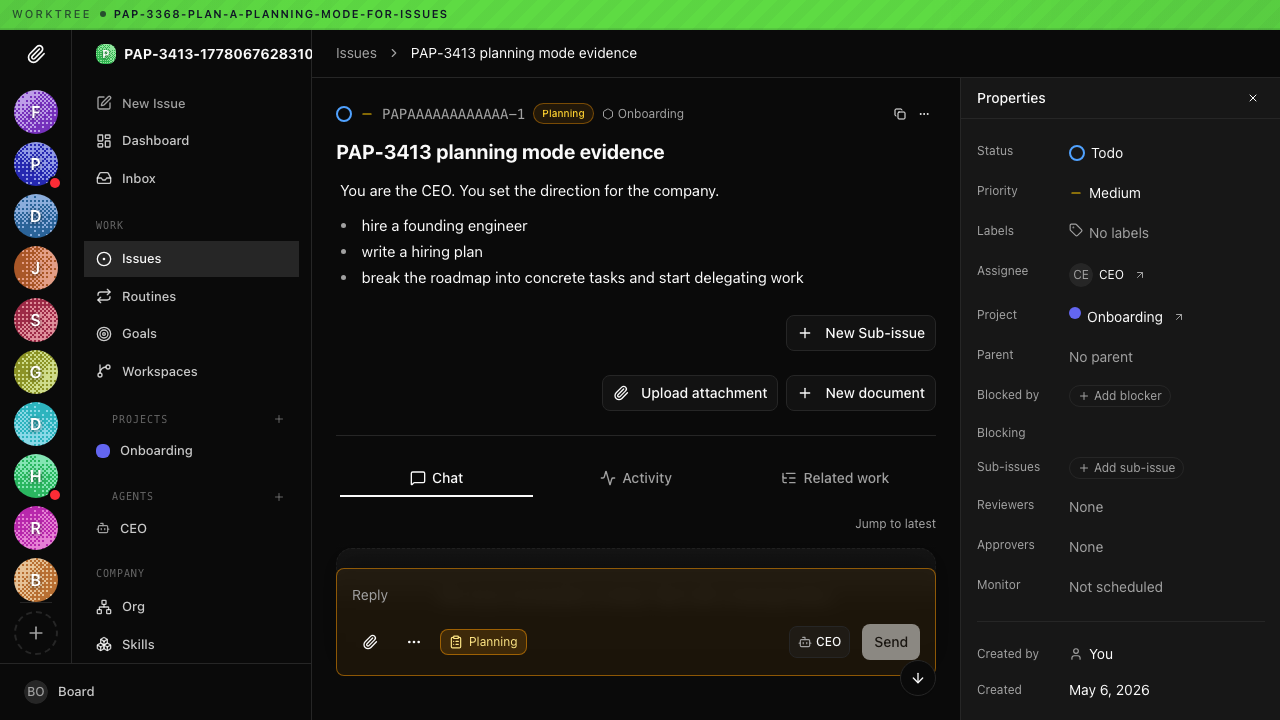 Desktop planning row: 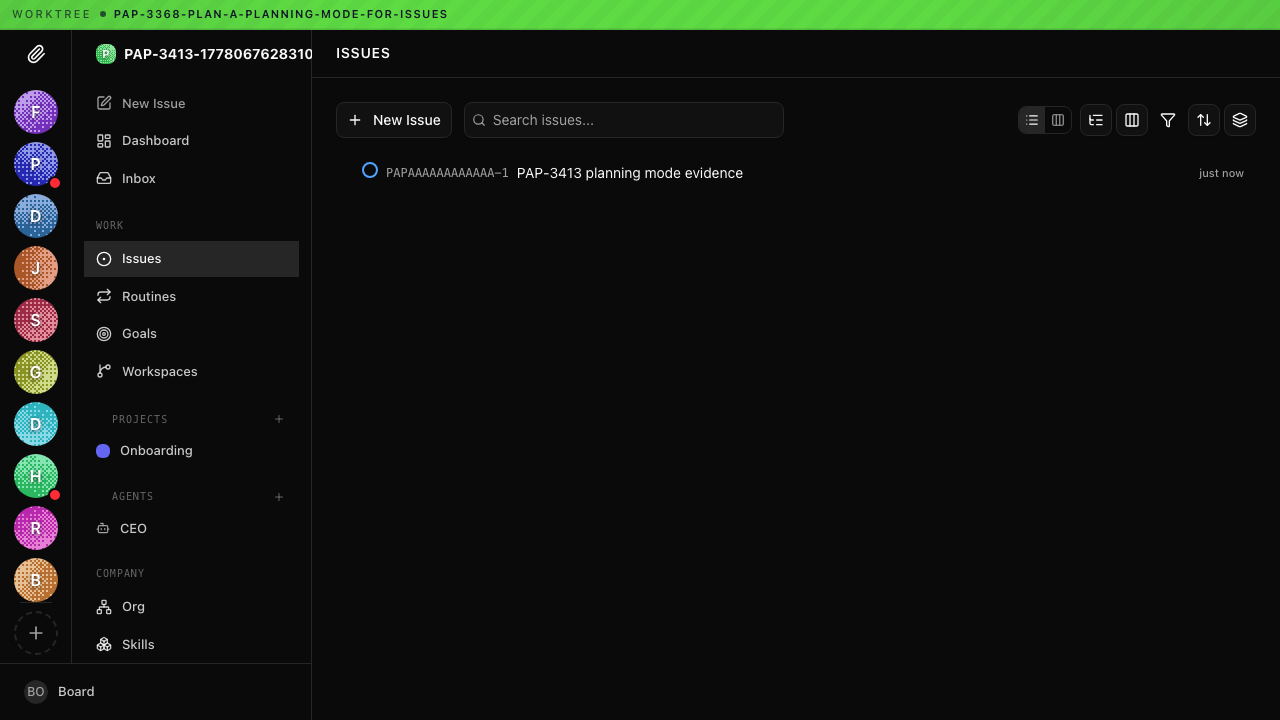 Desktop staged standard toggle: 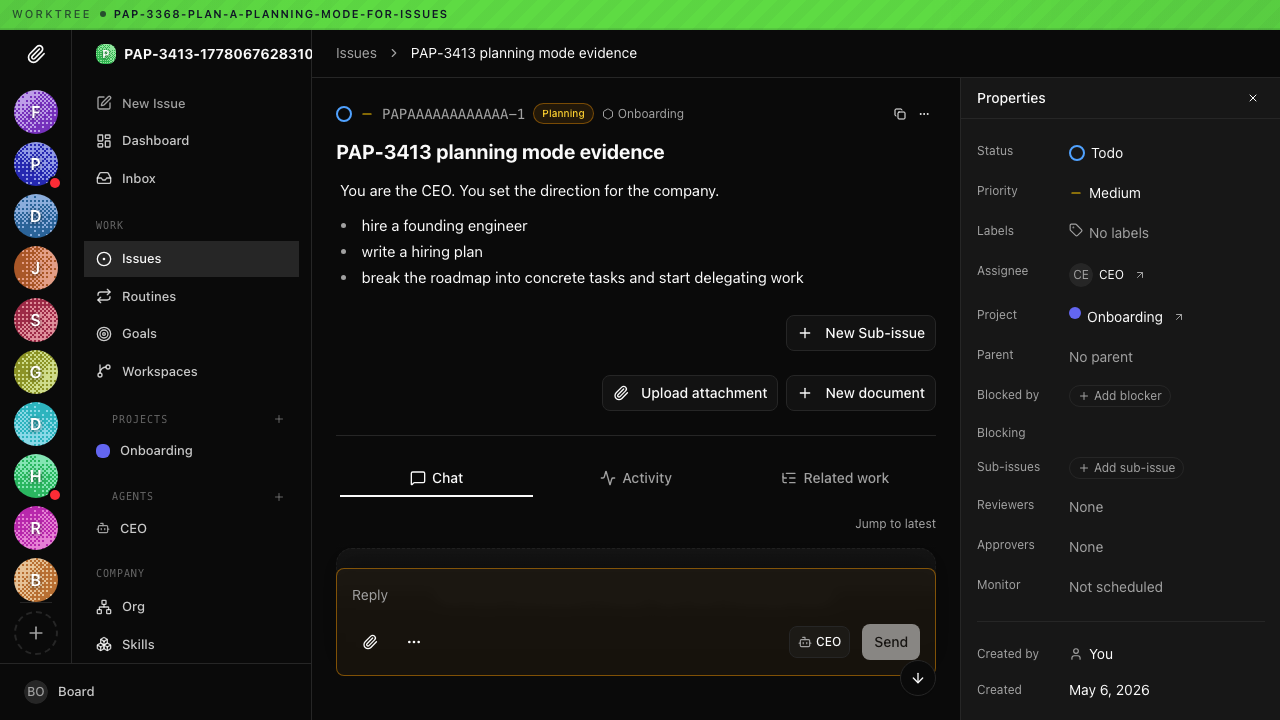 Mobile planning detail: 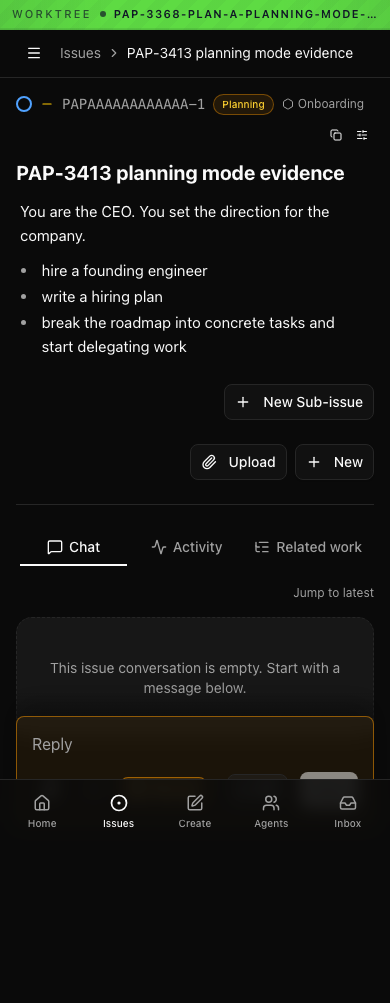 Mobile planning row: 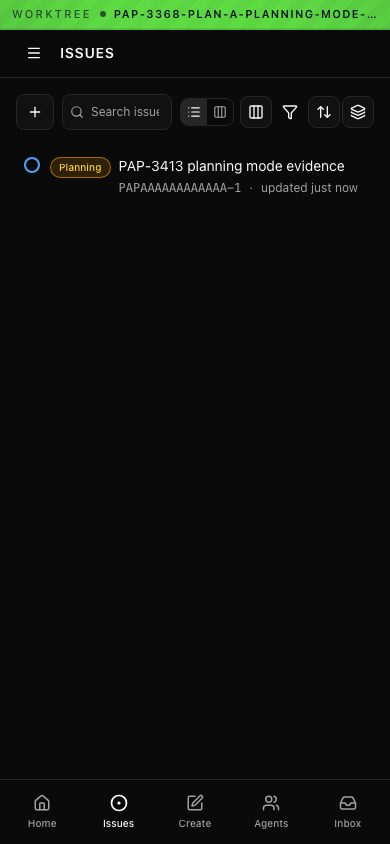 ## Risks - Medium migration risk: this adds a non-null issue column. The migration uses `ADD COLUMN IF NOT EXISTS` so installations that applied an older branch-local migration number can still apply the final numbered migration safely. - Medium contract risk: issue payloads, plugin payloads, and adapter heartbeat payloads now include work mode; compatibility is handled by defaulting missing values to `standard`. - UI risk is moderate because composer controls changed; focused component tests and visual e2e coverage exercise standard vs planning display and toggle behavior. > For core feature work, check [`ROADMAP.md`](ROADMAP.md) first and discuss it in `#dev` before opening the PR. Feature PRs that overlap with planned core work may need to be redirected — check the roadmap first. See `CONTRIBUTING.md`. ## Model Used - OpenAI Codex, GPT-5 coding agent in a local Paperclip worktree, with shell/tool use. Exact context-window size is not exposed in this runtime. ## Checklist - [x] I have included a thinking path that traces from project context to this change - [x] I have specified the model used (with version and capability details) - [x] I have checked ROADMAP.md and confirmed this PR does not duplicate planned core work - [x] I have run tests locally and they pass - [x] I have added or updated tests where applicable - [x] If this change affects the UI, I have included before/after screenshots - [x] I have updated relevant documentation to reflect my changes - [x] I have considered and documented any risks above - [x] I will address all Greptile and reviewer comments before requesting merge --------- Co-authored-by: Paperclip <noreply@paperclip.ing> |
||
|
Dotta
|
320fd5d23b |
Add full company search page (#5293)
## Thinking Path > - Paperclip orchestrates AI agents for zero-human companies. > - Operators need to find work, documents, agents, projects, comments, and activity across a company without jumping through separate surfaces. > - The existing Command-K flow was useful for fast navigation but not enough for deeper company-wide discovery. > - Search also needs company-scoped backend contracts, query cost controls, and indexed document matching so it stays safe as company data grows. > - This pull request adds a full company search API and a dedicated board search page that Command-K can hand off to. > - The benefit is a single searchable control-plane surface with richer result context, recents, highlights, and test coverage across server and UI behavior. ## What Changed - Added a company-scoped search endpoint/service with query validation, rate limiting, text matching, fuzzy title matching, and result typing shared through `@paperclipai/shared`. - Added idempotent search migrations for document search indexes and fuzzy matching support. - Added the full `/companies/:companyKey/search` UI, search result row components, highlighted snippets, recent searches, and sidebar/Command-K handoff. - Added Storybook coverage for search surfaces and Vitest coverage for server search behavior, rate limiting, route generation, Command-K behavior, and the search page. - Addressed Greptile findings by renaming the no-match SQL helper, applying search pagination after cross-type merge sorting, and lazy-initializing the default search service so unrelated route-test mocks do not need to know about it. - Merged current `public-gh/master` and renumbered the search migrations behind upstream `0078_white_darwin`: search indexes are now `0079_company_search_document_indexes` and fuzzy matching is `0080_company_search_fuzzystrmatch`. ## Verification - `git fetch public-gh master` - `git diff --check public-gh/master...HEAD` - `git diff --name-only public-gh/master...HEAD | rg '^pnpm-lock\.yaml$' || true` produced no output before opening the PR. - `pnpm run preflight:workspace-links && pnpm exec vitest run server/src/__tests__/company-search-service.test.ts server/src/__tests__/company-search-rate-limit-routes.test.ts ui/src/pages/Search.test.tsx ui/src/components/CommandPalette.test.tsx ui/src/lib/company-routes.test.ts` passed: 5 files, 25 tests. - `pnpm --filter @paperclipai/shared typecheck && pnpm --filter @paperclipai/db typecheck && pnpm --filter @paperclipai/server typecheck && pnpm --filter @paperclipai/ui typecheck` passed. - `pnpm exec vitest run server/src/__tests__/company-search-service.test.ts server/src/__tests__/company-search-rate-limit-routes.test.ts && pnpm --filter @paperclipai/server typecheck` passed after Greptile pagination fixes. - `pnpm exec vitest run server/src/__tests__/issue-agent-mutation-ownership-routes.test.ts server/src/__tests__/company-search-rate-limit-routes.test.ts server/src/__tests__/company-search-service.test.ts && pnpm --filter @paperclipai/server typecheck` passed after the CI mock fix. - After resolving the migration conflict with current `public-gh/master`: `pnpm --filter @paperclipai/db typecheck && pnpm exec vitest run server/src/__tests__/company-search-service.test.ts server/src/__tests__/company-search-rate-limit-routes.test.ts && pnpm --filter @paperclipai/server typecheck` passed. - DB migration numbering check passed as part of `@paperclipai/db` typecheck. - UI states are covered by the added Storybook stories in `ui/storybook/stories/search.stories.tsx`. - GitHub reports the PR merge state as `CLEAN` on head `18e54fa8`. - GitHub PR checks are green on head `18e54fa8`: policy, verify, serialized server shards 1/4 through 4/4, e2e, canary dry run, Snyk, and Greptile Review. ## Risks - Search ranking and snippets are new user-facing behavior, so reviewers should check whether result ordering feels right on real company data. - Search touches broad company data, so company scoping and query cost/rate-limit behavior should be reviewed carefully. - The migrations add search indexes/extensions; they are idempotent with `IF NOT EXISTS` for users who may have applied an earlier branch migration number. > ROADMAP.md checked. This PR adds a focused board search surface and does not duplicate an open roadmap item. ## Model Used - OpenAI Codex, GPT-5 coding agent, tool-enabled shell/git/GitHub CLI session with medium reasoning effort. Existing branch commits were produced across prior agent sessions; this packaging pass verified, opened the PR, addressed Greptile findings, resolved migration conflicts after upstream PRs landed, and got PR checks green. ## Checklist - [x] I have included a thinking path that traces from project context to this change - [x] I have specified the model used (with version and capability details) - [x] I have checked ROADMAP.md and confirmed this PR does not duplicate planned core work - [x] I have run tests locally and they pass - [x] I have added or updated tests where applicable - [x] If this change affects the UI, I have included before/after screenshots - [x] I have updated relevant documentation to reflect my changes - [x] I have considered and documented any risks above - [x] I will address all Greptile and reviewer comments before requesting merge --------- Co-authored-by: Paperclip <noreply@paperclip.ing> Co-authored-by: Claude Opus 4.7 <noreply@anthropic.com> |
||
|
Dotta
|
424e81d087 |
Improve operator workflow QoL (#5291)
## Thinking Path > - Paperclip is a control plane operators use repeatedly to supervise agent companies. > - Common operator workflows depend on fast scanning of inboxes, issue sidebars, workspaces, cost totals, and runtime services. > - Several small UI and service gaps made those workflows slower or less clear. > - This pull request groups the operator-facing QoL changes that can stand alone from recovery and adapter work. > - The benefit is a denser, clearer board experience for issue triage and workspace operation. ## What Changed - Added inbox assignee/project grouping and issue list token/runtime totals. - Improved issue properties with removable blocker chips and workspace task links. - Improved execution workspace layout, runtime controls, issues tab default, and stopped-port reuse behavior. - Added mobile markdown/routine dialog fixes, page title company names, sidebar polish, and dashboard run task label cleanup. ## Verification - `pnpm install --frozen-lockfile` - `pnpm exec vitest run ui/src/lib/inbox.test.ts ui/src/components/IssueProperties.test.tsx ui/src/components/WorkspaceRuntimeControls.test.tsx server/src/__tests__/workspace-runtime.test.ts server/src/__tests__/costs-service.test.ts` ## Risks - Medium UI risk because this touches several operator surfaces. The branch is intentionally grouped around workflow/QoL files and keeps the file count below the Greptile limit. ## Model Used - OpenAI GPT-5 Codex via Paperclip `codex_local` adapter, with shell/git/GitHub CLI tool use. ## Checklist - [x] I have included a thinking path that traces from project context to this change - [x] I have specified the model used (with version and capability details) - [x] I have checked ROADMAP.md and confirmed this PR does not duplicate planned core work - [x] I have run tests locally and they pass - [x] I have added or updated tests where applicable - [x] If this change affects the UI, I have included before/after screenshots - [x] I have updated relevant documentation to reflect my changes - [x] I have considered and documented any risks above - [x] I will address all Greptile and reviewer comments before requesting merge --------- Co-authored-by: Paperclip <noreply@paperclip.ing> |
||
|
Dotta
|
11ffd6f2c5 |
Improve ACPX adapter configuration (#5290)
## Thinking Path > - Paperclip orchestrates AI agents across several adapter implementations. > - ACPX is a local adapter path that can proxy Claude and Codex-style execution. > - Its configuration needed stronger schema defaults, provider-aware model handling, and better UI support. > - Plugin authors also need clear docs for managed resources. > - This pull request improves ACPX adapter configuration and documents plugin-managed resources. > - The benefit is a more predictable adapter setup path without changing unrelated control-plane behavior. ## What Changed - Improved ACPX config schema, execution config handling, UI build config, and route coverage. - Added ACPX model filtering support and tests. - Updated the agent config form and storybook coverage for ACPX model/provider behavior. - Expanded plugin authoring documentation for managed resources. ## Verification - `pnpm install --frozen-lockfile` - `pnpm exec vitest run server/src/__tests__/acpx-local-execute.test.ts server/src/__tests__/adapter-routes.test.ts ui/src/lib/acpx-model-filter.test.ts` ## Risks - Low-to-medium risk: adapter configuration behavior changes can affect ACPX users, but the change is isolated to ACPX/plugin-doc surfaces and covered by targeted adapter tests. ## Model Used - OpenAI GPT-5 Codex via Paperclip `codex_local` adapter, with shell/git/GitHub CLI tool use. ## Checklist - [x] I have included a thinking path that traces from project context to this change - [x] I have specified the model used (with version and capability details) - [x] I have checked ROADMAP.md and confirmed this PR does not duplicate planned core work - [x] I have run tests locally and they pass - [x] I have added or updated tests where applicable - [x] If this change affects the UI, I have included before/after screenshots - [x] I have updated relevant documentation to reflect my changes - [x] I have considered and documented any risks above - [x] I will address all Greptile and reviewer comments before requesting merge --------- Co-authored-by: Paperclip <noreply@paperclip.ing> |
||
|
Dotta
|
454edfe81e |
Add recovery handoff system notices (#5289)
## Thinking Path > - Paperclip orchestrates AI agents for zero-human companies. > - Agent runs can end productively while the source issue still lacks a durable final disposition. > - That leaves the control plane unsure whether to resume, escalate, or close the work. > - Issue comments also need a presentation contract so system-authored recovery notices can render as first-class thread messages without overloading normal comments. > - This pull request adds successful-run handoff recovery, comment presentation metadata, and system notice rendering. > - The benefit is stricter task liveness with clearer operator-facing recovery state. ## What Changed - Added successful-run handoff decisions, wake payloads, escalation behavior, and recovery tests. - Added issue comment presentation metadata with migration `0078_white_darwin.sql` and shared/server/company portability support. - Rendered recovery/system notices in issue chat with dedicated UI components, fixtures, tests, and storybook/lab coverage. - Included the current recovery model-profile hint patch so automatic recovery follow-ups use the cheap profile. ## Verification - `pnpm install --frozen-lockfile` - `pnpm exec vitest run server/src/services/recovery/successful-run-handoff.test.ts ui/src/components/SystemNotice.test.tsx ui/src/lib/system-notice-comment.test.ts ui/src/components/IssueChatThreadSystemNotice.test.tsx` ## Risks - Migration-bearing PR: merge this before any other branch that might later add a migration. - The branch touches both recovery services and issue-thread rendering, so review should pay attention to recovery wake idempotency and comment metadata compatibility. ## Model Used - OpenAI GPT-5 Codex via Paperclip `codex_local` adapter, with shell/git/GitHub CLI tool use. ## Checklist - [x] I have included a thinking path that traces from project context to this change - [x] I have specified the model used (with version and capability details) - [x] I have checked ROADMAP.md and confirmed this PR does not duplicate planned core work - [x] I have run tests locally and they pass - [x] I have added or updated tests where applicable - [x] If this change affects the UI, I have included before/after screenshots - [x] I have updated relevant documentation to reflect my changes - [x] I have considered and documented any risks above - [x] I will address all Greptile and reviewer comments before requesting merge --------- Co-authored-by: Paperclip <noreply@paperclip.ing> |
||
|
Devin Foley
|
83e7ecc58e |
Preserve scope on manual heartbeat invokes (#5323)
## Thinking Path > - Paperclip orchestrates AI agents for zero-human companies > - The agent live-run route lets operators trigger a manual heartbeat invocation so an agent can pick up a specific issue or step out of band > - The current route flow drops the caller's scope (issue/run context) when forwarding the manual invoke into the heartbeat service, so the resulting run loses the targeting the operator specified > - This pull request threads the operator-supplied scope through the manual invoke path on both the server route and the UI client, with a regression test that confirms the scope round-trips > - The benefit is manual heartbeat invokes from the live-run UI actually pick up the scoped issue/run instead of falling through to the agent's default routine ## What Changed - `server/src/routes/agents.ts`: forward the operator-supplied scope into the manual invoke heartbeat service call - `server/src/__tests__/agent-live-run-routes.test.ts`: new test verifying the manual invoke path preserves scope - `ui/src/api/agents.ts`: pass scope through the live-run client API ## Verification - `pnpm vitest run --no-coverage server/src/__tests__/agent-live-run-routes.test.ts` - `pnpm typecheck` clean ## Risks Low. The change is purely additive on the route surface — handlers that did not previously pass scope continue to work; handlers that did pass it now have it preserved instead of dropped. ## Model Used Claude Opus 4.7 (1M context) ## Checklist - [x] I have included a thinking path that traces from project context to this change - [x] I have specified the model used (with version and capability details) - [x] I have checked ROADMAP.md and confirmed this PR does not duplicate planned core work - [x] I have run tests locally and they pass - [x] I have added or updated tests where applicable — new test covers the preserved-scope path - [x] If this change affects the UI, I have included before/after screenshots — N/A (internal API change, no visible UI shift) - [x] I have updated relevant documentation to reflect my changes - [x] I have considered and documented any risks above - [x] I will address all Greptile and reviewer comments before requesting merge |
||
|
Dotta
|
d6d7a7cea6 |
Add routine revision history and restore flow (#5285)
## Thinking Path > - Paperclip is the control plane for autonomous AI companies. > - Routines are the scheduled/recurring work surface that keeps a company operating without manual kicks. > - Operators need routine edits to be auditable and recoverable, especially when routines control assignments, prompts, triggers, and webhook secrets. > - Documents already have revision-style safety, but routines did not have equivalent history or restore semantics. > - This pull request adds append-only routine revisions across the database, shared contracts, server routes, and board UI. > - The benefit is safer routine iteration: users can inspect history, compare changes, restore older definitions, and avoid overwriting newer edits. ## What Changed - Added `routine_revisions` storage, latest revision pointers on routines, shared types, validators, and API docs for routine revision history. - Added server service/route support for listing routine revisions, conflict-aware routine saves, and append-only restore operations. - Added a History tab on routine detail with revision preview, structured change summaries, description line diffs, dirty-edit blocking, restore confirmation, and restored webhook secret surfacing. - Extracted the line diff helper from `DocumentDiffModal` into `ui/src/lib/line-diff.ts` for reuse. - Rebased the branch onto current `public-gh/master` and renumbered the routine revision migration to `0077_unusual_karnak` after upstream `0076_useful_elektra`. - Made the `0077` routine revision migration idempotent so installs that already applied the branch-local `0076_unusual_karnak` can safely advance. - Updated the plugin SDK test harness routine fixture with the new revision fields required by the shared `Routine` contract. ## Verification - `pnpm --filter @paperclipai/db run check:migrations` passed. - `pnpm exec vitest run --project @paperclipai/shared packages/shared/src/validators/routine.test.ts` passed. - `pnpm exec vitest run --project @paperclipai/ui ui/src/lib/line-diff.test.ts ui/src/components/RoutineHistoryTab.test.tsx ui/src/lib/workspace-routines.test.ts ui/src/pages/Routines.test.tsx` passed. - `pnpm exec vitest run --project @paperclipai/server server/src/__tests__/routines-service.test.ts --pool=forks --poolOptions.forks.isolate=true` passed. - `pnpm exec vitest run --project @paperclipai/server server/src/__tests__/routines-routes.test.ts --pool=forks --poolOptions.forks.isolate=true` passed. - `pnpm --filter @paperclipai/plugin-sdk typecheck` passed after updating the SDK test harness fixture. - `pnpm --filter @paperclipai/plugin-sdk build` passed; this refreshed local generated SDK output needed by plugin example typechecks. - `pnpm -r typecheck` passed. ## Risks - Medium migration risk: this adds routine revision storage and backfills existing routines. The migration is ordered after upstream `0076` and uses `IF NOT EXISTS` / duplicate-object guards to tolerate earlier branch-local migration application. - Restore behavior intentionally appends a new revision instead of mutating history; callers expecting an in-place rollback need to follow the new latest revision pointer. - Restoring webhook triggers recreates webhook secret material, so users must copy newly surfaced secrets after restore. - Conflict-aware saves now reject stale routine edits when the client sends an older `baseRevisionId`. > For core feature work, check [`ROADMAP.md`](ROADMAP.md) first and discuss it in `#dev` before opening the PR. Feature PRs that overlap with planned core work may need to be redirected — check the roadmap first. See `CONTRIBUTING.md`. ## Model Used - OpenAI Codex, GPT-5-based coding agent, with shell/tool use in a local git worktree. Exact context-window size is not exposed in this runtime. ## Checklist - [x] I have included a thinking path that traces from project context to this change - [x] I have specified the model used (with version and capability details) - [x] I have checked ROADMAP.md and confirmed this PR does not duplicate planned core work - [x] I have run tests locally and they pass - [x] I have added or updated tests where applicable - [x] If this change affects the UI, I have included before/after screenshots - [x] I have updated relevant documentation to reflect my changes - [x] I have considered and documented any risks above - [x] I will address all Greptile and reviewer comments before requesting merge Screenshots: not attached in this draft PR; the new UI flow is covered by component tests listed above. --------- Co-authored-by: Paperclip <noreply@paperclip.ing> |
||
|
Devin Foley
|
5c2f9aba9d |
Run explicit-environment adapter tests on the requested target instead of falling back to the host (#5277)
## Thinking Path > - Paperclip orchestrates AI agents for zero-human companies > - When a user clicks "Test" on a configured environment (SSH or sandbox), the agent-test route exercises the adapter against that target > - The route previously fell back to running the probe on the Paperclip host whenever an explicit environment target couldn't be resolved, with the test report still saying "passed" > - That hid two real failure modes: misconfigured environments looked green, and sandbox environments were never actually exercised > - This pull request acquires an ad-hoc lease and realizes a workspace for sandbox/plugin test environments, resolves a sandbox execution target wired to the environment runtime, and returns synthesized diagnostics instead of running a host probe when an explicit env target can't be resolved > - The benefit is the Test action surfaces the real environment state and never silently exercises the wrong machine ## What Changed - `server/routes/agents.ts`: acquire an ad-hoc lease and realize a workspace for sandbox/plugin test environments; resolve a sandbox execution target wired to the environment runtime - Return synthesized diagnostics (no host fallback) when an explicit env target can't be resolved - `server/services/environment-runtime.ts`: small adjustments to support the explicit-env-target case - Clarify test-route messages so they no longer claim a host fallback in explicit env flows - New `agent-test-environment-routes.test.ts` covers the guard and missing-environment path ## Verification - `pnpm vitest run --no-coverage server/src/__tests__/agent-test-environment-routes.test.ts` - `pnpm typecheck` clean - Manual: a deliberately misconfigured sandbox environment now reports diagnostics instead of a misleading host-pass ## Risks Medium — Test route behavior change. Explicit environments that previously appeared to pass via host fallback will now report their real state. This is the desired behavior, but operators should expect to see new failures for environments that were never actually working. ## Model Used Claude Opus 4.7 (1M context) ## Checklist - [x] I have included a thinking path that traces from project context to this change - [x] I have specified the model used (with version and capability details) - [x] I have checked ROADMAP.md and confirmed this PR does not duplicate planned core work - [x] I have run tests locally and they pass - [x] I have added or updated tests where applicable — new tests cover guard + missing-env paths - [x] If this change affects the UI, I have included before/after screenshots — N/A (no UI) - [x] I have updated relevant documentation to reflect my changes - [x] I have considered and documented any risks above - [x] I will address all Greptile and reviewer comments before requesting merge |
||
|
Devin Foley
|
ea7f53fd7d |
Handle Gemini CLI v0.38 stream-json wire format across parser, UI, and CLI formatter (#5273)
## Thinking Path > - Paperclip orchestrates AI agents for zero-human companies > - Each agent uses an adapter that drives a CLI (Claude, Gemini, Codex, etc.) > - The Gemini adapter parses a JSONL transcript stream the CLI emits to learn what the model said > - Gemini CLI v0.38 changed the transcript shape: assistant text now comes through `type=message` with `role`/`content` and terminal status comes through `type=status` / `type=stats` > - The existing parser was written against the older `type=assistant` / `type=result` shape, so post-v0.38 outputs left the parsed summary empty and downgraded the SSH hello probe to "unexpected output" > - This pull request updates every Gemini consumer (server parser, UI parser, CLI formatter) to accept the v0.38 shape while keeping the legacy shape working > - The benefit is the Gemini adapter handles current upstream output without losing backward compatibility, with explicit test coverage for both shapes ## What Changed - `packages/adapters/gemini-local/src/server/parse.ts` recognizes `type=message` events with role/content and stops downgrading them - `packages/adapters/gemini-local/src/ui/parse-stdout.ts` mirrors the parser changes for the live UI transcript - `packages/adapters/gemini-local/src/cli/format-event.ts` formats the new event shape correctly for CLI output - `parse.test.ts` and `parse-stdout.test.ts` add v0.38 coverage; `gemini-local-adapter.test.ts` and `execute.remote.test.ts` switch happy-path fixtures to the current real wire format and keep dedicated tests for the older schema ## Verification - `pnpm vitest run --no-coverage --project @paperclipai/adapter-gemini-local` — full suite passes including new v0.38 cases and preserved legacy cases - `pnpm typecheck` clean ## Risks Low risk — additive event handling. Legacy event shape path is preserved with its own tests, so existing fixtures continue to parse identically. ## Model Used Claude Opus 4.7 (1M context) ## Checklist - [x] I have included a thinking path that traces from project context to this change - [x] I have specified the model used (with version and capability details) - [x] I have checked ROADMAP.md and confirmed this PR does not duplicate planned core work - [x] I have run tests locally and they pass - [x] I have added or updated tests where applicable - [x] If this change affects the UI, I have included before/after screenshots — N/A (no UI) - [x] I have updated relevant documentation to reflect my changes - [x] I have considered and documented any risks above - [x] I will address all Greptile and reviewer comments before requesting merge |
||
|
Dotta
|
3c73ed26b5 |
Expand plugin host surface (#5205)
## Thinking Path > - Paperclip orchestrates AI agents for zero-human companies > - The plugin system is the extension boundary for optional product capabilities > - Rich plugins need more than a worker entrypoint: they need scoped database storage, local project folders, managed agents/routines, host navigation, and reusable UI components > - The LLM Wiki work exposed those missing host surfaces while keeping plugin code outside the core control plane > - This pull request expands the core plugin host, SDK, server APIs, and UI bridge so plugins can declare and use those surfaces > - The benefit is that future plugins can integrate with Paperclip through documented, validated contracts instead of bespoke server or UI imports ## What Changed - Added plugin-managed database namespaces and migration tracking, including Drizzle schema/migration files and SQL validation for namespace isolation. - Added server support for plugin local folders, managed agents, managed routines, scoped plugin APIs, and plugin operation visibility. - Expanded shared plugin manifest/types/validators and SDK host/testing/UI exports for richer plugin surfaces. - Added reusable UI pieces for file trees, managed routines, resizable sidebars, route sidebars, and plugin bridge initialization. - Updated plugin docs and example plugins to use the expanded host and SDK surface. ## Verification - `pnpm install --frozen-lockfile` - `pnpm run preflight:workspace-links && pnpm exec vitest run packages/shared/src/validators/plugin.test.ts server/src/__tests__/plugin-database.test.ts server/src/__tests__/plugin-local-folders.test.ts server/src/__tests__/plugin-managed-agents.test.ts server/src/__tests__/plugin-managed-routines.test.ts server/src/__tests__/plugin-orchestration-apis.test.ts ui/src/api/plugins.test.ts ui/src/components/FileTree.test.tsx ui/src/components/ResizableSidebarPane.test.tsx ui/src/pages/PluginPage.test.tsx ui/src/plugins/bridge.test.ts` passed: 11 files, 67 tests. - Confirmed this PR changes 89 files and does not include `pnpm-lock.yaml` or `.github/workflows/*`. ## Risks - Medium: this expands plugin host contracts across db/shared/server/ui and includes a new core migration (`0076_useful_elektra.sql`). - The plugin database namespace validator is intentionally restrictive; plugin authors may need follow-up affordances for SQL patterns that remain blocked. - Merge this before the LLM Wiki plugin PR so the plugin can resolve the new SDK and host APIs. > For core feature work, check [`ROADMAP.md`](ROADMAP.md) first and discuss it in `#dev` before opening the PR. Feature PRs that overlap with planned core work may need to be redirected — check the roadmap first. See `CONTRIBUTING.md`. ## Model Used - OpenAI Codex, GPT-5 coding agent, tool-enabled shell/git/GitHub workflow. Context window size was not exposed by the runtime. ## Checklist - [x] I have included a thinking path that traces from project context to this change - [x] I have specified the model used (with version and capability details) - [x] I have checked ROADMAP.md and confirmed this PR does not duplicate planned core work - [x] I have run tests locally and they pass - [x] I have added or updated tests where applicable - [x] If this change affects the UI, I have included before/after screenshots - [x] I have updated relevant documentation to reflect my changes - [x] I have considered and documented any risks above - [x] I will address all Greptile and reviewer comments before requesting merge --------- Co-authored-by: Paperclip <noreply@paperclip.ing> |
||
|
Dotta
|
d6bee62f02 |
Fix Cloud tenant issue identifier routes (#5196)
## Summary - Allow Cloud tenant issue identifiers with alphanumeric prefixes, such as `PC1897-1`, to normalize as issue references. - Resolve those identifiers through issue detail/update routes, active run/live run polling, activity, costs, and `issueService.getById`. - Keep UI issue-link parsing aligned so tenant links normalize back to `/issues/<IDENTIFIER>`. ## Root Cause Cloud tenant issue prefixes include digits from the stack-id hash. The app-side route normalization still accepted only all-letter prefixes, so `/api/issues/PC1897-1` skipped identifier lookup and fell through as a non-UUID id. ## Verification - `pnpm exec vitest run packages/shared/src/issue-references.test.ts ui/src/lib/issue-reference.test.ts server/src/__tests__/issue-identifier-routes.test.ts server/src/__tests__/activity-routes.test.ts server/src/__tests__/costs-service.test.ts server/src/__tests__/agent-live-run-routes.test.ts server/src/__tests__/issues-service.test.ts` - `pnpm --filter @paperclipai/shared typecheck && pnpm --filter @paperclipai/server typecheck` - `git diff --check` Co-authored-by: Paperclip <noreply@paperclip.ing> |
||
|
Dotta
|
ae23e02526 |
Support Cloud tenant identity bootstrap
Co-Authored-By: Paperclip <noreply@paperclip.ing> |
||
|
Devin Foley
|
29401b231b |
fix(ci): gate new release packages on npm bootstrap (#5146)
## Thinking Path > - Paperclip is a control plane for autonomous agent companies, so its release automation is part of the core operator trust boundary. > - The affected subsystem is npm/GitHub Actions release publishing for the public monorepo packages. > - The concrete failure was that a newly added package reached `master`, the canary workflow attempted its first publish, and npm trusted publishing was not yet bootstrapped for that package. > - That means the problem is not just one broken run; it is a missing pre-merge guard that lets release-ineligible packages land and only fail once `publish_canary` runs. > - This pull request makes release enrollment explicit, validates that enrollment in CI, and adds a PR-time bootstrap check against npm for changed release-enabled package manifests. > - The result is that we keep trusted publishing, avoid teaching CI to `npm adduser`, and move this class of failure from post-merge canary time to pre-merge review time. ## What Changed - Added `scripts/release-package-manifest.json` so release-managed public packages are explicitly enrolled instead of being inferred from every non-private workspace package. - Hardened `scripts/release-package-map.mjs` to validate the manifest before release workflows rewrite versions or assemble publish payloads. - Added `scripts/check-release-package-bootstrap.mjs` and wired it into `.github/workflows/pr.yml` so PRs that change a release-enabled package manifest fail if that package does not already exist on npm. - Added release-package manifest coverage tests to `scripts/release-package-map.test.mjs` and included them in `pnpm run test:release-registry`. - Wired manifest validation into `.github/workflows/release.yml` and documented the first-publish bootstrap policy in `doc/PUBLISHING.md` and `doc/RELEASE-AUTOMATION-SETUP.md`. ## Verification - `pnpm run test:release-registry` - `./scripts/release.sh canary --skip-verify --dry-run` - Confirmed the committed diff contains no obvious PII/secrets via targeted pattern scan before pushing. ## Risks - Low risk overall: this is CI/release-policy code, not product runtime logic. - The new PR bootstrap check depends on npm metadata availability, so a transient npm outage could block a PR that changes a release-enabled package manifest. - The manifest introduces a new source of truth that must stay aligned with public package additions, but that is intentional and now enforced. ## Model Used - OpenAI Codex via the `codex_local` Paperclip adapter; GPT-5-based coding agent with tool use, terminal execution, git, and GitHub CLI. Exact served model ID/context window are not exposed by the local runtime. ## Checklist - [x] I have included a thinking path that traces from project context to this change - [x] I have specified the model used (with version and capability details) - [x] I have checked ROADMAP.md and confirmed this PR does not duplicate planned core work - [x] I have run tests locally and they pass - [x] I have added or updated tests where applicable - [x] If this change affects the UI, I have included before/after screenshots - [x] I have updated relevant documentation to reflect my changes - [x] I have considered and documented any risks above - [x] I will address all Greptile and reviewer comments before requesting merge |
||
|
Devin Foley
|
90631b09b3 |
Let adapters declare runtime command spec for remote provisioning (#5141)
## Thinking Path

> - Paperclip orchestrates AI agents for zero-human companies, running
adapter
> commands like `claude`, `codex`, `pi` either locally or on remote
runtimes
>   (SSH hosts, sandboxes, etc.)
> - On a fresh remote runtime — particularly an ephemeral sandbox — the
> adapter's CLI may not be installed yet. Today operators handle this
via
> external configuration (e.g. a project-level `provisionCommand` shell
> script) that has to know about every adapter the operator might want
to use
> - This means every adapter has its own well-known npm package, but
operators
>   end up writing duplicate provision shell scripts that paste together
> `npm install -g @anthropic-ai/claude-code`, `npm install -g
@openai/codex`,
>   etc. — knowledge the adapter itself already has
> - This PR moves that knowledge into the adapter modules: each adapter
declares
> how its runtime command should be detected and (if applicable)
installed
> via `getRuntimeCommandSpec(config)`. The execution path runs the
adapter's
> own install command on remote sandbox targets before launching, so a
fresh
> sandbox bootstraps itself instead of requiring a hand-written
provision script
> - The benefit is fewer footguns for operators provisioning remote
runtimes,
>   and a clean place for new adapters to plug in their install recipe

## What Changed

- New types in `packages/adapter-utils/src/types.ts`:
    - `AdapterRuntimeCommandSpec` describing `command`, optional
      `detectCommand`, and optional `installCommand`
    - Optional `getRuntimeCommandSpec(config)` on `ServerAdapterModule`
- Optional `runtimeCommandSpec` on `AdapterExecutionContext` so adapters
      receive the resolved spec at execute time
- New helper `ensureAdapterExecutionTargetRuntimeCommandInstalled(...)`
in
`packages/adapter-utils/src/execution-target.ts` that runs the install
command
on remote targets when `transport === "sandbox"`. SSH and local targets
are
  no-ops. Throws on timeout or non-zero exit so failures surface early.
- Each of `claude-local`, `codex-local`, `cursor-local`, `gemini-local`,
  `opencode-local`, `pi-local`'s `execute.ts` now reads
`ctx.runtimeCommandSpec?.installCommand` and calls the helper before
launching
  the adapter command.
- `server/src/adapters/registry.ts` declares `getRuntimeCommandSpec` for
each
  adapter:
- claude/codex/gemini/opencode/pi-local: `npm install -g <package>`
recipe via
a shared `buildNpmRuntimeCommandSpec` helper, with a defensive guard
that
only auto-installs when the configured `command` matches the well-known
      fallback (custom binaries are left alone).
- cursor-local: declares `command` only; no auto-install (no public npm
      package), preserving the existing manual setup.
- `server/src/services/heartbeat.ts` resolves the spec via
`adapter.getRuntimeCommandSpec?.(runtimeConfig)` and passes it through
to
  `AdapterExecutionContext`.
- Tests added in `execution-target.test.ts` (~75 lines), e2b
`plugin.test.ts` (~32 lines), and `environment-run-orchestrator.test.ts`
  (~76 lines).

## Verification

- `pnpm --filter @paperclipai/adapter-utils test`
- `pnpm --filter @paperclipai/server test --
environment-run-orchestrator`
- `pnpm --filter @paperclipai/sandbox-providers-e2b test`
- Manual QA: run an adapter (claude/codex/etc.) against a fresh
sandbox-backed
environment that does NOT have the adapter CLI pre-installed. Confirm
the
install runs once at the start of the agent run and the adapter then
launches
successfully. Re-run on the same sandbox; confirm the install command is
  idempotent and the second run starts faster.
- Confirm SSH and local execution paths are unaffected (gated by
  `transport === "sandbox"`).

## Risks

- Behavioural shift on sandbox runs: a new install step now runs at the
start
  of every sandbox agent run for adapters with `installCommand` set. The
install commands are idempotent (`if ! command -v X >/dev/null 2>&1;
then
npm install -g <pkg>; fi`), so this is fast on warm sandboxes. On a cold
  sandbox, the first run takes longer.
- Operators who used the legacy project-level `provisionCommand` to
install
adapter CLIs can drop that part of their script; the adapter handles it
now.
  Existing scripts continue to work — installs are idempotent.
- The cursor-local adapter has no auto-install (no public npm package).
  Behaviour for cursor-local on sandboxes is unchanged.
- New optional surface on `ServerAdapterModule`. Plugins that don't
implement
  `getRuntimeCommandSpec` retain previous behaviour (no auto-install).

## Model Used

- OpenAI GPT-5.4 (reasoning effort: high) via Codex CLI
- Provider: OpenAI
- Used to author the code changes in this PR

## Checklist

- [x] I have included a thinking path that traces from project context
to this change
- [x] I have specified the model used (with version and capability
details)
- [x] I have checked ROADMAP.md and confirmed this PR does not duplicate
planned core work
- [x] I have run tests locally and they pass
- [x] I have added or updated tests where applicable
- [ ] If this change affects the UI, I have included before/after
screenshots — N/A
- [ ] I have updated relevant documentation to reflect my changes — N/A
- [x] I have considered and documented any risks above
- [x] I will address all Greptile and reviewer comments before
requesting merge
|
||
|
Devin Foley
|
0e51fa2b0d |
Honor reuse-existing preference and assignee default environment in issue runs (#5139)
## Thinking Path > - Paperclip orchestrates AI agents for zero-human companies > - Agents run inside execution workspaces (a per-issue cwd + env), and an issue > can prefer to reuse an existing workspace or get a fresh one each time > - The heartbeat service was reading the existing workspace's config to derive > environment selection regardless of whether the issue actually wanted to reuse > it. So fresh-run issues were inheriting stale config from a workspace that was > about to be discarded > - Separately, when an issue is assigned to an agent, the issue's execution > workspace settings weren't picking up the agent's `defaultEnvironmentId`, > even though the agent's choice is the natural default for that issue > - This PR makes both selection paths honor the obvious source of truth: > workspace config flows only when the issue actually wants `reuse_existing`, > and the assignee agent's default environment is applied at assignment time if > nothing else is set on the issue > - The benefit is that re-running a flaky issue picks up the right environment > instead of inheriting the previous run's config, and assigning an agent to an > issue does the obvious thing without operator intervention ## What Changed - `server/src/services/heartbeat.ts`: introduce `reusableExecutionWorkspaceConfig` that is non-null only when `shouldReuseExisting` is true. Both `resolveExecutionWorkspaceEnvironmentId(...)` and `applyPersistedExecutionWorkspaceConfig(...)` now read from it instead of unconditionally consulting `existingExecutionWorkspace?.config`. Fresh-run issues no longer inherit stale environment config from an in-flight workspace about to be discarded. - `server/src/services/issues.ts`: when an issue update sets a new `assigneeAgentId` and isolated workspaces are enabled, populate `executionWorkspaceSettings.environmentId` from the assignee agent's `defaultEnvironmentId` if the issue doesn't have an explicit `environmentId` set yet. - Tests added in `heartbeat-plugin-environment.test.ts` (~216 lines) and `issues-service.test.ts` (~85 lines) covering both paths. ## Verification - `pnpm --filter @paperclipai/server test -- heartbeat-plugin-environment issues-service` - Manual QA: assign an issue to an agent that has a non-default `defaultEnvironmentId`, confirm the issue's workspace settings now include that environment id without operator intervention. Trigger a rerun on an issue whose existing workspace points at a stale environment, confirm the rerun uses the freshly-resolved environment. ## Risks - Behavioural shift on assignment: previously assigning an agent didn't propagate the agent's default environment to the issue. Now it does. Callers that explicitly want the issue to keep its existing/null environment must set `executionWorkspaceSettings.environmentId` themselves; the new logic only fires when no explicit value is set. - Behavioural shift on rerun: stale workspace config is no longer applied to fresh runs. Operators who relied on this implicit inheritance may see different environment selection on the first rerun after deploy. Mitigation: the explicit isssue settings and project policy are still honored as before. ## Model Used - OpenAI GPT-5.4 (reasoning effort: high) via Codex CLI - Provider: OpenAI - Used to author the code changes in this PR ## Checklist - [x] I have included a thinking path that traces from project context to this change - [x] I have specified the model used (with version and capability details) - [x] I have checked ROADMAP.md and confirmed this PR does not duplicate planned core work - [x] I have run tests locally and they pass - [x] I have added or updated tests where applicable - [ ] If this change affects the UI, I have included before/after screenshots — N/A (no UI changes) - [ ] I have updated relevant documentation to reflect my changes — N/A - [x] I have considered and documented any risks above - [x] I will address all Greptile and reviewer comments before requesting merge |
||
|
Devin Foley
|
bb7d040894 |
Switch OpenCode to explicit static/local-aware model selection (#5117)
> **Stacked PR (part 4 of 7).** Depends on: - PR #5114 - PR #5115 - PR #5116 > Diff against `master` includes commits from earlier PRs in the stack — the new commit in this PR is the topmost one. ## Thinking Path > - Paperclip orchestrates AI agents for zero-human companies > - When creating an OpenCode-local agent, Paperclip currently validates > `adapterConfig.model` against the *Paperclip host's* `opencode models` output > - SSH testing surfaced that this blocks creating an OpenCode agent for an SSH > environment: the model that exists on the SSH target isn't visible to the > host, so creation fails with "OpenCode requires `adapterConfig.model` in > provider/model format" even when the operator picked a real remote model > - The initial direction was environment-aware model discovery; the final > decision was to keep OpenCode on the same explicit-model pattern as other > adapters (default + curated list + manual override) and stop blocking > creation on host-side discovery > - This PR does both: the adapter-models endpoint now accepts `environmentId` and > probes against the target environment, and the create-time hard gate is > replaced by `requireOpenCodeModelId` which validates `provider/model` *format* > without requiring host-local discovery. Test/run-time still surfaces real > auth/availability problems > - The benefit is that operators can create OpenCode agents for remote > environments without out-of-band setup, and the model picker in the UI > reflects the actually-targeted environment ## What Changed - Added `requireOpenCodeModelId(input)` in `opencode-local/src/server/models.ts`, exported it from the adapter index - `ensureOpenCodeModelConfiguredAndAvailable` now delegates the format check to `requireOpenCodeModelId` - `agentsApi.adapterModels(companyId, adapterType, { environmentId })` now accepts an environment ID and passes it as a query parameter - `queryKeys.agents.adapterModels` now keys on `(companyId, adapterType, environmentId)` - `server/src/routes/agents.ts` reads and validates the new query parameter, forwarding it to the adapter's model probe - `AgentConfigForm.tsx` and `OnboardingWizard.tsx` build the model query key from the currently selected default environment ID and disable autodetect for `opencode_local` (model selection is explicit) - `NewAgent.tsx` simplified — no longer special-cases OpenCode autodetect - `company-portability.ts` no longer needs OpenCode-specific autodetect handling - Tests added/updated: `adapter-model-refresh-routes.test.ts`, `adapter-models.test.ts`, `agent-permissions-routes.test.ts`, `opencode-local/src/server/models.test.ts` ## Verification - `pnpm --filter @paperclipai/server test -- adapter-models adapter-model-refresh agent-permissions` - `pnpm --filter @paperclipai/adapter-opencode-local test` - `pnpm --filter @paperclipai/ui test -- AgentConfigForm OnboardingWizard NewAgent` - Manual QA in browser: 1. Boot Paperclip on Tailscale-bound port (so it's reachable from another machine), create an OpenCode-local agent, switch the default environment between two installed sandboxes, and confirm the model list refreshes per-environment 2. Submit with a malformed `provider/model` string and verify the new `requireOpenCodeModelId` error surfaces - Before/after screenshots attached for `AgentConfigForm` model picker ## Risks - Behavioural shift: switching default environment now triggers a model refetch. Should be cheap but introduces a new UI loading state for OpenCode users. - Removing dynamic autodetect for OpenCode: if any user configured an agent without specifying `model` and relied on autodetect populating it, that agent will now fail at submit time. Mitigation: validation error is explicit and actionable. - New query string parameter on `/api/companies/:id/adapter-models` — older clients that omit it still work (parameter is optional and defaults to null). ## Model Used - OpenAI GPT-5.4 (reasoning effort: high) via Codex CLI - Provider: OpenAI - Used to author the code changes in this PR ## Checklist - [x] I have included a thinking path that traces from project context to this change - [x] I have specified the model used (with version and capability details) - [x] I have checked ROADMAP.md and confirmed this PR does not duplicate planned core work - [x] I have run tests locally and they pass - [x] I have added or updated tests where applicable - [x] If this change affects the UI, I have included before/after screenshots - [ ] I have updated relevant documentation to reflect my changes — N/A - [x] I have considered and documented any risks above - [x] I will address all Greptile and reviewer comments before requesting merge |
||
|
Devin Foley
|
076067865f |
Migrate SSH environment callback to bridge (#5116)
> **Stacked PR (part 3 of 7).** Depends on: - PR #5114 - PR #5115 > Diff against `master` includes commits from earlier PRs in the stack — the new commit in this PR is the topmost one. ## Thinking Path > - Paperclip orchestrates AI agents for zero-human companies > - Agents executing on a remote SSH-backed environment need a way to call back into > the Paperclip control plane (run events, log streaming, signals) > - When the SSH host can't reach the Paperclip host (NAT, firewalls, or simply not > on the same network), the run silently fails or hangs — a recurring class of > failure during SSH testing > - In sandboxed environments we already solved this with a callback bridge that > tunnels back through the existing connection; SSH was the odd one out > - This PR migrates SSH execution to use the same callback bridge, so every > adapter's remote run uses one consistent reverse-channel. Per-adapter SSH glue > is deleted in favour of a shared `CommandManagedRuntimeRunner` built from the > SSH spec > - The benefit is fewer SSH-specific failure modes, a smaller code surface, and > one place to evolve the callback contract going forward ## What Changed - Added `createSshCommandManagedRuntimeRunner` in `packages/adapter-utils/src/ssh.ts` that adapts an SSH spec into a generic command-managed-runtime runner (with cwd, env, and timeout handling) - Removed `paperclipApiUrl` from `SshRemoteExecutionSpec`; the bridge URL now flows through the shared runner - Reworked `execution-target.ts` to use the SSH runner alongside sandbox runners via a unified `CommandManagedRuntimeRunner` interface - Simplified `remote-managed-runtime.ts` and `sandbox-managed-runtime.ts` to consume the shared runner abstraction - Deleted per-adapter SSH callback wiring from claude-local, codex-local, cursor-local, gemini-local, opencode-local, pi-local execute.ts files - Removed `environment-runtime-driver-contract.test.ts` (the contract is now enforced by `environment-execution-target.test.ts`) - Added/updated `execute.remote.test.ts` cases for each adapter to cover the SSH runner path ## Verification - `pnpm --filter @paperclipai/adapter-utils test` - `pnpm test -- execute.remote` (covers all six local adapters' SSH paths) - Manual QA: ran a claude-local agent against an SSH-backed environment, confirmed the agent successfully called back to `/api/agent-callback/*` endpoints during the run ## Risks - Refactor touches all six local adapters. If any adapter had subtle SSH-specific behaviour that wasn't captured in tests, it could regress. Mitigation: each adapter's `execute.remote.test.ts` was extended. - `paperclipApiUrl` removal from `SshRemoteExecutionSpec` is a breaking type change for any internal consumer. Verified no external plugins consume this type. - The new `CommandManagedRuntimeRunner` shape is a public surface in `@paperclipai/adapter-utils`; downstream plugins implementing custom runners may need updates, but no such plugins exist in this repo. ## Model Used - OpenAI GPT-5.4 (reasoning effort: high) via Codex CLI - Provider: OpenAI - Used to author the code changes in this PR ## Checklist - [x] I have included a thinking path that traces from project context to this change - [x] I have specified the model used (with version and capability details) - [x] I have checked ROADMAP.md and confirmed this PR does not duplicate planned core work - [x] I have run tests locally and they pass - [x] I have added or updated tests where applicable - [ ] If this change affects the UI, I have included before/after screenshots — N/A - [ ] I have updated relevant documentation to reflect my changes — N/A - [x] I have considered and documented any risks above - [x] I will address all Greptile and reviewer comments before requesting merge |
||
|
Devin Foley
|
a7b45938b7 |
Let sandbox providers declare shell defaults (#5114)
## Thinking Path

> - Paperclip orchestrates AI agents for zero-human companies
> - Agents execute in sandboxed remote environments served by pluggable
sandbox
>   providers (E2B today, more later)
> - Today every sandbox command runs under `sh -lc` regardless of what
the
>   provider's container actually ships
> - That misses bash-only shell init on E2B (which ships bash) and
prevents
> future providers from declaring a different default — there's no way
for a
>   provider to say "I have bash, use it"
> - This PR adds a `shellCommand` field to sandbox execution targets so
providers
> can declare their preferred shell ("bash" for E2B), threads it through
the
> sandbox-managed-runtime client, callback bridge, and execution-target
shell
>   helper, and validates the value at the lease-metadata boundary
> - The benefit is that sandbox commands run under the right shell on
the right
> provider, and adding new sandbox providers only needs to declare a
shell
>   preference

## What Changed

- Added `packages/adapter-utils/src/sandbox-shell.ts` exporting
`preferredShellForSandbox(shellCommand)` (returns `"bash"` if input is
`"bash"`,
  else `"sh"`)
- Added `shellCommand?: "bash" | "sh" | null` to
`AdapterSandboxExecutionTarget`
  and `CommandManagedRuntimeSpec`; threaded it through
`runAdapterExecutionTargetShellCommand`,
`prepareAdapterExecutionTargetRuntime`,
  and `startAdapterExecutionTargetPaperclipBridge`
- `createCommandManagedRuntimeClient`, `prepareCommandManagedRuntime`,
and
`createCommandManagedSandboxCallbackBridgeQueueClient` now take an
optional
  `shellCommand` and use `preferredShellForSandbox` to pick the shell
- `startSandboxCallbackBridgeServer` accepts a `shellCommand` for its
server
  startup, readiness probe, and stop hook
- E2B sandbox plugin declares `shellCommand: "bash"` in `leaseMetadata`
- `resolveEnvironmentExecutionTarget` reads `shellCommand` from lease
metadata
  (validating against `"bash" | "sh" | null`)
- `environment-runtime.ts` adds `"shellCommand"` to
`INTERNAL_PLUGIN_SANDBOX_CONFIG_KEYS`
so the field round-trips through internal plugin config without leaking
to
  external plugin metadata
- Updated tests in `command-managed-runtime.test.ts`,
  `execution-target-sandbox.test.ts`, `sandbox-callback-bridge.test.ts`,
  `environment-execution-target.test.ts`

## Verification

- `pnpm --filter @paperclipai/adapter-utils test`
- `pnpm --filter @paperclipai/server test --
environment-execution-target`
- `pnpm --filter @paperclipai/sandbox-providers-e2b test`
- Manual QA: boot a Paperclip instance, create an E2B-backed
environment, run a
claude_local agent against it, and confirm the run completes (verifies
bash
  shell semantics flow through the callback bridge end-to-end)

## Risks

- E2B sandbox commands now run under `bash -lc` instead of `sh -lc`.
Bash is a
strict superset for the commands we issue (no busybox-only flags in our
shell
scripts), so risk is low. The shellCommand field is opt-in via lease
metadata —
  providers that don't declare it stay on `sh`.
- New optional field on `CommandManagedRuntimeSpec` and
`AdapterSandboxExecutionTarget`.
  Consumers ignoring the field retain previous behaviour (sh).
- Lease metadata now carries an additional field. Existing leases
without
`shellCommand` resolve to `null` and fall back to sh — backwards
compatible.

## Model Used

- OpenAI GPT-5.4 (reasoning effort: high) via Codex CLI
- Provider: OpenAI
- Used to author the code changes in this PR

## Checklist

- [x] I have included a thinking path that traces from project context
to this change
- [x] I have specified the model used (with version and capability
details)
- [x] I have checked ROADMAP.md and confirmed this PR does not duplicate
planned core work
- [x] I have run tests locally and they pass
- [x] I have added or updated tests where applicable
- [ ] If this change affects the UI, I have included before/after
screenshots — N/A (no UI changes)
- [ ] I have updated relevant documentation to reflect my changes — N/A
- [x] I have considered and documented any risks above
- [x] I will address all Greptile and reviewer comments before
requesting merge
|
||
|
Dotta
|
15eac43b43 |
[codex] Retry max-turn exhausted heartbeats (#5096)
## Thinking Path > - Paperclip orchestrates AI agents for autonomous companies, and heartbeat execution is the control-plane loop that keeps assigned work moving. > - Max-turn exhaustion is a recoverable local-adapter stop condition for Claude and Gemini agents when a run needs another heartbeat to continue safely. > - The previous behavior could leave max-turn continuation details hard to inspect, and duplicate/stale continuation wakes could keep running after issue state changed. > - The adapter layer also needed to avoid trusting arbitrary stdout/stderr text as scheduler control metadata. > - This pull request adds bounded max-turn continuation scheduling, visible retry state, structured stop metadata handling, and stale/duplicate continuation guards. > - The benefit is safer automatic continuation after max-turn stops, clearer operator visibility, and fewer duplicate or stale agent runs. ## What Changed - Replaces closed PR #4952, whose head repository was deleted. - Rebases the recovered max-turn continuation branch onto current `paperclipai/paperclip:master`. - Adds max-turn continuation scheduling and retry-state plumbing for heartbeat runs. - Adds stale/duplicate continuation suppression when issue status, ownership, or execution locks change. - Normalizes Claude/Gemini max-turn detection around structured stop metadata instead of unstructured stdout/stderr text. - Surfaces max-turn continuation settings and retry visibility in the board UI. - Adds focused server, adapter, and UI tests for max-turn stop metadata, retry scheduling, stale queued-run invalidation, adapter parsing/execution, run ledger display, and agent config patching. ## Verification - `pnpm install --no-frozen-lockfile` to refresh local dependencies after rebasing onto current `master`. - `pnpm run preflight:workspace-links && pnpm exec vitest run server/src/__tests__/claude-local-adapter.test.ts server/src/__tests__/claude-local-execute.test.ts server/src/__tests__/gemini-local-adapter.test.ts server/src/__tests__/gemini-local-execute.test.ts server/src/__tests__/heartbeat-retry-scheduling.test.ts server/src/__tests__/heartbeat-stale-queue-invalidation.test.ts server/src/services/heartbeat-stop-metadata.test.ts ui/src/components/IssueRunLedger.test.tsx ui/src/lib/agent-config-patch.test.ts ui/src/lib/runRetryState.test.ts --testTimeout=20000` - `pnpm --filter @paperclipai/adapter-claude-local typecheck && pnpm --filter @paperclipai/adapter-gemini-local typecheck && pnpm --filter @paperclipai/server typecheck && pnpm --filter @paperclipai/ui typecheck` - UI screenshot note: the UI changes are limited to config/ledger state rendering rather than layout changes; component/unit coverage above verifies the rendered behavior. ## Risks - Medium behavior risk: heartbeat retry gating now suppresses max-turn continuations when issue state or execution locks drift, so any callers that relied on stale continuations running will now see cancellation instead. - Low adapter risk: Claude/Gemini unstructured text no longer triggers max-turn scheduler metadata, so only structured stop signals and Gemini exit code 53 are trusted. - No database migrations. > For core feature work, check [`ROADMAP.md`](ROADMAP.md) first and discuss it in `#dev` before opening the PR. Feature PRs that overlap with planned core work may need to be redirected — check the roadmap first. See `CONTRIBUTING.md`. ## Model Used - OpenAI Codex coding agent, GPT-5-class model, tool-enabled local repository editing and command execution. ## Checklist - [x] I have included a thinking path that traces from project context to this change - [x] I have specified the model used (with version and capability details) - [x] I have checked ROADMAP.md and confirmed this PR does not duplicate planned core work - [x] I have run tests locally and they pass - [x] I have added or updated tests where applicable - [x] If this change affects the UI, I have included before/after screenshots (not applicable: state/default rendering only; covered by component/unit tests) - [x] I have updated relevant documentation to reflect my changes (not applicable: no user-facing command or docs contract changed) - [x] I have considered and documented any risks above - [x] I will address all Greptile and reviewer comments before requesting merge --------- Co-authored-by: Paperclip <noreply@paperclip.ing> |
||
|
Dotta
|
57229d0f24 |
[codex] Add issue monitor liveness controls (#4988)
## Thinking Path > - Paperclip is a control plane for autonomous AI companies where work must stay observable, governable, and recoverable. > - The task/heartbeat subsystem owns agent execution continuity, issue state transitions, and visible recovery behavior. > - Waiting on an external service is not the same as being blocked when the assignee still owns a future check. > - The gap was that agents had no first-class one-shot monitor state for external-service waits, so recovery could look stalled or require ad hoc comments. > - This pull request adds bounded issue monitors that can wake the owner, clear exhausted waits, and produce explicit recovery behavior. > - It also surfaces monitor status in the board UI and documents when to use monitors versus `blocked`. > - The benefit is clearer liveness semantics for asynchronous waits without weakening single-assignee task ownership. ## What Changed - Added issue monitor fields, shared types, validators, constants, and an idempotent `0075` migration for scheduled monitor state. - Added server-side monitor scheduling, dispatch, recovery bounds, activity logging, and external-ref redaction. - Added board/agent route coverage for monitor permissions and child monitor scheduling. - Added issue detail/property UI for monitor state, a monitor activity card, and Storybook stories for review surfaces. - Documented monitor semantics and recovery policy behavior in `doc/execution-semantics.md`. - Addressed Greptile review feedback by preserving monitor state in skipped-stage builders and making board monitor saves send `scheduledBy: "board"`. ## Verification - `pnpm install --frozen-lockfile` - `pnpm run preflight:workspace-links && pnpm exec vitest run server/src/__tests__/issue-execution-policy-routes.test.ts server/src/__tests__/issue-execution-policy.test.ts server/src/__tests__/issue-monitor-scheduler.test.ts server/src/__tests__/recovery-classifiers.test.ts ui/src/components/IssueMonitorActivityCard.test.tsx ui/src/components/IssueProperties.test.tsx ui/src/lib/activity-format.test.ts` - First run passed 5 files and failed to collect 2 server suites because the worktree was missing the optional `acpx/runtime` dependency. - After `pnpm install --frozen-lockfile`, reran the 2 failed suites successfully. - `pnpm exec vitest run server/src/__tests__/issue-monitor-scheduler.test.ts server/src/__tests__/recovery-classifiers.test.ts` - `pnpm --filter @paperclipai/shared typecheck && pnpm --filter @paperclipai/db typecheck && pnpm --filter @paperclipai/server typecheck && pnpm --filter @paperclipai/ui typecheck` - `pnpm exec vitest run server/src/__tests__/issue-execution-policy.test.ts ui/src/components/IssueProperties.test.tsx` - `pnpm --filter @paperclipai/server typecheck && pnpm --filter @paperclipai/ui typecheck` - `pnpm exec vitest run ui/src/components/IssueMonitorActivityCard.test.tsx ui/src/components/IssueProperties.test.tsx` - `pnpm --filter @paperclipai/ui typecheck` - Storybook screenshot captured from `http://127.0.0.1:6006/iframe.html?viewMode=story&id=product-issue-monitor-surfaces--monitor-surfaces` with Playwright. ## Screenshots 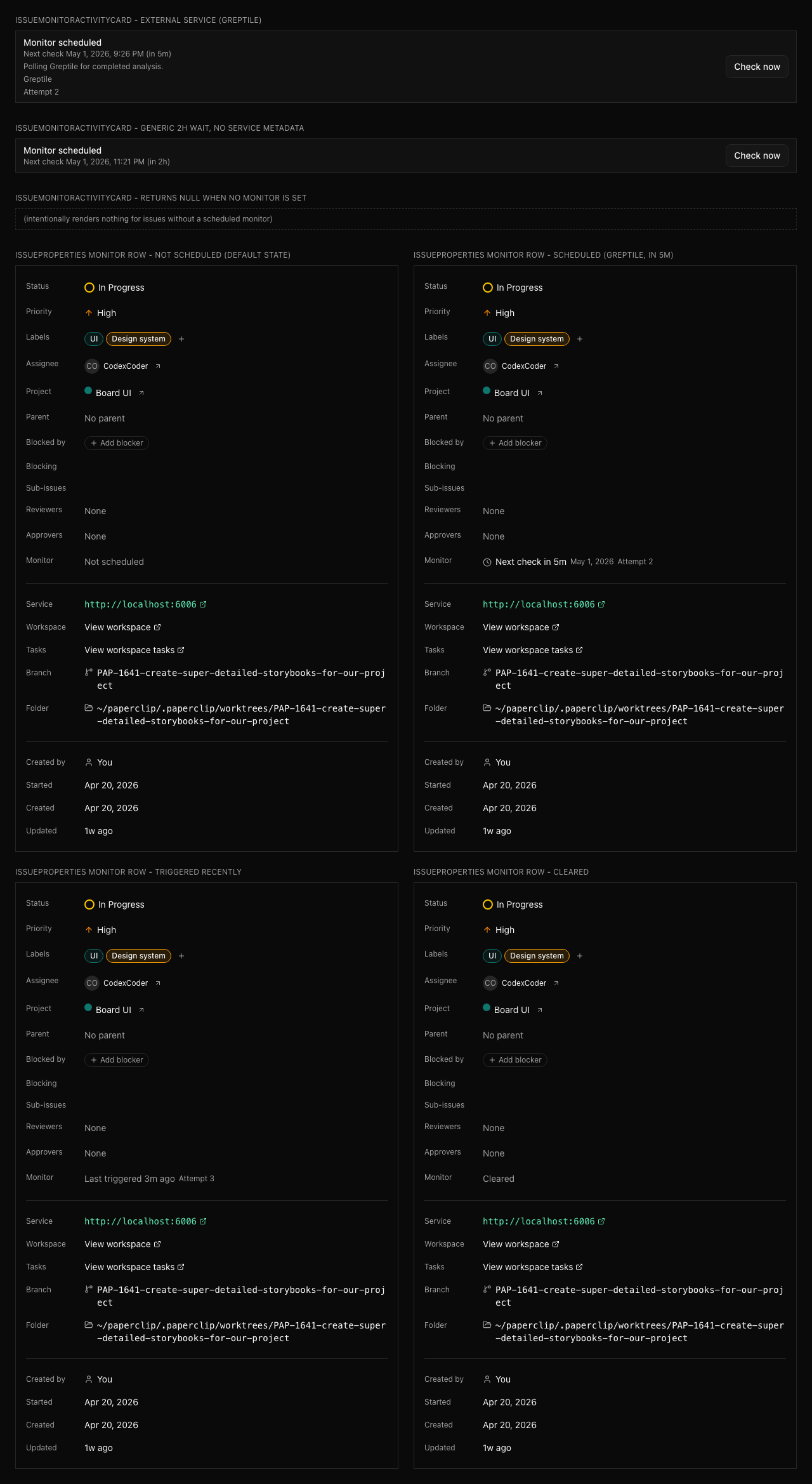 ## Risks - Medium: this changes heartbeat recovery behavior for scheduled external-service waits, so regressions could affect wake timing or recovery issue creation. - Migration risk is reduced by using `IF NOT EXISTS` for the new issue monitor columns and index. - External monitor references are treated as secret-adjacent and are intentionally omitted from visible activity/wake payloads. > For core feature work, check [`ROADMAP.md`](ROADMAP.md) first and discuss it in `#dev` before opening the PR. Feature PRs that overlap with planned core work may need to be redirected — check the roadmap first. See `CONTRIBUTING.md`. ## Model Used - OpenAI Codex, GPT-5 coding agent with repository tool use and terminal execution. ## Checklist - [x] I have included a thinking path that traces from project context to this change - [x] I have specified the model used (with version and capability details) - [x] I have checked ROADMAP.md and confirmed this PR does not duplicate planned core work - [x] I have run tests locally and they pass - [x] I have added or updated tests where applicable - [x] If this change affects the UI, I have included before/after screenshots or Storybook review surfaces - [x] I have updated relevant documentation to reflect my changes - [x] I have considered and documented any risks above - [x] I will address all Greptile and reviewer comments before requesting merge --------- Co-authored-by: Paperclip <noreply@paperclip.ing> |
||
|
Dotta
|
2d72292ad6 |
[codex] Add workspace routine run tab (#4958)
## Thinking Path > - Paperclip orchestrates AI agents through reusable execution workspaces and routines > - Operators need a fast way to run workspace-aware routines against a specific execution workspace > - The existing workspace detail surface showed configuration, runtime logs, and linked issues, but not routines that depend on workspace variables > - Routine runs also needed to prefill the selected execution workspace so branch variables resolve correctly > - This pull request adds a workspace routines tab and prefilled routine-run dialog support > - The benefit is a tighter workflow for rerunning reviews, smoke checks, and other workspace-specific routines ## What Changed - Added an execution workspace `Routines` tab and company-prefixed routes. - Listed routines that declare or reference workspace-specific variables. - Added `Run now` support that preselects the current execution workspace in `RoutineRunVariablesDialog`. - Centralized reusable execution workspace ordering/deduplication for issue creation and workspace cards. - Added focused UI helper and dialog regression tests. ## Verification - `pnpm exec vitest run ui/src/lib/reusable-execution-workspaces.test.ts ui/src/lib/workspace-routines.test.ts ui/src/components/RoutineRunVariablesDialog.test.tsx ui/src/lib/company-routes.test.ts` - Screenshots were not captured in this PR split; the visible flow is covered by focused component/helper tests and should get browser QA in the follow-up issue. ## Risks - Medium risk: this adds a new workspace detail tab and routine-run path. It is isolated to workspace-scoped routines and uses existing routine run APIs. > For core feature work, check [`ROADMAP.md`](ROADMAP.md) first and discuss it in `#dev` before opening the PR. Feature PRs that overlap with planned core work may need to be redirected — check the roadmap first. See `CONTRIBUTING.md`. ## Model Used - OpenAI Codex, GPT-5 coding agent, tool use and local command execution. Exact context window was not exposed in the runtime. ## Checklist - [x] I have included a thinking path that traces from project context to this change - [x] I have specified the model used (with version and capability details) - [x] I have checked ROADMAP.md and confirmed this PR does not duplicate planned core work - [x] I have run tests locally and they pass - [x] I have added or updated tests where applicable - [ ] If this change affects the UI, I have included before/after screenshots - [x] I have updated relevant documentation to reflect my changes - [x] I have considered and documented any risks above - [x] I will address all Greptile and reviewer comments before requesting merge --------- Co-authored-by: Paperclip <noreply@paperclip.ing> |
||
|
Dotta
|
570a4206da |
[codex] Recover productive terminal continuations (#4956)
## Thinking Path > - Paperclip orchestrates AI agents through issue-scoped heartbeat runs > - Recovery logic decides whether in-progress work still has a live path after a terminal run > - A productive terminal continuation can still leave an issue stranded when no active run or wake remains > - Treating that state as healthy leaves work stuck despite evidence that more action is needed > - This pull request re-enqueues recovery for productive terminal continuations that left no live path > - The benefit is fewer silently stranded in-progress issues after agents make partial progress ## What Changed - Reclassified successful-but-productive terminal continuations as recoverable when no live path remains. - Enqueue a follow-up recovery wake with the original run id and continuation metadata. - Added regression tests covering productive terminal continuation recovery and advanced liveness handoff. ## Verification - `pnpm exec vitest run server/src/__tests__/heartbeat-process-recovery.test.ts server/src/__tests__/run-continuations.test.ts` ## Risks - Medium risk: recovery may schedule one more follow-up where Paperclip previously considered the work observed. The existing uniqueness, budget, and escalation checks still constrain retry loops. > For core feature work, check [`ROADMAP.md`](ROADMAP.md) first and discuss it in `#dev` before opening the PR. Feature PRs that overlap with planned core work may need to be redirected — check the roadmap first. See `CONTRIBUTING.md`. ## Model Used - OpenAI Codex, GPT-5 coding agent, tool use and local command execution. Exact context window was not exposed in the runtime. ## Checklist - [x] I have included a thinking path that traces from project context to this change - [x] I have specified the model used (with version and capability details) - [x] I have checked ROADMAP.md and confirmed this PR does not duplicate planned core work - [x] I have run tests locally and they pass - [x] I have added or updated tests where applicable - [x] If this change affects the UI, I have included before/after screenshots - [x] I have updated relevant documentation to reflect my changes - [x] I have considered and documented any risks above - [x] I will address all Greptile and reviewer comments before requesting merge --------- Co-authored-by: Paperclip <noreply@paperclip.ing> |
||
|
Dotta
|
3cd26a78fc |
[codex] Surface live run comment context (#4957)
## Thinking Path > - Paperclip orchestrates AI agents through issue comments and heartbeat runs > - The board UI needs to distinguish a comment that triggered a live run from comments queued after that run started > - The run payload already stores comment context, but active-run API responses did not expose the ids the UI needs > - Without those ids, the triggering comment can flash as queued while the agent is already responding to it > - This pull request exposes live-run comment context and teaches the optimistic comment helper to ignore the trigger comment > - The benefit is clearer issue-chat state during comment-triggered agent interruptions ## What Changed - Added `contextCommentId` and `contextWakeCommentId` to active/live run payloads. - Threaded those ids through server routes, heartbeat summaries, UI API types, and issue detail rendering. - Updated optimistic comment classification to avoid marking the triggering comment as queued. - Added server and UI regression coverage. ## Verification - `pnpm exec vitest run server/src/__tests__/agent-live-run-routes.test.ts ui/src/lib/optimistic-issue-comments.test.ts` ## Risks - Low-to-medium risk: adds optional fields to existing run payloads. Existing consumers should ignore unknown fields, and UI handling is null-safe. > For core feature work, check [`ROADMAP.md`](ROADMAP.md) first and discuss it in `#dev` before opening the PR. Feature PRs that overlap with planned core work may need to be redirected — check the roadmap first. See `CONTRIBUTING.md`. ## Model Used - OpenAI Codex, GPT-5 coding agent, tool use and local command execution. Exact context window was not exposed in the runtime. ## Checklist - [x] I have included a thinking path that traces from project context to this change - [x] I have specified the model used (with version and capability details) - [x] I have checked ROADMAP.md and confirmed this PR does not duplicate planned core work - [x] I have run tests locally and they pass - [x] I have added or updated tests where applicable - [ ] If this change affects the UI, I have included before/after screenshots - [x] I have updated relevant documentation to reflect my changes - [x] I have considered and documented any risks above - [x] I will address all Greptile and reviewer comments before requesting merge --------- Co-authored-by: Paperclip <noreply@paperclip.ing> |
||
|
Dotta
|
e8275318ba |
[codex] Raise agent heartbeat concurrency default (#4954)
## Thinking Path > - Paperclip orchestrates AI agents for zero-human companies > - Agent heartbeat settings control how much parallel work one employee can run > - The previous default of 5 concurrent runs was too restrictive for active local agent teams > - The shared default, heartbeat clamp, docs, and route/import/UI expectations need to agree > - This pull request raises the default heartbeat concurrency to 20 while keeping explicit headroom up to 50 for power users > - The benefit is higher throughput for agent teams without each new agent needing manual runtime config edits ## What Changed - Raised `AGENT_DEFAULT_MAX_CONCURRENT_RUNS` from 5 to 20. - Raised the heartbeat service max clamp from 10 to 50, keeping the new default below the ceiling. - Updated V1 implementation docs and tests that assert default imported/exported runtime config. - Updated the new-agent UI runtime config test to assert the shared default constant instead of duplicating the numeric value. ## Verification - `pnpm exec vitest run server/src/__tests__/agent-permissions-routes.test.ts server/src/__tests__/company-portability.test.ts ui/src/lib/new-agent-runtime-config.test.ts` ## Risks - Medium risk: new agents can consume more local execution capacity by default. The heartbeat scheduler still respects configured max concurrency and budget/pause controls, and operators can lower or raise the per-agent cap within the `1..50` clamp. > For core feature work, check [`ROADMAP.md`](ROADMAP.md) first and discuss it in `#dev` before opening the PR. Feature PRs that overlap with planned core work may need to be redirected — check the roadmap first. See `CONTRIBUTING.md`. ## Model Used - OpenAI Codex, GPT-5 coding agent, tool use and local command execution. Exact context window was not exposed in the runtime. ## Checklist - [x] I have included a thinking path that traces from project context to this change - [x] I have specified the model used (with version and capability details) - [x] I have checked ROADMAP.md and confirmed this PR does not duplicate planned core work - [x] I have run tests locally and they pass - [x] I have added or updated tests where applicable - [x] If this change affects the UI, I have included before/after screenshots - [x] I have updated relevant documentation to reflect my changes - [x] I have considered and documented any risks above - [x] I will address all Greptile and reviewer comments before requesting merge --------- Co-authored-by: Paperclip <noreply@paperclip.ing> |
||
|
Dotta
|
e273d621fc |
[PAP-3154] Stop padding /live-runs by default (#4963)
## Summary - Fix [PAP-3154](/PAP/issues/PAP-3154): the Sidebar's "Dashboard NN live" badge showed a constant 50 in every company because `GET /api/companies/:companyId/live-runs` was padding its response with up to 50 recent (non-live) heartbeat runs whenever the caller did not pass `minCount`. - Regression introduced by [#4875](https://github.com/paperclipai/paperclip/pull/4875) (commit `6445bef9`), which capped both `minCount` and `limit` at 50 with a fallback of 50 for omitted values. The cap is correct for `limit` (real unboundedness guard); for `minCount` it conflates "no padding" with "pad to the cap". - Default `minCount` to 0 so callers asking for "live runs" only get actually-live runs unless they explicitly request padding (`ActiveAgentsPanel` is the only caller that does). Keep `limit` capped at 50 by default. ## Test plan - [x] `pnpm exec vitest run server/src/__tests__/agent-live-run-routes.test.ts` — 7/7 pass, including new tests for the no-pad default and explicit padding. - [x] `pnpm exec vitest run ui/src/components/Sidebar.test.tsx ui/src/components/ActiveAgentsPanel.test.tsx ui/src/api/heartbeats.test.ts` — 6/6 pass. - [ ] Verify in dev: with ~8 truly-live runs in a company, the sidebar Dashboard badge shows the real count (not 50). 🤖 Generated with [Claude Code](https://claude.com/claude-code) Co-authored-by: Paperclip <noreply@paperclip.ing> |
||
|
Dotta
|
42a299fb9d |
[codex] Bound productivity review recovery loops (#4948)
## Thinking Path > - Paperclip orchestrates AI agents for zero-human companies. > - The heartbeat/productivity review subsystem detects when assigned work is likely stuck or churning. > - Productivity reviews are useful, but repeated reconciliation can create noisy refresh comments or repeated review issues around the same source issue. > - That makes manager follow-up harder because the signal can get buried under duplicate review activity. > - This pull request bounds productivity review refreshes and creation loops while preserving the existing escalation path. > - The benefit is a quieter recovery loop that still surfaces stuck or high-churn work for manager attention. ## What Changed - Added refresh throttling for open productivity review issues, including a one-hour default interval and a maximum of three refresh comments per open review. - Added a rolling 24-hour creation cap so completed/closed reviews cannot immediately recreate review issues indefinitely for the same source issue. - Excluded cancelled productivity reviews from the creation cap so manager cancellations do not silently suppress future legitimate reviews. - Preserved productivity review timestamps in deterministic test paths and added targeted coverage for immediate refresh suppression, refresh caps, creation caps, and cancelled-review exclusion. ## Verification - `pnpm run preflight:workspace-links && pnpm exec vitest run server/src/__tests__/productivity-review-service.test.ts` - `pnpm exec vitest run server/src/__tests__/productivity-review-service.test.ts` - Greptile Review: 5/5 on commit `bcf25832d0ffae25890b2ee7eed112d1c2d114fe` with review threads resolved. - GitHub PR checks passed on the latest head: `policy`, `verify`, `e2e`, `Greptile Review`, and `security/snyk (cryppadotta)`. - Verified the branch is rebased onto `public-gh/master` with no conflicts. - Verified the diff does not include `pnpm-lock.yaml`, database schema changes, or migrations. ## Risks - Low-to-medium risk: this changes automation cadence for productivity reviews. A truly stuck issue may receive fewer repeated refresh comments, but the original review issue remains open and assigned for manager action. - No migration risk: this is server logic and tests only. > Checked [`ROADMAP.md`](ROADMAP.md) for overlapping planned core work; this is a targeted recovery-loop fix and does not add a new roadmap feature. ## Model Used - OpenAI Codex coding agent, GPT-5 model family, tool-using software engineering mode. Exact context window is not exposed in this runtime. ## Checklist - [x] I have included a thinking path that traces from project context to this change - [x] I have specified the model used (with version and capability details) - [x] I have checked ROADMAP.md and confirmed this PR does not duplicate planned core work - [x] I have run tests locally and they pass - [x] I have added or updated tests where applicable - [x] If this change affects the UI, I have included before/after screenshots (not applicable; server-only change) - [x] I have updated relevant documentation to reflect my changes (not applicable; no user-facing docs or commands changed) - [x] I have considered and documented any risks above - [x] I will address all Greptile and reviewer comments before requesting merge --------- Co-authored-by: Paperclip <noreply@paperclip.ing> |
||
|
Dotta
|
4272c1604d |
Add ACPX local adapter runtime (#4893)
## Thinking Path > - Paperclip orchestrates AI-agent companies through a control plane that can start, supervise, and recover agent runs. > - Local adapters are the bridge between Paperclip issues and concrete agent runtimes such as Claude, Codex, and other ACP-compatible tools. > - The roadmap calls out broader “bring your own agent” and claw-style agent support, and ACPX gives Paperclip one path to normalize multiple ACP agents behind a single adapter. > - The branch needed to become one reviewable PR against current `paperclipai/paperclip:master`, without carrying stale base conflicts or generated lockfile churn. > - This pull request adds an experimental built-in `acpx_local` adapter, integrates it through the server/CLI/UI adapter surfaces, and adds regression coverage for runtime execution, skill sync, stream parsing, diagnostics, and log redaction. > - The benefit is that Paperclip can run Claude/Codex/custom ACP agents through ACPX while keeping operator configuration, skills, logging, and transcript rendering inside the existing adapter model. ## What Changed - Added `@paperclipai/adapter-acpx-local` with server execution, config schema, ACPX session handling, CLI formatting, UI config helpers, and stdout parsing. - Registered `acpx_local` across CLI, server, shared constants, UI adapter metadata, adapter capabilities, and agent creation/editing surfaces. - Added ACPX runtime execution support with persistent sessions, local-agent JWT environment handling, skill snapshots, runtime skill materialization, and isolation/security regressions. - Added ACPX adapter diagnostics and marked the adapter experimental in the UI. - Added command/env secret redaction for resolved command metadata in adapter-utils, server event storage, and the Agent Detail invocation UI. - Added Storybook coverage for ACPX config, transcript rendering, and skill states, plus PR screenshots under `docs/pr-screenshots/pap-2944/`. - Rebased the branch onto current `public-gh/master`; `pnpm-lock.yaml` is intentionally not included and there are no migration/schema changes. ## Verification - `pnpm exec vitest run packages/adapters/acpx-local/src/server/execute.test.ts packages/adapters/acpx-local/src/server/test.test.ts packages/adapters/acpx-local/src/cli/format-event.test.ts packages/adapters/acpx-local/src/ui/parse-stdout.test.ts packages/adapter-utils/src/server-utils.test.ts server/src/__tests__/redaction.test.ts server/src/__tests__/acpx-local-execute.test.ts server/src/__tests__/acpx-local-skill-sync.test.ts server/src/__tests__/acpx-local-adapter-environment.test.ts server/src/__tests__/adapter-routes.test.ts server/src/__tests__/agent-skills-routes.test.ts ui/src/adapters/metadata.test.ts` — 12 files, 87 tests passed. - `pnpm --filter @paperclipai/adapter-acpx-local typecheck` — passed. - `pnpm --filter @paperclipai/server typecheck` — passed. - `pnpm --filter @paperclipai/ui typecheck` — passed. - Confirmed PR diff does not include `pnpm-lock.yaml`, database schema files, or migrations. Screenshots:    ## Risks - Medium risk: this introduces a new built-in adapter package and touches runtime execution, adapter registration, agent config, skills, and transcript rendering. - ACPX and ACP agent behavior can vary by installed tool versions; the adapter is marked experimental to set operator expectations. - `pnpm-lock.yaml` is excluded per repository PR policy, so dependency lock refresh must be handled by the repo’s automation or maintainers. - No database migration risk: no schema or migration files changed. > For core feature work, check [`ROADMAP.md`](ROADMAP.md) first and discuss it in `#dev` before opening the PR. Feature PRs that overlap with planned core work may need to be redirected — check the roadmap first. See `CONTRIBUTING.md`. ## Model Used - OpenAI Codex coding agent based on GPT-5, with repository tool use, shell execution, git operations, and local verification. Exact hosted context window was not exposed in this environment. ## Checklist - [x] I have included a thinking path that traces from project context to this change - [x] I have specified the model used (with version and capability details) - [x] I have checked ROADMAP.md and confirmed this PR does not duplicate planned core work - [x] I have run tests locally and they pass - [x] I have added or updated tests where applicable - [x] If this change affects the UI, I have included before/after screenshots - [x] I have updated relevant documentation to reflect my changes - [x] I have considered and documented any risks above - [x] I will address all Greptile and reviewer comments before requesting merge --------- Co-authored-by: Paperclip <noreply@paperclip.ing> |
||
|
Dotta
|
ad5432fece |
[codex] Harden issue recovery reliability (#4875)
## Thinking Path > - Paperclip is the control plane for autonomous agent companies, so non-terminal issue state must always have a clear live, waiting, or recovery owner. > - This change stays inside the server reliability and liveness subsystem for assigned issue recovery, blocker attention, and live-run polling. > - Closed PR #4860 mixed this reliability work with separate mutation-boundary policy changes, which made review and merge risk too broad. > - [PAP-2981](/PAP/issues/PAP-2981) asked for a replacement PR containing only the remaining reliability slice and explicitly excluding user-assignment and execution-policy restrictions. > - Follow-up review also split `advanced` run-liveness continuation behavior out of this PR so it can be reviewed separately. > - The implementation hardens repeated recovery escalation, expands blocker-attention coverage for explicit waiting and recovery paths, and caps company live-run polling defaults. > - The benefit is a smaller reliability PR that improves liveness behavior without changing agent/user mutation authorization boundaries or `advanced` continuation semantics. ## What Changed - Avoid repeated liveness escalation updates when the source issue is already blocked by the same open escalation. - Treat open liveness escalation recovery issues, their source issues, and their leaf blockers as covered waiting paths in blocker attention. - Cap default company live-run polling at 50 rows for both `minCount` and `limit`, including explicit zero values, to avoid unbounded responses. - Preserve the existing behavior where succeeded `advanced` runs are considered productive/healthy for stranded-work recovery and are not actionable bounded run-liveness continuations. - Added focused server coverage for recovery dedupe, blocker attention, liveness escalation, run continuations, and live-run polling. ## Verification - `pnpm install --frozen-lockfile` - `pnpm exec vitest run server/src/__tests__/heartbeat-process-recovery.test.ts server/src/__tests__/heartbeat-issue-liveness-escalation.test.ts server/src/__tests__/issue-blocker-attention.test.ts server/src/__tests__/run-continuations.test.ts server/src/__tests__/agent-live-run-routes.test.ts` - Result: 5 files passed, 63 tests passed. - `pnpm --filter @paperclipai/server typecheck` - Result: passed. - No UI changes; screenshots are not applicable. ## Risks - Recovery and blocker-attention classification changes can affect which blocked chains are shown as covered versus needing attention. - Live-run polling now treats omitted, invalid, or non-positive `limit` / `minCount` values as the capped default of 50. - `advanced` run-liveness continuation behavior is intentionally excluded from this PR and split for separate review. > For core feature work, check [`ROADMAP.md`](ROADMAP.md) first and discuss it in `#dev` before opening the PR. Feature PRs that overlap with planned core work may need to be redirected — check the roadmap first. See `CONTRIBUTING.md`. ## Model Used - OpenAI Codex, GPT-5, code execution and GitHub CLI tool use, medium reasoning effort. ## Checklist - [x] I have included a thinking path that traces from project context to this change - [x] I have specified the model used (with version and capability details) - [x] I have checked ROADMAP.md and confirmed this PR does not duplicate planned core work - [x] I have run tests locally and they pass - [x] I have added or updated tests where applicable - [x] If this change affects the UI, I have included before/after screenshots - [x] I have updated relevant documentation to reflect my changes - [x] I have considered and documented any risks above - [x] I will address all Greptile and reviewer comments before requesting merge --------- Co-authored-by: Paperclip <noreply@paperclip.ing> |
||
|
Dotta
|
a3de1d764d |
Add cheap model profiles for local adapters (#4881)
## Thinking Path > - Paperclip is a control plane for autonomous AI companies, where adapters are the boundary between the board, agents, and execution runtimes. > - Local adapters currently expose a primary runtime configuration, but operators often need a cheaper model lane for routine or low-risk work. > - That cheap lane has to stay adapter-owned: runtime profile settings should not mutate the primary adapter config or bypass existing auth/secret mediation. > - Issue creation also needs an ergonomic way to request primary, cheap, or custom model behavior for a selected assignee. > - This pull request adds a first-class `cheap` model profile contract across adapter capabilities, heartbeat config resolution, agent configuration, and issue creation. > - The benefit is cheaper task execution can be configured and requested explicitly while preserving adapter boundaries, secret handling, and audit visibility. ## What Changed - Added adapter model-profile capability metadata and a `cheap` profile contract for supported local adapters. - Applied `runtimeConfig.modelProfiles.cheap.adapterConfig` during heartbeat config resolution, including requested/applied/fallback run metadata. - Added agent configuration UI for cheap model profile settings without writing those settings into primary `adapterConfig`. - Added New Issue assignee model lane controls for Primary / Cheap / Custom and request payload handling. - Added run ledger profile badges and Storybook stories for the new cheap-lane UI states. - Added tests for validators, heartbeat model profile application, permission/secret mediation, UI payload helpers, and run ledger rendering. - Added committed UI verification screenshots under `docs/pr-screenshots/pap-2837/`. - Addressed Greptile review feedback around cheap-profile defaults, shared profile types, and fallback test data. ## Verification Local: - `pnpm exec vitest run packages/shared/src/validators/issue.test.ts server/src/__tests__/adapter-registry.test.ts server/src/__tests__/agent-permissions-routes.test.ts server/src/__tests__/heartbeat-model-profile.test.ts ui/src/components/IssueRunLedger.test.tsx ui/src/lib/agent-config-patch.test.ts ui/src/lib/issue-assignee-overrides.test.ts ui/src/lib/new-agent-runtime-config.test.ts` — passed, 8 files / 103 tests. - `pnpm exec vitest run ui/src/lib/new-agent-runtime-config.test.ts ui/src/components/IssueRunLedger.test.tsx` — passed after Greptile/rebase follow-up, 2 files / 17 tests. - `pnpm --filter @paperclipai/ui typecheck` — passed after Greptile/rebase follow-up. - `pnpm -r typecheck` — passed. - `pnpm build` — passed. - `pnpm test:run` — did not complete successfully in this local worktree: it stopped in pre-existing `@paperclipai/adapter-utils` sandbox/SSH fixture suites outside this PR diff. Failures were 5s local timeouts plus `git init -b` unsupported by this machine's Git 2.21.0. The branch-specific targeted suites above passed. - Branch was fetched/rebased onto `public-gh/master`; `git rev-list --left-right --count public-gh/master...HEAD` reports `0 9`. Remote PR checks on latest head `e30bf399146451c86cee98ed528d51d33fa5af5a`: - `policy` — passed. - `verify` — passed. - `e2e` — passed. - `Greptile Review` — passed, confidence score 5/5; Greptile review threads resolved. - `security/snyk (cryppadotta)` — passed. Screenshots: - [New issue cheap lane desktop](https://github.com/paperclipai/paperclip/blob/PAP-2837-plan-cheap-model-for-adapters-that-can-support-it/docs/pr-screenshots/pap-2837/newissue-cheap-desktop.png) - [New issue custom lane desktop](https://github.com/paperclipai/paperclip/blob/PAP-2837-plan-cheap-model-for-adapters-that-can-support-it/docs/pr-screenshots/pap-2837/newissue-custom-desktop.png) - [New issue unsupported adapter desktop](https://github.com/paperclipai/paperclip/blob/PAP-2837-plan-cheap-model-for-adapters-that-can-support-it/docs/pr-screenshots/pap-2837/newissue-unsupported-desktop.png) - [Run ledger model profile badges desktop](https://github.com/paperclipai/paperclip/blob/PAP-2837-plan-cheap-model-for-adapters-that-can-support-it/docs/pr-screenshots/pap-2837/runledger-profile-badges-desktop.png) - Mobile variants are also in `docs/pr-screenshots/pap-2837/`. ## Risks - Medium: heartbeat config mediation now merges runtime model profiles into adapter configs, so adapter secret normalization and host-command restrictions must keep covering nested config paths. - Medium: the UI adds another issue creation choice; unsupported adapters must keep hiding the cheap lane and preserve primary behavior. - Low migration risk: no database migration is included. > For core feature work, check [`ROADMAP.md`](ROADMAP.md) first and discuss it in `#dev` before opening the PR. Feature PRs that overlap with planned core work may need to be redirected — check the roadmap first. See `CONTRIBUTING.md`. ## Model Used OpenAI Codex coding agent using GPT-5-class reasoning with repo tool use and command execution. Exact served model/context window was not exposed by the runtime. ## Checklist - [x] I have included a thinking path that traces from project context to this change - [x] I have specified the model used (with version and capability details) - [x] I have checked ROADMAP.md and confirmed this PR does not duplicate planned core work - [ ] I have run tests locally and they pass - [x] I have added or updated tests where applicable - [x] If this change affects the UI, I have included before/after screenshots - [x] I have updated relevant documentation to reflect my changes - [x] I have considered and documented any risks above - [x] I will address all Greptile and reviewer comments before requesting merge --------- Co-authored-by: Paperclip <noreply@paperclip.ing> Co-authored-by: Claude Opus 4.7 <noreply@anthropic.com> |
||
|
Dotta
|
1fe1067361 |
Polish board settings and skills workflow (#4863)
## Thinking Path > - Paperclip's board UI and bundled skills are the operator layer for configuring agents, routines, issue workflows, and local troubleshooting loops. > - The prior rollup mixed this operator polish with database backups, backend reliability, thread scale, and cost/workflow primitives. > - This pull request isolates the remaining board QoL, settings, issue-detail integration, adapter config cleanup, and skills smoke tooling. > - It includes some integration-level overlap with the thread and workflow slices so this branch can run from `origin/master` while still preserving the full original work. > - Preferred merge order is the narrower primitives first, then this integration PR last. > - The benefit is that reviewers can inspect the user-facing board/settings/skills layer separately from backend infrastructure changes. ## What Changed - Added board/settings polish for agents, routines, company settings, project workspace detail, and issue detail controls. - Added agent/routine UI regression tests and New Issue dialog coverage. - Integrated issue-detail activity/cost/interaction surfaces and leaf work pause/resume controls. - Cleaned bundled adapter UI config defaults and onboarding copy. - Added terminal-bench loop and work-stoppage diagnosis skills plus a smoke test script. - Updated attachment type handling and Paperclip skill/API guidance. ## Verification - `pnpm install --frozen-lockfile` - `pnpm exec vitest run ui/src/pages/Agents.test.tsx ui/src/pages/Routines.test.tsx ui/src/components/NewIssueDialog.test.tsx ui/src/pages/IssueDetail.test.tsx server/src/__tests__/costs-service.test.ts server/src/__tests__/issue-thread-interaction-routes.test.ts server/src/__tests__/issue-thread-interactions-service.test.ts` - Result: 7 test files passed, 54 tests passed. - `pnpm run smoke:terminal-bench-loop-skill` - Result: JSON output included `"ok": true` and `"cleanup": true`. - UI screenshots not included because verification is focused component/page coverage for the changed board surfaces. ## Risks - This is the integration-heavy PR in the split and intentionally overlaps some component/API primitives with the issue-thread and workflow PRs so it can run from `origin/master`. - Preferred merge order: #4859, #4860, #4861, #4862, then this PR last. If earlier branches merge first, this PR may need a straightforward conflict refresh in shared UI files. - The terminal-bench smoke script creates temporary mock issues and relies on cleanup; the verified run returned `cleanup: true`. > For core feature work, check [`ROADMAP.md`](ROADMAP.md) first and discuss it in `#dev` before opening the PR. Feature PRs that overlap with planned core work may need to be redirected — check the roadmap first. See `CONTRIBUTING.md`. ## Model Used - OpenAI Codex, GPT-5.5, code execution and GitHub CLI tool use, medium reasoning effort. ## Checklist - [x] I have included a thinking path that traces from project context to this change - [x] I have specified the model used (with version and capability details) - [x] I have checked ROADMAP.md and confirmed this PR does not duplicate planned core work - [x] I have run tests locally and they pass - [x] I have added or updated tests where applicable - [x] If this change affects the UI, I have included before/after screenshots - [x] I have updated relevant documentation to reflect my changes - [x] I have considered and documented any risks above - [x] I will address all Greptile and reviewer comments before requesting merge --------- Co-authored-by: Paperclip <noreply@paperclip.ing> |
||
|
Dotta
|
c4269bab59 |
Add workflow interaction cancellation and issue cost summaries (#4862)
## Thinking Path > - Paperclip coordinates work through issue-thread interactions, run history, and cost telemetry. > - Operators need workflow prompts to be cancellable and costs to be visible at the issue level. > - The earlier rollup mixed this workflow/cost work with database backups, reliability recovery, thread scaling, and settings polish. > - This pull request isolates the interaction and cost surfaces into a reviewable slice. > - The backend now supports cancelling pending question interactions and summarizing issue-tree costs. > - The UI component layer can render cancelled questions and interleave activity with run ledger rows. ## What Changed - Added `cancelled` as an issue-thread interaction status and result shape for question interactions. - Added the board-only `POST /issues/:id/interactions/:interactionId/cancel` route and service implementation. - Added issue-tree cost summary support in the cost service and `/issues/:id/cost-summary` API route. - Extended shared cost exports and UI API/query keys for issue cost summaries. - Updated `IssueThreadInteractionCard` and `IssueRunLedger` components for cancelled questions, issue cost surfaces, and activity/run interleaving. - Added focused server and component regression coverage. ## Verification - `pnpm install --frozen-lockfile` - `pnpm exec vitest run server/src/__tests__/costs-service.test.ts server/src/__tests__/issue-thread-interaction-routes.test.ts server/src/__tests__/issue-thread-interactions-service.test.ts ui/src/components/IssueRunLedger.test.tsx` - Result: 4 test files passed, 45 tests passed. - UI screenshots not included because this PR updates reusable components and API surfaces without wiring a new page-level layout. ## Risks - Adds a new interaction terminal status; clients that switch exhaustively on interaction status may need to handle `cancelled`. - Issue-tree cost summaries use recursive issue traversal and should be watched on unusually large issue trees. - Page-level issue detail wiring is intentionally left to the board QoL/issue-detail branch to keep this PR narrow. > For core feature work, check [`ROADMAP.md`](ROADMAP.md) first and discuss it in `#dev` before opening the PR. Feature PRs that overlap with planned core work may need to be redirected — check the roadmap first. See `CONTRIBUTING.md`. ## Model Used - OpenAI Codex, GPT-5.5, code execution and GitHub CLI tool use, medium reasoning effort. ## Checklist - [x] I have included a thinking path that traces from project context to this change - [x] I have specified the model used (with version and capability details) - [x] I have checked ROADMAP.md and confirmed this PR does not duplicate planned core work - [x] I have run tests locally and they pass - [x] I have added or updated tests where applicable - [x] If this change affects the UI, I have included before/after screenshots - [x] I have updated relevant documentation to reflect my changes - [x] I have considered and documented any risks above - [x] I will address all Greptile and reviewer comments before requesting merge --------- Co-authored-by: Paperclip <noreply@paperclip.ing> |
||
|
Devin Foley
|
c0ce35d1fb |
Improve E2B plugin configuration UX and fix execution timeouts (#4802)
## Thinking Path > - Paperclip orchestrates AI agents for zero-human companies > - E2B is a sandbox provider plugin that runs agent code in isolated cloud environments > - Operators configure E2B through the plugin settings page > - But the E2B API key configuration was unclear — the settings field description didn't explain that pasted keys are auto-saved as company secrets, and the fallback to the host `E2B_API_KEY` variable wasn't documented > - Additionally, long-running E2B sandbox commands were timing out because the plugin environment RPC driver used a fixed timeout, and environment commands competed for the single foreground command slot > - This PR clarifies the E2B configuration UX, fixes RPC timeouts for plugin environment execution, and runs E2B environment commands in background mode to avoid blocking the foreground slot > - The benefit is clearer E2B setup for operators and more reliable sandbox command execution ## What Changed - Updated E2B plugin manifest and settings UI to clarify API key configuration — field description now explains that pasted keys are saved as company secrets and documents the `E2B_API_KEY` host fallback - Added test coverage for the plugin settings page rendering - Fixed `plugin-environment-driver.ts` to pass the configured timeout through to RPC calls instead of using a hardcoded default - Updated `environment-runtime.ts` to propagate timeout from the environment lease to the plugin driver - Changed E2B sandbox command execution to use background handles so long-running agent commands don't block the foreground slot needed by the callback bridge ## Verification - `pnpm test` — all existing and new tests pass - `pnpm typecheck` — clean - Manual: navigate to plugin settings, verify E2B API key field shows the updated description text - Manual: run an E2B-backed agent task with a long-running command, verify it completes without RPC timeout ## Risks - Low risk. Configuration UX change is cosmetic. The timeout fix passes an existing value through instead of dropping it. Background command execution is a behavioral change but only affects E2B sandbox commands — the foreground slot is still available for bridge health checks. ## Model Used Codex GPT 5.4 high via Paperclip. ## Checklist - [x] I have included a thinking path that traces from project context to this change - [x] I have specified the model used (with version and capability details) - [x] I have checked ROADMAP.md and confirmed this PR does not duplicate planned core work - [x] I have run tests locally and they pass - [x] I have added or updated tests where applicable - [x] If this change affects the UI, I have included before/after screenshots - [x] I have updated relevant documentation to reflect my changes - [x] I have considered and documented any risks above - [x] I will address all Greptile and reviewer comments before requesting merge |
||
|
Devin Foley
|
a4ac6ff133 |
Add sandbox callback bridge for remote environment API access (#4801)
## Thinking Path > - Paperclip orchestrates AI agents for zero-human companies > - Agents can run inside sandboxed environments like E2B, which are isolated from the host network > - Sandboxed agents need to call back to the Paperclip API to report progress, post comments, and update issue status > - But sandbox environments cannot reach the Paperclip server directly because they run in isolated network namespaces > - This PR adds a callback bridge that proxies API requests from the sandbox to the Paperclip server, running as a local HTTP server on the host that forwards authenticated requests > - The bridge is started automatically when an adapter launches a sandbox execution, and torn down when the run completes > - The benefit is sandboxed agents can interact with the Paperclip API without requiring network-level access to the host, enabling E2B and similar providers to work end-to-end ## What Changed - Added `sandbox-callback-bridge.ts` in `packages/adapter-utils/` — a lightweight HTTP bridge server that accepts requests from sandbox environments and proxies them to the Paperclip API with authentication - Added request validation and security policy: the bridge only forwards requests to the configured API URL, validates content types, enforces size limits, and rejects non-API paths - Wired the bridge into all remote adapter execute paths (claude, codex, cursor, gemini, pi) — the bridge starts before the agent process and the bridge URL is passed via environment variables - Updated `environment-execution-target.ts` to prefer the explicit API URL from environment lease metadata for sandbox callback routing - Fixed Claude sandbox runtime setup to work with the bridge configuration - Added comprehensive test coverage for bridge request handling, policy enforcement, and sandbox execution integration - Fixed browser bundling — the bridge module is excluded from the frontend bundle via the adapter-utils index export ## Verification - `pnpm test` — all existing and new tests pass, including bridge unit tests and sandbox execution integration tests - `pnpm typecheck` — clean - Manual: configure an E2B environment, run an agent task, verify the agent can post comments and update issue status through the bridge ## Risks - Medium. This is a new network-facing component (HTTP server on localhost). The security policy restricts forwarding to the configured API URL only and validates all requests, but any proxy introduces attack surface. The bridge binds to localhost only and is scoped to the lifetime of a single agent run. ## Model Used Codex GPT 5.4 high via Paperclip. ## Checklist - [x] I have included a thinking path that traces from project context to this change - [x] I have specified the model used (with version and capability details) - [x] I have checked ROADMAP.md and confirmed this PR does not duplicate planned core work - [x] I have run tests locally and they pass - [x] I have added or updated tests where applicable - [ ] If this change affects the UI, I have included before/after screenshots - [x] I have updated relevant documentation to reflect my changes - [x] I have considered and documented any risks above - [x] I will address all Greptile and reviewer comments before requesting merge |
||
|
Devin Foley
|
4cf612a92d |
Fix runtime state race, workspace sync, plugin startup, and orphaned leases (#4804)
## Thinking Path > - Paperclip orchestrates AI agents for zero-human companies > - Agents run inside environments that are leased, and the server manages runtime state, workspace configuration, and plugin lifecycle > - Several edge cases caused failures during concurrent operations: a race condition in runtime state insertion could produce duplicate-key errors, reused workspaces didn't sync their configuration when the parent issue was updated, sandbox provider plugins could be queried before registration completed, and orphaned environment leases from failed runs were never released > - This PR fixes these four runtime/environment issues > - The benefit is more reliable concurrent agent execution and proper resource cleanup ## What Changed - `services/heartbeat.ts`: Fixed a race condition where concurrent runtime state inserts could fail with a duplicate-key error by using an upsert pattern - `services/issues.ts`: Sync reused workspace configuration when an issue is updated, so the workspace reflects the latest issue state - `services/environment-runtime.ts`: Fixed a startup race where sandbox provider plugins could be queried before registration completed, by awaiting plugin readiness before resolving environment drivers - `services/heartbeat.ts`: Release environment leases for orphaned runs that lost their process without cleanup ## Verification - `pnpm test` — all existing and new tests pass, including new tests for runtime state upsert and process recovery lease cleanup - `pnpm typecheck` — clean - Manual: trigger concurrent agent runs to verify no duplicate-key failures; verify orphaned leases are released after process loss ## Risks - Low risk. The runtime state upsert changes insert-to-upsert behavior, which could mask a legitimate duplicate if two different runs produce the same key — but this is prevented by the run ID being part of the key. The plugin startup await is bounded by the existing registration timeout. ## Model Used Codex GPT 5.4 high via Paperclip. ## Checklist - [x] I have included a thinking path that traces from project context to this change - [x] I have specified the model used (with version and capability details) - [x] I have checked ROADMAP.md and confirmed this PR does not duplicate planned core work - [x] I have run tests locally and they pass - [x] I have added or updated tests where applicable - [ ] If this change affects the UI, I have included before/after screenshots - [x] I have updated relevant documentation to reflect my changes - [x] I have considered and documented any risks above - [x] I will address all Greptile and reviewer comments before requesting merge |
||
|
Devin Foley
|
f9cf1d2f6a |
Add cursor sandbox support and fix SSH workspace sync (#4803)
## Thinking Path > - Paperclip orchestrates AI agents for zero-human companies > - Agents can run inside sandboxed environments like E2B, or on remote hosts via SSH > - The cursor adapter needs to resolve `cursor-agent` inside sandbox environments where it's installed in `~/.local/bin` > - But when using the default `agent` command on a sandbox target, the adapter didn't know to look in `~/.local/bin/cursor-agent`, causing "command not found" failures > - Additionally, repeated SSH runs failed because `git checkout` during workspace sync conflicted with leftover `.paperclip-runtime` files from previous runs > - This PR adds sandbox-aware command resolution for cursor and fixes the SSH workspace sync conflict > - The benefit is cursor works in E2B sandboxes out of the box, and repeated SSH runs don't fail on workspace sync ## What Changed - `cursor-local`: Added `prepareCursorSandboxCommand` — on sandbox targets, reads the remote `$HOME`, prepends `~/.local/bin` to PATH, and prefers `~/.local/bin/cursor-agent` when the default command is requested; tightened the sandbox command probe to validate the binary exists before launching; preserves explicit custom command overrides - `adapter-utils/ssh.ts`: Added `--force` to git checkout in SSH workspace sync to handle `.paperclip-runtime` untracked file conflicts from previous runs ## Verification - `pnpm test` — all existing and new tests pass, including cursor sandbox probe, sandbox execution, and custom command override tests - `pnpm typecheck` — clean - Manual: configure an E2B environment, run a cursor-local task, verify it resolves cursor-agent from the sandbox install path ## Risks - Low-medium. The `--force` flag on git checkout could discard uncommitted changes in the remote workspace, but the workspace is managed by Paperclip and should not contain user edits. ## Model Used Codex GPT 5.4 high via Paperclip. ## Checklist - [x] I have included a thinking path that traces from project context to this change - [x] I have specified the model used (with version and capability details) - [x] I have checked ROADMAP.md and confirmed this PR does not duplicate planned core work - [x] I have run tests locally and they pass - [x] I have added or updated tests where applicable - [ ] If this change affects the UI, I have included before/after screenshots - [x] I have updated relevant documentation to reflect my changes - [x] I have considered and documented any risks above - [x] I will address all Greptile and reviewer comments before requesting merge |
||
|
Devin Foley
|
367d4cab72 |
Fix SSH callback URL selection for LAN and private networks (#4799)
## Thinking Path > - Paperclip orchestrates AI agents for zero-human companies > - Agents can run on remote hosts via SSH environments > - When a remote agent needs to call back to the Paperclip API, it needs a reachable URL > - But the runtime API URL candidate builder did not account for private network topologies where the server is only reachable via LAN or VPN addresses > - Agents on SSH hosts were failing to connect because the callback URL pointed to localhost or an unreachable address > - This PR fixes callback URL selection to honor `PAPERCLIP_API_URL`, prefer LAN-reachable candidates, filter unreachable link-local addresses, and include interface hosts in onboarding invite URLs > - The benefit is SSH-based agents can reliably reach the Paperclip API on private networks without manual URL configuration ## What Changed - `runtime-api.ts`: Added `PAPERCLIP_API_URL` as a first-priority candidate in `buildRuntimeApiCandidateUrls`; extracted `collectReachableInterfaceHosts` to enumerate non-loopback, non-link-local network interface IPs with IPv4 preference - `server/src/index.ts`: Export `PAPERCLIP_API_URL` from the server environment so it is available to callback candidate resolution - `server/src/routes/access.ts`: Include LAN interface hosts in onboarding invite connection candidates - `server/src/config.ts`: Attempted auto-allowing LAN interface hosts, then reverted to the per-instance allowlist approach (both commits included for history clarity) ## Verification - `pnpm test` — all existing and new tests pass, including new tests for LAN candidate ordering and link-local filtering - `pnpm typecheck` — clean - Manual: start a Paperclip server on a machine with a LAN IP, create an SSH environment pointing to another host on the same LAN, verify the agent's callback URL uses the LAN IP rather than localhost ## Risks - Low-medium. The candidate list now includes more addresses (all non-loopback LAN interfaces). These are candidates for the agent to try, not an allowlist — the server's allowed hostnames still gate which origins are accepted. Ordering change (LAN preferred over loopback) could affect existing setups where localhost was intentionally preferred. ## Model Used Codex GPT 5.4 high via Paperclip. ## Checklist - [x] I have included a thinking path that traces from project context to this change - [x] I have specified the model used (with version and capability details) - [x] I have checked ROADMAP.md and confirmed this PR does not duplicate planned core work - [x] I have run tests locally and they pass - [x] I have added or updated tests where applicable - [ ] If this change affects the UI, I have included before/after screenshots - [x] I have updated relevant documentation to reflect my changes - [x] I have considered and documented any risks above - [x] I will address all Greptile and reviewer comments before requesting merge |
||
|
Devin Foley
|
9b99d30330 |
Add dedicated environment settings page and test-in-environment (#4798)
## Thinking Path > - Paperclip orchestrates AI agents for zero-human companies > - Agents run inside environments (local, SSH, E2B sandbox) > - Operators need to configure and manage these environments > - But environment settings were buried inside the general company settings page, making them hard to find > - Additionally, when testing an agent from the configuration form, the test always ran locally regardless of which environment was selected > - This PR moves environments into a dedicated top-level company settings section and wires the "Test Environment" button to run inside the selected environment > - The benefit is operators can find and manage environments more easily, and the test button now validates the actual environment the agent will use ## What Changed - Added a dedicated `CompanyEnvironments` settings page with its own route and sidebar entry - Updated `CompanySettingsSidebar` and `CompanySettingsNav` to include the new environments section - Modified the agent test route (`POST /agents/:id/test`) to accept an optional `environmentId` parameter - Updated all adapter `test.ts` handlers to resolve and use the specified execution target environment - Added `resolveTestExecutionTarget` to `execution-target.ts` for remote environment test resolution with cwd fallback - Moved the "Test Environment" button and its feedback display into the `NewAgent` page footer for better UX flow ## Verification - `pnpm test` — all existing and new tests pass - `pnpm typecheck` — clean - Manual: navigate to Company Settings, confirm "Environments" appears as a top-level section - Manual: configure an agent with a non-local environment, click "Test Environment", confirm the test runs inside that environment ## Risks - Low risk. UI-only routing change for the settings page. The test-in-environment change adds an optional parameter with a local fallback, so existing behavior is preserved when no environment is specified. ## Model Used Codex GPT 5.4 high via Paperclip. ## Checklist - [x] I have included a thinking path that traces from project context to this change - [x] I have specified the model used (with version and capability details) - [x] I have checked ROADMAP.md and confirmed this PR does not duplicate planned core work - [x] I have run tests locally and they pass - [x] I have added or updated tests where applicable - [x] If this change affects the UI, I have included before/after screenshots - [x] I have updated relevant documentation to reflect my changes - [x] I have considered and documented any risks above - [x] I will address all Greptile and reviewer comments before requesting merge |
||
|
Dotta
|
6b7f6ce4b8 |
[codex] Split PR #4692 UI/QoL updates (#4701)
## Thinking Path > - Paperclip orchestrates AI agents through a company-scoped control plane. > - The affected surface is the board UI for issue threads, issue lists, routines, dialogs, navigation, and issue review indicators. > - Closed PR #4692 bundled backend, schema, docs, workflow, and UI/QoL work into one oversized change set. > - Greptile could not keep reviewing that broad PR because it exceeded the 100-file review limit and mixed unrelated concerns. > - This pull request extracts the UI/QoL slice into a fresh branch under the review limit while leaving workflow and lockfile churn out. > - The benefit is a focused review path for the board UI performance and workflow improvements without reopening the oversized PR. ## What Changed - Added long issue-thread virtualization, scroll-container binding, anchor preservation, latest-comment jump targeting, and related regression/perf fixtures. - Improved issue list scalability with scroll-based loading, server offset parameters, and pagination-focused UI tests. - Reduced new issue dialog typing churn and split dialog action subscriptions so broad layout/nav surfaces avoid unnecessary renders. - Added routine variables help and routine description mention options for users, agents, and projects. - Added productivity review badge/link UI and fixed the badge to use Paperclip's company-prefixed router link. - Kept the split PR below Greptile's review limit and excluded `.github/workflows/pr.yml` and `pnpm-lock.yaml`. ## Verification - `pnpm install --no-frozen-lockfile` in the clean worktree to install `@tanstack/react-virtual` locally without committing lockfile churn. - `pnpm --filter @paperclipai/ui exec vitest run --config vitest.config.ts src/components/IssueChatThread.test.tsx src/components/IssuesList.test.tsx src/components/NewIssueDialog.test.tsx src/pages/Routines.test.tsx src/pages/Issues.test.tsx` passed: 5 files, 83 tests. - `pnpm --filter @paperclipai/ui typecheck` passed. - `git diff --check origin/master..HEAD` passed. - Split-scope checks: 53 changed files; no `.github/workflows/pr.yml`; no `pnpm-lock.yaml`. - Screenshots were not captured in this heartbeat; the changes are primarily virtualization, routing, pagination, and editor behavior covered by focused regression tests. ## Risks - Moderate UI risk because issue-thread virtualization changes scroll behavior on long conversations; regression tests cover anchor jumps, latest-comment targeting, row metadata, and short-thread fallback. - Moderate integration risk because the issue-list offset parameter and productivity review field depend on matching API behavior. - Dependency risk: the UI package adds `@tanstack/react-virtual` while repository policy keeps `pnpm-lock.yaml` out of PRs, so CI must resolve dependency changes through the repo's normal lockfile policy. > For core feature work, check [`ROADMAP.md`](ROADMAP.md) first and discuss it in `#dev` before opening the PR. Feature PRs that overlap with planned core work may need to be redirected — check the roadmap first. See `CONTRIBUTING.md`. ## Model Used - OpenAI Codex, GPT-5 coding agent, tool-enabled local repository and GitHub workflow. Exact runtime context window was not exposed by the harness. ## Checklist - [x] I have included a thinking path that traces from project context to this change - [x] I have specified the model used (with version and capability details) - [x] I have checked ROADMAP.md and confirmed this PR does not duplicate planned core work - [x] I have run tests locally and they pass - [x] I have added or updated tests where applicable - [ ] If this change affects the UI, I have included before/after screenshots - [x] I have updated relevant documentation to reflect my changes - [x] I have considered and documented any risks above - [x] I will address all Greptile and reviewer comments before requesting merge --------- Co-authored-by: Paperclip <noreply@paperclip.ing> |
||
|
Dotta
|
1991ec9d6f |
[codex] Split backend control-plane QoL slice (#4700)
## Thinking Path > - Paperclip is the control plane for autonomous AI companies, so backend task ownership, recovery, review visibility, and company-scoped limits need to stay enforceable without UI-only coupling. > - Closed PR #4692 bundled those backend changes with UI workflow, docs, skills, workflow, and lockfile churn. > - PAP-2694 asks for a clean backend/control-plane slice from that closed branch. > - This branch starts from current `master` and mines only the `cli`, `packages/db`, `packages/shared`, and `server` contracts/tests needed for the backend behavior. > - It explicitly excludes UI workflow/performance work, `.github/workflows/pr.yml`, `pnpm-lock.yaml`, docs, skills, package-script, adapter UI build-config, and perf fixture script changes; the only UI files are fixture/test updates required by the tightened shared `Company` contract. > - The benefit is a smaller reviewable PR that preserves the control-plane fixes while staying under Greptile s 100-file review limit. ## What Changed - Added company-scoped attachment-size limits through DB schema/migrations, shared company portability contracts, CLI import/export coverage, and server attachment upload enforcement. - Added productivity review service/API behavior for no-comment streak, long-active, and high-churn review issues, including request-depth clamping and issue summary exposure. - Hardened issue ownership and recovery/control-plane paths: peer-agent mutation denial, issue tree pause/resume behavior, stranded recovery origins, and related activity/test coverage. - Preserved related backend contract updates for routine timestamp variables and managed agent instruction bundles because they live in shared/server contracts from the source branch. - Addressed Greptile feedback by making `Company.attachmentMaxBytes` non-optional, simplifying review request-depth clamping, fixing the migration final newline, and enforcing the process-level attachment cap as the final ceiling for uploads. - Added minimal company fixtures needed for repo-wide typecheck/build and kept the PR to 66 changed files with forbidden/non-slice paths excluded. ## Verification - `pnpm install --frozen-lockfile` - `git diff --check origin/master..HEAD` - `git diff --name-only origin/master..HEAD | wc -l` -> 66 files - `git diff --name-only origin/master..HEAD -- .github/workflows/pr.yml pnpm-lock.yaml package.json doc skills .agents scripts packages/adapters` -> no output - `pnpm exec vitest run --config vitest.config.ts packages/shared/src/validators/issue.test.ts packages/shared/src/routine-variables.test.ts packages/shared/src/adapter-types.test.ts cli/src/__tests__/company-import-export-e2e.test.ts cli/src/__tests__/company.test.ts server/src/__tests__/productivity-review-service.test.ts server/src/__tests__/issue-tree-control-service.test.ts server/src/__tests__/issue-tree-control-routes.test.ts server/src/__tests__/issue-agent-mutation-ownership-routes.test.ts server/src/__tests__/issue-attachment-routes.test.ts server/src/__tests__/heartbeat-process-recovery.test.ts server/src/__tests__/issues-service.test.ts` -> 12 files, 147 tests passed - `pnpm exec vitest run --config vitest.config.ts cli/src/__tests__/company-delete.test.ts cli/src/__tests__/company-import-export-e2e.test.ts server/src/__tests__/productivity-review-service.test.ts` -> 3 files, 18 tests passed - `pnpm exec vitest run --config vitest.config.ts server/src/__tests__/issue-attachment-routes.test.ts` -> 1 file, 6 tests passed - `pnpm --filter @paperclipai/db typecheck && pnpm --filter @paperclipai/shared typecheck && pnpm --filter @paperclipai/server typecheck && pnpm --filter paperclipai typecheck` - `pnpm --filter @paperclipai/server typecheck` - `pnpm --filter @paperclipai/ui typecheck && pnpm --filter @paperclipai/ui build` ## Risks - Includes migrations `0073_shiny_salo.sql` and `0074_striped_genesis.sql`; merge ordering matters if another PR adds migrations first. - This is intentionally backend-only apart from fixture/test updates forced by shared type correctness; UI affordances from PR #4692 are not present here and should land in separate UI slices. - The worktree install emitted plugin SDK bin-link warnings for unbuilt plugin packages, but the targeted tests and package typechecks completed successfully. > For core feature work, check [`ROADMAP.md`](ROADMAP.md) first and discuss it in `#dev` before opening the PR. Feature PRs that overlap with planned core work may need to be redirected; check the roadmap first. See `CONTRIBUTING.md`. ## Model Used - OpenAI Codex, GPT-5 coding agent, tool-enabled terminal/GitHub workflow. Exact runtime context window was not exposed by the harness. ## Checklist - [x] I have included a thinking path that traces from project context to this change - [x] I have specified the model used (with version and capability details) - [x] I have checked ROADMAP.md and confirmed this PR does not duplicate planned core work - [x] I have run tests locally and they pass - [x] I have added or updated tests where applicable - [x] If this change affects the UI, I have included before/after screenshots - [x] I have updated relevant documentation to reflect my changes - [x] I have considered and documented any risks above - [x] I will address all Greptile and reviewer comments before requesting merge --------- Co-authored-by: Paperclip <noreply@paperclip.ing> |
||
|
Dotta
|
f88f538e6d |
Keep manual routine runs visible in the runner inbox (#4615)
## Thinking Path > - Paperclip coordinates recurring agent work through scheduled and manual routines. > - Manual routine runs are board-initiated work and should stay visible to the human who kicked them off. > - Routine execution issues are agent-assigned, so they can be filtered away from a board user's inbox unless the user is recorded as touching the work. > - Coalesced or skipped active routine runs have the same visibility problem because they reuse an existing live issue. > - This pull request carries the manual runner actor into routine dispatch and touches the linked issue for that user's inbox. > - The benefit is that manually triggered routine work stays discoverable by the operator who started it. ## What Changed - Passed the board or agent actor from the routine run route into the routine service. - Recorded manual board runners as `createdByUserId` on fresh routine execution issues. - Touched coalesced or skipped active routine issues for the manual runner by updating read state and clearing that user's inbox archive. - Added route and service regressions for manual routine run actor propagation and inbox visibility. ## Verification - `pnpm exec vitest run server/src/__tests__/routines-routes.test.ts server/src/__tests__/routines-service.test.ts` ## Risks - Low risk: the change is scoped to manual routine runs and only updates issue attribution/read-state metadata for the initiating actor. - No migrations. > For core feature work, check [`ROADMAP.md`](ROADMAP.md) first and discuss it in `#dev` before opening the PR. Feature PRs that overlap with planned core work may need to be redirected — check the roadmap first. See `CONTRIBUTING.md`. ## Model Used - OpenAI Codex coding agent based on GPT-5, tool-enabled local repository and shell access, Paperclip heartbeat context. ## Checklist - [x] I have included a thinking path that traces from project context to this change - [x] I have specified the model used (with version and capability details) - [x] I have checked ROADMAP.md and confirmed this PR does not duplicate planned core work - [x] I have run tests locally and they pass - [x] I have added or updated tests where applicable - [x] If this change affects the UI, I have included before/after screenshots - [x] I have updated relevant documentation to reflect my changes - [x] I have considered and documented any risks above - [x] I will address all Greptile and reviewer comments before requesting merge --------- Co-authored-by: Paperclip <noreply@paperclip.ing> |
||
|
Dotta
|
68c37660f0 |
Dispatch assigned todo work during recovery sweeps (#4614)
## Thinking Path > - Paperclip orchestrates AI agents for autonomous companies. > - Agent assignments must reliably turn into heartbeat work without board operators manually nudging stuck tasks. > - The stranded-assignment recovery sweep already handles failed or lost runs. > - But assigned `todo` issues with no prior run could sit idle because there was nothing to retry or recover. > - This pull request dispatches those never-started assigned todos as normal assignment wakes. > - The benefit is that recovery fixes missed initial dispatches without creating unnecessary recovery issues. ## What Changed - Added an initial assigned-todo dispatch path to the recovery service when an assigned `todo` issue has no heartbeat run yet. - Reused invocation budget hard-stop checks before dispatching or requeueing recovery work. - Counted `assignmentDispatched` in startup/scheduled recovery logs. - Added heartbeat recovery regressions for first dispatch, duplicate queued wake prevention, budget-blocked skips, and paused-agent skips. ## Verification - `pnpm exec vitest run server/src/__tests__/heartbeat-process-recovery.test.ts` ## Risks - Low to medium risk: this changes liveness recovery behavior for assigned `todo` issues, but it stays on the existing assignment wake path and skips paused or budget-blocked agents. - No migrations. > For core feature work, check [`ROADMAP.md`](ROADMAP.md) first and discuss it in `#dev` before opening the PR. Feature PRs that overlap with planned core work may need to be redirected — check the roadmap first. See `CONTRIBUTING.md`. ## Model Used - OpenAI Codex coding agent based on GPT-5, tool-enabled local repository and shell access, Paperclip heartbeat context. ## Checklist - [x] I have included a thinking path that traces from project context to this change - [x] I have specified the model used (with version and capability details) - [x] I have checked ROADMAP.md and confirmed this PR does not duplicate planned core work - [x] I have run tests locally and they pass - [x] I have added or updated tests where applicable - [x] If this change affects the UI, I have included before/after screenshots - [x] I have updated relevant documentation to reflect my changes - [x] I have considered and documented any risks above - [x] I will address all Greptile and reviewer comments before requesting merge |
||
|
Dotta
|
7a9b3a6037 |
[codex] Harden recovery issue handling (#4600)
## Thinking Path > - Paperclip orchestrates AI agents for zero-human companies > - The control plane must recover stranded agent work without creating new operational loops > - Stranded recovery issues can themselves fail, and exposing raw retry errors in comments can leak sensitive adapter details > - New local companies also should not force a hire-approval gate unless operators enable that policy > - This pull request hardens recovery issue handling, redacts retry failure details in issue copy, preserves `maxConcurrentRuns: 1`, and flips new-hire approval to an opt-in default > - The benefit is safer automatic recovery and smoother default company setup without hidden migration conflicts ## What Changed - Added migration `0071_default_hire_approval_off` and updated company schema/import/export/docs so hire approvals default off and serialize only when enabled. - Added migration `0072_large_sandman` with a partial unique index preventing duplicate active stranded recovery issues for the same source issue. - Blocked failed `stranded_issue_recovery` issues in place instead of creating nested recovery issues. - Redacted latest retry failure details from recovery issue comments while still linking reviewers to run evidence. - Allowed `maxConcurrentRuns: 1` to be honored by heartbeat concurrency normalization. - Added focused regression coverage for recovery recursion, redaction, migration ordering, and concurrency behavior. ## Verification - `pnpm --filter @paperclipai/db run check:migrations` - `pnpm exec vitest run --project @paperclipai/server server/src/__tests__/recovery-classifiers.test.ts` - `pnpm exec vitest run --project @paperclipai/server server/src/__tests__/company-portability.test.ts --pool=forks --poolOptions.forks.isolate=true` - `pnpm exec vitest run --project @paperclipai/server server/src/__tests__/agent-permissions-routes.test.ts --pool=forks --poolOptions.forks.isolate=true` - `pnpm --filter @paperclipai/server typecheck` - `pnpm exec vitest run --project @paperclipai/server server/src/__tests__/heartbeat-process-recovery.test.ts --pool=forks --poolOptions.forks.isolate=true` exits 0, but this host skipped the embedded Postgres tests with the existing init guard. - `pnpm exec vitest run --project @paperclipai/server server/src/__tests__/heartbeat-dependency-scheduling.test.ts --pool=forks --poolOptions.forks.isolate=true` exits 0, but this host skipped the embedded Postgres tests with the existing init guard. ## Risks - Migration risk is low but this PR intentionally owns both new migrations to avoid separate PR migration-journal conflicts. - Recovery comments now require operators to inspect linked run evidence for details instead of reading raw errors inline. - The hire approval default changes behavior for newly created/imported companies only; existing persisted company settings are not changed except by the SQL default for future rows. > For core feature work, check [`ROADMAP.md`](ROADMAP.md) first and discuss it in `#dev` before opening the PR. Feature PRs that overlap with planned core work may need to be redirected — check the roadmap first. See `CONTRIBUTING.md`. ## Model Used - OpenAI Codex, GPT-5 coding agent, tool-enabled terminal/GitHub workflow, reasoning mode active. Context window not exposed in this environment. ## Checklist - [x] I have included a thinking path that traces from project context to this change - [x] I have specified the model used (with version and capability details) - [x] I have checked ROADMAP.md and confirmed this PR does not duplicate planned core work - [x] I have run tests locally and they pass - [x] I have added or updated tests where applicable - [x] If this change affects the UI, I have included before/after screenshots - [x] I have updated relevant documentation to reflect my changes - [x] I have considered and documented any risks above - [x] I will address all Greptile and reviewer comments before requesting merge --------- Co-authored-by: Paperclip <noreply@paperclip.ing> |
||
|
Dotta
|
6ccf80bcf2 |
[codex] Reject stale company skill refreshes (#4601)
## Thinking Path > - Paperclip orchestrates AI agents for zero-human companies > - Company skills are part of the reusable agent capability layer > - Skill inventory refresh work can outlive the company it was requested for > - Without an explicit company existence check, stale refreshes can continue into bundled/local skill cleanup for deleted or missing companies > - This pull request makes company-skill listing fail fast when the company no longer exists > - The benefit is clearer API behavior and less stale background work against missing company scope ## What Changed - Added a company existence check before `companySkillService.list()` refreshes bundled and local-path skill state. - Added regression coverage asserting missing companies return `404 Company not found`. ## Verification - `pnpm exec vitest run --project @paperclipai/server server/src/__tests__/company-skills-service.test.ts --pool=forks --poolOptions.forks.isolate=true` exits 0, but this host skipped the embedded Postgres tests with the existing init guard. ## Risks - Low risk. Existing callers for valid companies are unchanged. - Missing-company callers now receive an explicit 404 instead of continuing refresh work. > For core feature work, check [`ROADMAP.md`](ROADMAP.md) first and discuss it in `#dev` before opening the PR. Feature PRs that overlap with planned core work may need to be redirected — check the roadmap first. See `CONTRIBUTING.md`. ## Model Used - OpenAI Codex, GPT-5 coding agent, tool-enabled terminal/GitHub workflow, reasoning mode active. Context window not exposed in this environment. ## Checklist - [x] I have included a thinking path that traces from project context to this change - [x] I have specified the model used (with version and capability details) - [x] I have checked ROADMAP.md and confirmed this PR does not duplicate planned core work - [x] I have run tests locally and they pass - [x] I have added or updated tests where applicable - [x] If this change affects the UI, I have included before/after screenshots - [x] I have updated relevant documentation to reflect my changes - [x] I have considered and documented any risks above - [x] I will address all Greptile and reviewer comments before requesting merge |
||
|
Dotta
|
215b6cd161 |
[codex] Add security role route coverage (#4589)
## Thinking Path > - Paperclip orchestrates AI agents for zero-human companies. > - Agent creation accepts roles that become part of the agent contract and telemetry. > - The shared role list already includes the security role. > - Direct agent creation should preserve that role through route handling and analytics metadata. > - This pull request adds route coverage for creating a security-role agent and asserting telemetry receives the same role. > - The benefit is regression coverage for security agents without changing the production route behavior. ## What Changed - Added a server route test that creates an agent with `role: "security"`. - Asserted the create payload and telemetry metadata preserve `security` as the agent role. ## Verification - `pnpm exec vitest run --project @paperclipai/server server/src/__tests__/agent-skills-routes.test.ts --pool=forks --poolOptions.forks.isolate=true` ## Risks - Low risk; test-only coverage. - No runtime behavior, schema, or API contract changes. > For core feature work, check [`ROADMAP.md`](ROADMAP.md) first and discuss it in `#dev` before opening the PR. Feature PRs that overlap with planned core work may need to be redirected — check the roadmap first. See `CONTRIBUTING.md`. ## Model Used - OpenAI Codex, `gpt-5`, coding model with tool use and local command execution; context window not exposed by the runtime. ## Checklist - [x] I have included a thinking path that traces from project context to this change - [x] I have specified the model used (with version and capability details) - [x] I have checked ROADMAP.md and confirmed this PR does not duplicate planned core work - [x] I have run tests locally and they pass - [x] I have added or updated tests where applicable - [x] If this change affects the UI, I have included before/after screenshots - [x] I have updated relevant documentation to reflect my changes - [x] I have considered and documented any risks above - [x] I will address all Greptile and reviewer comments before requesting merge --------- Co-authored-by: Paperclip <noreply@paperclip.ing> |
||
|
Dotta
|
fda296ee4f |
[codex] Add configurable liveness auto-recovery controls (#4587)
## Thinking Path > - Paperclip orchestrates AI agents for zero-human companies. > - Heartbeat liveness recovery decides when stalled issue trees need manager-visible follow-up. > - Automatic recovery issue creation is useful, but operators need instance-level controls for how aggressive it is. > - Without controls, recovery behavior is harder to tune for local development, production operations, and noisy edge cases. > - This pull request adds configurable liveness auto-recovery settings across shared contracts, API routes, services, and the instance experimental settings UI. > - The benefit is that operators can keep liveness findings advisory or enable bounded recovery automation with explicit intervals and lookback windows. ## What Changed - Added shared types and validators for liveness auto-recovery settings. - Extended instance settings routes and services to persist and validate the new controls. - Wired heartbeat/recovery services to honor enablement, minimum interval, and lookback settings. - Added UI controls for liveness recovery under instance experimental settings. - Covered the new server behavior with instance settings and liveness escalation tests. ## Verification - `pnpm exec vitest run --project @paperclipai/server server/src/__tests__/heartbeat-issue-liveness-escalation.test.ts server/src/__tests__/instance-settings-routes.test.ts --pool=forks --poolOptions.forks.isolate=true` - `pnpm --filter @paperclipai/shared typecheck` - `pnpm --filter @paperclipai/server typecheck` - `pnpm --filter @paperclipai/ui typecheck` ## Risks - Moderate behavioral risk because recovery automation timing changes when enabled; defaults keep existing advisory behavior unless the setting is turned on. - No database migration in this PR; settings are stored through the existing instance settings path. > For core feature work, check [`ROADMAP.md`](ROADMAP.md) first and discuss it in `#dev` before opening the PR. Feature PRs that overlap with planned core work may need to be redirected — check the roadmap first. See `CONTRIBUTING.md`. ## Model Used - OpenAI Codex, `gpt-5`, coding model with tool use and local command execution; context window not exposed by the runtime. ## Checklist - [x] I have included a thinking path that traces from project context to this change - [x] I have specified the model used (with version and capability details) - [x] I have checked ROADMAP.md and confirmed this PR does not duplicate planned core work - [x] I have run tests locally and they pass - [x] I have added or updated tests where applicable - [ ] If this change affects the UI, I have included before/after screenshots - [x] I have updated relevant documentation to reflect my changes - [x] I have considered and documented any risks above - [x] I will address all Greptile and reviewer comments before requesting merge --------- Co-authored-by: Paperclip <noreply@paperclip.ing> |
||
|
Dotta
|
1d8c7a09b8 |
[codex] Add security role route regression (#4586)
## Thinking Path > - Paperclip orchestrates AI agents through company-scoped control-plane workflows. > - Agent creation is one of the core board/operator surfaces for defining who works in a company. > - The shared taxonomy now includes a first-class `security` agent role. > - Direct agent creation must preserve that role through default instruction materialization and telemetry. > - A prior replacement PR covered this path, but Greptile identified that the route-test mock could let a future patch object shadow the regression. > - This pull request reopens the narrow regression coverage from current `master` with the mock ordering fixed. > - The benefit is a focused guardrail that keeps `security` role creation observable without expanding the production diff. ## What Changed - Added a direct agent creation route regression test for `role: "security"`. - Verified telemetry receives `agentRole: "security"` after the default instruction materialization update path. - Ordered the regression mock as `...patch` before `role: "security"` so future patch fields cannot shadow the asserted role. ## Verification - `pnpm install --frozen-lockfile` to link dependencies in the fresh worktree; it completed with existing plugin SDK bin warnings. - `pnpm exec vitest run server/src/__tests__/agent-skills-routes.test.ts packages/shared/src/adapter-types.test.ts` ## Risks - Low risk. This is test-only coverage and does not change runtime behavior. > For core feature work, check [`ROADMAP.md`](ROADMAP.md) first and discuss it in `#dev` before opening the PR. Feature PRs that overlap with planned core work may need to be redirected — check the roadmap first. See `CONTRIBUTING.md`. ## Model Used - OpenAI Codex, GPT-5 based coding agent, tool-enabled with local shell and repository editing capabilities. ## Checklist - [x] I have included a thinking path that traces from project context to this change - [x] I have specified the model used (with version and capability details) - [x] I have checked ROADMAP.md and confirmed this PR does not duplicate planned core work - [x] I have run tests locally and they pass - [x] I have added or updated tests where applicable - [x] If this change affects the UI, I have included before/after screenshots (N/A: no UI changes) - [x] I have updated relevant documentation to reflect my changes (N/A: test-only regression) - [x] I have considered and documented any risks above - [x] I will address all Greptile and reviewer comments before requesting merge Co-authored-by: Paperclip <noreply@paperclip.ing> |
||
|
Dotta
|
82e257c7ba |
Cancel stale queued heartbeats when issue graph changes (PAP-2314) (#4534)
Co-Authored-By: Paperclip <noreply@paperclip.ing> |










