897cc322c75e46695be8b3b8b198797f05f0bb4c
2 Commits
| Author | SHA1 | Message | Date | |
|---|---|---|---|---|
 Aron Prins Aron Prins
|
897cc322c7 |
Improve external agent invite flow (#6183)
## Thinking Path > - Paperclip orchestrates AI agents for zero-human companies. > - Agent creation can happen through local runtimes, managed runtimes, and external agents that onboard through invites. > - The old OpenClaw-oriented invite UX lived under company settings/invites and made a gateway-specific path look like a company access setting. > - That hid the broader bring-your-own-agent flow and forced operators to leave the add-agent modal when adding an external agent. > - This pull request moves external agent invite generation into the add-agent modal and makes the copy agent-oriented instead of OpenClaw-only. > - The benefit is a clearer agent-first onboarding path while company invites stay focused on human access. ## What Changed - Added an external-agent invite branch to the add-agent modal, including a dedicated prompt result view with Back navigation. - Added a shared agent onboarding prompt builder and focused modal coverage for prompt replacement/back navigation. - Removed the agent invite prompt UI from Company Settings and Company Invites, leaving Company Invites focused on human access links and invite history. - Updated the hidden OpenClaw Gateway runtime hint to direct operators to the add-agent invite flow instead of presenting it as a blocked runtime card. - Updated invite/onboarding docs, storybook coverage, and server-side onboarding copy toward generic agent language while preserving existing gateway compatibility. ## Verification - `pnpm -r typecheck` - `pnpm build` - `FAKE_BIN="$(mktemp -d)/bin"; mkdir -p "$FAKE_BIN"; printf '#!/bin/sh\nexit 1\n' > "$FAKE_BIN/tailscale"; chmod +x "$FAKE_BIN/tailscale"; PATH="$FAKE_BIN:$PATH" pnpm test:run` - `pnpm test:run` without the fake `tailscale` shim was also attempted; it failed only in two pre-existing CLI tailnet fallback tests because this host has a real Tailscale address (`100.125.202.3`) where those tests expect no Tailscale. - Focused confirmation for that host-env issue: `FAKE_BIN=... PATH="$FAKE_BIN:$PATH" pnpm exec vitest run --project paperclipai cli/src/__tests__/network-bind.test.ts cli/src/__tests__/onboard.test.ts` - Manual UI verification: served UI locally in light mode, opened add-agent modal, generated external agent prompt, verified the generated prompt replaces the form and Back returns to the form. ### Screenshots 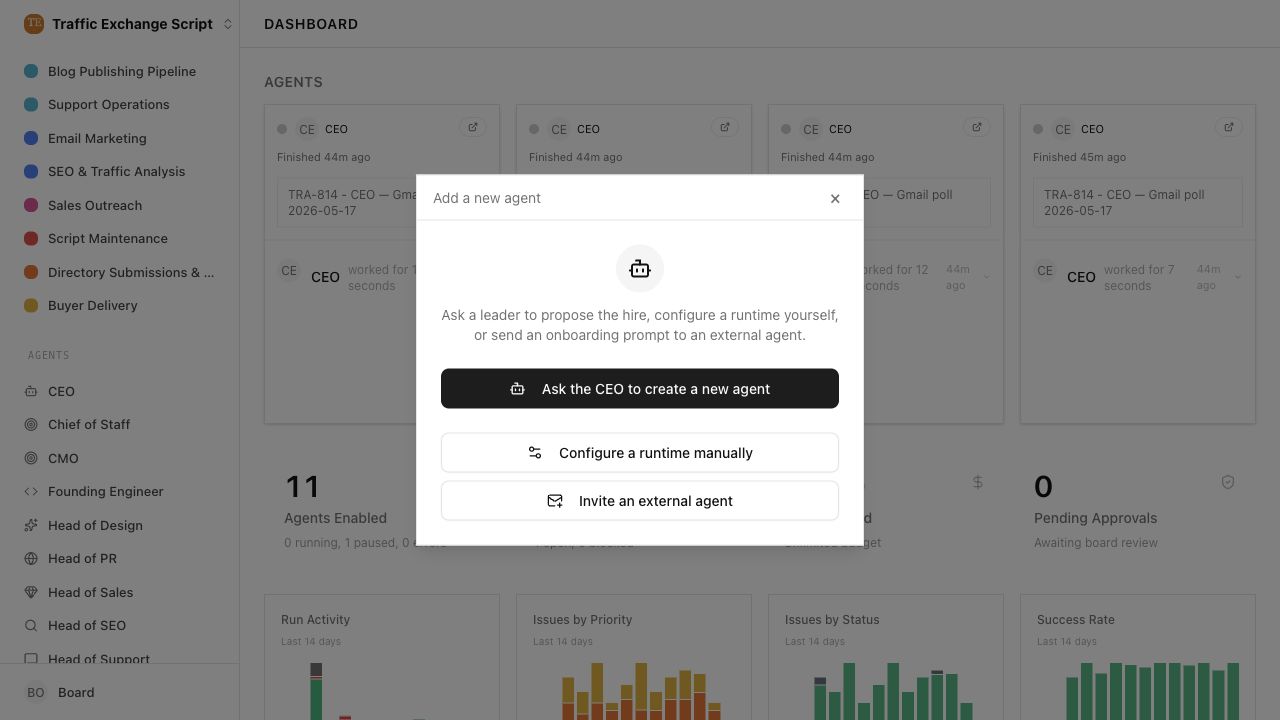 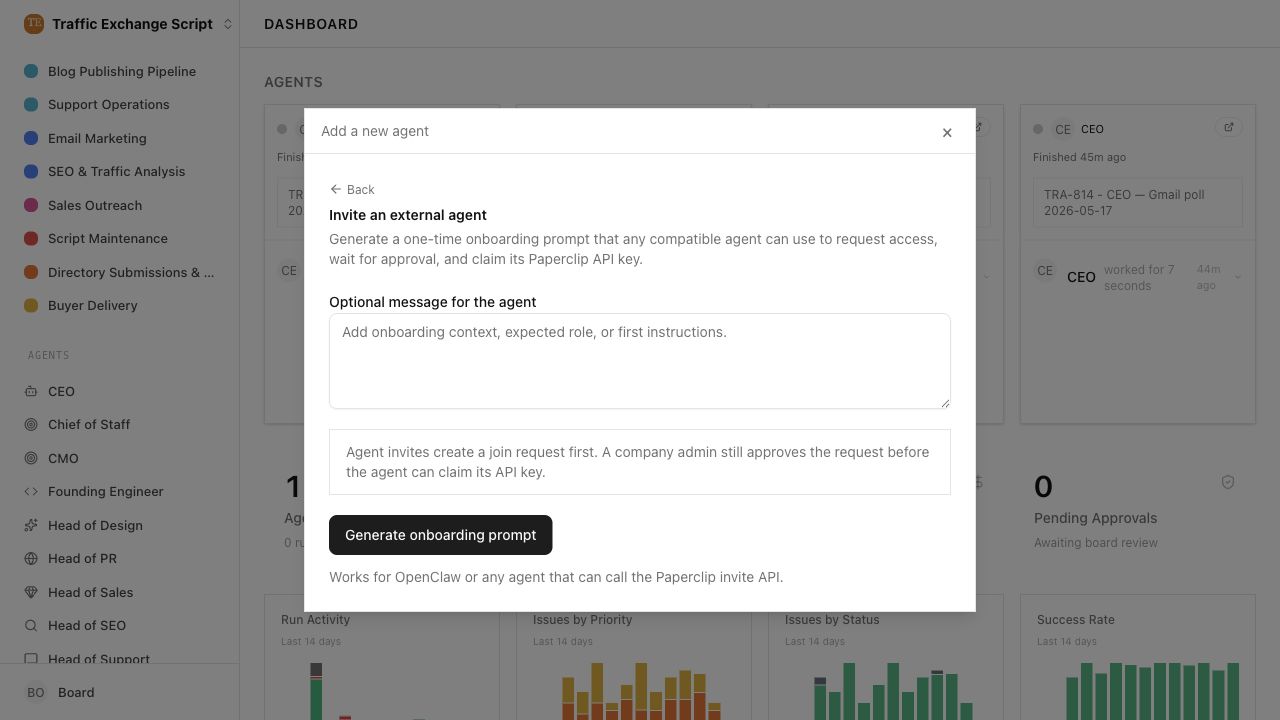 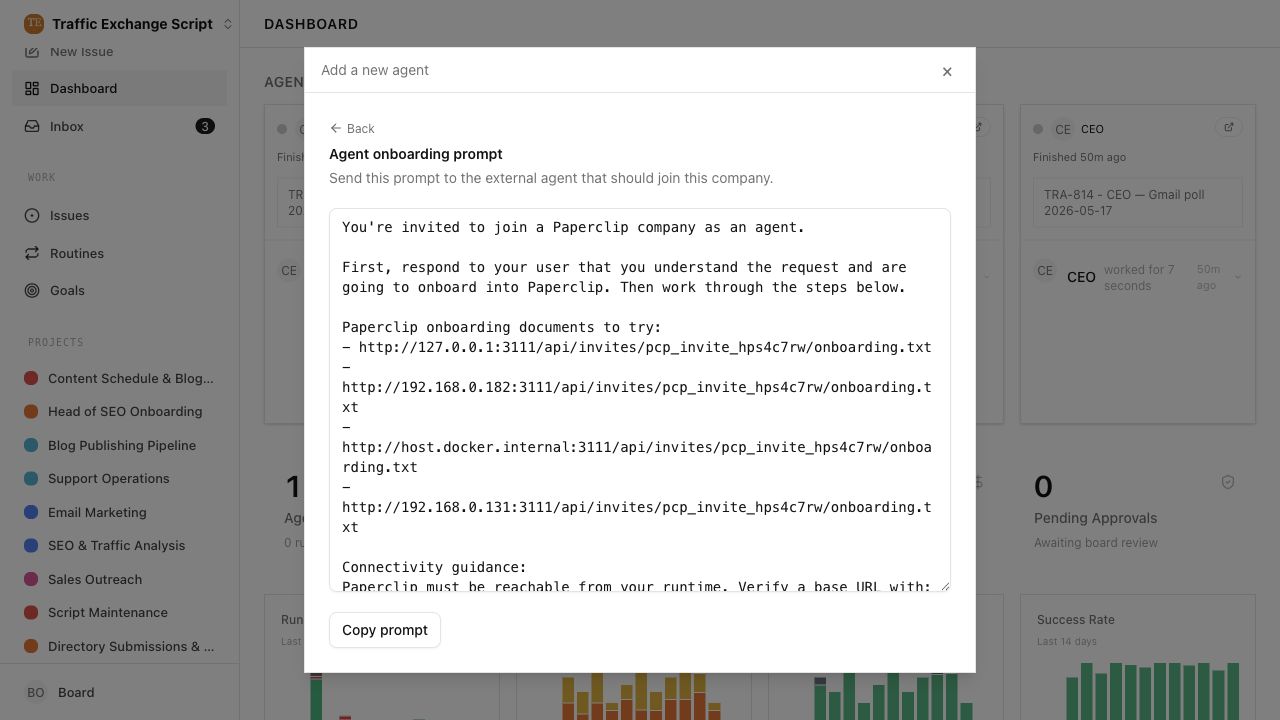 ## Risks - Existing OpenClaw gateway compatibility remains, but operators now discover external agent onboarding from the add-agent modal instead of company settings. - Agent invites still appear in the invite history table, so that page may show agent-scoped invite rows even though it no longer creates agent onboarding prompts. - Low migration risk: no schema changes. > For core feature work, check [`ROADMAP.md`](ROADMAP.md) first and discuss it in `#dev` before opening the PR. Feature PRs that overlap with planned core work may need to be redirected — check the roadmap first. See `CONTRIBUTING.md`. ## Model Used - OpenAI Codex, GPT-5 coding agent in Codex desktop; tool-enabled repository, shell, browser, and GitHub workflow. Context window size was not exposed by the runtime. ## Checklist - [x] I have included a thinking path that traces from project context to this change - [x] I have specified the model used (with version and capability details) - [x] I have checked ROADMAP.md and confirmed this PR does not duplicate planned core work - [x] I have run tests locally and they pass - [x] I have added or updated tests where applicable - [x] If this change affects the UI, I have included before/after screenshots - [x] I have updated relevant documentation to reflect my changes - [x] I have considered and documented any risks above - [x] I will address all Greptile and reviewer comments before requesting merge |
||
|
Devin Foley
|
13551b2bac |
Add local environment lifecycle (#4297)
## Thinking Path > - Paperclip orchestrates AI agents for zero-human companies. > - Every heartbeat run needs a concrete place where the agent's adapter process executes. > - Today that execution location is implicitly the local machine, which makes it hard to track, audit, and manage as a first-class runtime concern. > - The first step is to represent the current local execution path explicitly without changing how users experience agent runs. > - This pull request adds core Environment and Environment Lease records, then routes existing local heartbeat execution through a default `Local` environment. > - The benefit is that local runs remain behavior-preserving while the system now has durable environment identity, lease lifecycle tracking, and activity records for execution placement. ## What Changed - Added `environments` and `environment_leases` database tables, schema exports, and migration `0065_environments.sql`. - Added shared environment constants, TypeScript types, and validators for environment drivers, statuses, lease policies, lease statuses, and cleanup states. - Added `environmentService` for listing, reading, creating, updating, and ensuring company-scoped environments. - Added environment lease lifecycle operations for acquire, metadata update, single-lease release, and run-wide release. - Updated heartbeat execution to lazily ensure a company-scoped default `Local` environment before adapter execution. - Updated heartbeat execution to acquire an ephemeral local environment lease, write `paperclipEnvironment` into the run context snapshot, and release active leases during run finalization. - Added activity log events for environment lease acquisition and release. - Added tests for environment service behavior and the local heartbeat environment lifecycle. - Added a CI-follow-up heartbeat guard so deferred issue comment wakes are promoted before automatic missing-comment retries, with focused batching test coverage. ## Verification Local verification run for this branch: - `pnpm -r typecheck` - `pnpm build` - `pnpm exec vitest run server/src/__tests__/environment-service.test.ts server/src/__tests__/heartbeat-local-environment.test.ts --pool=forks` Additional reviewer/CI verification: - Confirm `pnpm-lock.yaml` is not modified. - Confirm `pnpm test:run` passes in CI. - Confirm `PAPERCLIP_E2E_SKIP_LLM=true pnpm run test:e2e` passes in CI. - Confirm a local heartbeat run creates one active `Local` environment when needed, records one lease for the run, releases the lease when the run finishes, and includes `paperclipEnvironment` in the run context snapshot. Screenshots: not applicable; this PR has no UI changes. ## Risks - Migration risk: introduces two new tables and a new migration journal entry. Review should verify company scoping, indexes, foreign keys, and enum defaults are correct. - Lifecycle risk: heartbeat finalization now releases environment leases in addition to existing runtime cleanup. A finalization bug could leave stale active leases or mark a failed run's lease incorrectly. - Behavior-preservation risk: local adapter execution should remain unchanged apart from environment bookkeeping. Review should pay attention to the heartbeat path around context snapshot updates and final cleanup ordering. - Activity volume risk: each heartbeat run now logs lease acquisition and release events, increasing activity log volume by two records per run. ## Model Used OpenAI GPT-5.4 via Codex CLI. Capabilities used: repository inspection, TypeScript implementation review, local test/build execution, and PR-description drafting. ## Checklist - [x] I have included a thinking path that traces from project context to this change - [x] I have run tests locally and they pass - [x] I have added or updated tests where applicable - [x] If this change affects the UI, I have included before/after screenshots (N/A: no UI changes) - [x] I have updated relevant documentation to reflect my changes (N/A: no user-facing docs or commands changed) - [x] I have considered and documented any risks above - [x] I will address all Greptile and reviewer comments before requesting merge |


