## Thinking Path
> - Paperclip orchestrates AI agents for zero-human companies.
> - Agent creation can happen through local runtimes, managed runtimes,
and external agents that onboard through invites.
> - The old OpenClaw-oriented invite UX lived under company
settings/invites and made a gateway-specific path look like a company
access setting.
> - That hid the broader bring-your-own-agent flow and forced operators
to leave the add-agent modal when adding an external agent.
> - This pull request moves external agent invite generation into the
add-agent modal and makes the copy agent-oriented instead of
OpenClaw-only.
> - The benefit is a clearer agent-first onboarding path while company
invites stay focused on human access.
## What Changed
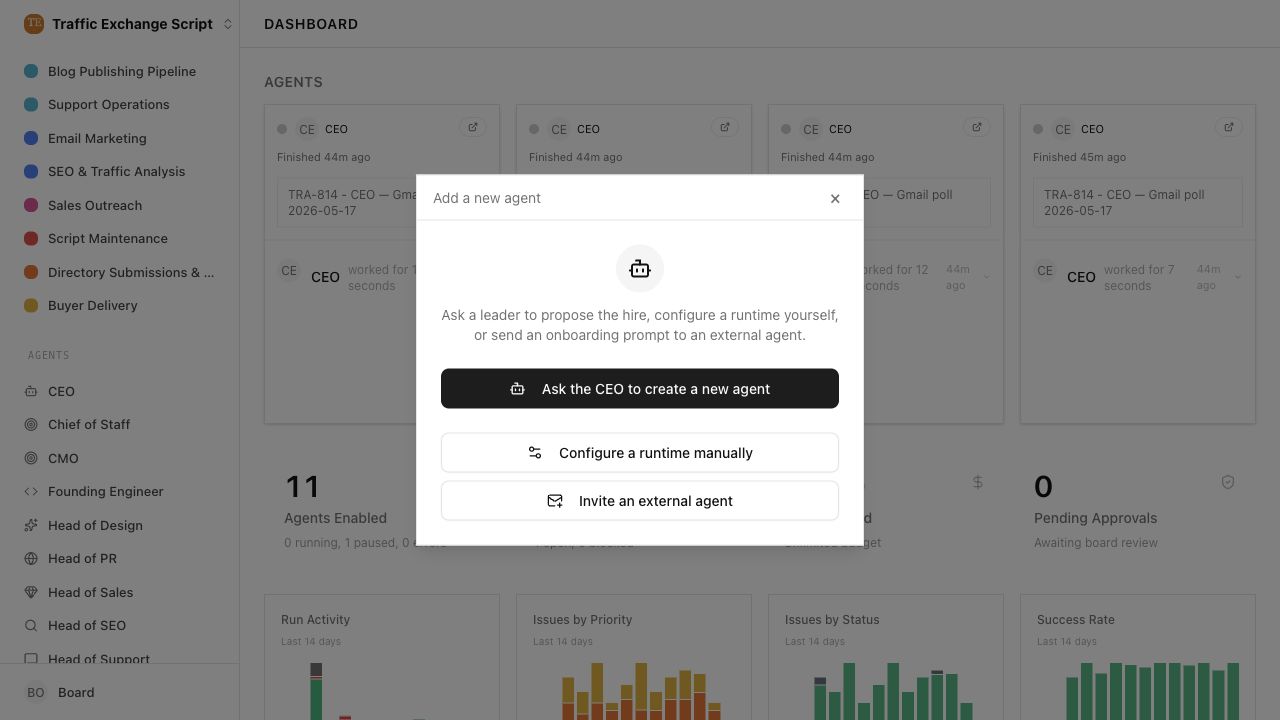
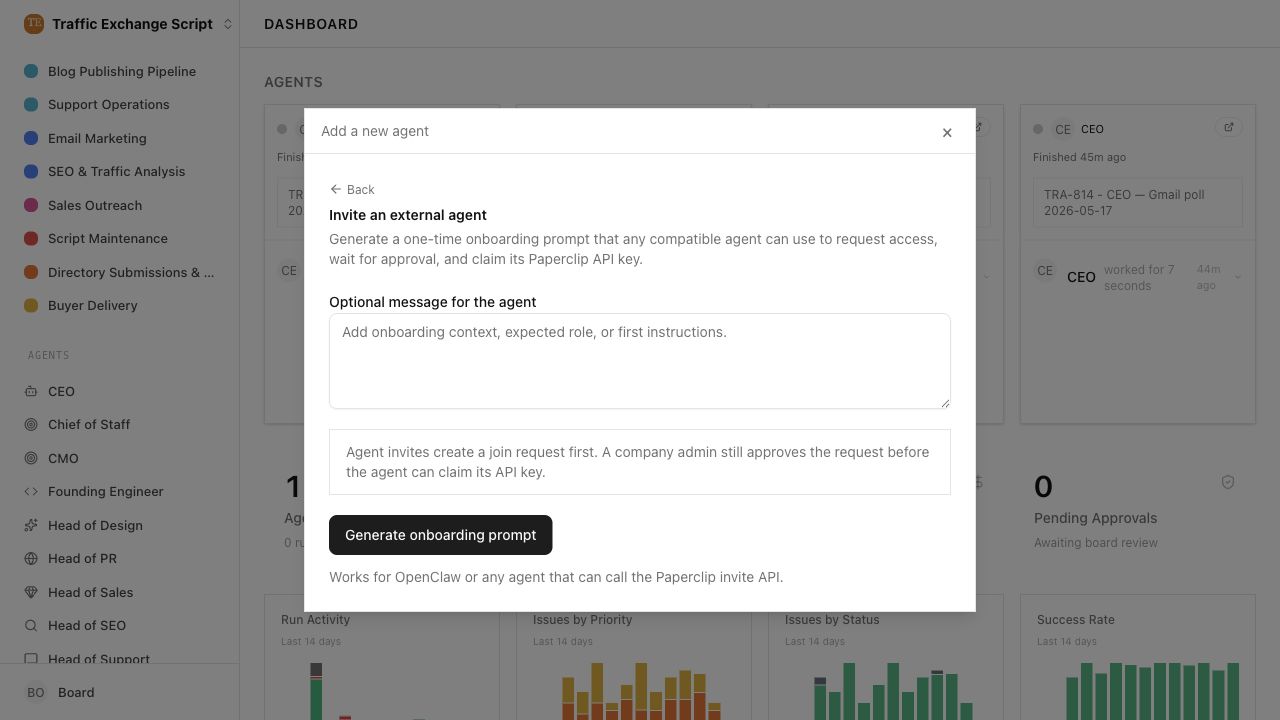
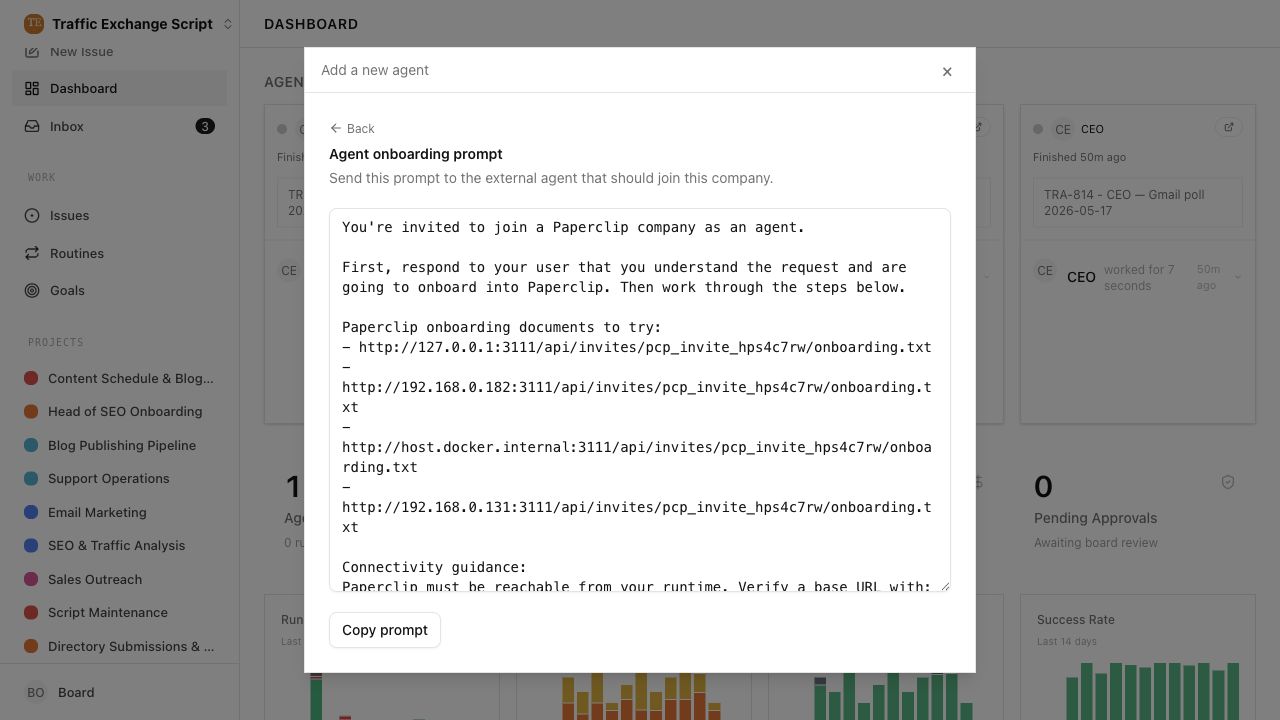
- Added an external-agent invite branch to the add-agent modal,
including a dedicated prompt result view with Back navigation.
- Added a shared agent onboarding prompt builder and focused modal
coverage for prompt replacement/back navigation.
- Removed the agent invite prompt UI from Company Settings and Company
Invites, leaving Company Invites focused on human access links and
invite history.
- Updated the hidden OpenClaw Gateway runtime hint to direct operators
to the add-agent invite flow instead of presenting it as a blocked
runtime card.
- Updated invite/onboarding docs, storybook coverage, and server-side
onboarding copy toward generic agent language while preserving existing
gateway compatibility.
## Verification
- `pnpm -r typecheck`
- `pnpm build`
- `FAKE_BIN="$(mktemp -d)/bin"; mkdir -p "$FAKE_BIN"; printf
'#!/bin/sh\nexit 1\n' > "$FAKE_BIN/tailscale"; chmod +x
"$FAKE_BIN/tailscale"; PATH="$FAKE_BIN:$PATH" pnpm test:run`
- `pnpm test:run` without the fake `tailscale` shim was also attempted;
it failed only in two pre-existing CLI tailnet fallback tests because
this host has a real Tailscale address (`100.125.202.3`) where those
tests expect no Tailscale.
- Focused confirmation for that host-env issue: `FAKE_BIN=...
PATH="$FAKE_BIN:$PATH" pnpm exec vitest run --project paperclipai
cli/src/__tests__/network-bind.test.ts
cli/src/__tests__/onboard.test.ts`
- Manual UI verification: served UI locally in light mode, opened
add-agent modal, generated external agent prompt, verified the generated
prompt replaces the form and Back returns to the form.
### Screenshots
## Risks
- Existing OpenClaw gateway compatibility remains, but operators now
discover external agent onboarding from the add-agent modal instead of
company settings.
- Agent invites still appear in the invite history table, so that page
may show agent-scoped invite rows even though it no longer creates agent
onboarding prompts.
- Low migration risk: no schema changes.
> For core feature work, check [`ROADMAP.md`](ROADMAP.md) first and
discuss it in `#dev` before opening the PR. Feature PRs that overlap
with planned core work may need to be redirected — check the roadmap
first. See `CONTRIBUTING.md`.
## Model Used
- OpenAI Codex, GPT-5 coding agent in Codex desktop; tool-enabled
repository, shell, browser, and GitHub workflow. Context window size was
not exposed by the runtime.
## Checklist
- [x] I have included a thinking path that traces from project context
to this change
- [x] I have specified the model used (with version and capability
details)
- [x] I have checked ROADMAP.md and confirmed this PR does not duplicate
planned core work
- [x] I have run tests locally and they pass
- [x] I have added or updated tests where applicable
- [x] If this change affects the UI, I have included before/after
screenshots
- [x] I have updated relevant documentation to reflect my changes
- [x] I have considered and documented any risks above
- [x] I will address all Greptile and reviewer comments before
requesting merge
## Thinking Path

> - Paperclip orchestrates AI agents for zero-human companies
> - Agents can run on remote hosts via SSH environments
> - When a remote agent needs to call back to the Paperclip API, it
needs a reachable URL
> - But the runtime API URL candidate builder did not account for
private network topologies where the server is only reachable via LAN or
VPN addresses
> - Agents on SSH hosts were failing to connect because the callback URL
pointed to localhost or an unreachable address
> - This PR fixes callback URL selection to honor `PAPERCLIP_API_URL`,
prefer LAN-reachable candidates, filter unreachable link-local
addresses, and include interface hosts in onboarding invite URLs
> - The benefit is SSH-based agents can reliably reach the Paperclip API
on private networks without manual URL configuration

## What Changed

- `runtime-api.ts`: Added `PAPERCLIP_API_URL` as a first-priority
candidate in `buildRuntimeApiCandidateUrls`; extracted
`collectReachableInterfaceHosts` to enumerate non-loopback,
non-link-local network interface IPs with IPv4 preference
- `server/src/index.ts`: Export `PAPERCLIP_API_URL` from the server
environment so it is available to callback candidate resolution
- `server/src/routes/access.ts`: Include LAN interface hosts in
onboarding invite connection candidates
- `server/src/config.ts`: Attempted auto-allowing LAN interface hosts,
then reverted to the per-instance allowlist approach (both commits
included for history clarity)

## Verification

- `pnpm test` — all existing and new tests pass, including new tests for
LAN candidate ordering and link-local filtering
- `pnpm typecheck` — clean
- Manual: start a Paperclip server on a machine with a LAN IP, create an
SSH environment pointing to another host on the same LAN, verify the
agent's callback URL uses the LAN IP rather than localhost

## Risks

- Low-medium. The candidate list now includes more addresses (all
non-loopback LAN interfaces). These are candidates for the agent to try,
not an allowlist — the server's allowed hostnames still gate which
origins are accepted. Ordering change (LAN preferred over loopback)
could affect existing setups where localhost was intentionally
preferred.

## Model Used

Codex GPT 5.4 high via Paperclip.

## Checklist

- [x] I have included a thinking path that traces from project context
to this change
- [x] I have specified the model used (with version and capability
details)
- [x] I have checked ROADMAP.md and confirmed this PR does not duplicate
planned core work
- [x] I have run tests locally and they pass
- [x] I have added or updated tests where applicable
- [ ] If this change affects the UI, I have included before/after
screenshots
- [x] I have updated relevant documentation to reflect my changes
- [x] I have considered and documented any risks above
- [x] I will address all Greptile and reviewer comments before
requesting merge
## Thinking Path

> - Paperclip orchestrates AI agents for zero-human companies
> - The control plane depends on authenticated routes enforcing company
boundaries and role permissions correctly
> - This branch also touches the issue detail and markdown editing flows
operators use while handling advisory and triage work
> - Partial issue cache seeds and fragile rich-editor parsing could
leave important issue content missing or blank at the moment an operator
needed it
> - Blocked issues becoming actionable again should wake their assignee
automatically instead of silently staying idle
> - This pull request rebases the advisory follow-up branch onto current
`master`, hardens authenticated route authorization, and carries the
issue-detail/editor reliability fixes forward with regression tests
> - The benefit is tighter authz on sensitive routes plus more reliable
issue/advisory editing and wakeup behavior on top of the latest base

## What Changed

- Hardened authenticated route authorization across agent, activity,
approval, access, project, plugin, health, execution-workspace,
portability, and related server paths, with new cross-tenant and
runtime-authz regression coverage.
- Switched issue detail queries from `initialData` to placeholder-based
hydration so list/quicklook seeds still refetch full issue bodies.
- Normalized advisory-style HTML images before mounting the markdown
editor and strengthened fallback behavior when the rich editor silently
fails or rejects the content.
- Woke assigned agents when blocked issues move back to `todo`, with
route coverage for reopen and unblock transitions.
- Rebasing note: this branch now sits cleanly on top of the latest
`master` tip used for the PR base.

## Verification

- `pnpm exec vitest run ui/src/lib/issueDetailQuery.test.tsx
ui/src/components/MarkdownEditor.test.tsx
server/src/__tests__/issue-comment-reopen-routes.test.ts
server/src/__tests__/activity-routes.test.ts
server/src/__tests__/agent-cross-tenant-authz-routes.test.ts`
- Confirmed `pnpm-lock.yaml` is not part of the PR diff.
- Rebased the branch onto current `public-gh/master` before publishing.

## Risks

- Broad authz tightening may expose existing flows that were relying on
permissive board or agent access and now need explicit grants.
- Markdown editor fallback changes could affect focus or rendering in
edge-case content that mixes HTML-like advisory markup with normal
markdown.
- This verification was intentionally scoped to touched regressions and
did not run the full repository suite.

## Model Used

- OpenAI Codex, GPT-5-based coding agent in the Codex CLI environment
with tool use for terminal, git, and GitHub operations. The exact
runtime model identifier is not exposed inside this session.

## Checklist

- [x] I have included a thinking path that traces from project context
to this change
- [x] I have specified the model used (with version and capability
details)
- [x] I have run tests locally and they pass
- [x] I have added or updated tests where applicable
- [x] If this change affects the UI, it is behavior-only and does not
need before/after screenshots
- [x] I have updated relevant documentation to reflect my changes, or no
documentation changes were needed for these internal fixes
- [x] I have considered and documented any risks above
- [x] I will address all Greptile and reviewer comments before
requesting merge

---------

Co-authored-by: Paperclip <noreply@paperclip.ing>
 Aron Prins


