daa1324e5ffb9e9bbe02fb042444829285e44190
13 Commits
| Author | SHA1 | Message | Date | |
|---|---|---|---|---|
 Devin Foley Devin Foley
|
d9f91576a0 |
Add accepted-plan decomposition exact-once guards and UI state (#6831)
## Thinking Path > - Paperclip orchestrates AI agents for zero-human companies, so planning approvals and child-issue fan-out are part of the core control-plane loop. > - Accepted plans are supposed to be a safe bridge from planning into execution, especially when agents wake from review decisions and reuse isolated workspaces. > - The duplicate-subtask incident showed that an accepted plan revision could be interpreted more than once across overlapping runs, which broke the single-source-of-truth model for issue decomposition. > - Fixing that required tightening the backend contract first: accepted-plan decomposition needs an exact-once fingerprint, durable claim state, and retry-safe child creation. > - Once that backend behavior existed, the board still needed visibility into what happened, so the issue detail view needed a dedicated decomposition section instead of forcing operators to reconstruct child creation from raw activity. > - This pull request adds the exact-once decomposition primitive, hardens wake routing and regressions around the incident, and surfaces decomposition state in the UI so future incidents are both prevented and easier to inspect. ## What Changed - Added accepted-plan decomposition semantics to `doc/execution-semantics.md`, including the exact-once fingerprint, durable claim/result expectations, and retry/resume behavior. - Added persistent accepted-plan decomposition claims in the backend, including schema, shared types/validators, service logic, and issue routes for creating and listing decomposition state. - Hardened heartbeat routing so an accepted-plan continuation stays scoped to the relevant planning issue instead of opportunistically re-decomposing another accepted issue on the same assignee. - Added regression coverage for the original failure modes: concurrent same-parent retries, cross-issue accepted-plan isolation, and partial child recreation under the same fingerprint. - Added the `Plan decomposition` issue-detail section plus supporting API/query-key/activity formatting updates so operators can see revision status, owner, child counts, and the linked child issues directly in the UI. - Included the small follow-up UI fix so the decomposition section still renders when the issue work mode is no longer `planning`. ## Verification - `pnpm --filter @paperclipai/server typecheck` - `pnpm --filter @paperclipai/ui typecheck` - `pnpm --filter @paperclipai/db typecheck` - `pnpm exec vitest run server/src/__tests__/issues-service.test.ts` - `pnpm exec vitest run server/src/__tests__/issues-service.test.ts -t "lists persisted decompositions with child issue summaries"` - `pnpm exec vitest run server/src/__tests__/issues-service.test.ts -t "accepted plan decomposition" server/src/__tests__/heartbeat-accepted-plan-workspace-refresh.test.ts server/src/__tests__/heartbeat-context-summary.test.ts` - Manual UI path: create a planning issue without an isolated execution workspace, add a `plan` document, accept the `request_confirmation`, let Paperclip create child issues, then reopen the parent issue detail page and confirm the `Plan decomposition` section shows the accepted revision, status, idempotent-claim badge, and child links. - Separate follow-up bug noted during manual UI validation: accepting a plan on an issue whose run never records `workspace_finalize` is tracked in `PAPA-445` and is not part of this PR’s fix scope. ## Risks - This adds a new migration and a large Drizzle snapshot update; reviewers should confirm the schema shape and generated metadata match the intended decomposition table. - The exact-once claim changes sit on the accepted-plan fan-out path, so regressions there could block legitimate child creation or mis-handle retries if the claim state machine is wrong. - The new UI only appears when decomposition records exist; reviewers should use the manual verification path above rather than expecting existing issues on a stale local instance to show the section automatically. - `PAPA-445` remains an open follow-up for the `workspace_finalize` accept gate when a planning handoff never records finalize; that bug can interfere with reproducing the UI flow on isolated workspaces but does not change the correctness of the exact-once decomposition feature itself. > Checked `ROADMAP.md`: this PR is a bug fix / control-plane hardening change for accepted-plan decomposition, not a new uncoordinated roadmap feature. ## Model Used - OpenAI Codex via Paperclip `codex_local` (GPT-5-based coding agent; exact backend model ID/context window not exposed in the run context), with repository tool use, shell execution, and code-editing capabilities. <img width="806" height="1069" alt="Screenshot 2026-05-27 at 11 05 48 PM" src="https://github.com/user-attachments/assets/5b00b670-96cd-4470-b0a3-581743bcae28" /> ## Checklist - [x] I have included a thinking path that traces from project context to this change - [x] I have specified the model used (with version and capability details) - [x] I have checked ROADMAP.md and confirmed this PR does not duplicate planned core work - [x] I have run tests locally and they pass - [x] I have added or updated tests where applicable - [x] If this change affects the UI, I have included before/after screenshots - [x] I have updated relevant documentation to reflect my changes - [x] I have considered and documented any risks above - [x] I will address all Greptile and reviewer comments before requesting merge --------- Co-authored-by: Paperclip <noreply@paperclip.ing> |
||
|
Dotta
|
012a738729 |
Add ordered sub-issue navigation (#5938)
## Thinking Path > - Paperclip orchestrates AI-agent companies through company-scoped issues, comments, and execution context. > - The issue detail page is the board surface where operators and agents inspect a task in its parent/child workflow. > - Ordered sub-issues need a low-friction way to move through work without returning to the parent list after every issue. > - Existing issue detail navigation only covered sibling transitions and did not continue into a parent issue's first ordered child. > - This pull request adds ordered previous/next navigation for issue detail views and extends it to continue from a parent or last sibling into the first direct child. > - The benefit is a smoother review/execution path through hierarchical work while preserving hidden issue filtering and dependency-aware ordering. ## What Changed - Added `IssueSiblingNavigation` and route-state handling so issue detail footers can link to previous/next ordered issues. - Extended sub-issue ordering helpers to build navigation from siblings plus direct children, including root-parent and last-sibling-to-first-child cases. - Added page, component, and library tests for ordered sibling navigation, child fallback navigation, hidden issues, and link rendering. - Fixed the quicklook blur/click race Greptile found by deferring close until after portaled link clicks can complete, with a regression test. - Polished the navigation landmark label so it remains accurate when the next target is a direct child rather than a sibling. ## Verification - `pnpm exec vitest run src/components/IssueLinkQuicklook.test.tsx src/lib/issue-detail-subissues.test.ts src/components/IssueSiblingNavigation.test.tsx src/pages/IssueDetail.test.tsx --config vitest.config.ts` from `ui/` - 31 tests passed. - `pnpm --filter @paperclipai/ui typecheck` - passed. - `git diff --check` - passed. - GitHub PR checks on latest head `34046be2` - passed: Greptile Review, verify, e2e, Canary Dry Run, policy, Snyk, and serialized server shards. - Screenshots: not captured in this heartbeat; this PR is a draft and the changed states are covered by focused component/page tests. ## Risks - Low risk; this is a UI navigation addition with no database or API contract changes. - The main behavioral risk is navigation ordering drift if `workflowSort` expectations change later. - The IssueDetail navigation now waits for child issue loading, which avoids stale child fallback links but can delay footer navigation briefly while data loads. > For core feature work, check [`ROADMAP.md`](ROADMAP.md) first and discuss it in `#dev` before opening the PR. Feature PRs that overlap with planned core work may need to be redirected - check the roadmap first. See `CONTRIBUTING.md`. ## Model Used - OpenAI Codex, GPT-5 coding agent with repository tool use and shell execution. ## Checklist - [x] I have included a thinking path that traces from project context to this change - [x] I have specified the model used (with version and capability details) - [x] I have checked ROADMAP.md and confirmed this PR does not duplicate planned core work - [x] I have run tests locally and they pass - [x] I have added or updated tests where applicable - [ ] If this change affects the UI, I have included before/after screenshots - [x] I have updated relevant documentation to reflect my changes - [x] I have considered and documented any risks above - [x] I will address all Greptile and reviewer comments before requesting merge --------- Co-authored-by: Paperclip <noreply@paperclip.ing> |
||
|
Dotta
|
0808b388ee |
[codex] Add source-scoped recovery actions (#5599)
## Thinking Path > - Paperclip is a control plane for autonomous AI companies, where work must end with a clear disposition rather than ambiguous agent liveness. > - Recovery currently detects stalled or missing-next-step issues, but source issue recovery can become split across child recovery issues, blockers, and comments. > - That makes it harder for operators and agents to see who owns recovery and what exact action is needed on the original issue. > - Source-scoped recovery actions give the original issue a first-class active recovery state with owner, evidence, wake policy, and resolution outcome. > - This pull request adds the recovery-action data model, backend reconciliation and resolution APIs, and board UI indicators/actions. > - The benefit is clearer stalled-work recovery without losing source issue context or relying on comments as the liveness path. ## What Changed - Added the `issue_recovery_actions` schema, shared types/constants/validators, and an idempotent `0084_issue_recovery_actions` migration ordered after current `master` migrations. - Updated stranded/missing-disposition recovery to create source-scoped recovery actions, wake the recovery owner on the source issue, and avoid locking the source issue for recovery-action wakes. - Added API support for reading active recovery actions on issue detail/list surfaces and resolving them with restored, blocked, cancelled, or false-positive outcomes. - Require blocked recovery resolutions to have an unresolved first-class blocker, and removed the UI shortcut that could mark recovery blocked without a blocker selection path. - Surfaced recovery indicators/actions in the issue UI, blocker notices, active run panels, issue rows, and Storybook coverage. - Updated docs and focused tests for recovery semantics, ownership, races, stale comments, and UI behavior. ## Verification - `pnpm exec vitest run server/src/__tests__/issue-recovery-actions.test.ts server/src/__tests__/heartbeat-process-recovery.test.ts ui/src/components/IssueRecoveryActionCard.test.tsx ui/src/components/IssueBlockedNotice.test.tsx ui/src/api/issues.test.ts` — 5 files, 72 tests passed. - `pnpm --filter @paperclipai/shared typecheck` — passed. - `pnpm --filter @paperclipai/db typecheck` — passed, including migration numbering check. - `pnpm --filter @paperclipai/server typecheck` — passed. - `pnpm --filter @paperclipai/ui typecheck` — passed. - Follow-up verification after blocker-resolution guard: `pnpm exec vitest run server/src/__tests__/issue-recovery-actions.test.ts ui/src/components/IssueRecoveryActionCard.test.tsx ui/src/api/issues.test.ts` — 3 files, 27 tests passed. - Follow-up `pnpm --filter @paperclipai/server typecheck` — passed. - Follow-up `pnpm --filter @paperclipai/ui typecheck` — passed. - UI states are available in `ui/storybook/stories/source-issue-recovery.stories.tsx`; screenshot capture helper is `scripts/screenshot-recovery-card.cjs`. ## Risks - Medium: recovery behavior changes from child recovery issue ownership toward source-scoped actions, so operators may see stalled-work state in new places. - Migration risk is mitigated by using the next migration slot after `master` and making the table/constraints/index creation idempotent for anyone who previously applied the old branch-local `0082_dizzy_master_mold` migration. - Existing child recovery issue paths are still guarded for already-created recovery issues, but new source-scoped flows should be watched in CI and Greptile review. > For core feature work, check [`ROADMAP.md`](ROADMAP.md) first and discuss it in `#dev` before opening the PR. Feature PRs that overlap with planned core work may need to be redirected — check the roadmap first. See `CONTRIBUTING.md`. ## Model Used - OpenAI Codex, GPT-5 coding agent, tool use enabled for shell, Git, GitHub, and local test execution. Context window not exposed by the runtime. ## Checklist - [x] I have included a thinking path that traces from project context to this change - [x] I have specified the model used (with version and capability details) - [x] I have checked ROADMAP.md and confirmed this PR does not duplicate planned core work - [x] I have run tests locally and they pass - [x] I have added or updated tests where applicable - [x] If this change affects the UI, I have included before/after screenshots - [x] I have updated relevant documentation to reflect my changes - [x] I have considered and documented any risks above - [x] I will address all Greptile and reviewer comments before requesting merge --------- Co-authored-by: Paperclip <noreply@paperclip.ing> |
||
|
Devin Foley
|
0e1a582831 |
Revert "Add experimental newest-first issue thread" (#5460)
This is actually bad. Glad it was under experiments. |
||
|
Devin Foley
|
a904effb96 |
Add experimental newest-first issue thread (#5455)
## Thinking Path > - Paperclip orchestrates AI agents for zero-human companies, so issue threads are a core operator surface for reviewing work. > - The issue detail page is the place where humans read agent messages, user comments, and execution context together. > - That thread originally rendered oldest-first, which made recent activity harder to see during active review. > - Reversing the thread order changes navigation expectations, timestamp placement, and the "Jump to latest" affordance, so the UI behavior needed to move as a coherent set. > - Because this is a visible core-product behavior shift, it also needed a safe rollout path instead of becoming the default immediately. > - This pull request adds the newest-first issue thread behavior behind an Experimental setting, updates the thread UI to match that mode, and keeps the legacy oldest-first experience unchanged by default. > - The benefit is that reviewers can opt into a more recent-first issue workflow without forcing a global behavior change on every Paperclip instance. ## What Changed - Reversed issue thread rendering so the newest comments and messages appear first when the experiment is enabled. - Moved the plain comment timestamp into the card header in newest-first mode and kept the legacy timestamp placement for oldest-first mode. - Moved the `Jump to latest` control to the bottom of the thread in newest-first mode while leaving the existing top placement for the legacy mode. - Added the `Enable Newest-First Issue Thread` experimental instance setting and wired issue detail to read that toggle. - Added regression coverage for thread order, timestamp placement, jump-button placement, and the issue-detail experiment toggle behavior. ## Verification - `pnpm -r typecheck` - `pnpm test:run` - `pnpm build` - Focused checks that also passed during issue review: - `pnpm vitest run src/components/IssueChatThread.test.tsx src/pages/IssueDetail.test.tsx` in `ui/` - `pnpm vitest run src/__tests__/instance-settings-routes.test.ts` in `server/` - Manual review path: - Enable `Instance Settings > Experimental > Enable Newest-First Issue Thread` - Open an issue with comments/messages and confirm newest activity renders first, timestamps move into the header, and `Jump to latest` sits below the thread - Disable the experiment and confirm the legacy oldest-first behavior returns ## Risks - Low risk: the behavioral change is gated behind an instance-level experimental toggle and defaults off. - The main regression risk is thread navigation drift between the two modes, especially around anchor scrolling and the `Jump to latest` affordance. - There is some UI coupling between issue-detail query state and experimental settings fetches, so future changes in that area should keep both modes covered. - Screenshots are not attached in this PR body; verification is described with automated coverage and manual steps instead. > I checked [`ROADMAP.md`](ROADMAP.md). This is a scoped issue-thread UX improvement and rollout gate, not a duplicate of a roadmap-level planned core feature. ## Model Used - OpenAI Codex via the local `codex_local` Paperclip adapter, GPT-5-based coding agent with terminal tool use and local code execution in this repository worktree. ## Checklist - [x] I have included a thinking path that traces from project context to this change - [x] I have specified the model used (with version and capability details) - [x] I have checked ROADMAP.md and confirmed this PR does not duplicate planned core work - [x] I have run tests locally and they pass - [x] I have added or updated tests where applicable - [ ] If this change affects the UI, I have included before/after screenshots - [ ] I have updated relevant documentation to reflect my changes - [x] I have considered and documented any risks above - [x] I will address all Greptile and reviewer comments before requesting merge |
||
|
Dotta
|
a1b30c9f35 |
Add planning mode for issue work (#5353)
## Thinking Path > - Paperclip is a control plane for autonomous AI companies. > - Issues are the core unit of work, and issue comments are how board users and agents coordinate execution. > - Some issue conversations need to produce plans and approvals instead of immediate implementation work. > - The existing issue contract did not distinguish standard execution comments from planning-oriented issue work. > - This pull request adds an issue work-mode contract and board UI affordances for standard vs planning mode. > - The benefit is that planning-mode issues can be created, displayed, discussed, and carried through agent heartbeat context without losing the normal issue workflow. ## What Changed - Added `standard` / `planning` issue work-mode contracts across DB, shared validators/types, server issue flows, plugin protocol, and adapter heartbeat payloads. - Added an idempotent `0081_optimal_dormammu` migration for `issues.work_mode`, ordered after current `public-gh/master` migrations. - Updated heartbeat/context summaries and issue-thread interaction behavior so planning work mode is preserved when creating suggested follow-up issues. - Added UI support for planning-mode issue creation, issue rows, detail composer styling, and composer work-mode toggles. - Added focused server/shared/UI tests plus a Playwright visual verification spec for planning-mode surfaces. - Rebased the branch onto current `public-gh/master` and added durable planning-mode screenshots under `doc/assets/pap-3368/`. ## Verification - `pnpm --filter @paperclipai/db run check:migrations` - `pnpm exec vitest run --project @paperclipai/shared packages/shared/src/validators/issue.test.ts` - `pnpm exec vitest run --project @paperclipai/server server/src/__tests__/heartbeat-context-summary.test.ts server/src/__tests__/issue-thread-interactions-service.test.ts server/src/__tests__/issues-goal-context-routes.test.ts --pool=forks --poolOptions.forks.isolate=true` - `pnpm exec vitest run --project @paperclipai/ui ui/src/components/IssueChatThread.test.tsx ui/src/components/NewIssueDialog.test.tsx ui/src/components/IssueRow.test.tsx ui/src/pages/IssueDetail.test.tsx` - `pnpm exec vitest run --project @paperclipai/adapter-utils packages/adapter-utils/src/server-utils.test.ts` - `PAPERCLIP_E2E_SKIP_LLM=true npx playwright test --config tests/e2e/playwright.config.ts tests/e2e/planning-mode-visual-verification.spec.ts` ## Screenshots Desktop planning detail: 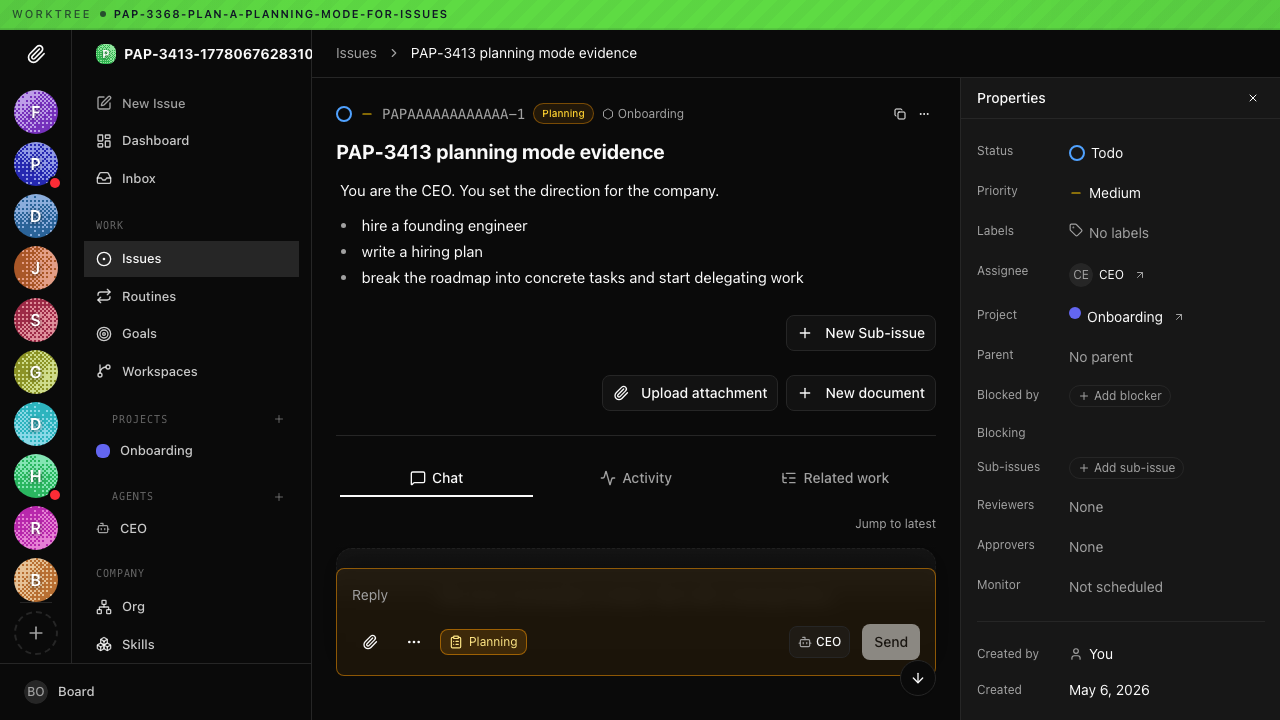 Desktop planning row: 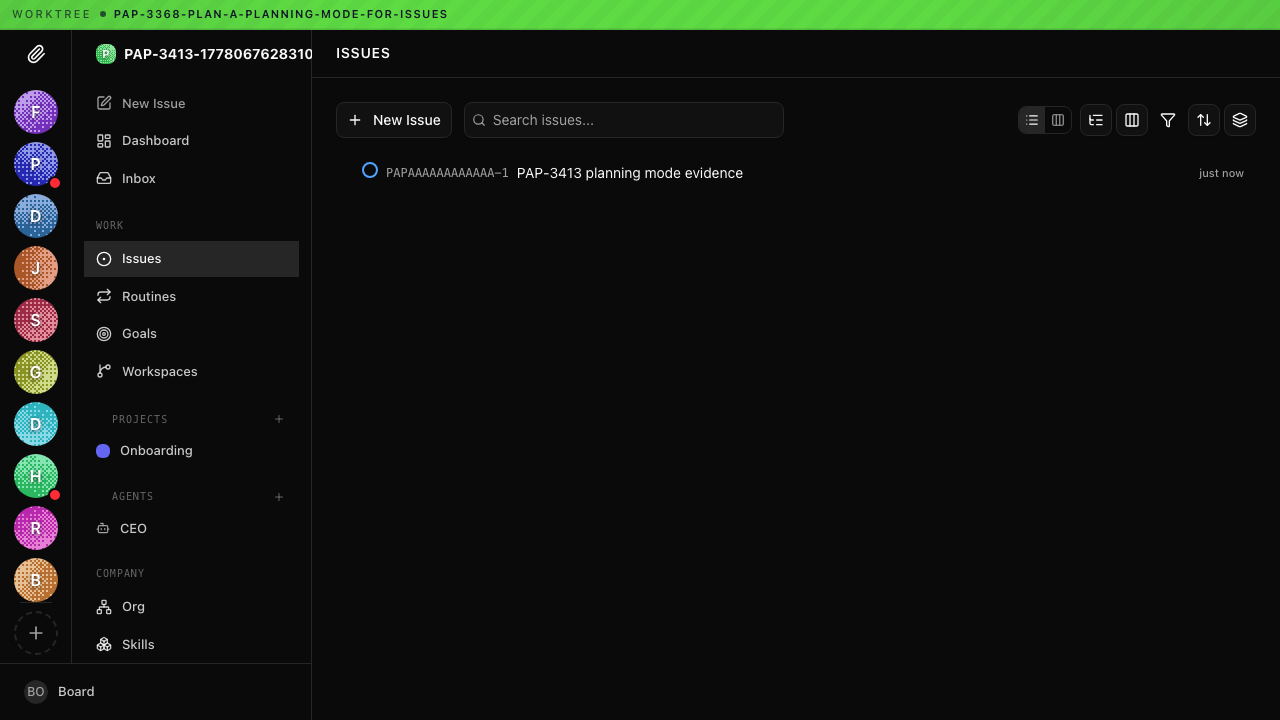 Desktop staged standard toggle: 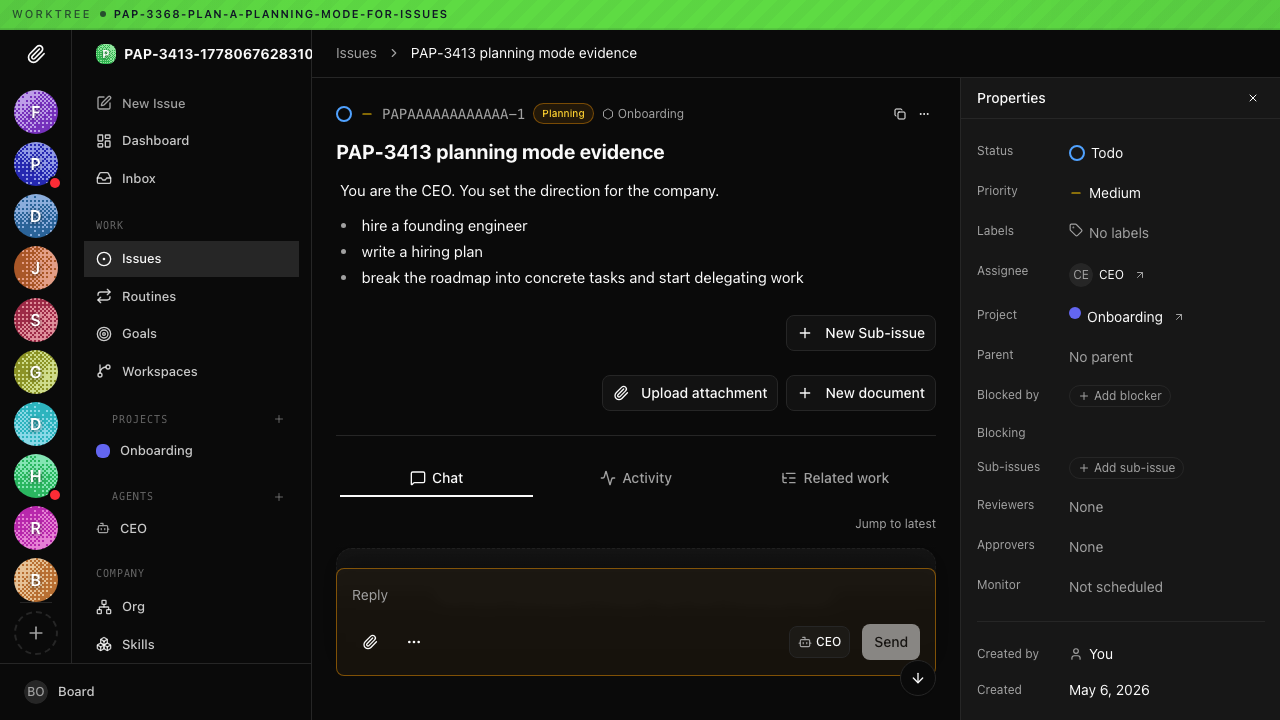 Mobile planning detail: 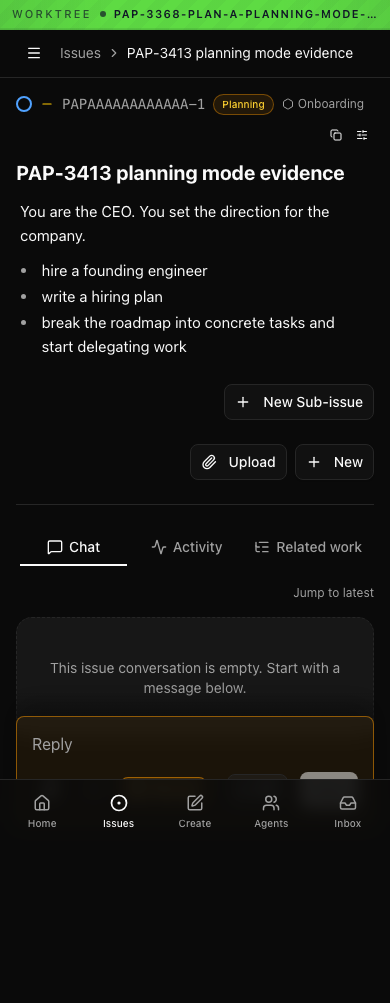 Mobile planning row: 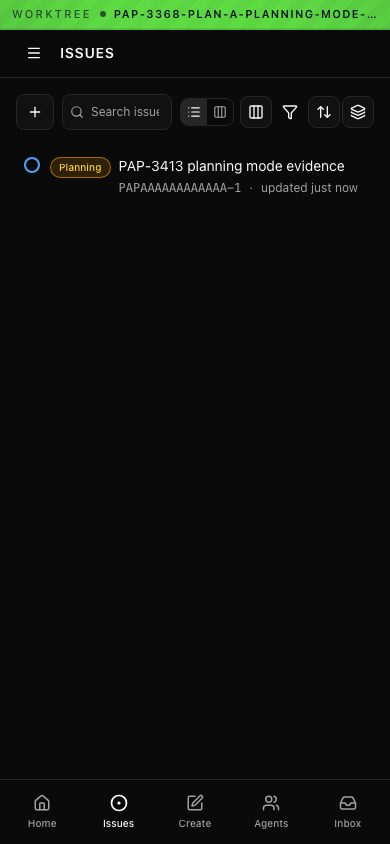 ## Risks - Medium migration risk: this adds a non-null issue column. The migration uses `ADD COLUMN IF NOT EXISTS` so installations that applied an older branch-local migration number can still apply the final numbered migration safely. - Medium contract risk: issue payloads, plugin payloads, and adapter heartbeat payloads now include work mode; compatibility is handled by defaulting missing values to `standard`. - UI risk is moderate because composer controls changed; focused component tests and visual e2e coverage exercise standard vs planning display and toggle behavior. > For core feature work, check [`ROADMAP.md`](ROADMAP.md) first and discuss it in `#dev` before opening the PR. Feature PRs that overlap with planned core work may need to be redirected — check the roadmap first. See `CONTRIBUTING.md`. ## Model Used - OpenAI Codex, GPT-5 coding agent in a local Paperclip worktree, with shell/tool use. Exact context-window size is not exposed in this runtime. ## Checklist - [x] I have included a thinking path that traces from project context to this change - [x] I have specified the model used (with version and capability details) - [x] I have checked ROADMAP.md and confirmed this PR does not duplicate planned core work - [x] I have run tests locally and they pass - [x] I have added or updated tests where applicable - [x] If this change affects the UI, I have included before/after screenshots - [x] I have updated relevant documentation to reflect my changes - [x] I have considered and documented any risks above - [x] I will address all Greptile and reviewer comments before requesting merge --------- Co-authored-by: Paperclip <noreply@paperclip.ing> |
||
|
Dotta
|
1fe1067361 |
Polish board settings and skills workflow (#4863)
## Thinking Path > - Paperclip's board UI and bundled skills are the operator layer for configuring agents, routines, issue workflows, and local troubleshooting loops. > - The prior rollup mixed this operator polish with database backups, backend reliability, thread scale, and cost/workflow primitives. > - This pull request isolates the remaining board QoL, settings, issue-detail integration, adapter config cleanup, and skills smoke tooling. > - It includes some integration-level overlap with the thread and workflow slices so this branch can run from `origin/master` while still preserving the full original work. > - Preferred merge order is the narrower primitives first, then this integration PR last. > - The benefit is that reviewers can inspect the user-facing board/settings/skills layer separately from backend infrastructure changes. ## What Changed - Added board/settings polish for agents, routines, company settings, project workspace detail, and issue detail controls. - Added agent/routine UI regression tests and New Issue dialog coverage. - Integrated issue-detail activity/cost/interaction surfaces and leaf work pause/resume controls. - Cleaned bundled adapter UI config defaults and onboarding copy. - Added terminal-bench loop and work-stoppage diagnosis skills plus a smoke test script. - Updated attachment type handling and Paperclip skill/API guidance. ## Verification - `pnpm install --frozen-lockfile` - `pnpm exec vitest run ui/src/pages/Agents.test.tsx ui/src/pages/Routines.test.tsx ui/src/components/NewIssueDialog.test.tsx ui/src/pages/IssueDetail.test.tsx server/src/__tests__/costs-service.test.ts server/src/__tests__/issue-thread-interaction-routes.test.ts server/src/__tests__/issue-thread-interactions-service.test.ts` - Result: 7 test files passed, 54 tests passed. - `pnpm run smoke:terminal-bench-loop-skill` - Result: JSON output included `"ok": true` and `"cleanup": true`. - UI screenshots not included because verification is focused component/page coverage for the changed board surfaces. ## Risks - This is the integration-heavy PR in the split and intentionally overlaps some component/API primitives with the issue-thread and workflow PRs so it can run from `origin/master`. - Preferred merge order: #4859, #4860, #4861, #4862, then this PR last. If earlier branches merge first, this PR may need a straightforward conflict refresh in shared UI files. - The terminal-bench smoke script creates temporary mock issues and relies on cleanup; the verified run returned `cleanup: true`. > For core feature work, check [`ROADMAP.md`](ROADMAP.md) first and discuss it in `#dev` before opening the PR. Feature PRs that overlap with planned core work may need to be redirected — check the roadmap first. See `CONTRIBUTING.md`. ## Model Used - OpenAI Codex, GPT-5.5, code execution and GitHub CLI tool use, medium reasoning effort. ## Checklist - [x] I have included a thinking path that traces from project context to this change - [x] I have specified the model used (with version and capability details) - [x] I have checked ROADMAP.md and confirmed this PR does not duplicate planned core work - [x] I have run tests locally and they pass - [x] I have added or updated tests where applicable - [x] If this change affects the UI, I have included before/after screenshots - [x] I have updated relevant documentation to reflect my changes - [x] I have considered and documented any risks above - [x] I will address all Greptile and reviewer comments before requesting merge --------- Co-authored-by: Paperclip <noreply@paperclip.ing> |
||
|
Dotta
|
6b7f6ce4b8 |
[codex] Split PR #4692 UI/QoL updates (#4701)
## Thinking Path > - Paperclip orchestrates AI agents through a company-scoped control plane. > - The affected surface is the board UI for issue threads, issue lists, routines, dialogs, navigation, and issue review indicators. > - Closed PR #4692 bundled backend, schema, docs, workflow, and UI/QoL work into one oversized change set. > - Greptile could not keep reviewing that broad PR because it exceeded the 100-file review limit and mixed unrelated concerns. > - This pull request extracts the UI/QoL slice into a fresh branch under the review limit while leaving workflow and lockfile churn out. > - The benefit is a focused review path for the board UI performance and workflow improvements without reopening the oversized PR. ## What Changed - Added long issue-thread virtualization, scroll-container binding, anchor preservation, latest-comment jump targeting, and related regression/perf fixtures. - Improved issue list scalability with scroll-based loading, server offset parameters, and pagination-focused UI tests. - Reduced new issue dialog typing churn and split dialog action subscriptions so broad layout/nav surfaces avoid unnecessary renders. - Added routine variables help and routine description mention options for users, agents, and projects. - Added productivity review badge/link UI and fixed the badge to use Paperclip's company-prefixed router link. - Kept the split PR below Greptile's review limit and excluded `.github/workflows/pr.yml` and `pnpm-lock.yaml`. ## Verification - `pnpm install --no-frozen-lockfile` in the clean worktree to install `@tanstack/react-virtual` locally without committing lockfile churn. - `pnpm --filter @paperclipai/ui exec vitest run --config vitest.config.ts src/components/IssueChatThread.test.tsx src/components/IssuesList.test.tsx src/components/NewIssueDialog.test.tsx src/pages/Routines.test.tsx src/pages/Issues.test.tsx` passed: 5 files, 83 tests. - `pnpm --filter @paperclipai/ui typecheck` passed. - `git diff --check origin/master..HEAD` passed. - Split-scope checks: 53 changed files; no `.github/workflows/pr.yml`; no `pnpm-lock.yaml`. - Screenshots were not captured in this heartbeat; the changes are primarily virtualization, routing, pagination, and editor behavior covered by focused regression tests. ## Risks - Moderate UI risk because issue-thread virtualization changes scroll behavior on long conversations; regression tests cover anchor jumps, latest-comment targeting, row metadata, and short-thread fallback. - Moderate integration risk because the issue-list offset parameter and productivity review field depend on matching API behavior. - Dependency risk: the UI package adds `@tanstack/react-virtual` while repository policy keeps `pnpm-lock.yaml` out of PRs, so CI must resolve dependency changes through the repo's normal lockfile policy. > For core feature work, check [`ROADMAP.md`](ROADMAP.md) first and discuss it in `#dev` before opening the PR. Feature PRs that overlap with planned core work may need to be redirected — check the roadmap first. See `CONTRIBUTING.md`. ## Model Used - OpenAI Codex, GPT-5 coding agent, tool-enabled local repository and GitHub workflow. Exact runtime context window was not exposed by the harness. ## Checklist - [x] I have included a thinking path that traces from project context to this change - [x] I have specified the model used (with version and capability details) - [x] I have checked ROADMAP.md and confirmed this PR does not duplicate planned core work - [x] I have run tests locally and they pass - [x] I have added or updated tests where applicable - [ ] If this change affects the UI, I have included before/after screenshots - [x] I have updated relevant documentation to reflect my changes - [x] I have considered and documented any risks above - [x] I will address all Greptile and reviewer comments before requesting merge --------- Co-authored-by: Paperclip <noreply@paperclip.ing> |
||
|
Dotta
|
82e257c7ba |
Cancel stale queued heartbeats when issue graph changes (PAP-2314) (#4534)
Co-Authored-By: Paperclip <noreply@paperclip.ing> |
||
|
Dotta
|
df425fde96 |
Present ordered sub-issues as a workflow checklist (#4523)
## Thinking Path > - Paperclip orchestrates AI agents for zero-human companies. > - Operators use issue detail pages and child issue lists to understand multi-step execution plans. > - Ordered sub-issues currently read like a flat table, so dependency chains and current next steps are harder to scan. > - The branch work adds a workflow-oriented presentation for child issues without changing the single-assignee task model. > - This pull request makes ordered sub-issues read more like a progress checklist while preserving normal issue list controls. > - The benefit is that operators can see completed steps, active work, blocked follow-ups, and dependency order at a glance. ## What Changed - Added workflow sorting utilities and tests for dependency-aware child issue ordering. - Added sub-issue progress summary, checklist numbering, current-step affordances, blocker context, and done-state de-emphasis in the issue list UI. - Wired issue detail sub-issue panels to use the workflow sort/progress checklist presentation. - Updated issue service behavior/tests for child issue ordering inputs used by the UI. - Added a Storybook visual review fixture and screenshot helper for the sub-issue workflow checklist surface. ## Verification - `pnpm run preflight:workspace-links && pnpm exec vitest run server/src/__tests__/issues-service.test.ts ui/src/components/IssueRow.test.tsx ui/src/components/IssuesList.test.tsx ui/src/pages/IssueDetail.test.tsx ui/src/lib/issue-detail-subissues.test.ts ui/src/lib/workflow-sort.test.ts` - Result: 6 test files passed, 55 tests passed, 34 embedded Postgres issue-service tests skipped because `@embedded-postgres/darwin-x64` is unavailable on this host. - Visual review: generated Storybook screenshots from the existing local Storybook server on port 6006 with `node scripts/screenshot-subissues.mjs /tmp/pap-2189-subissues-screens http://localhost:6006`. - Screenshot artifacts: - Desktop dark:  - Desktop light:  - Mobile dark:  - Mobile light:  - Local Storybook note: starting a second Storybook process selected port 6008 because 6006 was occupied, then Vite failed with an esbuild host/binary version mismatch (`0.25.12` host vs `0.27.3` binary). The already-running Storybook server on 6006 served the fixture successfully for screenshots. ## Risks - Medium UI risk: the issue list now has additional sub-issue-specific visual states, so dense lists should be checked for spacing and scanability. - Low ordering risk: workflow sorting is covered by focused unit tests, but unusual dependency topologies may still need reviewer attention. - No migration risk: this PR does not add database migrations or touch `pnpm-lock.yaml`. > For core feature work, check [`ROADMAP.md`](ROADMAP.md) first and discuss it in `#dev` before opening the PR. Feature PRs that overlap with planned core work may need to be redirected — check the roadmap first. See `CONTRIBUTING.md`. ## Model Used - OpenAI Codex, GPT-5 coding agent, tool-enabled shell/git/GitHub workflow. Context window is runtime-provided and not exposed in this environment. ## Checklist - [x] I have included a thinking path that traces from project context to this change - [x] I have specified the model used (with version and capability details) - [x] I have checked ROADMAP.md and confirmed this PR does not duplicate planned core work - [x] I have run tests locally and they pass - [x] I have added or updated tests where applicable - [x] If this change affects the UI, I have included before/after screenshots - [x] I have updated relevant documentation to reflect my changes - [x] I have considered and documented any risks above - [x] I will address all Greptile and reviewer comments before requesting merge --------- Co-authored-by: Paperclip <noreply@paperclip.ing> |
||
|
Dotta
|
5a0c1979cf | [codex] Add runtime lifecycle recovery and live issue visibility (#4419) | ||
|
Dotta
|
7ad225a198 |
[codex] Improve issue thread review flow (#4381)
## Thinking Path > - Paperclip orchestrates AI agents for zero-human companies > - Issue detail is where operators coordinate review, approvals, and follow-up work with active runs > - That thread UI needs to surface blockers, descendants, review handoffs, and reply ergonomics clearly enough for humans to guide agent work > - Several small gaps in the issue-thread flow were making review and navigation clunkier than necessary > - This pull request improves the reply composer, descendant/blocker presentation, interaction folding, and review-request handoff plumbing together as one cohesive issue-thread workflow slice > - The benefit is a cleaner operator review loop without changing the broader task model ## What Changed - restored and refined the floating reply composer behavior in the issue thread - folded expired confirmation interactions and improved post-submit thread scrolling behavior - surfaced descendant issue context and inline blocker/paused-assignee notices on the issue detail view - tightened large-board first paint behavior in `IssuesList` - added loose review-request handoffs through the issue execution-policy/update path and covered them with tests ## Verification - `pnpm vitest run ui/src/pages/IssueDetail.test.tsx` - `pnpm vitest run server/src/__tests__/issues-service.test.ts server/src/__tests__/issue-execution-policy.test.ts` - `pnpm exec vitest run --project @paperclipai/ui ui/src/components/IssueChatThread.test.tsx ui/src/components/IssueProperties.test.tsx ui/src/components/IssuesList.test.tsx ui/src/lib/issue-tree.test.ts ui/src/api/issues.test.ts` - `pnpm exec vitest run --project @paperclipai/adapter-utils packages/adapter-utils/src/server-utils.test.ts` - `pnpm exec vitest run --project @paperclipai/server server/src/__tests__/issue-comment-reopen-routes.test.ts -t "coerces executor handoff patches into workflow-controlled review wakes|wakes the return assignee with execution_changes_requested"` - `pnpm exec vitest run --project @paperclipai/server server/src/__tests__/issue-execution-policy.test.ts server/src/__tests__/issues-service.test.ts` ## Visual Evidence - UI layout changes are covered by the focused issue-thread component and issue-detail tests listed above. Browser screenshots were not attachable from this automated greploop environment, so reviewers should use the running preview for final visual confirmation. ## Risks - Moderate UI-flow risk: these changes touch the issue detail experience in multiple spots, so regressions would most likely show up as thread-layout quirks or incorrect review-handoff behavior > For core feature work, check [`ROADMAP.md`](ROADMAP.md) first and discuss it in `#dev` before opening the PR. Feature PRs that overlap with planned core work may need to be redirected — check the roadmap first. See `CONTRIBUTING.md`. ## Model Used - OpenAI Codex GPT-5-based coding agent with tool use and code execution in the Codex CLI environment ## Checklist - [x] I have included a thinking path that traces from project context to this change - [x] I have specified the model used (with version and capability details) - [x] I have checked ROADMAP.md and confirmed this PR does not duplicate planned core work - [x] I have run tests locally and they pass - [x] I have added or updated tests where applicable - [x] If this change affects the UI, I have included before/after screenshots or documented the visual verification path - [ ] I have updated relevant documentation to reflect my changes - [x] I have considered and documented any risks above - [x] I will address all Greptile and reviewer comments before requesting merge --------- Co-authored-by: Paperclip <noreply@paperclip.ing> |
||
|
Dotta
|
f98c348e2b |
[codex] Add issue subtree pause, cancel, and restore controls (#4332)
## Thinking Path > - Paperclip orchestrates AI agents for zero-human companies. > - This branch extends the issue control-plane so board operators can pause, cancel, and later restore whole issue subtrees while keeping descendant execution and wake behavior coherent. > - That required new hold state in the database, shared contracts, server routes/services, and issue detail UI controls so subtree actions are durable and auditable instead of ad hoc. > - While this branch was in flight, `master` advanced with new environment lifecycle work, including a new `0065_environments` migration. > - Before opening the PR, this branch had to be rebased onto `paperclipai/paperclip:master` without losing the existing subtree-control work or leaving conflicting migration numbering behind. > - This pull request rebases the subtree pause/cancel/restore feature cleanly onto current `master`, renumbers the hold migration to `0066_issue_tree_holds`, and preserves the full branch diff in a single PR. > - The benefit is that reviewers get one clean, mergeable PR for the subtree-control feature instead of stale branch history with migration conflicts. ## What Changed - Added durable issue subtree hold data structures, shared API/types/validators, server routes/services, and UI flows for subtree pause, cancel, and restore operations. - Added server and UI coverage for subtree previewing, hold creation/release, dependency-aware scheduling under holds, and issue detail subtree controls. - Rebased the branch onto current `paperclipai/paperclip:master` and renumbered the branch migration from `0065_issue_tree_holds` to `0066_issue_tree_holds` so it no longer conflicts with upstream `0065_environments`. - Added a small follow-up commit that makes restore requests return `200 OK` explicitly while keeping pause/cancel hold creation at `201 Created`, and updated the route test to match that contract. ## Verification - `pnpm --filter @paperclipai/db typecheck` - `pnpm --filter @paperclipai/shared typecheck` - `pnpm --filter @paperclipai/server typecheck` - `pnpm --filter @paperclipai/ui typecheck` - `cd server && pnpm exec vitest run src/__tests__/issue-tree-control-routes.test.ts src/__tests__/issue-tree-control-service.test.ts src/__tests__/issue-tree-control-service-unit.test.ts src/__tests__/heartbeat-dependency-scheduling.test.ts` - `cd ui && pnpm exec vitest run src/components/IssueChatThread.test.tsx src/pages/IssueDetail.test.tsx` ## Risks - This is a broad cross-layer change touching DB/schema, shared contracts, server orchestration, and UI; regressions are most likely around subtree status restoration or wake suppression/resume edge cases. - The migration was renumbered during PR prep to avoid the new upstream `0065_environments` conflict. Reviewers should confirm the final `0066_issue_tree_holds` ordering is the only hold-related migration that lands. - The issue-tree restore endpoint now responds with `200` instead of relying on implicit behavior, which is semantically better for a restore operation but still changes an API detail that clients or tests could have assumed. > For core feature work, check [`ROADMAP.md`](ROADMAP.md) first and discuss it in `#dev` before opening the PR. Feature PRs that overlap with planned core work may need to be redirected — check the roadmap first. See `CONTRIBUTING.md`. ## Model Used - OpenAI Codex coding agent in the Paperclip Codex runtime (GPT-5-class tool-using coding model; exact deployment ID/context window is not exposed inside this session). ## Checklist - [x] I have included a thinking path that traces from project context to this change - [x] I have specified the model used (with version and capability details) - [x] I have checked ROADMAP.md and confirmed this PR does not duplicate planned core work - [x] I have run tests locally and they pass - [x] I have added or updated tests where applicable - [ ] If this change affects the UI, I have included before/after screenshots - [ ] I have updated relevant documentation to reflect my changes - [x] I have considered and documented any risks above - [x] I will address all Greptile and reviewer comments before requesting merge --------- Co-authored-by: Paperclip <noreply@paperclip.ing> |




