 Dotta
778e775c35
Dotta
778e775c35
## Thinking Path > - Paperclip orchestrates AI-agent companies and needs secrets handling to work across local development, hosted operators, and governed agent execution. > - The affected subsystem is the company-scoped secrets control plane: database schema, server services/routes, CLI workflows, and the Secrets settings UI. > - The gap was that secrets were local-only and operators could not manage provider vaults or import existing remote references without exposing plaintext. > - This branch adds provider vault configuration plus an AWS Secrets Manager remote-import path while preserving company boundaries, binding context, and audit trails. > - I kept the PR to a single branch PR, removed unrelated lockfile/package drift, rebased the full branch onto the current `public-gh/master`, and addressed fresh Greptile findings. > - The benefit is a reviewable implementation of provider-backed secrets with focused tests covering provider selection, import conflicts, deleted secret reuse, rotation guards, and AWS signing behavior. ## What Changed - Added provider vault support for company secrets, including provider config storage, default vault handling, health checks, binding usage, access events, and remote import preview/commit. - Added an AWS Secrets Manager provider using SigV4 request signing, bounded request timeouts, namespace guardrails, cached runtime credential resolution, and external-reference linking without plaintext reads. - Added Secrets UI surfaces for vault management and remote import, plus CLI/API documentation for setup and operations. - Stabilized routine webhook secret binding paths and SSH environment-driver fixture bindings discovered during verification. - Addressed Greptile and CI findings: no lockfile/package drift, monotonic migration metadata, disabled-vault default races, soft-deleted secret hiding/recreate behavior, remove behavior with disabled vaults, soft-deleted external-reference re-import, non-active rotation guards, managed-secret soft deletion through PATCH, and per-call AWS SDK credential client churn. - Rebased this branch onto `public-gh/master` at `0e1a5828` and force-pushed with lease to keep this as the single PR for the branch. ## Verification - `git fetch public-gh master` - `git rebase public-gh/master` - `git diff --name-only public-gh/master...HEAD | grep '^pnpm-lock\.yaml$' || true` confirmed `pnpm-lock.yaml` is not in the PR diff. - Confirmed migration ordering: master ends at `0081_optimal_dormammu`; this PR adds `0082_dry_vision` and `0083_company_secret_provider_configs`. - Inspected migrations for repeat safety: new tables/indexes use `IF NOT EXISTS`; foreign keys are guarded by `DO $$ ... IF NOT EXISTS`; column additions use `ADD COLUMN IF NOT EXISTS`. - `pnpm -r typecheck` passed before the Greptile follow-up commits. - `pnpm test:run` ran the full stable Vitest path before the Greptile follow-up commits; it completed with 3 timing-related failures under parallel load: `codex-local-execute.test.ts`, `cursor-local-execute.test.ts`, and `environment-service.test.ts`. - `pnpm --filter @paperclipai/server exec vitest run src/__tests__/codex-local-execute.test.ts src/__tests__/cursor-local-execute.test.ts src/__tests__/environment-service.test.ts` passed on targeted rerun (`24/24`). - `pnpm build` passed before the Greptile follow-up commits. Vite reported existing chunk-size/dynamic-import warnings. - After Greptile follow-up commits: `pnpm --filter @paperclipai/server exec vitest run src/__tests__/secrets-service.test.ts` passed (`26/26`). - After Greptile follow-up commits: `pnpm --filter @paperclipai/server exec vitest run src/__tests__/aws-secrets-manager-provider.test.ts src/__tests__/secrets-service.test.ts` passed (`39/39`). - After Greptile follow-up commits: `pnpm --filter @paperclipai/server typecheck` passed. - Captured Storybook screenshots from `ui/storybook-static` for visual review. - Latest PR checks on `5ca3a5cf`: `policy`, serialized server suites 1/4-4/4, `Canary Dry Run`, `e2e`, `security/snyk`, and `Greptile Review` pass; aggregate `verify` is still registering the completed child checks. - Greptile review loop continued through the latest requested pass; all Greptile review threads are resolved and the latest `Greptile Review` check on `5ca3a5cf` passed with 0 comments added. ## Screenshots Before: the provider-vault and remote-import surfaces did not exist on `master`; these are after-state screenshots from the Storybook fixtures. 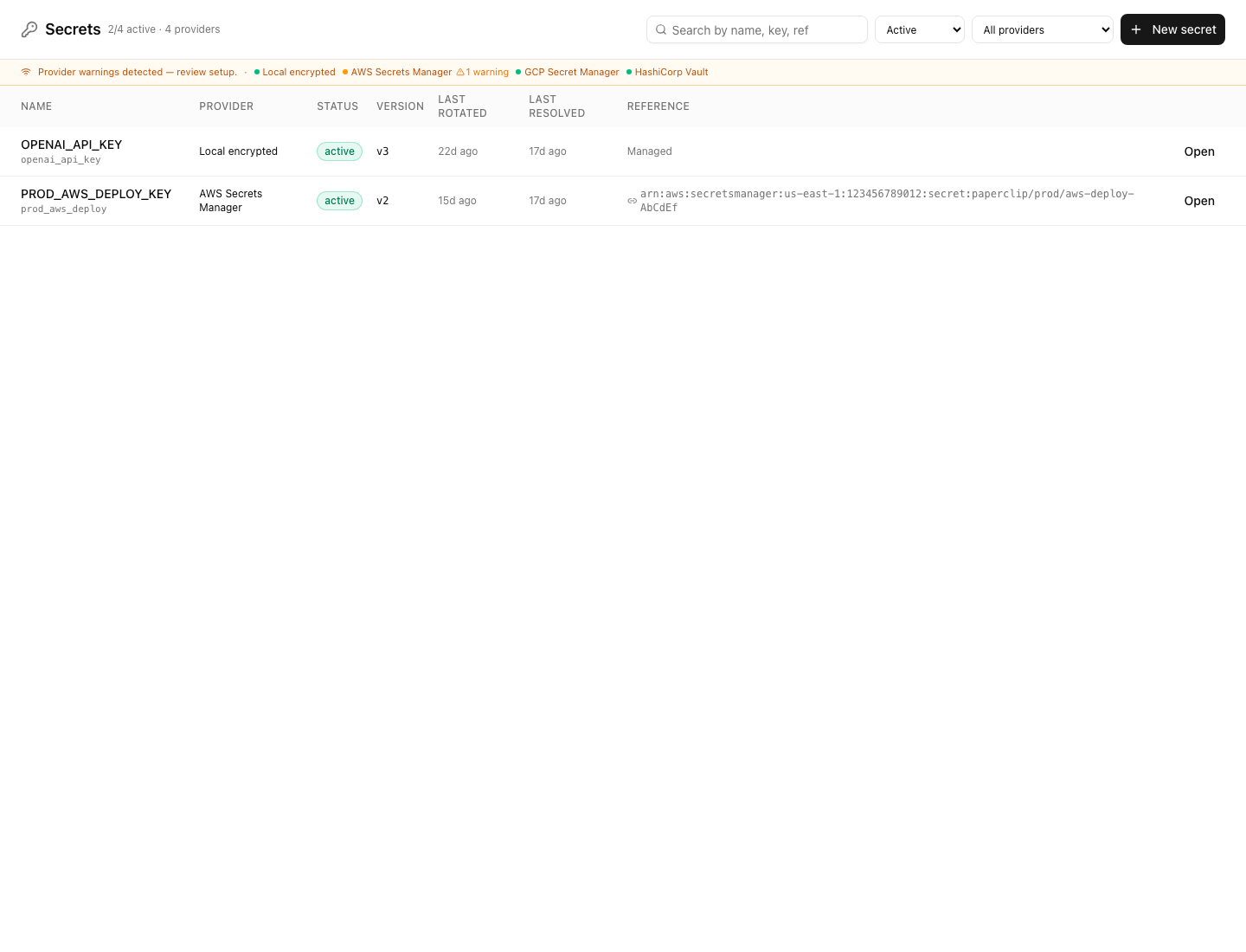 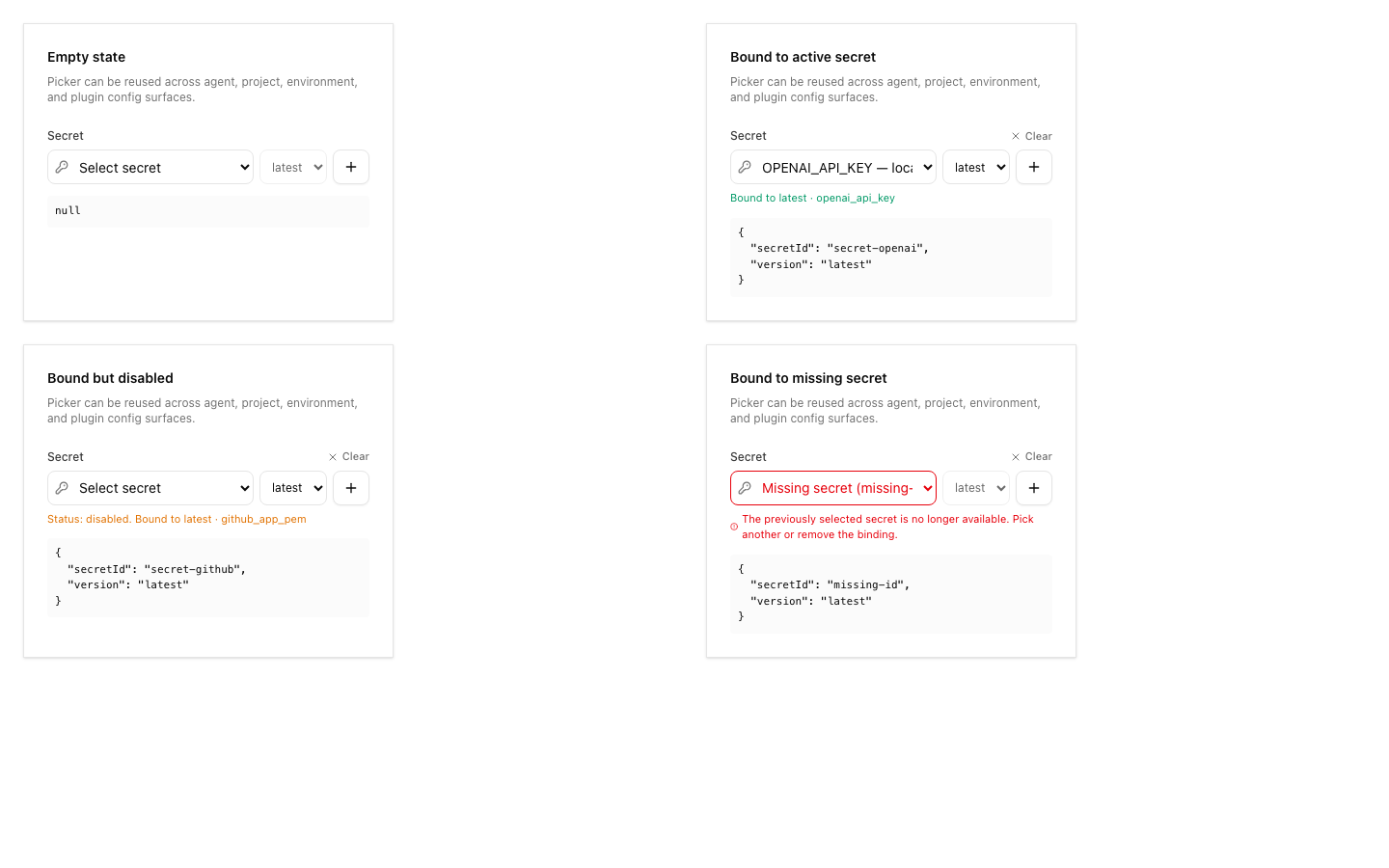 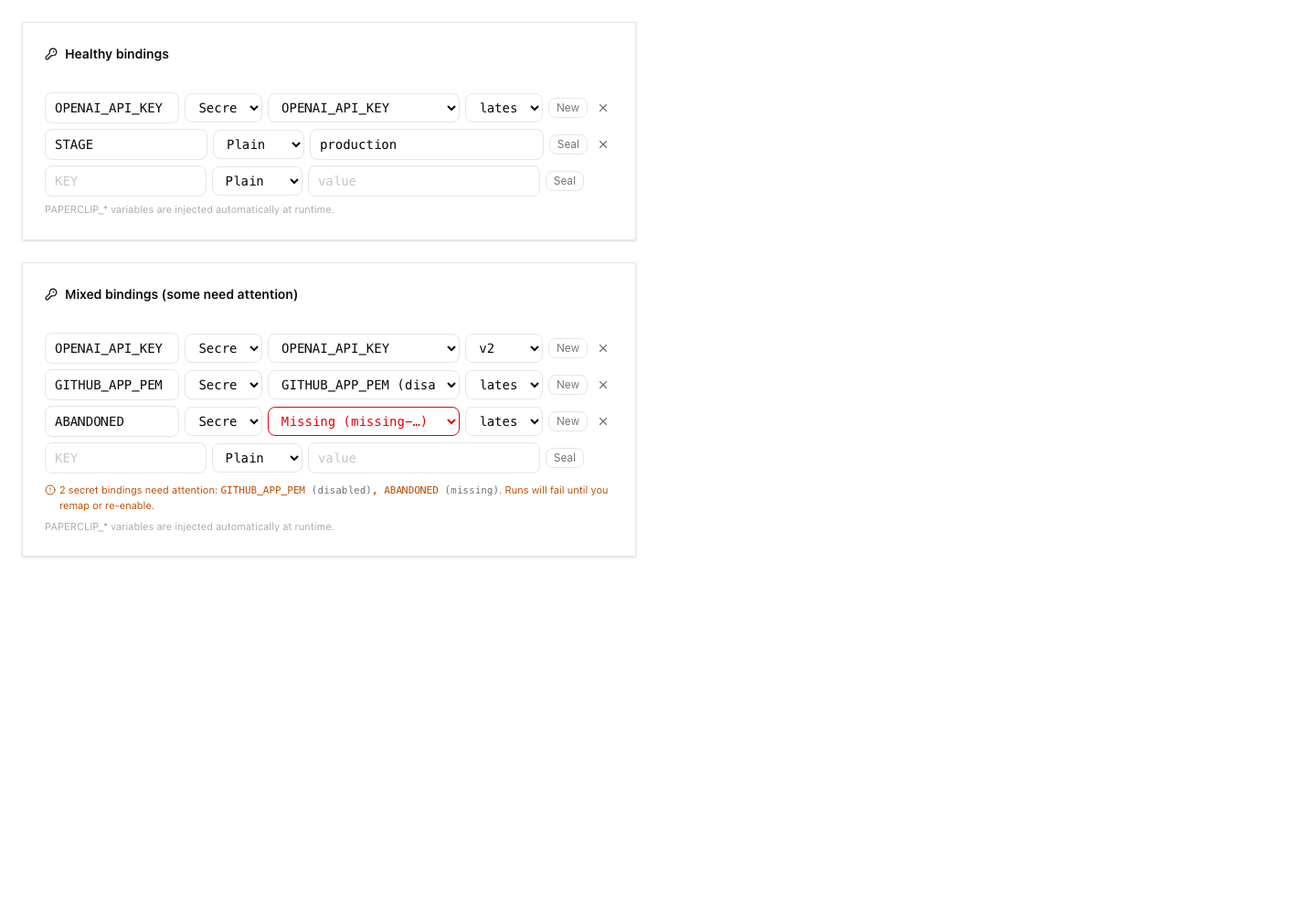 ## Risks - Migration risk: this adds new secret provider tables and extends existing secret rows. The migrations were checked for monotonic ordering and idempotent guards, but reviewers should still inspect upgrade behavior carefully. - Provider risk: AWS support uses direct SigV4 requests. Automated tests cover signing, request timeouts, vault-config selection, namespace guardrails, pending-version archival, sanitized provider errors, and service-level cleanup paths. A real-vault AWS smoke test remains deployment validation for an operator with AWS credentials rather than an unverified merge blocker in this local branch. - UI risk: the Secrets page and import dialog are large new surfaces; screenshots are included above for reviewer inspection. - Verification risk: the full local stable test command hit parallel-load timing failures, although the exact failed files passed when rerun directly. - Operational risk: remote import intentionally avoids plaintext reads; operators must understand that imported external references resolve at runtime and may fail if AWS permissions change. > For core feature work, check [`ROADMAP.md`](ROADMAP.md) first and discuss it in `#dev` before opening the PR. Feature PRs that overlap with planned core work may need to be redirected — check the roadmap first. See `CONTRIBUTING.md`. ## Model Used - OpenAI Codex, GPT-5 coding agent with local shell/tool use in the Paperclip worktree. Exact context-window size was not exposed by the runtime. ## Checklist - [x] I have included a thinking path that traces from project context to this change - [x] I have specified the model used (with version and capability details) - [x] I have checked ROADMAP.md and confirmed this PR does not duplicate planned core work - [ ] I have run tests locally and they pass - [x] I have added or updated tests where applicable - [x] If this change affects the UI, I have included before/after screenshots - [x] I have updated relevant documentation to reflect my changes - [x] I have considered and documented any risks above - [x] I will address all Greptile and reviewer comments before requesting merge --------- Co-authored-by: Paperclip <noreply@paperclip.ing> Co-authored-by: Claude Sonnet 4.6 <noreply@anthropic.com>



4.6 KiB
4.6 KiB
Plugin Secret Refs: Company Scope Reintroduction Plan
Date: 2026-04-26 Status: follow-up after fail-closed mitigation Related issue: PAP-2394
Current state
PAP-2394 now fails closed:
POST /api/plugins/:pluginId/configrejects any config containing plugin secret refs.ctx.secrets.resolve()is disabled for plugin workers.
This removes the release-blocking cross-company exposure path, but it also disables plugin secret-ref support until the runtime carries company scope end to end.
Vulnerability summary
The original design mixed an instance-global config store with company-scoped secret bindings:
- server/src/routes/plugins.ts saved one global plugin config row, then wrote bindings into
company_secret_bindingsgrouped by each referenced secret's owning company. - packages/db/src/schema/plugin_config.ts stored one config row per plugin, with no company dimension.
- packages/db/src/schema/company_secret_bindings.ts already modeled bindings as company-scoped.
- server/src/services/plugin-secrets-handler.ts resolved by
pluginId+ secret UUID, with no active company context from the bridge call. - packages/plugins/sdk/src/worker-rpc-host.ts exposed
ctx.config.get()andctx.secrets.resolve()without a company parameter.
This violated Least Privilege, Complete Mediation, and Secure Defaults.
Recommended end state
Re-enable plugin secret refs only after both of these are true:
- Plugin config reads/writes are company-scoped.
- Runtime secret resolution carries explicit company context and enforces it at resolution time.
Implementation plan
1. Make plugin config company-scoped
- Add
company_idtoplugin_config, with a unique index on(plugin_id, company_id). - Update registry helpers to require
companyIdforgetConfig,upsertConfig,patchConfig, anddeleteConfig. - Update plugin config routes to require
companyIdand callassertCompanyAccess(req, companyId). - Keep instance-global plugin lifecycle state separate from company-scoped plugin config.
2. Propagate company context through the worker runtime
- Extend the SDK so
ctx.config.get()andctx.secrets.resolve()can receive or derivecompanyId. - Introduce worker request context storage for handlers that already run with company scope:
getDataperformAction- scoped API routes
- tool executions
- environment driver calls
- Fail closed when plugin code tries to read company-scoped config or secrets outside an active company context.
3. Rebind secrets by (companyId, pluginId, configPath)
- On config save, validate every referenced secret belongs to the authorized company.
- Store bindings only for that company.
- Resolve secrets only by the current company-scoped binding, never by bare plugin ID plus UUID.
- Treat stale bindings as invalid and remove them on config replacement.
4. Prevent cross-company config disclosure
- When returning config to the UI, only materialize the selected company's secret refs.
- Never expose another company's secret UUIDs through the global plugin config surface.
Required regression coverage
- Company A board user cannot save plugin config that references a Company B secret.
- Company A plugin execution cannot resolve a Company B secret even if the same plugin is configured for Company B.
- Company-scoped config reads only return the selected company's secret bindings.
- Config replacement removes stale bindings for the same
(companyId, pluginId)target. - Runtime calls without company context fail closed.
Migration notes
- Existing
plugin_configrows need a migration strategy before re-enable. - Safest default: do not auto-assume a company for historical secret refs.
- Prefer one of:
- explicit admin migration per company, or
- import existing rows as non-secret config only and require re-entry of secret refs.
Release posture
- Keep plugin secret refs disabled until all steps above land.
- Do not restore the feature behind a soft warning; the insecure path must remain unavailable by default.