forked from farhoodlabs/paperclip
docs/exec-semantics-gro2055
5 Commits
| Author | SHA1 | Message | Date | |
|---|---|---|---|---|
 Devin Foley Devin Foley
|
1f70fd9a22 |
PAPA-430: workspace finalize gates + no-remote-git enforcement (#6969)
## Thinking Path > - Paperclip orchestrates AI agents across isolated execution workspaces; the local cwd is the only persistence boundary between runs. > - Workspace lifecycle (worktree_prepare → execute → workspace_finalize) and the wake/accept flow are what guarantee that dependent issues see a consistent worktree. > - PAPA-380 / PAPA-431 / PAPA-432 / PAPA-440 surfaced three holes in that contract: silent env reuse across assignees, dependent wakes firing before finalize, and `issue.interaction.accept` advancing before finalize landed. > - PAPA-441 / PAPA-442 then needed to document the "no remote git" contract and prevent future adapter/runtime code from quietly reintroducing `git push` as a backdoor sync. > - This pull request lands those server fixes, the static `check-no-git-push` enforcement, the AUTHORING.md cross-link, and the Cody-review follow-ups on the PAPA-430 thread. > - The benefit is that finalize is a real barrier — board accepts, dependent wakes, and operator-set env all respect it — and adapter code can't bypass it via raw `git push`. ## What Changed - **server (PAPA-380, PAPA-431):** `execution-workspace-policy` refuses silent env reuse when the assignee's resolved env disagrees with the workspace it would inherit. The inheritance protection is now scoped to the actual inheritance signal — explicit issue-level `environmentId` is honored even when the agent's default env is `null`. - **server (PAPA-432):** `heartbeat.ts` gates dependent wakes on `listUnfinalizedExecutionWorkspaceIds`, and writes a `workspace_finalize` row on the succeeded path. Write failures now surface instead of being swallowed so dependents aren't silently stranded behind a missing row. - **server (PAPA-440):** `issue-thread-interactions.acceptInteraction` adds a workspace_finalize precondition for `request_confirmation` (not `suggest_tasks`). Accept returns 409 if finalize hasn't succeeded for the latest workspace operation. - **ci (PAPA-442):** new `scripts/check-no-git-push.mjs` static check scans `packages/adapters/`, `packages/adapter-utils/`, `server/src/`, and `cli/src/` for any `git push` invocation (string or args-array). Wired into the `policy` PR job and `test:release-registry`. Operators can opt in per-call with `// paperclip:allow-git-push: <reason>`. Release scripts are out of scope by design. - **docs (PAPA-441):** `AUTHORING.md` documents the no-remote-git contract and cross-links the static check so adapter authors learn the rule and the enforcement together. - **review follow-up (PAPA-430, Cody):** three fixes — env resolver bug, accept-gate scope (request_confirmation only), and finalize record write on the succeeded path. ## Verification - `pnpm exec vitest run server/src/__tests__/execution-workspace-policy.test.ts server/src/__tests__/issue-thread-interactions-service.test.ts` → 33/33 pass - `node scripts/check-no-git-push.test.mjs` → check covers string form, args-array form, comment exclusions, and per-line allow-comment. - Manual: server compiles; the policy job runs the check in <1s before heavier jobs. ## Risks - **Behavioral shift in accept:** boards accepting `request_confirmation` while finalize is in-flight now get 409s. This is intentional — they can retry — but it changes timing on a hot path. `suggest_tasks` is unaffected. - **Workspace policy:** the env-reuse refusal is a new error path. Issues that previously silently reused an env from a different-assignee workspace will now fail-loud; the resolver still honors explicit issue-level `executionWorkspaceSettings.environmentId`. - **CI rule:** any future legitimate `git push` in scoped dirs must be marked with the allow-comment, which is the intended ergonomic. ## Model Used - Claude Opus 4.7 (`claude-opus-4-7`, extended thinking), via Claude Code in the Paperclip executor adapter. ## Checklist - [x] I have included a thinking path that traces from project context to this change - [x] I have specified the model used (with version and capability details) - [x] I have checked ROADMAP.md and confirmed this PR does not duplicate planned core work - [x] I have run tests locally and they pass - [x] I have added or updated tests where applicable - [ ] If this change affects the UI, I have included before/after screenshots (N/A — server/CI/docs only) - [x] I have updated relevant documentation to reflect my changes - [x] I have considered and documented any risks above - [x] I will address all Greptile and reviewer comments before requesting merge Closes related issues: PAPA-430, PAPA-380, PAPA-431, PAPA-432, PAPA-440, PAPA-441, PAPA-442 --------- Co-authored-by: Paperclip <noreply@paperclip.ing> |
||
|
Dotta
|
778e775c35 |
Add secrets provider vaults and remote import (#5429)
## Thinking Path > - Paperclip orchestrates AI-agent companies and needs secrets handling to work across local development, hosted operators, and governed agent execution. > - The affected subsystem is the company-scoped secrets control plane: database schema, server services/routes, CLI workflows, and the Secrets settings UI. > - The gap was that secrets were local-only and operators could not manage provider vaults or import existing remote references without exposing plaintext. > - This branch adds provider vault configuration plus an AWS Secrets Manager remote-import path while preserving company boundaries, binding context, and audit trails. > - I kept the PR to a single branch PR, removed unrelated lockfile/package drift, rebased the full branch onto the current `public-gh/master`, and addressed fresh Greptile findings. > - The benefit is a reviewable implementation of provider-backed secrets with focused tests covering provider selection, import conflicts, deleted secret reuse, rotation guards, and AWS signing behavior. ## What Changed - Added provider vault support for company secrets, including provider config storage, default vault handling, health checks, binding usage, access events, and remote import preview/commit. - Added an AWS Secrets Manager provider using SigV4 request signing, bounded request timeouts, namespace guardrails, cached runtime credential resolution, and external-reference linking without plaintext reads. - Added Secrets UI surfaces for vault management and remote import, plus CLI/API documentation for setup and operations. - Stabilized routine webhook secret binding paths and SSH environment-driver fixture bindings discovered during verification. - Addressed Greptile and CI findings: no lockfile/package drift, monotonic migration metadata, disabled-vault default races, soft-deleted secret hiding/recreate behavior, remove behavior with disabled vaults, soft-deleted external-reference re-import, non-active rotation guards, managed-secret soft deletion through PATCH, and per-call AWS SDK credential client churn. - Rebased this branch onto `public-gh/master` at `0e1a5828` and force-pushed with lease to keep this as the single PR for the branch. ## Verification - `git fetch public-gh master` - `git rebase public-gh/master` - `git diff --name-only public-gh/master...HEAD | grep '^pnpm-lock\.yaml$' || true` confirmed `pnpm-lock.yaml` is not in the PR diff. - Confirmed migration ordering: master ends at `0081_optimal_dormammu`; this PR adds `0082_dry_vision` and `0083_company_secret_provider_configs`. - Inspected migrations for repeat safety: new tables/indexes use `IF NOT EXISTS`; foreign keys are guarded by `DO $$ ... IF NOT EXISTS`; column additions use `ADD COLUMN IF NOT EXISTS`. - `pnpm -r typecheck` passed before the Greptile follow-up commits. - `pnpm test:run` ran the full stable Vitest path before the Greptile follow-up commits; it completed with 3 timing-related failures under parallel load: `codex-local-execute.test.ts`, `cursor-local-execute.test.ts`, and `environment-service.test.ts`. - `pnpm --filter @paperclipai/server exec vitest run src/__tests__/codex-local-execute.test.ts src/__tests__/cursor-local-execute.test.ts src/__tests__/environment-service.test.ts` passed on targeted rerun (`24/24`). - `pnpm build` passed before the Greptile follow-up commits. Vite reported existing chunk-size/dynamic-import warnings. - After Greptile follow-up commits: `pnpm --filter @paperclipai/server exec vitest run src/__tests__/secrets-service.test.ts` passed (`26/26`). - After Greptile follow-up commits: `pnpm --filter @paperclipai/server exec vitest run src/__tests__/aws-secrets-manager-provider.test.ts src/__tests__/secrets-service.test.ts` passed (`39/39`). - After Greptile follow-up commits: `pnpm --filter @paperclipai/server typecheck` passed. - Captured Storybook screenshots from `ui/storybook-static` for visual review. - Latest PR checks on `5ca3a5cf`: `policy`, serialized server suites 1/4-4/4, `Canary Dry Run`, `e2e`, `security/snyk`, and `Greptile Review` pass; aggregate `verify` is still registering the completed child checks. - Greptile review loop continued through the latest requested pass; all Greptile review threads are resolved and the latest `Greptile Review` check on `5ca3a5cf` passed with 0 comments added. ## Screenshots Before: the provider-vault and remote-import surfaces did not exist on `master`; these are after-state screenshots from the Storybook fixtures. 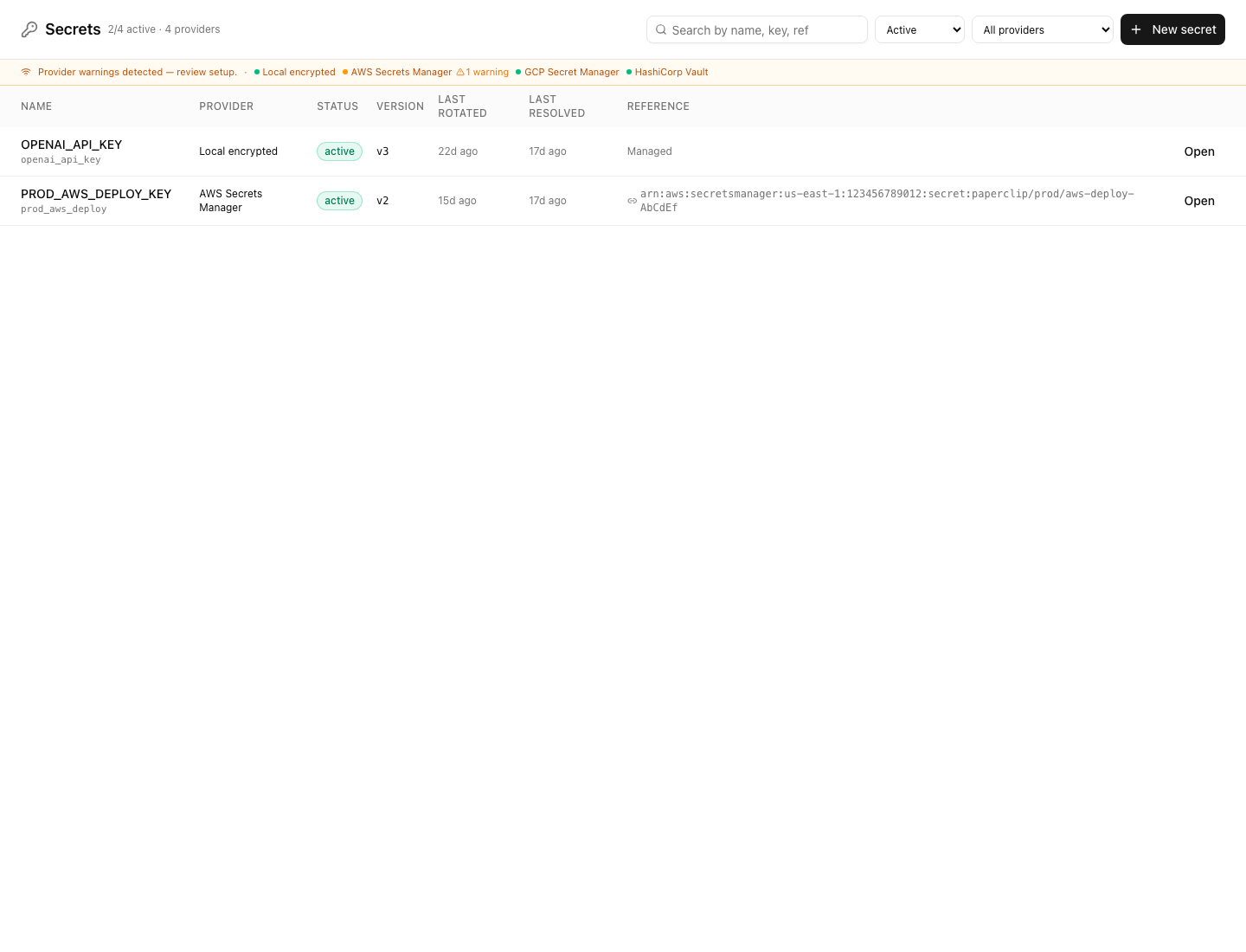 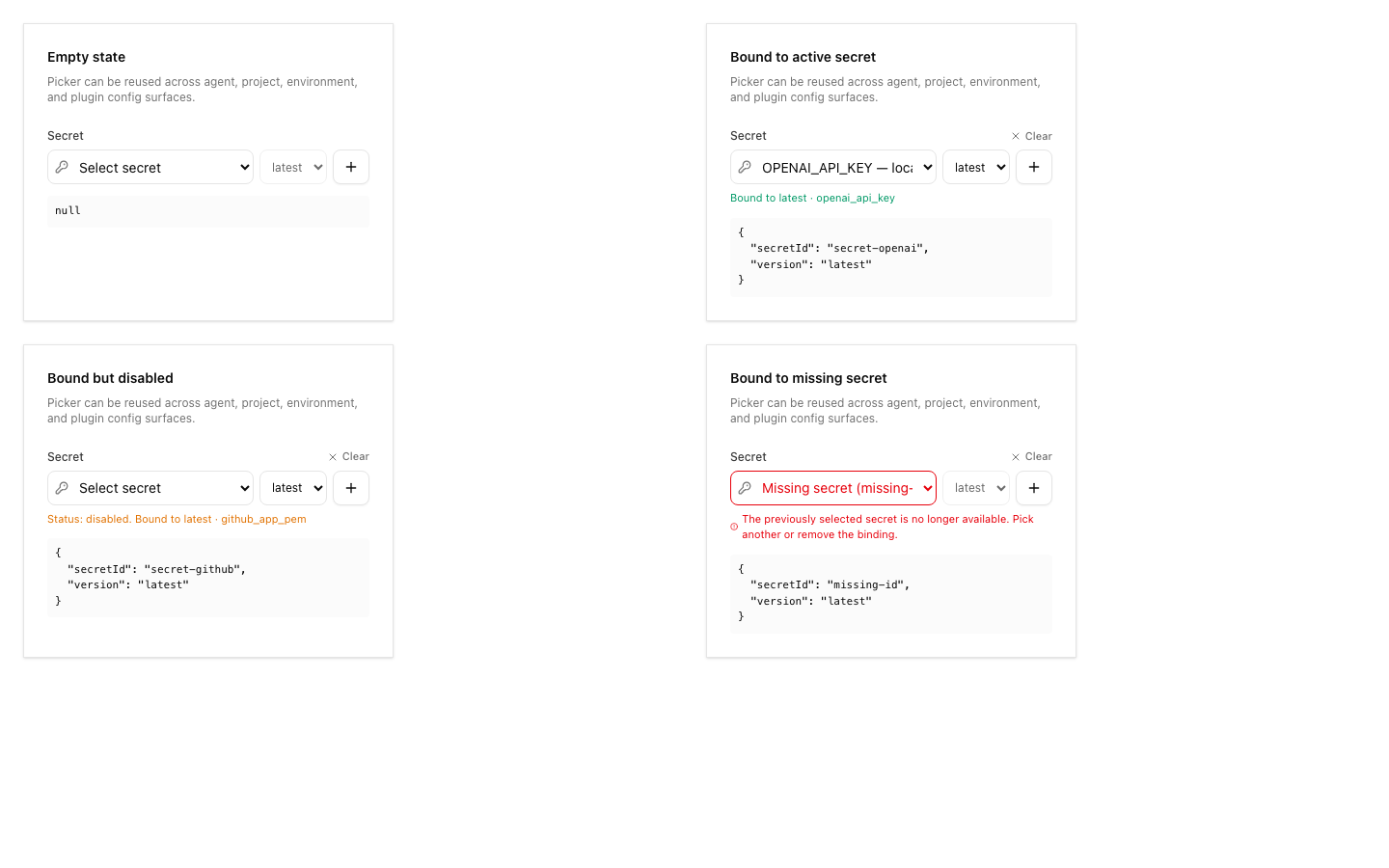 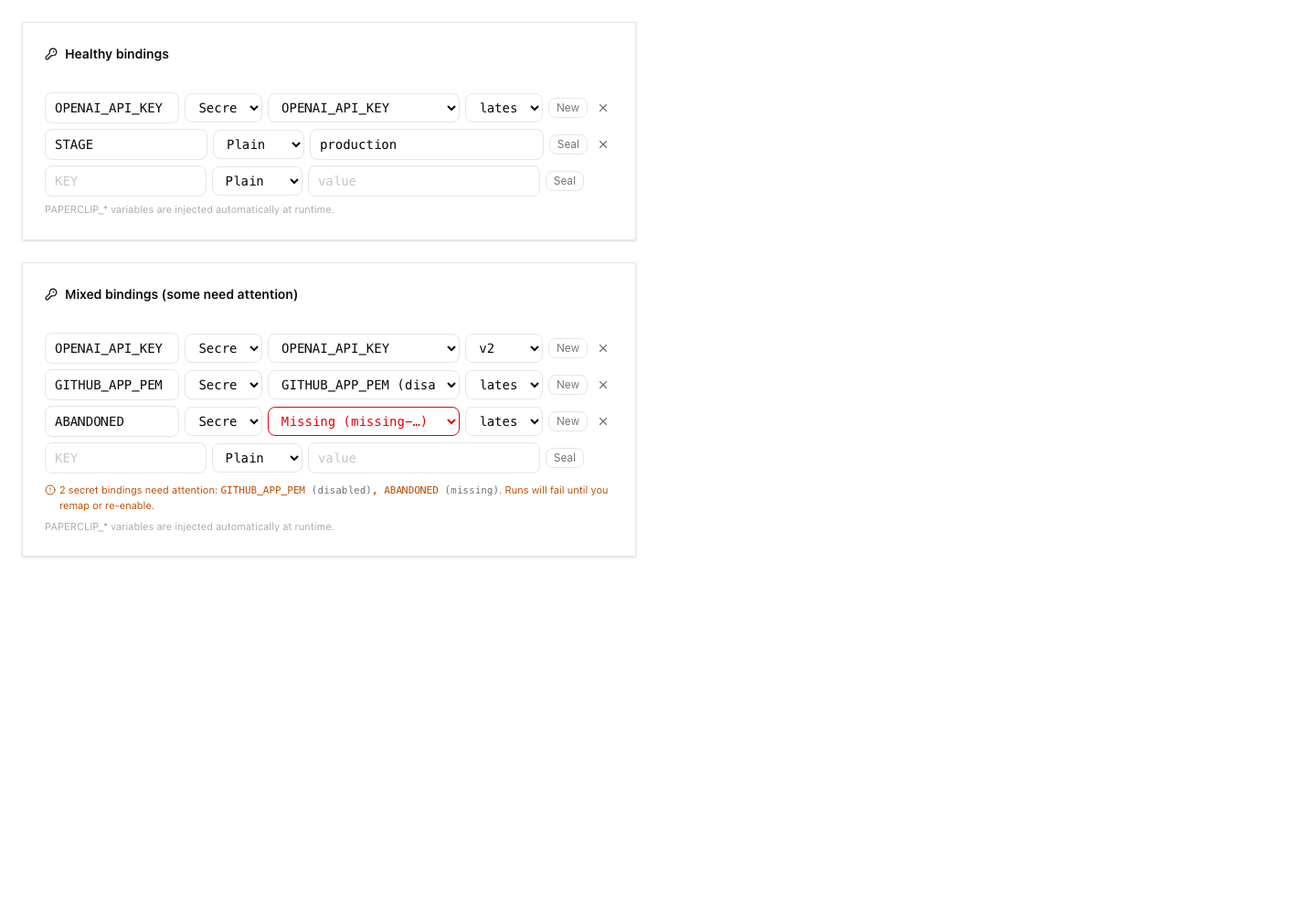 ## Risks - Migration risk: this adds new secret provider tables and extends existing secret rows. The migrations were checked for monotonic ordering and idempotent guards, but reviewers should still inspect upgrade behavior carefully. - Provider risk: AWS support uses direct SigV4 requests. Automated tests cover signing, request timeouts, vault-config selection, namespace guardrails, pending-version archival, sanitized provider errors, and service-level cleanup paths. A real-vault AWS smoke test remains deployment validation for an operator with AWS credentials rather than an unverified merge blocker in this local branch. - UI risk: the Secrets page and import dialog are large new surfaces; screenshots are included above for reviewer inspection. - Verification risk: the full local stable test command hit parallel-load timing failures, although the exact failed files passed when rerun directly. - Operational risk: remote import intentionally avoids plaintext reads; operators must understand that imported external references resolve at runtime and may fail if AWS permissions change. > For core feature work, check [`ROADMAP.md`](ROADMAP.md) first and discuss it in `#dev` before opening the PR. Feature PRs that overlap with planned core work may need to be redirected — check the roadmap first. See `CONTRIBUTING.md`. ## Model Used - OpenAI Codex, GPT-5 coding agent with local shell/tool use in the Paperclip worktree. Exact context-window size was not exposed by the runtime. ## Checklist - [x] I have included a thinking path that traces from project context to this change - [x] I have specified the model used (with version and capability details) - [x] I have checked ROADMAP.md and confirmed this PR does not duplicate planned core work - [ ] I have run tests locally and they pass - [x] I have added or updated tests where applicable - [x] If this change affects the UI, I have included before/after screenshots - [x] I have updated relevant documentation to reflect my changes - [x] I have considered and documented any risks above - [x] I will address all Greptile and reviewer comments before requesting merge --------- Co-authored-by: Paperclip <noreply@paperclip.ing> Co-authored-by: Claude Sonnet 4.6 <noreply@anthropic.com> |
||
|
Devin Foley
|
12cb7b40fd |
Harden remote workspace sync and restore flows (#5444)
## Thinking Path

> - Paperclip orchestrates AI agents for zero-human companies
> - When an agent runs against a remote target, Paperclip syncs the
workspace out to the remote at run start and restores changes back to
the local workspace at run end
> - The previous restore flow naïvely overwrote local files with
whatever the remote returned, so files that the remote run never touched
but had timestamp/mode drift could be needlessly rewritten — and a
single static `refs/paperclip/ssh-sync/imported` ref made concurrent SSH
workspace exports race on the same git ref
> - This pull request adds a `workspace-restore-merge` module that diffs
a pre-run snapshot against the post-run remote state and only writes
back files the remote actually changed; SSH workspace exports now use a
per-import unique ref so concurrent runs can't trample each other
> - Every adapter's execute path threads the snapshot through
`prepareAdapterExecutionTargetRuntime` so the merge has the baseline it
needs
> - The benefit is workspace restores no longer churn untouched files,
and concurrent SSH runs no longer collide on the import ref

## What Changed

- `packages/adapter-utils/src/workspace-restore-merge.{ts,test.ts}`: new
module — directory snapshot (kind/mode/sha256/symlink target) plus
snapshot-aware merge that writes only the files the remote changed
- `packages/adapter-utils/src/ssh.ts`: SSH workspace export uses a
per-import unique ref (`refs/paperclip/ssh-sync/imported/<uuid>`);
restore goes through the new merge helper; `ssh-fixture.test.ts` covers
the unique-ref + merge paths
- `packages/adapter-utils/src/sandbox-managed-runtime.ts` +
`remote-managed-runtime.ts`: thread the snapshot/merge through the
sandbox and SSH paths
- `packages/adapter-utils/src/server-utils.{ts,test.ts}` +
`execution-target.ts`: helpers for capturing the pre-run snapshot;
`prepareAdapterExecutionTargetRuntime` gains required `runId` and
optional `workspaceRemoteDir`, and returns the realized
`workspaceRemoteDir`
- Each adapter's `execute.ts` (acpx, claude, codex, cursor, gemini,
opencode, pi) takes the snapshot at run start and passes it through to
the runtime restore
- Remote execute test mocks updated to match the new
`prepareWorkspaceForSshExecution` return shape and the per-run
`${managedRemoteWorkspace}` cwd subdirectory

## Verification

- `pnpm vitest run --no-coverage --project @paperclipai/adapter-utils
--project @paperclipai/adapter-acpx-local --project
@paperclipai/adapter-claude-local --project
@paperclipai/adapter-codex-local --project
@paperclipai/adapter-cursor-local --project
@paperclipai/adapter-gemini-local --project
@paperclipai/adapter-opencode-local --project
@paperclipai/adapter-pi-local` — 196/196 passing
- `pnpm typecheck` clean across the workspace

## Risks

Medium. The restore path now writes a strict subset of what it
previously did — files the remote did not touch are no longer rewritten.
If any flow was relying on a touch-without-content-change being copied
back (timestamp or permission propagation only), that behavior is now
skipped. Snapshot capture adds an O(N-files-in-workspace) hash pass at
run start; the cost is bounded by the existing exclude list. The `runId`
parameter on `prepareAdapterExecutionTargetRuntime` is now required —
every in-tree caller is updated; out-of-tree adapter authors need to
pass it.

## Model Used

Claude Opus 4.7 (1M context)

## Checklist

- [x] I have included a thinking path that traces from project context
to this change
- [x] I have specified the model used (with version and capability
details)
- [x] I have checked ROADMAP.md and confirmed this PR does not duplicate
planned core work
- [x] I have run tests locally and they pass
- [x] I have added or updated tests where applicable — new module +
every adapter execute path covered
- [x] If this change affects the UI, I have included before/after
screenshots — N/A (no UI)
- [x] I have updated relevant documentation to reflect my changes
- [x] I have considered and documented any risks above
- [x] I will address all Greptile and reviewer comments before
requesting merge
|
||
|
Devin Foley
|
50db8c01d2 |
Serialize sandbox callback bridge against concurrent heartbeats (#5326)
> **Stacked PR.** This PR's branch carries cumulative content from #5324 (bridge allowlist expand) and #5325 (env sanitization) — the mutex/sha256 logic in this PR sits on top of both. Reviewers should focus on the files this PR's commit touches: `packages/adapter-utils/src/sandbox-callback-bridge.{ts,test.ts}`, `packages/adapter-utils/src/ssh.ts`, and `packages/adapter-utils/src/ssh-fixture.test.ts`. Will rebase onto `master` and force-push once both prerequisite PRs are merged. ## Thinking Path > - Paperclip orchestrates AI agents for zero-human companies > - Each agent that runs in a sandbox or via SSH talks back to the Paperclip server through a per-lease callback bridge whose entrypoint script is uploaded to the remote > - When two heartbeats target the same agent on the same machine concurrently, both upload the bridge entrypoint and both write to the same response files — producing torn-write races: `SyntaxError: Identifier 'randomUUID' has already been declared` from a concatenated upload, `mv: cannot stat …` from colliding `.json.tmp` writes, and 0-byte commits from a truncated stdin > - This pull request serializes those operations with a POSIX `mkdir`-mutex (PID liveness check + atomic rename) at the bridge entrypoint upload, applies the same lock to the bridge response writer, forwards stdin into remote ssh commands so the entrypoint payload arrives intact, and verifies a sha256 of the upload before promoting it > - The benefit is concurrent heartbeats no longer corrupt each other's bridge state ## What Changed - `packages/adapter-utils/src/sandbox-callback-bridge.ts`: serialize entrypoint upload and response writes via POSIX `mkdir`-mutex with PID liveness; sha256 the upload before promoting via `mv`; content-skip when the existing entrypoint already matches - `packages/adapter-utils/src/ssh.ts`: forward stdin into remote ssh commands through the SSH managed runtime so `cat > "$remote_upload"` actually receives the base64-encoded entrypoint - `packages/adapter-utils/src/ssh-fixture.test.ts`: cover the stdin-forwarded SSH path - `packages/adapter-utils/src/sandbox-callback-bridge.test.ts`: cover the mutex, content-skip, sha256-verify, and atomic-rename paths ## Verification - `pnpm vitest run --no-coverage --project @paperclipai/adapter-utils` - `pnpm typecheck` clean - Manual: two parallel heartbeats targeting the same SSH agent no longer race on the bridge entrypoint or response files ## Risks Medium. Serializing previously-parallel operations adds latency on the contended path (one heartbeat waits on another), bounded by the entrypoint upload time. The mutex includes PID liveness so a crashed heartbeat doesn't deadlock subsequent ones. Sha256-verify gives a clear "torn upload" failure mode instead of silent 0-byte commits. ## Model Used Claude Opus 4.7 (1M context) ## Checklist - [x] I have included a thinking path that traces from project context to this change - [x] I have specified the model used (with version and capability details) - [x] I have checked ROADMAP.md and confirmed this PR does not duplicate planned core work - [x] I have run tests locally and they pass - [x] I have added or updated tests where applicable — tests cover mutex + sha256-verify + stdin-forwarded ssh - [x] If this change affects the UI, I have included before/after screenshots — N/A (no UI) - [x] I have updated relevant documentation to reflect my changes - [x] I have considered and documented any risks above - [x] I will address all Greptile and reviewer comments before requesting merge |
||
|
Devin Foley
|
e4995bbb1c |
Add SSH environment support (#4358)
## Thinking Path > - Paperclip orchestrates AI agents for zero-human companies > - The environments subsystem already models execution environments, but before this branch there was no end-to-end SSH-backed runtime path for agents to actually run work against a remote box > - That meant agents could be configured around environment concepts without a reliable way to execute adapter sessions remotely, sync workspace state, and preserve run context across supported adapters > - We also need environment selection to participate in normal Paperclip control-plane behavior: agent defaults, project/issue selection, route validation, and environment probing > - Because this capability is still experimental, the UI surface should be easy to hide and easy to remove later without undoing the underlying implementation > - This pull request adds SSH environment execution support across the runtime, adapters, routes, schema, and tests, then puts the visible environment-management UI behind an experimental flag > - The benefit is that we can validate real SSH-backed agent execution now while keeping the user-facing controls safely gated until the feature is ready to come out of experimentation ## What Changed - Added SSH-backed execution target support in the shared adapter runtime, including remote workspace preparation, skill/runtime asset sync, remote session handling, and workspace restore behavior after runs. - Added SSH execution coverage for supported local adapters, plus remote execution tests across Claude, Codex, Cursor, Gemini, OpenCode, and Pi. - Added environment selection and environment-management backend support needed for SSH execution, including route/service work, validation, probing, and agent default environment persistence. - Added CLI support for SSH environment lab verification and updated related docs/tests. - Added the `enableEnvironments` experimental flag and gated the environment UI behind it on company settings, agent configuration, and project configuration surfaces. ## Verification - `pnpm exec vitest run packages/adapters/claude-local/src/server/execute.remote.test.ts packages/adapters/cursor-local/src/server/execute.remote.test.ts packages/adapters/gemini-local/src/server/execute.remote.test.ts packages/adapters/opencode-local/src/server/execute.remote.test.ts packages/adapters/pi-local/src/server/execute.remote.test.ts` - `pnpm exec vitest run server/src/__tests__/environment-routes.test.ts` - `pnpm exec vitest run server/src/__tests__/instance-settings-routes.test.ts` - `pnpm exec vitest run ui/src/lib/new-agent-hire-payload.test.ts ui/src/lib/new-agent-runtime-config.test.ts` - `pnpm -r typecheck` - `pnpm build` - Manual verification on a branch-local dev server: - enabled the experimental flag - created an SSH environment - created a Linux Claude agent using that environment - confirmed a run executed on the Linux box and synced workspace changes back ## Risks - Medium: this touches runtime execution flow across multiple adapters, so regressions would likely show up in remote session setup, workspace sync, or environment selection precedence. - The UI flag reduces exposure, but the underlying runtime and route changes are still substantial and rely on migration correctness. - The change set is broad across adapters, control-plane services, migrations, and UI gating, so review should pay close attention to environment-selection precedence and remote workspace lifecycle behavior. ## Model Used - OpenAI Codex via Paperclip's local Codex adapter, GPT-5-class coding model with tool use and code execution in the local repo workspace. The local adapter does not surface a more specific public model version string in this branch workflow. ## Checklist - [x] I have included a thinking path that traces from project context to this change - [x] I have specified the model used (with version and capability details) - [x] I have checked ROADMAP.md and confirmed this PR does not duplicate planned core work - [x] I have run tests locally and they pass - [x] I have added or updated tests where applicable - [ ] If this change affects the UI, I have included before/after screenshots - [x] I have updated relevant documentation to reflect my changes - [x] I have considered and documented any risks above - [x] I will address all Greptile and reviewer comments before requesting merge |


