forked from farhoodlabs/paperclip
1f70fd9a22be00c7e2daefadaa17699e72ca3a6a
28 Commits
| Author | SHA1 | Message | Date | |
|---|---|---|---|---|
 Devin Foley Devin Foley
|
1f70fd9a22 |
PAPA-430: workspace finalize gates + no-remote-git enforcement (#6969)
## Thinking Path > - Paperclip orchestrates AI agents across isolated execution workspaces; the local cwd is the only persistence boundary between runs. > - Workspace lifecycle (worktree_prepare → execute → workspace_finalize) and the wake/accept flow are what guarantee that dependent issues see a consistent worktree. > - PAPA-380 / PAPA-431 / PAPA-432 / PAPA-440 surfaced three holes in that contract: silent env reuse across assignees, dependent wakes firing before finalize, and `issue.interaction.accept` advancing before finalize landed. > - PAPA-441 / PAPA-442 then needed to document the "no remote git" contract and prevent future adapter/runtime code from quietly reintroducing `git push` as a backdoor sync. > - This pull request lands those server fixes, the static `check-no-git-push` enforcement, the AUTHORING.md cross-link, and the Cody-review follow-ups on the PAPA-430 thread. > - The benefit is that finalize is a real barrier — board accepts, dependent wakes, and operator-set env all respect it — and adapter code can't bypass it via raw `git push`. ## What Changed - **server (PAPA-380, PAPA-431):** `execution-workspace-policy` refuses silent env reuse when the assignee's resolved env disagrees with the workspace it would inherit. The inheritance protection is now scoped to the actual inheritance signal — explicit issue-level `environmentId` is honored even when the agent's default env is `null`. - **server (PAPA-432):** `heartbeat.ts` gates dependent wakes on `listUnfinalizedExecutionWorkspaceIds`, and writes a `workspace_finalize` row on the succeeded path. Write failures now surface instead of being swallowed so dependents aren't silently stranded behind a missing row. - **server (PAPA-440):** `issue-thread-interactions.acceptInteraction` adds a workspace_finalize precondition for `request_confirmation` (not `suggest_tasks`). Accept returns 409 if finalize hasn't succeeded for the latest workspace operation. - **ci (PAPA-442):** new `scripts/check-no-git-push.mjs` static check scans `packages/adapters/`, `packages/adapter-utils/`, `server/src/`, and `cli/src/` for any `git push` invocation (string or args-array). Wired into the `policy` PR job and `test:release-registry`. Operators can opt in per-call with `// paperclip:allow-git-push: <reason>`. Release scripts are out of scope by design. - **docs (PAPA-441):** `AUTHORING.md` documents the no-remote-git contract and cross-links the static check so adapter authors learn the rule and the enforcement together. - **review follow-up (PAPA-430, Cody):** three fixes — env resolver bug, accept-gate scope (request_confirmation only), and finalize record write on the succeeded path. ## Verification - `pnpm exec vitest run server/src/__tests__/execution-workspace-policy.test.ts server/src/__tests__/issue-thread-interactions-service.test.ts` → 33/33 pass - `node scripts/check-no-git-push.test.mjs` → check covers string form, args-array form, comment exclusions, and per-line allow-comment. - Manual: server compiles; the policy job runs the check in <1s before heavier jobs. ## Risks - **Behavioral shift in accept:** boards accepting `request_confirmation` while finalize is in-flight now get 409s. This is intentional — they can retry — but it changes timing on a hot path. `suggest_tasks` is unaffected. - **Workspace policy:** the env-reuse refusal is a new error path. Issues that previously silently reused an env from a different-assignee workspace will now fail-loud; the resolver still honors explicit issue-level `executionWorkspaceSettings.environmentId`. - **CI rule:** any future legitimate `git push` in scoped dirs must be marked with the allow-comment, which is the intended ergonomic. ## Model Used - Claude Opus 4.7 (`claude-opus-4-7`, extended thinking), via Claude Code in the Paperclip executor adapter. ## Checklist - [x] I have included a thinking path that traces from project context to this change - [x] I have specified the model used (with version and capability details) - [x] I have checked ROADMAP.md and confirmed this PR does not duplicate planned core work - [x] I have run tests locally and they pass - [x] I have added or updated tests where applicable - [ ] If this change affects the UI, I have included before/after screenshots (N/A — server/CI/docs only) - [x] I have updated relevant documentation to reflect my changes - [x] I have considered and documented any risks above - [x] I will address all Greptile and reviewer comments before requesting merge Closes related issues: PAPA-430, PAPA-380, PAPA-431, PAPA-432, PAPA-440, PAPA-441, PAPA-442 --------- Co-authored-by: Paperclip <noreply@paperclip.ing> |
||
|
Devin Foley
|
d9f91576a0 |
Add accepted-plan decomposition exact-once guards and UI state (#6831)
## Thinking Path > - Paperclip orchestrates AI agents for zero-human companies, so planning approvals and child-issue fan-out are part of the core control-plane loop. > - Accepted plans are supposed to be a safe bridge from planning into execution, especially when agents wake from review decisions and reuse isolated workspaces. > - The duplicate-subtask incident showed that an accepted plan revision could be interpreted more than once across overlapping runs, which broke the single-source-of-truth model for issue decomposition. > - Fixing that required tightening the backend contract first: accepted-plan decomposition needs an exact-once fingerprint, durable claim state, and retry-safe child creation. > - Once that backend behavior existed, the board still needed visibility into what happened, so the issue detail view needed a dedicated decomposition section instead of forcing operators to reconstruct child creation from raw activity. > - This pull request adds the exact-once decomposition primitive, hardens wake routing and regressions around the incident, and surfaces decomposition state in the UI so future incidents are both prevented and easier to inspect. ## What Changed - Added accepted-plan decomposition semantics to `doc/execution-semantics.md`, including the exact-once fingerprint, durable claim/result expectations, and retry/resume behavior. - Added persistent accepted-plan decomposition claims in the backend, including schema, shared types/validators, service logic, and issue routes for creating and listing decomposition state. - Hardened heartbeat routing so an accepted-plan continuation stays scoped to the relevant planning issue instead of opportunistically re-decomposing another accepted issue on the same assignee. - Added regression coverage for the original failure modes: concurrent same-parent retries, cross-issue accepted-plan isolation, and partial child recreation under the same fingerprint. - Added the `Plan decomposition` issue-detail section plus supporting API/query-key/activity formatting updates so operators can see revision status, owner, child counts, and the linked child issues directly in the UI. - Included the small follow-up UI fix so the decomposition section still renders when the issue work mode is no longer `planning`. ## Verification - `pnpm --filter @paperclipai/server typecheck` - `pnpm --filter @paperclipai/ui typecheck` - `pnpm --filter @paperclipai/db typecheck` - `pnpm exec vitest run server/src/__tests__/issues-service.test.ts` - `pnpm exec vitest run server/src/__tests__/issues-service.test.ts -t "lists persisted decompositions with child issue summaries"` - `pnpm exec vitest run server/src/__tests__/issues-service.test.ts -t "accepted plan decomposition" server/src/__tests__/heartbeat-accepted-plan-workspace-refresh.test.ts server/src/__tests__/heartbeat-context-summary.test.ts` - Manual UI path: create a planning issue without an isolated execution workspace, add a `plan` document, accept the `request_confirmation`, let Paperclip create child issues, then reopen the parent issue detail page and confirm the `Plan decomposition` section shows the accepted revision, status, idempotent-claim badge, and child links. - Separate follow-up bug noted during manual UI validation: accepting a plan on an issue whose run never records `workspace_finalize` is tracked in `PAPA-445` and is not part of this PR’s fix scope. ## Risks - This adds a new migration and a large Drizzle snapshot update; reviewers should confirm the schema shape and generated metadata match the intended decomposition table. - The exact-once claim changes sit on the accepted-plan fan-out path, so regressions there could block legitimate child creation or mis-handle retries if the claim state machine is wrong. - The new UI only appears when decomposition records exist; reviewers should use the manual verification path above rather than expecting existing issues on a stale local instance to show the section automatically. - `PAPA-445` remains an open follow-up for the `workspace_finalize` accept gate when a planning handoff never records finalize; that bug can interfere with reproducing the UI flow on isolated workspaces but does not change the correctness of the exact-once decomposition feature itself. > Checked `ROADMAP.md`: this PR is a bug fix / control-plane hardening change for accepted-plan decomposition, not a new uncoordinated roadmap feature. ## Model Used - OpenAI Codex via Paperclip `codex_local` (GPT-5-based coding agent; exact backend model ID/context window not exposed in the run context), with repository tool use, shell execution, and code-editing capabilities. <img width="806" height="1069" alt="Screenshot 2026-05-27 at 11 05 48 PM" src="https://github.com/user-attachments/assets/5b00b670-96cd-4470-b0a3-581743bcae28" /> ## Checklist - [x] I have included a thinking path that traces from project context to this change - [x] I have specified the model used (with version and capability details) - [x] I have checked ROADMAP.md and confirmed this PR does not duplicate planned core work - [x] I have run tests locally and they pass - [x] I have added or updated tests where applicable - [x] If this change affects the UI, I have included before/after screenshots - [x] I have updated relevant documentation to reflect my changes - [x] I have considered and documented any risks above - [x] I will address all Greptile and reviewer comments before requesting merge --------- Co-authored-by: Paperclip <noreply@paperclip.ing> |
||
|
Dotta
|
bfe6369ef5 |
Guard cheap recovery model usage (#6371)
## Thinking Path > - Paperclip is the control plane that coordinates AI-agent work through issues, heartbeats, comments, approvals, and auditable recovery paths. > - The affected subsystem is heartbeat/recovery orchestration, especially the optional cheap model profile used for operational recovery overhead. > - Cheap recovery should repair status and liveness, but it must not become the worker lane that writes deliverables, continues source work, or propagates cheap execution hints into downstream retries. > - The gap was that cheap-profile hints could follow recovery wake contexts and assignment overrides farther than intended, making real work eligible to run on the cheap model. > - This pull request separates status-only cheap recovery from normal source-work continuations, adds route guards for deliverable mutations during cheap status-only runs, and documents the invariant. > - The benefit is safer retry/recovery behavior: cheap runs can clean up control-plane state, while any remaining source work resumes through a normal/original model path. ## What Changed - Added recovery model-profile work classes so status-only recovery carries explicit guard context and normal-model continuations scrub cheap hints. - Updated heartbeat, productivity review, liveness continuation, and recovery service wakeups to request cheap only for bounded status-only recovery work. - Blocked cheap status-only recovery runs from writing issue documents, plans, attachments, work products, or assigning downstream work back to `modelProfile: "cheap"`. - Added/updated server tests for cheap profile propagation, artifact/document guards, route authorization, retry scheduling, and successful-run handoff behavior. - Documented the recovery model-profile lane in `doc/SPEC-implementation.md` and `doc/execution-semantics.md`. - After rebasing onto current `public-gh/master`, stabilized the new `InstanceSidebar` plugin-filter tests so the PR check lane stays green. ## Verification - Local: `pnpm exec vitest run --config vitest.config.ts src/services/recovery/model-profile-hint.test.ts src/__tests__/issue-agent-mutation-ownership-routes.test.ts src/__tests__/issue-document-restore-routes.test.ts` from `server/` - 3 files, 37 tests passed after final edits. - Local: `pnpm exec vitest run --config vitest.config.ts src/__tests__/heartbeat-process-recovery.test.ts` from `server/` - 44 tests passed after rerunning the cleanup-sensitive file alone. - Local: `pnpm --filter @paperclipai/ui exec vitest run src/components/InstanceSidebar.test.tsx` - 4 tests passed. - Local: `pnpm --filter @paperclipai/server typecheck` - passed. - Local: `pnpm --filter @paperclipai/ui typecheck` - passed. - PR checks on latest head `6f8c3b1380f5bd872c6f49f6f7188ecf3bb6d263` - all green, including `verify`, build, typecheck, server/general/serialized tests, e2e, Snyk, and policy. - Greptile: pass 3 returned Confidence Score 5/5 with zero unresolved Greptile review threads. ## Risks - Medium risk: recovery behavior is intentionally stricter, so any path that incorrectly relies on cheap recovery to keep doing source work will now need to hand back to a normal-model run. - Low migration risk: no schema changes. - No product UI changes; the UI file touched is a test-only stabilization after rebasing onto current `master`. > For core feature work, check [`ROADMAP.md`](ROADMAP.md) first and discuss it in `#dev` before opening the PR. Feature PRs that overlap with planned core work may need to be redirected — check the roadmap first. See `CONTRIBUTING.md`. ## Model Used - OpenAI Codex coding agent, GPT-5 model family (`gpt-5`), tool use and local code execution enabled; context window not exposed in this environment. ## Checklist - [x] I have included a thinking path that traces from project context to this change - [x] I have specified the model used (with version and capability details) - [x] I have checked ROADMAP.md and confirmed this PR does not duplicate planned core work - [x] I have run tests locally and they pass - [x] I have added or updated tests where applicable - [x] If this change affects the UI, I have included before/after screenshots (N/A: no product UI changes) - [x] I have updated relevant documentation to reflect my changes - [x] I have considered and documented any risks above - [x] I will address all Greptile and reviewer comments before requesting merge |
||
|
Dotta
|
0808b388ee |
[codex] Add source-scoped recovery actions (#5599)
## Thinking Path > - Paperclip is a control plane for autonomous AI companies, where work must end with a clear disposition rather than ambiguous agent liveness. > - Recovery currently detects stalled or missing-next-step issues, but source issue recovery can become split across child recovery issues, blockers, and comments. > - That makes it harder for operators and agents to see who owns recovery and what exact action is needed on the original issue. > - Source-scoped recovery actions give the original issue a first-class active recovery state with owner, evidence, wake policy, and resolution outcome. > - This pull request adds the recovery-action data model, backend reconciliation and resolution APIs, and board UI indicators/actions. > - The benefit is clearer stalled-work recovery without losing source issue context or relying on comments as the liveness path. ## What Changed - Added the `issue_recovery_actions` schema, shared types/constants/validators, and an idempotent `0084_issue_recovery_actions` migration ordered after current `master` migrations. - Updated stranded/missing-disposition recovery to create source-scoped recovery actions, wake the recovery owner on the source issue, and avoid locking the source issue for recovery-action wakes. - Added API support for reading active recovery actions on issue detail/list surfaces and resolving them with restored, blocked, cancelled, or false-positive outcomes. - Require blocked recovery resolutions to have an unresolved first-class blocker, and removed the UI shortcut that could mark recovery blocked without a blocker selection path. - Surfaced recovery indicators/actions in the issue UI, blocker notices, active run panels, issue rows, and Storybook coverage. - Updated docs and focused tests for recovery semantics, ownership, races, stale comments, and UI behavior. ## Verification - `pnpm exec vitest run server/src/__tests__/issue-recovery-actions.test.ts server/src/__tests__/heartbeat-process-recovery.test.ts ui/src/components/IssueRecoveryActionCard.test.tsx ui/src/components/IssueBlockedNotice.test.tsx ui/src/api/issues.test.ts` — 5 files, 72 tests passed. - `pnpm --filter @paperclipai/shared typecheck` — passed. - `pnpm --filter @paperclipai/db typecheck` — passed, including migration numbering check. - `pnpm --filter @paperclipai/server typecheck` — passed. - `pnpm --filter @paperclipai/ui typecheck` — passed. - Follow-up verification after blocker-resolution guard: `pnpm exec vitest run server/src/__tests__/issue-recovery-actions.test.ts ui/src/components/IssueRecoveryActionCard.test.tsx ui/src/api/issues.test.ts` — 3 files, 27 tests passed. - Follow-up `pnpm --filter @paperclipai/server typecheck` — passed. - Follow-up `pnpm --filter @paperclipai/ui typecheck` — passed. - UI states are available in `ui/storybook/stories/source-issue-recovery.stories.tsx`; screenshot capture helper is `scripts/screenshot-recovery-card.cjs`. ## Risks - Medium: recovery behavior changes from child recovery issue ownership toward source-scoped actions, so operators may see stalled-work state in new places. - Migration risk is mitigated by using the next migration slot after `master` and making the table/constraints/index creation idempotent for anyone who previously applied the old branch-local `0082_dizzy_master_mold` migration. - Existing child recovery issue paths are still guarded for already-created recovery issues, but new source-scoped flows should be watched in CI and Greptile review. > For core feature work, check [`ROADMAP.md`](ROADMAP.md) first and discuss it in `#dev` before opening the PR. Feature PRs that overlap with planned core work may need to be redirected — check the roadmap first. See `CONTRIBUTING.md`. ## Model Used - OpenAI Codex, GPT-5 coding agent, tool use enabled for shell, Git, GitHub, and local test execution. Context window not exposed by the runtime. ## Checklist - [x] I have included a thinking path that traces from project context to this change - [x] I have specified the model used (with version and capability details) - [x] I have checked ROADMAP.md and confirmed this PR does not duplicate planned core work - [x] I have run tests locally and they pass - [x] I have added or updated tests where applicable - [x] If this change affects the UI, I have included before/after screenshots - [x] I have updated relevant documentation to reflect my changes - [x] I have considered and documented any risks above - [x] I will address all Greptile and reviewer comments before requesting merge --------- Co-authored-by: Paperclip <noreply@paperclip.ing> |
||
|
Dotta
|
778e775c35 |
Add secrets provider vaults and remote import (#5429)
## Thinking Path > - Paperclip orchestrates AI-agent companies and needs secrets handling to work across local development, hosted operators, and governed agent execution. > - The affected subsystem is the company-scoped secrets control plane: database schema, server services/routes, CLI workflows, and the Secrets settings UI. > - The gap was that secrets were local-only and operators could not manage provider vaults or import existing remote references without exposing plaintext. > - This branch adds provider vault configuration plus an AWS Secrets Manager remote-import path while preserving company boundaries, binding context, and audit trails. > - I kept the PR to a single branch PR, removed unrelated lockfile/package drift, rebased the full branch onto the current `public-gh/master`, and addressed fresh Greptile findings. > - The benefit is a reviewable implementation of provider-backed secrets with focused tests covering provider selection, import conflicts, deleted secret reuse, rotation guards, and AWS signing behavior. ## What Changed - Added provider vault support for company secrets, including provider config storage, default vault handling, health checks, binding usage, access events, and remote import preview/commit. - Added an AWS Secrets Manager provider using SigV4 request signing, bounded request timeouts, namespace guardrails, cached runtime credential resolution, and external-reference linking without plaintext reads. - Added Secrets UI surfaces for vault management and remote import, plus CLI/API documentation for setup and operations. - Stabilized routine webhook secret binding paths and SSH environment-driver fixture bindings discovered during verification. - Addressed Greptile and CI findings: no lockfile/package drift, monotonic migration metadata, disabled-vault default races, soft-deleted secret hiding/recreate behavior, remove behavior with disabled vaults, soft-deleted external-reference re-import, non-active rotation guards, managed-secret soft deletion through PATCH, and per-call AWS SDK credential client churn. - Rebased this branch onto `public-gh/master` at `0e1a5828` and force-pushed with lease to keep this as the single PR for the branch. ## Verification - `git fetch public-gh master` - `git rebase public-gh/master` - `git diff --name-only public-gh/master...HEAD | grep '^pnpm-lock\.yaml$' || true` confirmed `pnpm-lock.yaml` is not in the PR diff. - Confirmed migration ordering: master ends at `0081_optimal_dormammu`; this PR adds `0082_dry_vision` and `0083_company_secret_provider_configs`. - Inspected migrations for repeat safety: new tables/indexes use `IF NOT EXISTS`; foreign keys are guarded by `DO $$ ... IF NOT EXISTS`; column additions use `ADD COLUMN IF NOT EXISTS`. - `pnpm -r typecheck` passed before the Greptile follow-up commits. - `pnpm test:run` ran the full stable Vitest path before the Greptile follow-up commits; it completed with 3 timing-related failures under parallel load: `codex-local-execute.test.ts`, `cursor-local-execute.test.ts`, and `environment-service.test.ts`. - `pnpm --filter @paperclipai/server exec vitest run src/__tests__/codex-local-execute.test.ts src/__tests__/cursor-local-execute.test.ts src/__tests__/environment-service.test.ts` passed on targeted rerun (`24/24`). - `pnpm build` passed before the Greptile follow-up commits. Vite reported existing chunk-size/dynamic-import warnings. - After Greptile follow-up commits: `pnpm --filter @paperclipai/server exec vitest run src/__tests__/secrets-service.test.ts` passed (`26/26`). - After Greptile follow-up commits: `pnpm --filter @paperclipai/server exec vitest run src/__tests__/aws-secrets-manager-provider.test.ts src/__tests__/secrets-service.test.ts` passed (`39/39`). - After Greptile follow-up commits: `pnpm --filter @paperclipai/server typecheck` passed. - Captured Storybook screenshots from `ui/storybook-static` for visual review. - Latest PR checks on `5ca3a5cf`: `policy`, serialized server suites 1/4-4/4, `Canary Dry Run`, `e2e`, `security/snyk`, and `Greptile Review` pass; aggregate `verify` is still registering the completed child checks. - Greptile review loop continued through the latest requested pass; all Greptile review threads are resolved and the latest `Greptile Review` check on `5ca3a5cf` passed with 0 comments added. ## Screenshots Before: the provider-vault and remote-import surfaces did not exist on `master`; these are after-state screenshots from the Storybook fixtures. 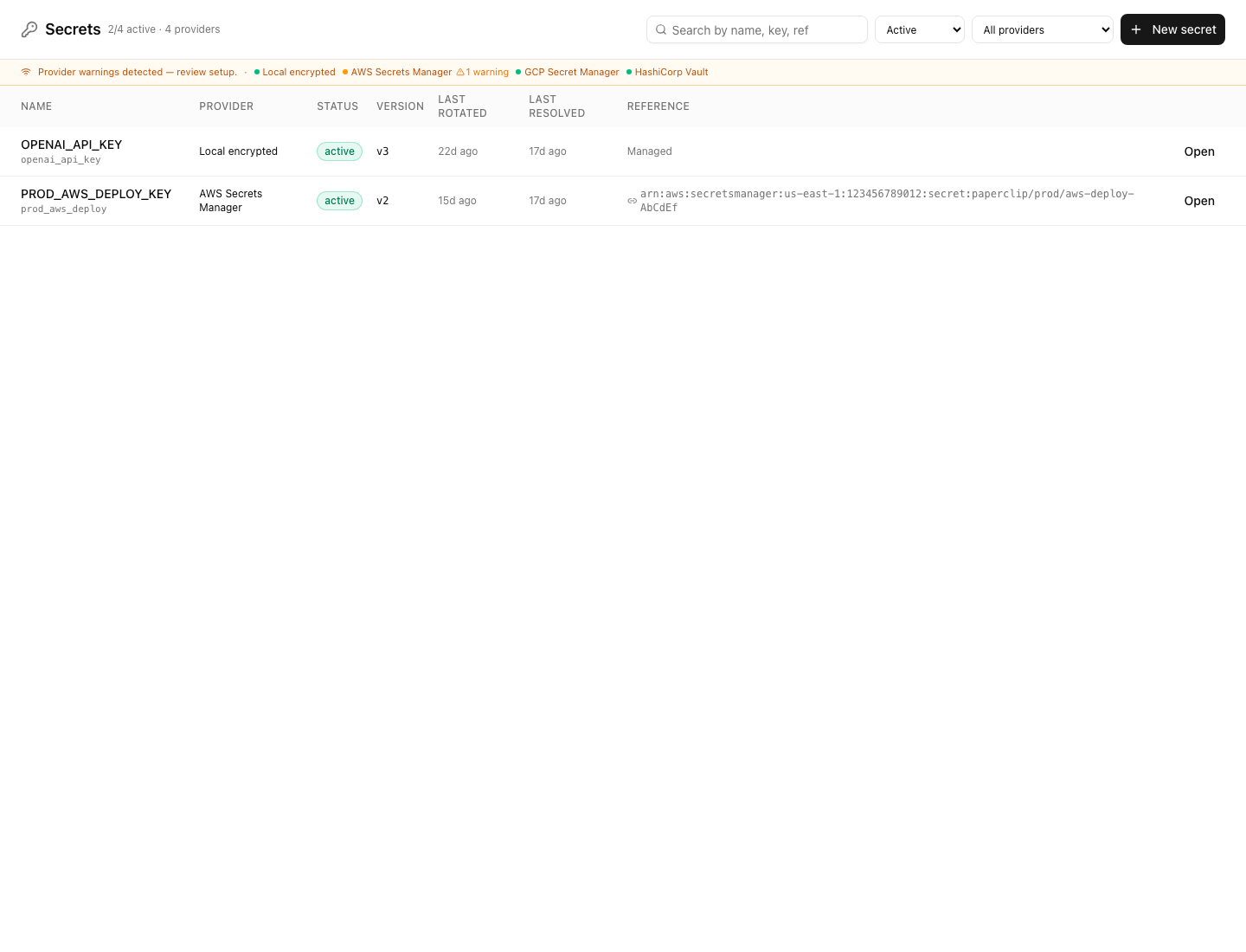 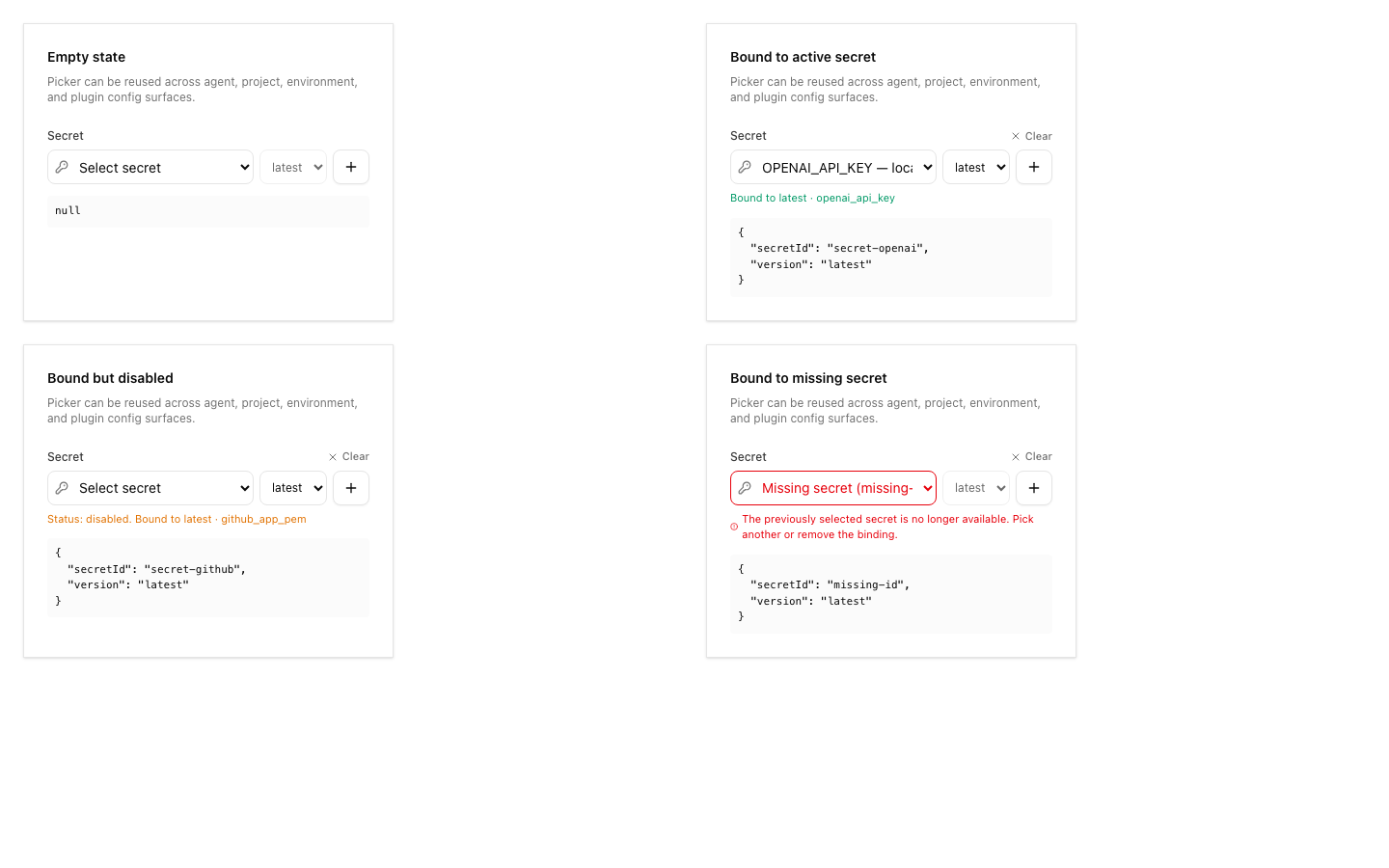 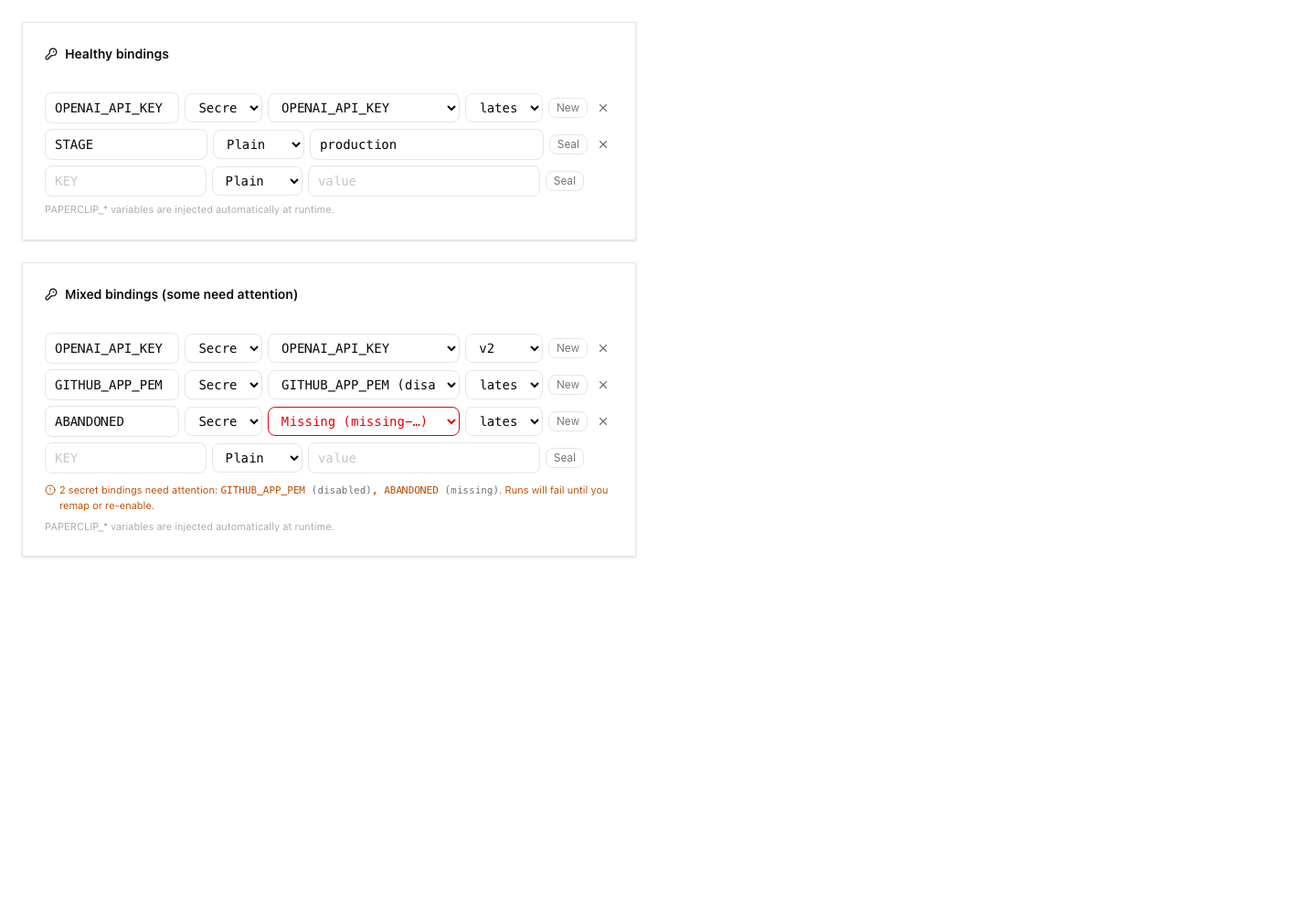 ## Risks - Migration risk: this adds new secret provider tables and extends existing secret rows. The migrations were checked for monotonic ordering and idempotent guards, but reviewers should still inspect upgrade behavior carefully. - Provider risk: AWS support uses direct SigV4 requests. Automated tests cover signing, request timeouts, vault-config selection, namespace guardrails, pending-version archival, sanitized provider errors, and service-level cleanup paths. A real-vault AWS smoke test remains deployment validation for an operator with AWS credentials rather than an unverified merge blocker in this local branch. - UI risk: the Secrets page and import dialog are large new surfaces; screenshots are included above for reviewer inspection. - Verification risk: the full local stable test command hit parallel-load timing failures, although the exact failed files passed when rerun directly. - Operational risk: remote import intentionally avoids plaintext reads; operators must understand that imported external references resolve at runtime and may fail if AWS permissions change. > For core feature work, check [`ROADMAP.md`](ROADMAP.md) first and discuss it in `#dev` before opening the PR. Feature PRs that overlap with planned core work may need to be redirected — check the roadmap first. See `CONTRIBUTING.md`. ## Model Used - OpenAI Codex, GPT-5 coding agent with local shell/tool use in the Paperclip worktree. Exact context-window size was not exposed by the runtime. ## Checklist - [x] I have included a thinking path that traces from project context to this change - [x] I have specified the model used (with version and capability details) - [x] I have checked ROADMAP.md and confirmed this PR does not duplicate planned core work - [ ] I have run tests locally and they pass - [x] I have added or updated tests where applicable - [x] If this change affects the UI, I have included before/after screenshots - [x] I have updated relevant documentation to reflect my changes - [x] I have considered and documented any risks above - [x] I will address all Greptile and reviewer comments before requesting merge --------- Co-authored-by: Paperclip <noreply@paperclip.ing> Co-authored-by: Claude Sonnet 4.6 <noreply@anthropic.com> |
||
|
Dotta
|
454edfe81e |
Add recovery handoff system notices (#5289)
## Thinking Path > - Paperclip orchestrates AI agents for zero-human companies. > - Agent runs can end productively while the source issue still lacks a durable final disposition. > - That leaves the control plane unsure whether to resume, escalate, or close the work. > - Issue comments also need a presentation contract so system-authored recovery notices can render as first-class thread messages without overloading normal comments. > - This pull request adds successful-run handoff recovery, comment presentation metadata, and system notice rendering. > - The benefit is stricter task liveness with clearer operator-facing recovery state. ## What Changed - Added successful-run handoff decisions, wake payloads, escalation behavior, and recovery tests. - Added issue comment presentation metadata with migration `0078_white_darwin.sql` and shared/server/company portability support. - Rendered recovery/system notices in issue chat with dedicated UI components, fixtures, tests, and storybook/lab coverage. - Included the current recovery model-profile hint patch so automatic recovery follow-ups use the cheap profile. ## Verification - `pnpm install --frozen-lockfile` - `pnpm exec vitest run server/src/services/recovery/successful-run-handoff.test.ts ui/src/components/SystemNotice.test.tsx ui/src/lib/system-notice-comment.test.ts ui/src/components/IssueChatThreadSystemNotice.test.tsx` ## Risks - Migration-bearing PR: merge this before any other branch that might later add a migration. - The branch touches both recovery services and issue-thread rendering, so review should pay attention to recovery wake idempotency and comment metadata compatibility. ## Model Used - OpenAI GPT-5 Codex via Paperclip `codex_local` adapter, with shell/git/GitHub CLI tool use. ## Checklist - [x] I have included a thinking path that traces from project context to this change - [x] I have specified the model used (with version and capability details) - [x] I have checked ROADMAP.md and confirmed this PR does not duplicate planned core work - [x] I have run tests locally and they pass - [x] I have added or updated tests where applicable - [x] If this change affects the UI, I have included before/after screenshots - [x] I have updated relevant documentation to reflect my changes - [x] I have considered and documented any risks above - [x] I will address all Greptile and reviewer comments before requesting merge --------- Co-authored-by: Paperclip <noreply@paperclip.ing> |
||
|
Dotta
|
570a4206da |
[codex] Recover productive terminal continuations (#4956)
## Thinking Path > - Paperclip orchestrates AI agents through issue-scoped heartbeat runs > - Recovery logic decides whether in-progress work still has a live path after a terminal run > - A productive terminal continuation can still leave an issue stranded when no active run or wake remains > - Treating that state as healthy leaves work stuck despite evidence that more action is needed > - This pull request re-enqueues recovery for productive terminal continuations that left no live path > - The benefit is fewer silently stranded in-progress issues after agents make partial progress ## What Changed - Reclassified successful-but-productive terminal continuations as recoverable when no live path remains. - Enqueue a follow-up recovery wake with the original run id and continuation metadata. - Added regression tests covering productive terminal continuation recovery and advanced liveness handoff. ## Verification - `pnpm exec vitest run server/src/__tests__/heartbeat-process-recovery.test.ts server/src/__tests__/run-continuations.test.ts` ## Risks - Medium risk: recovery may schedule one more follow-up where Paperclip previously considered the work observed. The existing uniqueness, budget, and escalation checks still constrain retry loops. > For core feature work, check [`ROADMAP.md`](ROADMAP.md) first and discuss it in `#dev` before opening the PR. Feature PRs that overlap with planned core work may need to be redirected — check the roadmap first. See `CONTRIBUTING.md`. ## Model Used - OpenAI Codex, GPT-5 coding agent, tool use and local command execution. Exact context window was not exposed in the runtime. ## Checklist - [x] I have included a thinking path that traces from project context to this change - [x] I have specified the model used (with version and capability details) - [x] I have checked ROADMAP.md and confirmed this PR does not duplicate planned core work - [x] I have run tests locally and they pass - [x] I have added or updated tests where applicable - [x] If this change affects the UI, I have included before/after screenshots - [x] I have updated relevant documentation to reflect my changes - [x] I have considered and documented any risks above - [x] I will address all Greptile and reviewer comments before requesting merge --------- Co-authored-by: Paperclip <noreply@paperclip.ing> |
||
|
Devin Foley
|
4cf612a92d |
Fix runtime state race, workspace sync, plugin startup, and orphaned leases (#4804)
## Thinking Path > - Paperclip orchestrates AI agents for zero-human companies > - Agents run inside environments that are leased, and the server manages runtime state, workspace configuration, and plugin lifecycle > - Several edge cases caused failures during concurrent operations: a race condition in runtime state insertion could produce duplicate-key errors, reused workspaces didn't sync their configuration when the parent issue was updated, sandbox provider plugins could be queried before registration completed, and orphaned environment leases from failed runs were never released > - This PR fixes these four runtime/environment issues > - The benefit is more reliable concurrent agent execution and proper resource cleanup ## What Changed - `services/heartbeat.ts`: Fixed a race condition where concurrent runtime state inserts could fail with a duplicate-key error by using an upsert pattern - `services/issues.ts`: Sync reused workspace configuration when an issue is updated, so the workspace reflects the latest issue state - `services/environment-runtime.ts`: Fixed a startup race where sandbox provider plugins could be queried before registration completed, by awaiting plugin readiness before resolving environment drivers - `services/heartbeat.ts`: Release environment leases for orphaned runs that lost their process without cleanup ## Verification - `pnpm test` — all existing and new tests pass, including new tests for runtime state upsert and process recovery lease cleanup - `pnpm typecheck` — clean - Manual: trigger concurrent agent runs to verify no duplicate-key failures; verify orphaned leases are released after process loss ## Risks - Low risk. The runtime state upsert changes insert-to-upsert behavior, which could mask a legitimate duplicate if two different runs produce the same key — but this is prevented by the run ID being part of the key. The plugin startup await is bounded by the existing registration timeout. ## Model Used Codex GPT 5.4 high via Paperclip. ## Checklist - [x] I have included a thinking path that traces from project context to this change - [x] I have specified the model used (with version and capability details) - [x] I have checked ROADMAP.md and confirmed this PR does not duplicate planned core work - [x] I have run tests locally and they pass - [x] I have added or updated tests where applicable - [ ] If this change affects the UI, I have included before/after screenshots - [x] I have updated relevant documentation to reflect my changes - [x] I have considered and documented any risks above - [x] I will address all Greptile and reviewer comments before requesting merge |
||
|
Dotta
|
1991ec9d6f |
[codex] Split backend control-plane QoL slice (#4700)
## Thinking Path > - Paperclip is the control plane for autonomous AI companies, so backend task ownership, recovery, review visibility, and company-scoped limits need to stay enforceable without UI-only coupling. > - Closed PR #4692 bundled those backend changes with UI workflow, docs, skills, workflow, and lockfile churn. > - PAP-2694 asks for a clean backend/control-plane slice from that closed branch. > - This branch starts from current `master` and mines only the `cli`, `packages/db`, `packages/shared`, and `server` contracts/tests needed for the backend behavior. > - It explicitly excludes UI workflow/performance work, `.github/workflows/pr.yml`, `pnpm-lock.yaml`, docs, skills, package-script, adapter UI build-config, and perf fixture script changes; the only UI files are fixture/test updates required by the tightened shared `Company` contract. > - The benefit is a smaller reviewable PR that preserves the control-plane fixes while staying under Greptile s 100-file review limit. ## What Changed - Added company-scoped attachment-size limits through DB schema/migrations, shared company portability contracts, CLI import/export coverage, and server attachment upload enforcement. - Added productivity review service/API behavior for no-comment streak, long-active, and high-churn review issues, including request-depth clamping and issue summary exposure. - Hardened issue ownership and recovery/control-plane paths: peer-agent mutation denial, issue tree pause/resume behavior, stranded recovery origins, and related activity/test coverage. - Preserved related backend contract updates for routine timestamp variables and managed agent instruction bundles because they live in shared/server contracts from the source branch. - Addressed Greptile feedback by making `Company.attachmentMaxBytes` non-optional, simplifying review request-depth clamping, fixing the migration final newline, and enforcing the process-level attachment cap as the final ceiling for uploads. - Added minimal company fixtures needed for repo-wide typecheck/build and kept the PR to 66 changed files with forbidden/non-slice paths excluded. ## Verification - `pnpm install --frozen-lockfile` - `git diff --check origin/master..HEAD` - `git diff --name-only origin/master..HEAD | wc -l` -> 66 files - `git diff --name-only origin/master..HEAD -- .github/workflows/pr.yml pnpm-lock.yaml package.json doc skills .agents scripts packages/adapters` -> no output - `pnpm exec vitest run --config vitest.config.ts packages/shared/src/validators/issue.test.ts packages/shared/src/routine-variables.test.ts packages/shared/src/adapter-types.test.ts cli/src/__tests__/company-import-export-e2e.test.ts cli/src/__tests__/company.test.ts server/src/__tests__/productivity-review-service.test.ts server/src/__tests__/issue-tree-control-service.test.ts server/src/__tests__/issue-tree-control-routes.test.ts server/src/__tests__/issue-agent-mutation-ownership-routes.test.ts server/src/__tests__/issue-attachment-routes.test.ts server/src/__tests__/heartbeat-process-recovery.test.ts server/src/__tests__/issues-service.test.ts` -> 12 files, 147 tests passed - `pnpm exec vitest run --config vitest.config.ts cli/src/__tests__/company-delete.test.ts cli/src/__tests__/company-import-export-e2e.test.ts server/src/__tests__/productivity-review-service.test.ts` -> 3 files, 18 tests passed - `pnpm exec vitest run --config vitest.config.ts server/src/__tests__/issue-attachment-routes.test.ts` -> 1 file, 6 tests passed - `pnpm --filter @paperclipai/db typecheck && pnpm --filter @paperclipai/shared typecheck && pnpm --filter @paperclipai/server typecheck && pnpm --filter paperclipai typecheck` - `pnpm --filter @paperclipai/server typecheck` - `pnpm --filter @paperclipai/ui typecheck && pnpm --filter @paperclipai/ui build` ## Risks - Includes migrations `0073_shiny_salo.sql` and `0074_striped_genesis.sql`; merge ordering matters if another PR adds migrations first. - This is intentionally backend-only apart from fixture/test updates forced by shared type correctness; UI affordances from PR #4692 are not present here and should land in separate UI slices. - The worktree install emitted plugin SDK bin-link warnings for unbuilt plugin packages, but the targeted tests and package typechecks completed successfully. > For core feature work, check [`ROADMAP.md`](ROADMAP.md) first and discuss it in `#dev` before opening the PR. Feature PRs that overlap with planned core work may need to be redirected; check the roadmap first. See `CONTRIBUTING.md`. ## Model Used - OpenAI Codex, GPT-5 coding agent, tool-enabled terminal/GitHub workflow. Exact runtime context window was not exposed by the harness. ## Checklist - [x] I have included a thinking path that traces from project context to this change - [x] I have specified the model used (with version and capability details) - [x] I have checked ROADMAP.md and confirmed this PR does not duplicate planned core work - [x] I have run tests locally and they pass - [x] I have added or updated tests where applicable - [x] If this change affects the UI, I have included before/after screenshots - [x] I have updated relevant documentation to reflect my changes - [x] I have considered and documented any risks above - [x] I will address all Greptile and reviewer comments before requesting merge --------- Co-authored-by: Paperclip <noreply@paperclip.ing> |
||
|
Dotta
|
68c37660f0 |
Dispatch assigned todo work during recovery sweeps (#4614)
## Thinking Path > - Paperclip orchestrates AI agents for autonomous companies. > - Agent assignments must reliably turn into heartbeat work without board operators manually nudging stuck tasks. > - The stranded-assignment recovery sweep already handles failed or lost runs. > - But assigned `todo` issues with no prior run could sit idle because there was nothing to retry or recover. > - This pull request dispatches those never-started assigned todos as normal assignment wakes. > - The benefit is that recovery fixes missed initial dispatches without creating unnecessary recovery issues. ## What Changed - Added an initial assigned-todo dispatch path to the recovery service when an assigned `todo` issue has no heartbeat run yet. - Reused invocation budget hard-stop checks before dispatching or requeueing recovery work. - Counted `assignmentDispatched` in startup/scheduled recovery logs. - Added heartbeat recovery regressions for first dispatch, duplicate queued wake prevention, budget-blocked skips, and paused-agent skips. ## Verification - `pnpm exec vitest run server/src/__tests__/heartbeat-process-recovery.test.ts` ## Risks - Low to medium risk: this changes liveness recovery behavior for assigned `todo` issues, but it stays on the existing assignment wake path and skips paused or budget-blocked agents. - No migrations. > For core feature work, check [`ROADMAP.md`](ROADMAP.md) first and discuss it in `#dev` before opening the PR. Feature PRs that overlap with planned core work may need to be redirected — check the roadmap first. See `CONTRIBUTING.md`. ## Model Used - OpenAI Codex coding agent based on GPT-5, tool-enabled local repository and shell access, Paperclip heartbeat context. ## Checklist - [x] I have included a thinking path that traces from project context to this change - [x] I have specified the model used (with version and capability details) - [x] I have checked ROADMAP.md and confirmed this PR does not duplicate planned core work - [x] I have run tests locally and they pass - [x] I have added or updated tests where applicable - [x] If this change affects the UI, I have included before/after screenshots - [x] I have updated relevant documentation to reflect my changes - [x] I have considered and documented any risks above - [x] I will address all Greptile and reviewer comments before requesting merge |
||
|
Dotta
|
7a9b3a6037 |
[codex] Harden recovery issue handling (#4600)
## Thinking Path > - Paperclip orchestrates AI agents for zero-human companies > - The control plane must recover stranded agent work without creating new operational loops > - Stranded recovery issues can themselves fail, and exposing raw retry errors in comments can leak sensitive adapter details > - New local companies also should not force a hire-approval gate unless operators enable that policy > - This pull request hardens recovery issue handling, redacts retry failure details in issue copy, preserves `maxConcurrentRuns: 1`, and flips new-hire approval to an opt-in default > - The benefit is safer automatic recovery and smoother default company setup without hidden migration conflicts ## What Changed - Added migration `0071_default_hire_approval_off` and updated company schema/import/export/docs so hire approvals default off and serialize only when enabled. - Added migration `0072_large_sandman` with a partial unique index preventing duplicate active stranded recovery issues for the same source issue. - Blocked failed `stranded_issue_recovery` issues in place instead of creating nested recovery issues. - Redacted latest retry failure details from recovery issue comments while still linking reviewers to run evidence. - Allowed `maxConcurrentRuns: 1` to be honored by heartbeat concurrency normalization. - Added focused regression coverage for recovery recursion, redaction, migration ordering, and concurrency behavior. ## Verification - `pnpm --filter @paperclipai/db run check:migrations` - `pnpm exec vitest run --project @paperclipai/server server/src/__tests__/recovery-classifiers.test.ts` - `pnpm exec vitest run --project @paperclipai/server server/src/__tests__/company-portability.test.ts --pool=forks --poolOptions.forks.isolate=true` - `pnpm exec vitest run --project @paperclipai/server server/src/__tests__/agent-permissions-routes.test.ts --pool=forks --poolOptions.forks.isolate=true` - `pnpm --filter @paperclipai/server typecheck` - `pnpm exec vitest run --project @paperclipai/server server/src/__tests__/heartbeat-process-recovery.test.ts --pool=forks --poolOptions.forks.isolate=true` exits 0, but this host skipped the embedded Postgres tests with the existing init guard. - `pnpm exec vitest run --project @paperclipai/server server/src/__tests__/heartbeat-dependency-scheduling.test.ts --pool=forks --poolOptions.forks.isolate=true` exits 0, but this host skipped the embedded Postgres tests with the existing init guard. ## Risks - Migration risk is low but this PR intentionally owns both new migrations to avoid separate PR migration-journal conflicts. - Recovery comments now require operators to inspect linked run evidence for details instead of reading raw errors inline. - The hire approval default changes behavior for newly created/imported companies only; existing persisted company settings are not changed except by the SQL default for future rows. > For core feature work, check [`ROADMAP.md`](ROADMAP.md) first and discuss it in `#dev` before opening the PR. Feature PRs that overlap with planned core work may need to be redirected — check the roadmap first. See `CONTRIBUTING.md`. ## Model Used - OpenAI Codex, GPT-5 coding agent, tool-enabled terminal/GitHub workflow, reasoning mode active. Context window not exposed in this environment. ## Checklist - [x] I have included a thinking path that traces from project context to this change - [x] I have specified the model used (with version and capability details) - [x] I have checked ROADMAP.md and confirmed this PR does not duplicate planned core work - [x] I have run tests locally and they pass - [x] I have added or updated tests where applicable - [x] If this change affects the UI, I have included before/after screenshots - [x] I have updated relevant documentation to reflect my changes - [x] I have considered and documented any risks above - [x] I will address all Greptile and reviewer comments before requesting merge --------- Co-authored-by: Paperclip <noreply@paperclip.ing> |
||
|
Devin Foley
|
1d9f7a5149 |
Fix flaky heartbeat recovery teardown CI failure (#4559)
## Thinking Path > - Paperclip orchestrates AI agents for zero-human companies. > - The linked CI job is in the server test/recovery path, where heartbeat runs and issue cleanup need to leave the control plane in a consistent state even when retries fail. > - In this case the failure was not runtime product behavior but test teardown behavior inside `heartbeat-process-recovery.test.ts`. > - The failing GitHub Actions job showed a foreign-key race on `company_skills_company_id_companies_id_fk` while the test tried to delete the parent company record. > - The surrounding teardown code already uses bounded retry cleanup for other dependent tables (`issues`, `heartbeatRuns`, and `agents`) because this test file intentionally exercises asynchronous recovery flows. > - This pull request applies that same retry pattern to the final `db.delete(companies)` step, re-clearing `companySkills` before each retry. > - The benefit is a targeted fix for the CI flake without changing runtime behavior or expanding the scope beyond the failing teardown path. ## What Changed - Wrapped the final `db.delete(companies)` call in `server/src/__tests__/heartbeat-process-recovery.test.ts` with the same 5-attempt retry pattern already used elsewhere in that teardown. - Re-cleared `companySkills` before each company-delete retry so late-arriving FK-dependent rows do not mask the real test result. - Verified the fix against the originally failing `heartbeat-process-recovery` test file and the broader `pnpm test:run` command under CI-like env conditions. ## Verification - `pnpm exec vitest run server/src/__tests__/heartbeat-process-recovery.test.ts` - Re-ran `pnpm exec vitest run server/src/__tests__/heartbeat-process-recovery.test.ts` multiple times locally; the previously failing teardown stayed green. - `env -u PAPERCLIP_API_URL -u PAPERCLIP_RUNTIME_API_URL -u PAPERCLIP_RUN_ID -u PAPERCLIP_TASK_ID -u PAPERCLIP_AGENT_ID -u PAPERCLIP_COMPANY_ID -u PAPERCLIP_API_KEY -u PAPERCLIP_WAKE_REASON -u PAPERCLIP_WAKE_COMMENT_ID -u PAPERCLIP_WAKE_PAYLOAD_JSON -u PAPERCLIP_APPROVAL_ID -u PAPERCLIP_APPROVAL_STATUS pnpm test:run` ## Risks - Low risk. The change is test-only and scoped to teardown retry behavior in a single server test file. - If the underlying async cleanup behavior changes again, this test could still become flaky in a different way, but this PR addresses the specific FK race seen in the linked CI job. > For core feature work, check [`ROADMAP.md`](ROADMAP.md) first and discuss it in `#dev` before opening the PR. Feature PRs that overlap with planned core work may need to be redirected — check the roadmap first. See `CONTRIBUTING.md`. ## Model Used - OpenAI `gpt-5.4` via Paperclip `codex_local`, high reasoning mode, with tool use for shell, git, HTTP API calls, and patch application. ## Checklist - [x] I have included a thinking path that traces from project context to this change - [x] I have specified the model used (with version and capability details) - [x] I have checked ROADMAP.md and confirmed this PR does not duplicate planned core work - [x] I have run tests locally and they pass - [x] I have added or updated tests where applicable - [x] If this change affects the UI, I have included before/after screenshots - [x] I have updated relevant documentation to reflect my changes - [x] I have considered and documented any risks above - [x] I will address all Greptile and reviewer comments before requesting merge |
||
|
Dotta
|
5a0c1979cf | [codex] Add runtime lifecycle recovery and live issue visibility (#4419) | ||
|
Devin Foley
|
70679a3321 |
Add sandbox environment support (#4415)
## Thinking Path > - Paperclip orchestrates AI agents for zero-human companies. > - The environment/runtime layer decides where agent work executes and how the control plane reaches those runtimes. > - Today Paperclip can run locally and over SSH, but sandboxed execution needs a first-class environment model instead of one-off adapter behavior. > - We also want sandbox providers to be pluggable so the core does not hardcode every provider implementation. > - This branch adds the Sandbox environment path, the provider contract, and a deterministic fake provider plugin. > - That required synchronized changes across shared contracts, plugin SDK surfaces, server runtime orchestration, and the UI environment/workspace flows. > - The result is that sandbox execution becomes a core control-plane capability while keeping provider implementations extensible and testable. ## What Changed - Added sandbox runtime support to the environment execution path, including runtime URL discovery, sandbox execution targeting, orchestration, and heartbeat integration. - Added plugin-provider support for sandbox environments so providers can be supplied via plugins instead of hardcoded server logic. - Added the fake sandbox provider plugin with deterministic behavior suitable for local and automated testing. - Updated shared types, validators, plugin protocol definitions, and SDK helpers to carry sandbox provider and workspace-runtime contracts across package boundaries. - Updated server routes and services so companies can create sandbox environments, select them for work, and execute work through the sandbox runtime path. - Updated the UI environment and workspace surfaces to expose sandbox environment configuration and selection. - Added test coverage for sandbox runtime behavior, provider seams, environment route guards, orchestration, and the fake provider plugin. ## Verification - Ran locally before the final fixture-only scrub: - `pnpm -r typecheck` - `pnpm test:run` - `pnpm build` - Ran locally after the final scrub amend: - `pnpm vitest run server/src/__tests__/runtime-api.test.ts` - Reviewer spot checks: - create a sandbox environment backed by the fake provider plugin - run work through that environment - confirm sandbox provider execution does not inherit host secrets implicitly ## Risks - This touches shared contracts, plugin SDK plumbing, server runtime orchestration, and UI environment/workspace flows, so regressions would likely show up as cross-layer mismatches rather than isolated type errors. - Runtime URL discovery and sandbox callback selection are sensitive to host/bind configuration; if that logic is wrong, sandbox-backed callbacks may fail even when execution succeeds. - The fake provider plugin is intentionally deterministic and test-oriented; future providers may expose capability gaps that this branch does not yet cover. ## Model Used - OpenAI Codex coding agent on a GPT-5-class backend in the Paperclip/Codex harness. Exact backend model ID is not exposed in-session. Tool-assisted workflow with shell execution, file editing, git history inspection, and local test execution. ## Checklist - [x] I have included a thinking path that traces from project context to this change - [x] I have specified the model used (with version and capability details) - [x] I have checked ROADMAP.md and confirmed this PR does not duplicate planned core work - [x] I have run tests locally and they pass - [x] I have added or updated tests where applicable - [ ] If this change affects the UI, I have included before/after screenshots - [x] I have updated relevant documentation to reflect my changes - [x] I have considered and documented any risks above - [x] I will address all Greptile and reviewer comments before requesting merge |
||
|
Dotta
|
8f1cd0474f |
[codex] Improve transient recovery and Codex model refresh (#4383)
## Thinking Path > - Paperclip orchestrates AI agents for zero-human companies > - Adapter execution and retry classification decide whether agent work pauses, retries, or recovers automatically > - Transient provider failures need to be classified precisely so Paperclip does not convert retryable upstream conditions into false hard failures > - At the same time, operators need an up-to-date model list for Codex-backed agents and prompts should nudge agents toward targeted verification instead of repo-wide sweeps > - This pull request tightens transient recovery classification for Claude and Codex, updates the agent prompt guidance, and adds Codex model refresh support end-to-end > - The benefit is better automatic retry behavior plus fresher operator-facing model configuration ## What Changed - added Codex usage-limit retry-window parsing and Claude extra-usage transient classification - normalized the heartbeat transient-recovery contract across adapter executions and heartbeat scheduling - documented that deferred comment wakes only reopen completed issues for human/comment-reopen interactions, while system follow-ups leave closed work closed - updated adapter-utils prompt guidance to prefer targeted verification - added Codex model refresh support in the server route, registry, shared types, and agent config form - added adapter/server tests covering the new parsing, retry scheduling, and model-refresh behavior ## Verification - `pnpm exec vitest run --project @paperclipai/adapter-utils packages/adapter-utils/src/server-utils.test.ts` - `pnpm exec vitest run --project @paperclipai/adapter-claude-local packages/adapters/claude-local/src/server/parse.test.ts` - `pnpm exec vitest run --project @paperclipai/adapter-codex-local packages/adapters/codex-local/src/server/parse.test.ts` - `pnpm exec vitest run --project @paperclipai/server server/src/__tests__/adapter-model-refresh-routes.test.ts server/src/__tests__/adapter-models.test.ts server/src/__tests__/claude-local-execute.test.ts server/src/__tests__/codex-local-execute.test.ts server/src/__tests__/heartbeat-process-recovery.test.ts server/src/__tests__/heartbeat-retry-scheduling.test.ts` ## Risks - Moderate behavior risk: retry classification affects whether runs auto-recover or block, so mistakes here could either suppress needed retries or over-retry real failures - Low workflow risk: deferred comment wake reopening is intentionally scoped to human/comment-reopen interactions so system follow-ups do not revive completed issues unexpectedly > For core feature work, check [`ROADMAP.md`](ROADMAP.md) first and discuss it in `#dev` before opening the PR. Feature PRs that overlap with planned core work may need to be redirected — check the roadmap first. See `CONTRIBUTING.md`. ## Model Used - OpenAI Codex GPT-5-based coding agent with tool use and code execution in the Codex CLI environment ## Checklist - [x] I have included a thinking path that traces from project context to this change - [x] I have specified the model used (with version and capability details) - [x] I have checked ROADMAP.md and confirmed this PR does not duplicate planned core work - [x] I have run tests locally and they pass - [x] I have added or updated tests where applicable - [ ] If this change affects the UI, I have included before/after screenshots - [ ] I have updated relevant documentation to reflect my changes - [x] I have considered and documented any risks above - [x] I will address all Greptile and reviewer comments before requesting merge --------- Co-authored-by: Paperclip <noreply@paperclip.ing> |
||
|
Devin Foley
|
e4995bbb1c |
Add SSH environment support (#4358)
## Thinking Path > - Paperclip orchestrates AI agents for zero-human companies > - The environments subsystem already models execution environments, but before this branch there was no end-to-end SSH-backed runtime path for agents to actually run work against a remote box > - That meant agents could be configured around environment concepts without a reliable way to execute adapter sessions remotely, sync workspace state, and preserve run context across supported adapters > - We also need environment selection to participate in normal Paperclip control-plane behavior: agent defaults, project/issue selection, route validation, and environment probing > - Because this capability is still experimental, the UI surface should be easy to hide and easy to remove later without undoing the underlying implementation > - This pull request adds SSH environment execution support across the runtime, adapters, routes, schema, and tests, then puts the visible environment-management UI behind an experimental flag > - The benefit is that we can validate real SSH-backed agent execution now while keeping the user-facing controls safely gated until the feature is ready to come out of experimentation ## What Changed - Added SSH-backed execution target support in the shared adapter runtime, including remote workspace preparation, skill/runtime asset sync, remote session handling, and workspace restore behavior after runs. - Added SSH execution coverage for supported local adapters, plus remote execution tests across Claude, Codex, Cursor, Gemini, OpenCode, and Pi. - Added environment selection and environment-management backend support needed for SSH execution, including route/service work, validation, probing, and agent default environment persistence. - Added CLI support for SSH environment lab verification and updated related docs/tests. - Added the `enableEnvironments` experimental flag and gated the environment UI behind it on company settings, agent configuration, and project configuration surfaces. ## Verification - `pnpm exec vitest run packages/adapters/claude-local/src/server/execute.remote.test.ts packages/adapters/cursor-local/src/server/execute.remote.test.ts packages/adapters/gemini-local/src/server/execute.remote.test.ts packages/adapters/opencode-local/src/server/execute.remote.test.ts packages/adapters/pi-local/src/server/execute.remote.test.ts` - `pnpm exec vitest run server/src/__tests__/environment-routes.test.ts` - `pnpm exec vitest run server/src/__tests__/instance-settings-routes.test.ts` - `pnpm exec vitest run ui/src/lib/new-agent-hire-payload.test.ts ui/src/lib/new-agent-runtime-config.test.ts` - `pnpm -r typecheck` - `pnpm build` - Manual verification on a branch-local dev server: - enabled the experimental flag - created an SSH environment - created a Linux Claude agent using that environment - confirmed a run executed on the Linux box and synced workspace changes back ## Risks - Medium: this touches runtime execution flow across multiple adapters, so regressions would likely show up in remote session setup, workspace sync, or environment selection precedence. - The UI flag reduces exposure, but the underlying runtime and route changes are still substantial and rely on migration correctness. - The change set is broad across adapters, control-plane services, migrations, and UI gating, so review should pay close attention to environment-selection precedence and remote workspace lifecycle behavior. ## Model Used - OpenAI Codex via Paperclip's local Codex adapter, GPT-5-class coding model with tool use and code execution in the local repo workspace. The local adapter does not surface a more specific public model version string in this branch workflow. ## Checklist - [x] I have included a thinking path that traces from project context to this change - [x] I have specified the model used (with version and capability details) - [x] I have checked ROADMAP.md and confirmed this PR does not duplicate planned core work - [x] I have run tests locally and they pass - [x] I have added or updated tests where applicable - [ ] If this change affects the UI, I have included before/after screenshots - [x] I have updated relevant documentation to reflect my changes - [x] I have considered and documented any risks above - [x] I will address all Greptile and reviewer comments before requesting merge |
||
|
Dotta
|
a957394420 |
[codex] Add structured issue-thread interactions (#4244)
## Thinking Path > - Paperclip orchestrates AI agents for zero-human companies. > - Operators supervise that work through issues, comments, approvals, and the board UI. > - Some agent proposals need structured board/user decisions, not hidden markdown conventions or heavyweight governed approvals. > - Issue-thread interactions already provide a natural thread-native surface for proposed tasks and questions. > - This pull request extends that surface with request confirmations, richer interaction cards, and agent/plugin/MCP helpers. > - The benefit is that plan approvals and yes/no decisions become explicit, auditable, and resumable without losing the single-issue workflow. ## What Changed - Added persisted issue-thread interactions for suggested tasks, structured questions, and request confirmations. - Added board UI cards for interaction review, selection, question answers, and accept/reject confirmation flows. - Added MCP and plugin SDK helpers for creating interaction cards from agents/plugins. - Updated agent wake instructions, onboarding assets, Paperclip skill docs, and public docs to prefer structured confirmations for issue-scoped decisions. - Rebased the branch onto `public-gh/master` and renumbered branch migrations to `0063` and `0064`; the idempotency migration uses `ADD COLUMN IF NOT EXISTS` for old branch users. ## Verification - `git diff --check public-gh/master..HEAD` - `pnpm exec vitest run packages/adapter-utils/src/server-utils.test.ts packages/mcp-server/src/tools.test.ts packages/shared/src/issue-thread-interactions.test.ts ui/src/lib/issue-thread-interactions.test.ts ui/src/lib/issue-chat-messages.test.ts ui/src/components/IssueThreadInteractionCard.test.tsx ui/src/components/IssueChatThread.test.tsx server/src/__tests__/issue-thread-interaction-routes.test.ts server/src/__tests__/issue-thread-interactions-service.test.ts server/src/services/issue-thread-interactions.test.ts` -> 9 files / 79 tests passed - `pnpm -r typecheck` -> passed, including `packages/db` migration numbering check ## Risks - Medium: this adds a new issue-thread interaction model across db/shared/server/ui/plugin surfaces. - Migration risk is reduced by placing this branch after current master migrations (`0063`, `0064`) and making the idempotency column add idempotent for users who applied the old branch numbering. - UI interaction behavior is covered by component tests, but this PR does not include browser screenshots. > For core feature work, check [`ROADMAP.md`](ROADMAP.md) first and discuss it in `#dev` before opening the PR. Feature PRs that overlap with planned core work may need to be redirected — check the roadmap first. See `CONTRIBUTING.md`. ## Model Used - OpenAI Codex, GPT-5-class coding agent runtime. Exact model ID and context window are not exposed in this Paperclip run; tool use and local shell/code execution were enabled. ## Checklist - [x] I have included a thinking path that traces from project context to this change - [x] I have specified the model used (with version and capability details) - [x] I have checked ROADMAP.md and confirmed this PR does not duplicate planned core work - [x] I have run tests locally and they pass - [x] I have added or updated tests where applicable - [ ] If this change affects the UI, I have included before/after screenshots - [x] I have updated relevant documentation to reflect my changes - [x] I have considered and documented any risks above - [x] I will address all Greptile and reviewer comments before requesting merge --------- Co-authored-by: Paperclip <noreply@paperclip.ing> |
||
|
Dotta
|
09d0678840 |
[codex] Harden heartbeat scheduling and runtime controls (#4223)
## Thinking Path > - Paperclip orchestrates AI agents through issue checkout, heartbeat runs, routines, and auditable control-plane state > - The runtime path has to recover from lost local processes, transient adapter failures, blocked dependencies, and routine coalescing without stranding work > - The existing branch carried several reliability fixes across heartbeat scheduling, issue runtime controls, routine dispatch, and operator-facing run state > - These changes belong together because they share backend contracts, migrations, and runtime status semantics > - This pull request groups the control-plane/runtime slice so it can merge independently from board UI polish and adapter sandbox work > - The benefit is safer heartbeat recovery, clearer runtime controls, and more predictable recurring execution behavior ## What Changed - Adds bounded heartbeat retry scheduling, scheduled retry state, and Codex transient failure recovery handling. - Tightens heartbeat process recovery, blocker wake behavior, issue comment wake handling, routine dispatch coalescing, and activity/dashboard bounds. - Adds runtime-control MCP tools and Paperclip skill docs for issue workspace runtime management. - Adds migrations `0061_lively_thor_girl.sql` and `0062_routine_run_dispatch_fingerprint.sql`. - Surfaces retry state in run ledger/agent UI and keeps related shared types synchronized. ## Verification - `pnpm exec vitest run server/src/__tests__/heartbeat-retry-scheduling.test.ts server/src/__tests__/heartbeat-process-recovery.test.ts server/src/__tests__/routines-service.test.ts` - `pnpm exec vitest run src/tools.test.ts` from `packages/mcp-server` ## Risks - Medium risk: this touches heartbeat recovery and routine dispatch, which are central execution paths. - Migration order matters if split branches land out of order: merge this PR before branches that assume the new runtime/routine fields. - Runtime retry behavior should be watched in CI and in local operator smoke tests because it changes how transient failures are resumed. > For core feature work, check [`ROADMAP.md`](ROADMAP.md) first and discuss it in `#dev` before opening the PR. Feature PRs that overlap with planned core work may need to be redirected — check the roadmap first. See `CONTRIBUTING.md`. ## Model Used - OpenAI Codex, GPT-5-based coding agent runtime, shell/git tool use enabled. Exact hosted model build and context window are not exposed in this Paperclip heartbeat environment. ## Checklist - [x] I have included a thinking path that traces from project context to this change - [x] I have specified the model used (with version and capability details) - [x] I have checked ROADMAP.md and confirmed this PR does not duplicate planned core work - [x] I have run tests locally and they pass - [x] I have added or updated tests where applicable - [ ] If this change affects the UI, I have included before/after screenshots - [x] I have updated relevant documentation to reflect my changes - [x] I have considered and documented any risks above - [x] I will address all Greptile and reviewer comments before requesting merge |
||
|
Dotta
|
16b2b84d84 |
[codex] Improve agent runtime recovery and governance (#4086)
## Thinking Path > - Paperclip orchestrates AI agents for zero-human companies. > - The heartbeat runtime, agent import path, and agent configuration defaults determine whether work is dispatched safely and predictably. > - Several accumulated fixes all touched agent execution recovery, wake routing, import behavior, and runtime concurrency defaults. > - Those changes need to land together so the heartbeat service and agent creation defaults stay internally consistent. > - This pull request groups the runtime/governance changes from the split branch into one standalone branch. > - The benefit is safer recovery for stranded runs, bounded high-volume reads, imported-agent approval correctness, skill-template support, and a clearer default concurrency policy. ## What Changed - Fixed stranded continuation recovery so successful automatic retries are requeued instead of incorrectly blocking the issue. - Bounded high-volume issue/log reads across issue, heartbeat, agent, project, and workspace paths. - Fixed imported-agent approval and instruction-path permission handling. - Quarantined seeded worktree execution state during worktree provisioning. - Queued approval follow-up wakes and hardened SQL_ASCII heartbeat output handling. - Added reusable agent instruction templates for hiring flows. - Set the default max concurrent agent runs to five and updated related UI/tests/docs. ## Verification - `pnpm install --frozen-lockfile` - `pnpm exec vitest run server/src/__tests__/company-portability.test.ts server/src/__tests__/heartbeat-process-recovery.test.ts server/src/__tests__/heartbeat-comment-wake-batching.test.ts server/src/__tests__/heartbeat-list.test.ts server/src/__tests__/issues-service.test.ts server/src/__tests__/agent-permissions-routes.test.ts packages/adapter-utils/src/server-utils.test.ts ui/src/lib/new-agent-runtime-config.test.ts` - Split integration check: merged this branch first, followed by the other [PAP-1614](/PAP/issues/PAP-1614) branches, with no merge conflicts. - Confirmed this branch does not include `pnpm-lock.yaml`. ## Risks - Medium risk: touches heartbeat recovery, queueing, and issue list bounds in central runtime paths. - Imported-agent and concurrency default behavior changes may affect existing automation that assumes one-at-a-time default runs. - No database migrations are included. > For core feature work, check [`ROADMAP.md`](ROADMAP.md) first and discuss it in `#dev` before opening the PR. Feature PRs that overlap with planned core work may need to be redirected — check the roadmap first. See `CONTRIBUTING.md`. ## Model Used - OpenAI Codex, GPT-5.4 tool-enabled coding model, agentic code-editing/runtime with local shell and GitHub CLI access; exact context window and reasoning mode are not exposed by the Paperclip harness. ## Checklist - [x] I have included a thinking path that traces from project context to this change - [x] I have specified the model used (with version and capability details) - [x] I have checked ROADMAP.md and confirmed this PR does not duplicate planned core work - [x] I have run tests locally and they pass - [x] I have added or updated tests where applicable - [x] If this change affects the UI, I have included before/after screenshots - [x] I have updated relevant documentation to reflect my changes - [x] I have considered and documented any risks above - [x] I will address all Greptile and reviewer comments before requesting merge --------- Co-authored-by: Paperclip <noreply@paperclip.ing> |
||
|
Dotta
|
236d11d36f |
[codex] Add run liveness continuations (#4083)
## Thinking Path > - Paperclip orchestrates AI agents for zero-human companies. > - Heartbeat runs are the control-plane record of each agent execution window. > - Long-running local agents can exhaust context or stop while still holding useful next-step state. > - Operators need that stop reason, next action, and continuation path to be durable and visible. > - This pull request adds run liveness metadata, continuation summaries, and UI surfaces for issue run ledgers. > - The benefit is that interrupted or long-running work can resume with clearer context instead of losing the agent's last useful handoff. ## What Changed - Added heartbeat-run liveness fields, continuation attempt tracking, and an idempotent `0058` migration. - Added server services and tests for run liveness, continuation summaries, stop metadata, and activity backfill. - Wired local and HTTP adapters to surface continuation/liveness context through shared adapter utilities. - Added shared constants, validators, and heartbeat types for liveness continuation state. - Added issue-detail UI surfaces for continuation handoffs and the run ledger, with component tests. - Updated agent runtime docs, heartbeat protocol docs, prompt guidance, onboarding assets, and skills instructions to explain continuation behavior. - Addressed Greptile feedback by scoping document evidence by run, excluding system continuation-summary documents from liveness evidence, importing shared liveness types, surfacing hidden ledger run counts, documenting bounded retry behavior, and moving run-ledger liveness backfill off the request path. ## Verification - `pnpm exec vitest run packages/adapter-utils/src/server-utils.test.ts server/src/__tests__/run-continuations.test.ts server/src/__tests__/run-liveness.test.ts server/src/__tests__/activity-service.test.ts server/src/__tests__/documents-service.test.ts server/src/__tests__/issue-continuation-summary.test.ts server/src/services/heartbeat-stop-metadata.test.ts ui/src/components/IssueRunLedger.test.tsx ui/src/components/IssueContinuationHandoff.test.tsx ui/src/components/IssueDocumentsSection.test.tsx` - `pnpm --filter @paperclipai/db build` - `pnpm exec vitest run server/src/__tests__/activity-service.test.ts ui/src/components/IssueRunLedger.test.tsx` - `pnpm --filter @paperclipai/ui typecheck` - `pnpm --filter @paperclipai/server typecheck` - `pnpm exec vitest run server/src/__tests__/activity-service.test.ts server/src/__tests__/run-continuations.test.ts ui/src/components/IssueRunLedger.test.tsx` - `pnpm exec vitest run server/src/__tests__/heartbeat-process-recovery.test.ts -t "treats a plan document update"` - `pnpm exec vitest run server/src/__tests__/activity-service.test.ts server/src/__tests__/heartbeat-process-recovery.test.ts -t "activity service|treats a plan document update"` - Remote PR checks on head `e53b1a1d`: `verify`, `e2e`, `policy`, and Snyk all passed. - Confirmed `public-gh/master` is an ancestor of this branch after fetching `public-gh master`. - Confirmed `pnpm-lock.yaml` is not included in the branch diff. - Confirmed migration `0058_wealthy_starbolt.sql` is ordered after `0057` and uses `IF NOT EXISTS` guards for repeat application. - Greptile inline review threads are resolved. ## Risks - Medium risk: this touches heartbeat execution, liveness recovery, activity rendering, issue routes, shared contracts, docs, and UI. - Migration risk is mitigated by additive columns/indexes and idempotent guards. - Run-ledger liveness backfill is now asynchronous, so the first ledger response can briefly show historical missing liveness until the background backfill completes. - UI screenshot coverage is not included in this packaging pass; validation is currently through focused component tests. > For core feature work, check [`ROADMAP.md`](ROADMAP.md) first and discuss it in `#dev` before opening the PR. Feature PRs that overlap with planned core work may need to be redirected — check the roadmap first. See `CONTRIBUTING.md`. ## Model Used - OpenAI Codex, GPT-5.4, local tool-use coding agent with terminal, git, GitHub connector, GitHub CLI, and Paperclip API access. ## Checklist - [x] I have included a thinking path that traces from project context to this change - [x] I have specified the model used (with version and capability details) - [x] I have checked ROADMAP.md and confirmed this PR does not duplicate planned core work - [x] I have run tests locally and they pass - [x] I have added or updated tests where applicable - [x] If this change affects the UI, I have included before/after screenshots - [x] I have updated relevant documentation to reflect my changes - [x] I have considered and documented any risks above - [x] I will address all Greptile and reviewer comments before requesting merge Screenshot note: no before/after screenshots were captured in this PR packaging pass; the UI changes are covered by focused component tests listed above. --------- Co-authored-by: Paperclip <noreply@paperclip.ing> |
||
|
Dotta
|
b9a80dcf22 |
feat: implement multi-user access and invite flows (#3784)
## Thinking Path > - Paperclip is the control plane for autonomous AI companies. > - V1 needs to stay local-first while also supporting shared, authenticated deployments. > - Human operators need real identities, company membership, invite flows, profile surfaces, and company-scoped access controls. > - Agents and operators also need the existing issue, inbox, workspace, approval, and plugin flows to keep working under those authenticated boundaries. > - This branch accumulated the multi-user implementation, follow-up QA fixes, workspace/runtime refinements, invite UX improvements, release-branch conflict resolution, and review hardening. > - This pull request consolidates that branch onto the current `master` branch as a single reviewable PR. > - The benefit is a complete multi-user implementation path with tests and docs carried forward without dropping existing branch work. ## What Changed - Added authenticated human-user access surfaces: auth/session routes, company user directory, profile settings, company access/member management, join requests, and invite management. - Added invite creation, invite landing, onboarding, logo/branding, invite grants, deduped join requests, and authenticated multi-user E2E coverage. - Tightened company-scoped and instance-admin authorization across board, plugin, adapter, access, issue, and workspace routes. - Added profile-image URL validation hardening, avatar preservation on name-only profile updates, and join-request uniqueness migration cleanup for pending human requests. - Added an atomic member role/status/grants update path so Company Access saves no longer leave partially updated permissions. - Improved issue chat, inbox, assignee identity rendering, sidebar/account/company navigation, workspace routing, and execution workspace reuse behavior for multi-user operation. - Added and updated server/UI tests covering auth, invites, membership, issue workspace inheritance, plugin authz, inbox/chat behavior, and multi-user flows. - Merged current `public-gh/master` into this branch, resolved all conflicts, and verified no `pnpm-lock.yaml` change is included in this PR diff. ## Verification - `pnpm exec vitest run server/src/__tests__/issues-service.test.ts ui/src/components/IssueChatThread.test.tsx ui/src/pages/Inbox.test.tsx` - `pnpm run preflight:workspace-links && pnpm exec vitest run server/src/__tests__/plugin-routes-authz.test.ts` - `pnpm exec vitest run server/src/__tests__/plugin-routes-authz.test.ts server/src/__tests__/workspace-runtime-service-authz.test.ts server/src/__tests__/access-validators.test.ts` - `pnpm exec vitest run server/src/__tests__/authz-company-access.test.ts server/src/__tests__/routines-routes.test.ts server/src/__tests__/sidebar-preferences-routes.test.ts server/src/__tests__/approval-routes-idempotency.test.ts server/src/__tests__/openclaw-invite-prompt-route.test.ts server/src/__tests__/agent-cross-tenant-authz-routes.test.ts server/src/__tests__/routines-e2e.test.ts` - `pnpm exec vitest run server/src/__tests__/auth-routes.test.ts ui/src/pages/CompanyAccess.test.tsx` - `pnpm --filter @paperclipai/shared typecheck && pnpm --filter @paperclipai/db typecheck && pnpm --filter @paperclipai/server typecheck` - `pnpm --filter @paperclipai/shared typecheck && pnpm --filter @paperclipai/server typecheck` - `pnpm --filter @paperclipai/ui typecheck` - `pnpm db:generate` - `npx playwright test --config tests/e2e/playwright.config.ts --list` - Confirmed branch has no uncommitted changes and is `0` commits behind `public-gh/master` before PR creation. - Confirmed no `pnpm-lock.yaml` change is staged or present in the PR diff. ## Risks - High review surface area: this PR contains the accumulated multi-user branch plus follow-up fixes, so reviewers should focus especially on company-boundary enforcement and authenticated-vs-local deployment behavior. - UI behavior changed across invites, inbox, issue chat, access settings, and sidebar navigation; no browser screenshots are included in this branch-consolidation PR. - Plugin install, upgrade, and lifecycle/config mutations now require instance-admin access, which is intentional but may change expectations for non-admin board users. - A join-request dedupe migration rejects duplicate pending human requests before creating unique indexes; deployments with unusual historical duplicates should review the migration behavior. - Company member role/status/grant saves now use a new combined endpoint; older separate endpoints remain for compatibility. - Full production build was not run locally in this heartbeat; CI should cover the full matrix. ## Model Used - OpenAI Codex coding agent, GPT-5-based model, CLI/tool-use environment. Exact deployed model identifier and context window were not exposed by the runtime. ## Checklist - [x] I have included a thinking path that traces from project context to this change - [x] I have specified the model used (with version and capability details) - [x] I have run tests locally and they pass - [x] I have added or updated tests where applicable - [x] If this change affects the UI, I have included before/after screenshots - [x] I have updated relevant documentation to reflect my changes - [x] I have considered and documented any risks above - [x] I will address all Greptile and reviewer comments before requesting merge Note on screenshots: this is a branch-consolidation PR for an already-developed multi-user branch, and no browser screenshots were captured during this heartbeat. --------- Co-authored-by: dotta <dotta@example.com> Co-authored-by: Paperclip <noreply@paperclip.ing> Co-authored-by: Claude Opus 4.6 <noreply@anthropic.com> |
||
|
Dotta
|
3fa5d25de1 |
[codex] harden heartbeat run summaries and recovery context (#3742)
## Thinking Path > - Paperclip orchestrates AI agents for zero-human companies > - Heartbeat runs are the control-plane record of what agents did, why they woke up, and what operators should see next > - Run lists, stranded issue comments, and live log polling all depend on compact but accurate heartbeat summaries > - The current branch had a focused backend slice that improves how run result JSON is summarized, how stale process recovery comments are written, and how live log polling resolves the active run > - This pull request isolates that heartbeat/runtime reliability work from the unrelated UI and dev-tooling changes > - The benefit is more reliable issue context and cheaper run lookups without dragging unrelated board UI changes into the same review ## What Changed - Include the latest run failure in stranded issue comments during orphaned process recovery. - Bound heartbeat `result_json` payloads for list responses while preserving the raw stored payloads. - Narrow heartbeat log endpoint lookups so issue polling resolves the relevant active run with less unnecessary scanning. - Add focused tests for heartbeat list summaries, live run polling, orphaned process recovery, and the run context/result summary helpers. ## Verification - `pnpm vitest run server/src/__tests__/heartbeat-context-summary.test.ts server/src/__tests__/heartbeat-list.test.ts server/src/__tests__/agent-live-run-routes.test.ts server/src/__tests__/heartbeat-process-recovery.test.ts` ## Risks - The main risk is accidentally hiding a field that some client still expects from summarized `result_json`, or over-constraining the live log lookup path for edge-case run routing. - Recovery comments now surface the latest failure more aggressively, so wording changes may affect downstream expectations if anyone parses those comments too strictly. ## Model Used - OpenAI Codex, GPT-5-based coding agent in the Codex CLI environment. Exact backend model deployment ID was not exposed in-session. Tool-assisted editing and shell execution were used. ## Checklist - [x] I have included a thinking path that traces from project context to this change - [x] I have specified the model used (with version and capability details) - [x] I have run tests locally and they pass - [x] I have added or updated tests where applicable - [x] If this change affects the UI, I have included before/after screenshots - [x] I have updated relevant documentation to reflect my changes - [x] I have considered and documented any risks above - [x] I will address all Greptile and reviewer comments before requesting merge |
||
|
Dotta
|
7f893ac4ec |
[codex] Harden execution reliability and heartbeat tooling (#3679)
## Thinking Path > - Paperclip orchestrates AI agents for zero-human companies > - Reliable execution depends on heartbeat routing, issue lifecycle semantics, telemetry, and a fast enough local verification loop to keep regressions visible > - The remaining commits on this branch were mostly server/runtime correctness fixes plus test and documentation follow-ups in that area > - Those changes are logically separate from the UI-focused issue-detail and workspace/navigation branches even when they touch overlapping issue APIs > - This pull request groups the execution reliability, heartbeat, telemetry, and tooling changes into one standalone branch > - The benefit is a focused review of the control-plane correctness work, including the follow-up fix that restored the implicit comment-reopen helpers after branch splitting ## What Changed - Hardened issue/heartbeat execution behavior, including self-review stage skipping, deferred mention wakes during active execution, stranded execution recovery, active-run scoping, assignee resolution, and blocked-to-todo wake resumption - Reduced noisy polling/logging overhead by trimming issue run payloads, compacting persisted run logs, silencing high-volume request logs, and capping heartbeat-run queries in dashboard/inbox surfaces - Expanded telemetry and status semantics with adapter/model fields on task completion plus clearer status guidance in docs/onboarding material - Updated test infrastructure and verification defaults with faster route-test module isolation, cheaper default `pnpm test`, e2e isolation from local state, and repo verification follow-ups - Included docs/release housekeeping from the branch and added a small follow-up commit restoring the implicit comment-reopen helpers that were dropped during branch reconstruction ## Verification - `pnpm vitest run server/src/__tests__/issue-comment-reopen-routes.test.ts server/src/__tests__/issue-telemetry-routes.test.ts` - `pnpm vitest run server/src/__tests__/http-log-policy.test.ts server/src/__tests__/heartbeat-run-log.test.ts server/src/__tests__/health.test.ts` - `server/src/__tests__/activity-service.test.ts`, `server/src/__tests__/heartbeat-comment-wake-batching.test.ts`, and `server/src/__tests__/heartbeat-process-recovery.test.ts` were attempted on this host but the embedded Postgres harness reported init-script/data-dir problems and skipped or failed to start, so they are noted as environment-limited ## Risks - Medium: this branch changes core issue/heartbeat routing and reopen/wakeup behavior, so regressions would affect agent execution flow rather than isolated UI polish - Because it also updates verification infrastructure, reviewers should pay attention to whether the new tests are asserting the right failure modes and not just reshaping harness behavior ## Model Used - OpenAI Codex coding agent (GPT-5-class runtime in Codex CLI; exact deployed model ID is not exposed in this environment), reasoning enabled, tool use and local code execution enabled ## Checklist - [x] I have included a thinking path that traces from project context to this change - [x] I have specified the model used (with version and capability details) - [ ] I have run tests locally and they pass - [x] I have added or updated tests where applicable - [ ] If this change affects the UI, I have included before/after screenshots - [x] I have updated relevant documentation to reflect my changes - [x] I have considered and documented any risks above - [x] I will address all Greptile and reviewer comments before requesting merge --------- Co-authored-by: Paperclip <noreply@paperclip.ing> |
||
|
Dotta
|
c566a9236c | fix: harden heartbeat and adapter runtime workflows | ||
|
dotta
|
85e6371cb6 |
fix: use agent role for first heartbeat telemetry
Co-Authored-By: Paperclip <noreply@paperclip.ing> |
||
|
dotta
|
c916626cef |
test: skip embedded postgres suites when initdb is unavailable
Co-Authored-By: Paperclip <noreply@paperclip.ing> |
||
|
dotta
|
5602576ae1 |
Fix embedded Postgres initdb failure in Docker slim containers
The embedded-postgres library hardcodes --lc-messages=en_US.UTF-8 and strips the parent process environment when spawning initdb/postgres. In slim Docker images (e.g. node:20-bookworm-slim), the en_US.UTF-8 locale isn't installed, causing initdb to exit with code 1. Two fixes applied: 1. Add --lc-messages=C to all initdbFlags arrays (overrides the library's hardcoded locale since our flags come after in the spread) 2. pnpm patch on embedded-postgres to preserve process.env in spawn calls, preventing loss of PATH, LD_LIBRARY_PATH, and other vars Co-Authored-By: Paperclip <noreply@paperclip.ing> |
||
|
dotta
|
c844ca1a40 |
Improve orphaned local heartbeat recovery
Persist child-process metadata for local adapter runs, keep detached runs alive when their pid still exists, queue a single automatic retry when the pid is confirmed dead, and clear detached warnings when the original run reports activity again. Co-Authored-By: Paperclip <noreply@paperclip.ing> |


