forked from farhoodlabs/paperclip
e01ffc18d320c5ef593f52d155dcf4f2742ec701
244 Commits
| Author | SHA1 | Message | Date | |
|---|---|---|---|---|
 Dotta Dotta
|
57229d0f24 |
[codex] Add issue monitor liveness controls (#4988)
## Thinking Path > - Paperclip is a control plane for autonomous AI companies where work must stay observable, governable, and recoverable. > - The task/heartbeat subsystem owns agent execution continuity, issue state transitions, and visible recovery behavior. > - Waiting on an external service is not the same as being blocked when the assignee still owns a future check. > - The gap was that agents had no first-class one-shot monitor state for external-service waits, so recovery could look stalled or require ad hoc comments. > - This pull request adds bounded issue monitors that can wake the owner, clear exhausted waits, and produce explicit recovery behavior. > - It also surfaces monitor status in the board UI and documents when to use monitors versus `blocked`. > - The benefit is clearer liveness semantics for asynchronous waits without weakening single-assignee task ownership. ## What Changed - Added issue monitor fields, shared types, validators, constants, and an idempotent `0075` migration for scheduled monitor state. - Added server-side monitor scheduling, dispatch, recovery bounds, activity logging, and external-ref redaction. - Added board/agent route coverage for monitor permissions and child monitor scheduling. - Added issue detail/property UI for monitor state, a monitor activity card, and Storybook stories for review surfaces. - Documented monitor semantics and recovery policy behavior in `doc/execution-semantics.md`. - Addressed Greptile review feedback by preserving monitor state in skipped-stage builders and making board monitor saves send `scheduledBy: "board"`. ## Verification - `pnpm install --frozen-lockfile` - `pnpm run preflight:workspace-links && pnpm exec vitest run server/src/__tests__/issue-execution-policy-routes.test.ts server/src/__tests__/issue-execution-policy.test.ts server/src/__tests__/issue-monitor-scheduler.test.ts server/src/__tests__/recovery-classifiers.test.ts ui/src/components/IssueMonitorActivityCard.test.tsx ui/src/components/IssueProperties.test.tsx ui/src/lib/activity-format.test.ts` - First run passed 5 files and failed to collect 2 server suites because the worktree was missing the optional `acpx/runtime` dependency. - After `pnpm install --frozen-lockfile`, reran the 2 failed suites successfully. - `pnpm exec vitest run server/src/__tests__/issue-monitor-scheduler.test.ts server/src/__tests__/recovery-classifiers.test.ts` - `pnpm --filter @paperclipai/shared typecheck && pnpm --filter @paperclipai/db typecheck && pnpm --filter @paperclipai/server typecheck && pnpm --filter @paperclipai/ui typecheck` - `pnpm exec vitest run server/src/__tests__/issue-execution-policy.test.ts ui/src/components/IssueProperties.test.tsx` - `pnpm --filter @paperclipai/server typecheck && pnpm --filter @paperclipai/ui typecheck` - `pnpm exec vitest run ui/src/components/IssueMonitorActivityCard.test.tsx ui/src/components/IssueProperties.test.tsx` - `pnpm --filter @paperclipai/ui typecheck` - Storybook screenshot captured from `http://127.0.0.1:6006/iframe.html?viewMode=story&id=product-issue-monitor-surfaces--monitor-surfaces` with Playwright. ## Screenshots 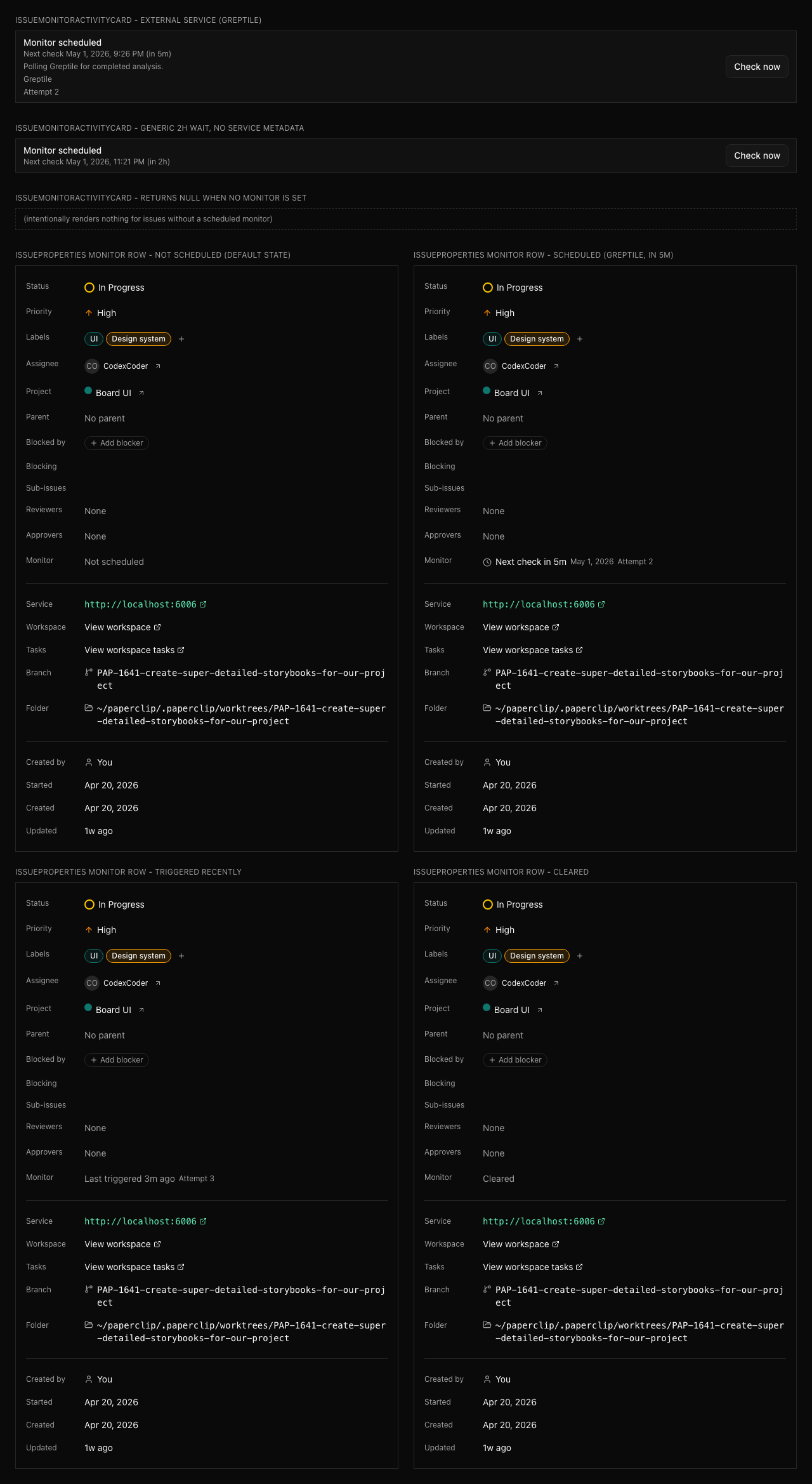 ## Risks - Medium: this changes heartbeat recovery behavior for scheduled external-service waits, so regressions could affect wake timing or recovery issue creation. - Migration risk is reduced by using `IF NOT EXISTS` for the new issue monitor columns and index. - External monitor references are treated as secret-adjacent and are intentionally omitted from visible activity/wake payloads. > For core feature work, check [`ROADMAP.md`](ROADMAP.md) first and discuss it in `#dev` before opening the PR. Feature PRs that overlap with planned core work may need to be redirected — check the roadmap first. See `CONTRIBUTING.md`. ## Model Used - OpenAI Codex, GPT-5 coding agent with repository tool use and terminal execution. ## Checklist - [x] I have included a thinking path that traces from project context to this change - [x] I have specified the model used (with version and capability details) - [x] I have checked ROADMAP.md and confirmed this PR does not duplicate planned core work - [x] I have run tests locally and they pass - [x] I have added or updated tests where applicable - [x] If this change affects the UI, I have included before/after screenshots or Storybook review surfaces - [x] I have updated relevant documentation to reflect my changes - [x] I have considered and documented any risks above - [x] I will address all Greptile and reviewer comments before requesting merge --------- Co-authored-by: Paperclip <noreply@paperclip.ing> |
||
|
Dotta
|
e8275318ba |
[codex] Raise agent heartbeat concurrency default (#4954)
## Thinking Path > - Paperclip orchestrates AI agents for zero-human companies > - Agent heartbeat settings control how much parallel work one employee can run > - The previous default of 5 concurrent runs was too restrictive for active local agent teams > - The shared default, heartbeat clamp, docs, and route/import/UI expectations need to agree > - This pull request raises the default heartbeat concurrency to 20 while keeping explicit headroom up to 50 for power users > - The benefit is higher throughput for agent teams without each new agent needing manual runtime config edits ## What Changed - Raised `AGENT_DEFAULT_MAX_CONCURRENT_RUNS` from 5 to 20. - Raised the heartbeat service max clamp from 10 to 50, keeping the new default below the ceiling. - Updated V1 implementation docs and tests that assert default imported/exported runtime config. - Updated the new-agent UI runtime config test to assert the shared default constant instead of duplicating the numeric value. ## Verification - `pnpm exec vitest run server/src/__tests__/agent-permissions-routes.test.ts server/src/__tests__/company-portability.test.ts ui/src/lib/new-agent-runtime-config.test.ts` ## Risks - Medium risk: new agents can consume more local execution capacity by default. The heartbeat scheduler still respects configured max concurrency and budget/pause controls, and operators can lower or raise the per-agent cap within the `1..50` clamp. > For core feature work, check [`ROADMAP.md`](ROADMAP.md) first and discuss it in `#dev` before opening the PR. Feature PRs that overlap with planned core work may need to be redirected — check the roadmap first. See `CONTRIBUTING.md`. ## Model Used - OpenAI Codex, GPT-5 coding agent, tool use and local command execution. Exact context window was not exposed in the runtime. ## Checklist - [x] I have included a thinking path that traces from project context to this change - [x] I have specified the model used (with version and capability details) - [x] I have checked ROADMAP.md and confirmed this PR does not duplicate planned core work - [x] I have run tests locally and they pass - [x] I have added or updated tests where applicable - [x] If this change affects the UI, I have included before/after screenshots - [x] I have updated relevant documentation to reflect my changes - [x] I have considered and documented any risks above - [x] I will address all Greptile and reviewer comments before requesting merge --------- Co-authored-by: Paperclip <noreply@paperclip.ing> |
||
|
Dotta
|
4272c1604d |
Add ACPX local adapter runtime (#4893)
## Thinking Path > - Paperclip orchestrates AI-agent companies through a control plane that can start, supervise, and recover agent runs. > - Local adapters are the bridge between Paperclip issues and concrete agent runtimes such as Claude, Codex, and other ACP-compatible tools. > - The roadmap calls out broader “bring your own agent” and claw-style agent support, and ACPX gives Paperclip one path to normalize multiple ACP agents behind a single adapter. > - The branch needed to become one reviewable PR against current `paperclipai/paperclip:master`, without carrying stale base conflicts or generated lockfile churn. > - This pull request adds an experimental built-in `acpx_local` adapter, integrates it through the server/CLI/UI adapter surfaces, and adds regression coverage for runtime execution, skill sync, stream parsing, diagnostics, and log redaction. > - The benefit is that Paperclip can run Claude/Codex/custom ACP agents through ACPX while keeping operator configuration, skills, logging, and transcript rendering inside the existing adapter model. ## What Changed - Added `@paperclipai/adapter-acpx-local` with server execution, config schema, ACPX session handling, CLI formatting, UI config helpers, and stdout parsing. - Registered `acpx_local` across CLI, server, shared constants, UI adapter metadata, adapter capabilities, and agent creation/editing surfaces. - Added ACPX runtime execution support with persistent sessions, local-agent JWT environment handling, skill snapshots, runtime skill materialization, and isolation/security regressions. - Added ACPX adapter diagnostics and marked the adapter experimental in the UI. - Added command/env secret redaction for resolved command metadata in adapter-utils, server event storage, and the Agent Detail invocation UI. - Added Storybook coverage for ACPX config, transcript rendering, and skill states, plus PR screenshots under `docs/pr-screenshots/pap-2944/`. - Rebased the branch onto current `public-gh/master`; `pnpm-lock.yaml` is intentionally not included and there are no migration/schema changes. ## Verification - `pnpm exec vitest run packages/adapters/acpx-local/src/server/execute.test.ts packages/adapters/acpx-local/src/server/test.test.ts packages/adapters/acpx-local/src/cli/format-event.test.ts packages/adapters/acpx-local/src/ui/parse-stdout.test.ts packages/adapter-utils/src/server-utils.test.ts server/src/__tests__/redaction.test.ts server/src/__tests__/acpx-local-execute.test.ts server/src/__tests__/acpx-local-skill-sync.test.ts server/src/__tests__/acpx-local-adapter-environment.test.ts server/src/__tests__/adapter-routes.test.ts server/src/__tests__/agent-skills-routes.test.ts ui/src/adapters/metadata.test.ts` — 12 files, 87 tests passed. - `pnpm --filter @paperclipai/adapter-acpx-local typecheck` — passed. - `pnpm --filter @paperclipai/server typecheck` — passed. - `pnpm --filter @paperclipai/ui typecheck` — passed. - Confirmed PR diff does not include `pnpm-lock.yaml`, database schema files, or migrations. Screenshots:    ## Risks - Medium risk: this introduces a new built-in adapter package and touches runtime execution, adapter registration, agent config, skills, and transcript rendering. - ACPX and ACP agent behavior can vary by installed tool versions; the adapter is marked experimental to set operator expectations. - `pnpm-lock.yaml` is excluded per repository PR policy, so dependency lock refresh must be handled by the repo’s automation or maintainers. - No database migration risk: no schema or migration files changed. > For core feature work, check [`ROADMAP.md`](ROADMAP.md) first and discuss it in `#dev` before opening the PR. Feature PRs that overlap with planned core work may need to be redirected — check the roadmap first. See `CONTRIBUTING.md`. ## Model Used - OpenAI Codex coding agent based on GPT-5, with repository tool use, shell execution, git operations, and local verification. Exact hosted context window was not exposed in this environment. ## Checklist - [x] I have included a thinking path that traces from project context to this change - [x] I have specified the model used (with version and capability details) - [x] I have checked ROADMAP.md and confirmed this PR does not duplicate planned core work - [x] I have run tests locally and they pass - [x] I have added or updated tests where applicable - [x] If this change affects the UI, I have included before/after screenshots - [x] I have updated relevant documentation to reflect my changes - [x] I have considered and documented any risks above - [x] I will address all Greptile and reviewer comments before requesting merge --------- Co-authored-by: Paperclip <noreply@paperclip.ing> |
||
|
Dotta
|
a3de1d764d |
Add cheap model profiles for local adapters (#4881)
## Thinking Path > - Paperclip is a control plane for autonomous AI companies, where adapters are the boundary between the board, agents, and execution runtimes. > - Local adapters currently expose a primary runtime configuration, but operators often need a cheaper model lane for routine or low-risk work. > - That cheap lane has to stay adapter-owned: runtime profile settings should not mutate the primary adapter config or bypass existing auth/secret mediation. > - Issue creation also needs an ergonomic way to request primary, cheap, or custom model behavior for a selected assignee. > - This pull request adds a first-class `cheap` model profile contract across adapter capabilities, heartbeat config resolution, agent configuration, and issue creation. > - The benefit is cheaper task execution can be configured and requested explicitly while preserving adapter boundaries, secret handling, and audit visibility. ## What Changed - Added adapter model-profile capability metadata and a `cheap` profile contract for supported local adapters. - Applied `runtimeConfig.modelProfiles.cheap.adapterConfig` during heartbeat config resolution, including requested/applied/fallback run metadata. - Added agent configuration UI for cheap model profile settings without writing those settings into primary `adapterConfig`. - Added New Issue assignee model lane controls for Primary / Cheap / Custom and request payload handling. - Added run ledger profile badges and Storybook stories for the new cheap-lane UI states. - Added tests for validators, heartbeat model profile application, permission/secret mediation, UI payload helpers, and run ledger rendering. - Added committed UI verification screenshots under `docs/pr-screenshots/pap-2837/`. - Addressed Greptile review feedback around cheap-profile defaults, shared profile types, and fallback test data. ## Verification Local: - `pnpm exec vitest run packages/shared/src/validators/issue.test.ts server/src/__tests__/adapter-registry.test.ts server/src/__tests__/agent-permissions-routes.test.ts server/src/__tests__/heartbeat-model-profile.test.ts ui/src/components/IssueRunLedger.test.tsx ui/src/lib/agent-config-patch.test.ts ui/src/lib/issue-assignee-overrides.test.ts ui/src/lib/new-agent-runtime-config.test.ts` — passed, 8 files / 103 tests. - `pnpm exec vitest run ui/src/lib/new-agent-runtime-config.test.ts ui/src/components/IssueRunLedger.test.tsx` — passed after Greptile/rebase follow-up, 2 files / 17 tests. - `pnpm --filter @paperclipai/ui typecheck` — passed after Greptile/rebase follow-up. - `pnpm -r typecheck` — passed. - `pnpm build` — passed. - `pnpm test:run` — did not complete successfully in this local worktree: it stopped in pre-existing `@paperclipai/adapter-utils` sandbox/SSH fixture suites outside this PR diff. Failures were 5s local timeouts plus `git init -b` unsupported by this machine's Git 2.21.0. The branch-specific targeted suites above passed. - Branch was fetched/rebased onto `public-gh/master`; `git rev-list --left-right --count public-gh/master...HEAD` reports `0 9`. Remote PR checks on latest head `e30bf399146451c86cee98ed528d51d33fa5af5a`: - `policy` — passed. - `verify` — passed. - `e2e` — passed. - `Greptile Review` — passed, confidence score 5/5; Greptile review threads resolved. - `security/snyk (cryppadotta)` — passed. Screenshots: - [New issue cheap lane desktop](https://github.com/paperclipai/paperclip/blob/PAP-2837-plan-cheap-model-for-adapters-that-can-support-it/docs/pr-screenshots/pap-2837/newissue-cheap-desktop.png) - [New issue custom lane desktop](https://github.com/paperclipai/paperclip/blob/PAP-2837-plan-cheap-model-for-adapters-that-can-support-it/docs/pr-screenshots/pap-2837/newissue-custom-desktop.png) - [New issue unsupported adapter desktop](https://github.com/paperclipai/paperclip/blob/PAP-2837-plan-cheap-model-for-adapters-that-can-support-it/docs/pr-screenshots/pap-2837/newissue-unsupported-desktop.png) - [Run ledger model profile badges desktop](https://github.com/paperclipai/paperclip/blob/PAP-2837-plan-cheap-model-for-adapters-that-can-support-it/docs/pr-screenshots/pap-2837/runledger-profile-badges-desktop.png) - Mobile variants are also in `docs/pr-screenshots/pap-2837/`. ## Risks - Medium: heartbeat config mediation now merges runtime model profiles into adapter configs, so adapter secret normalization and host-command restrictions must keep covering nested config paths. - Medium: the UI adds another issue creation choice; unsupported adapters must keep hiding the cheap lane and preserve primary behavior. - Low migration risk: no database migration is included. > For core feature work, check [`ROADMAP.md`](ROADMAP.md) first and discuss it in `#dev` before opening the PR. Feature PRs that overlap with planned core work may need to be redirected — check the roadmap first. See `CONTRIBUTING.md`. ## Model Used OpenAI Codex coding agent using GPT-5-class reasoning with repo tool use and command execution. Exact served model/context window was not exposed by the runtime. ## Checklist - [x] I have included a thinking path that traces from project context to this change - [x] I have specified the model used (with version and capability details) - [x] I have checked ROADMAP.md and confirmed this PR does not duplicate planned core work - [ ] I have run tests locally and they pass - [x] I have added or updated tests where applicable - [x] If this change affects the UI, I have included before/after screenshots - [x] I have updated relevant documentation to reflect my changes - [x] I have considered and documented any risks above - [x] I will address all Greptile and reviewer comments before requesting merge --------- Co-authored-by: Paperclip <noreply@paperclip.ing> Co-authored-by: Claude Opus 4.7 <noreply@anthropic.com> |
||
|
Dotta
|
c4269bab59 |
Add workflow interaction cancellation and issue cost summaries (#4862)
## Thinking Path > - Paperclip coordinates work through issue-thread interactions, run history, and cost telemetry. > - Operators need workflow prompts to be cancellable and costs to be visible at the issue level. > - The earlier rollup mixed this workflow/cost work with database backups, reliability recovery, thread scaling, and settings polish. > - This pull request isolates the interaction and cost surfaces into a reviewable slice. > - The backend now supports cancelling pending question interactions and summarizing issue-tree costs. > - The UI component layer can render cancelled questions and interleave activity with run ledger rows. ## What Changed - Added `cancelled` as an issue-thread interaction status and result shape for question interactions. - Added the board-only `POST /issues/:id/interactions/:interactionId/cancel` route and service implementation. - Added issue-tree cost summary support in the cost service and `/issues/:id/cost-summary` API route. - Extended shared cost exports and UI API/query keys for issue cost summaries. - Updated `IssueThreadInteractionCard` and `IssueRunLedger` components for cancelled questions, issue cost surfaces, and activity/run interleaving. - Added focused server and component regression coverage. ## Verification - `pnpm install --frozen-lockfile` - `pnpm exec vitest run server/src/__tests__/costs-service.test.ts server/src/__tests__/issue-thread-interaction-routes.test.ts server/src/__tests__/issue-thread-interactions-service.test.ts ui/src/components/IssueRunLedger.test.tsx` - Result: 4 test files passed, 45 tests passed. - UI screenshots not included because this PR updates reusable components and API surfaces without wiring a new page-level layout. ## Risks - Adds a new interaction terminal status; clients that switch exhaustively on interaction status may need to handle `cancelled`. - Issue-tree cost summaries use recursive issue traversal and should be watched on unusually large issue trees. - Page-level issue detail wiring is intentionally left to the board QoL/issue-detail branch to keep this PR narrow. > For core feature work, check [`ROADMAP.md`](ROADMAP.md) first and discuss it in `#dev` before opening the PR. Feature PRs that overlap with planned core work may need to be redirected — check the roadmap first. See `CONTRIBUTING.md`. ## Model Used - OpenAI Codex, GPT-5.5, code execution and GitHub CLI tool use, medium reasoning effort. ## Checklist - [x] I have included a thinking path that traces from project context to this change - [x] I have specified the model used (with version and capability details) - [x] I have checked ROADMAP.md and confirmed this PR does not duplicate planned core work - [x] I have run tests locally and they pass - [x] I have added or updated tests where applicable - [x] If this change affects the UI, I have included before/after screenshots - [x] I have updated relevant documentation to reflect my changes - [x] I have considered and documented any risks above - [x] I will address all Greptile and reviewer comments before requesting merge --------- Co-authored-by: Paperclip <noreply@paperclip.ing> |
||
|
Devin Foley
|
9b99d30330 |
Add dedicated environment settings page and test-in-environment (#4798)
## Thinking Path > - Paperclip orchestrates AI agents for zero-human companies > - Agents run inside environments (local, SSH, E2B sandbox) > - Operators need to configure and manage these environments > - But environment settings were buried inside the general company settings page, making them hard to find > - Additionally, when testing an agent from the configuration form, the test always ran locally regardless of which environment was selected > - This PR moves environments into a dedicated top-level company settings section and wires the "Test Environment" button to run inside the selected environment > - The benefit is operators can find and manage environments more easily, and the test button now validates the actual environment the agent will use ## What Changed - Added a dedicated `CompanyEnvironments` settings page with its own route and sidebar entry - Updated `CompanySettingsSidebar` and `CompanySettingsNav` to include the new environments section - Modified the agent test route (`POST /agents/:id/test`) to accept an optional `environmentId` parameter - Updated all adapter `test.ts` handlers to resolve and use the specified execution target environment - Added `resolveTestExecutionTarget` to `execution-target.ts` for remote environment test resolution with cwd fallback - Moved the "Test Environment" button and its feedback display into the `NewAgent` page footer for better UX flow ## Verification - `pnpm test` — all existing and new tests pass - `pnpm typecheck` — clean - Manual: navigate to Company Settings, confirm "Environments" appears as a top-level section - Manual: configure an agent with a non-local environment, click "Test Environment", confirm the test runs inside that environment ## Risks - Low risk. UI-only routing change for the settings page. The test-in-environment change adds an optional parameter with a local fallback, so existing behavior is preserved when no environment is specified. ## Model Used Codex GPT 5.4 high via Paperclip. ## Checklist - [x] I have included a thinking path that traces from project context to this change - [x] I have specified the model used (with version and capability details) - [x] I have checked ROADMAP.md and confirmed this PR does not duplicate planned core work - [x] I have run tests locally and they pass - [x] I have added or updated tests where applicable - [x] If this change affects the UI, I have included before/after screenshots - [x] I have updated relevant documentation to reflect my changes - [x] I have considered and documented any risks above - [x] I will address all Greptile and reviewer comments before requesting merge |
||
|
Dotta
|
1991ec9d6f |
[codex] Split backend control-plane QoL slice (#4700)
## Thinking Path > - Paperclip is the control plane for autonomous AI companies, so backend task ownership, recovery, review visibility, and company-scoped limits need to stay enforceable without UI-only coupling. > - Closed PR #4692 bundled those backend changes with UI workflow, docs, skills, workflow, and lockfile churn. > - PAP-2694 asks for a clean backend/control-plane slice from that closed branch. > - This branch starts from current `master` and mines only the `cli`, `packages/db`, `packages/shared`, and `server` contracts/tests needed for the backend behavior. > - It explicitly excludes UI workflow/performance work, `.github/workflows/pr.yml`, `pnpm-lock.yaml`, docs, skills, package-script, adapter UI build-config, and perf fixture script changes; the only UI files are fixture/test updates required by the tightened shared `Company` contract. > - The benefit is a smaller reviewable PR that preserves the control-plane fixes while staying under Greptile s 100-file review limit. ## What Changed - Added company-scoped attachment-size limits through DB schema/migrations, shared company portability contracts, CLI import/export coverage, and server attachment upload enforcement. - Added productivity review service/API behavior for no-comment streak, long-active, and high-churn review issues, including request-depth clamping and issue summary exposure. - Hardened issue ownership and recovery/control-plane paths: peer-agent mutation denial, issue tree pause/resume behavior, stranded recovery origins, and related activity/test coverage. - Preserved related backend contract updates for routine timestamp variables and managed agent instruction bundles because they live in shared/server contracts from the source branch. - Addressed Greptile feedback by making `Company.attachmentMaxBytes` non-optional, simplifying review request-depth clamping, fixing the migration final newline, and enforcing the process-level attachment cap as the final ceiling for uploads. - Added minimal company fixtures needed for repo-wide typecheck/build and kept the PR to 66 changed files with forbidden/non-slice paths excluded. ## Verification - `pnpm install --frozen-lockfile` - `git diff --check origin/master..HEAD` - `git diff --name-only origin/master..HEAD | wc -l` -> 66 files - `git diff --name-only origin/master..HEAD -- .github/workflows/pr.yml pnpm-lock.yaml package.json doc skills .agents scripts packages/adapters` -> no output - `pnpm exec vitest run --config vitest.config.ts packages/shared/src/validators/issue.test.ts packages/shared/src/routine-variables.test.ts packages/shared/src/adapter-types.test.ts cli/src/__tests__/company-import-export-e2e.test.ts cli/src/__tests__/company.test.ts server/src/__tests__/productivity-review-service.test.ts server/src/__tests__/issue-tree-control-service.test.ts server/src/__tests__/issue-tree-control-routes.test.ts server/src/__tests__/issue-agent-mutation-ownership-routes.test.ts server/src/__tests__/issue-attachment-routes.test.ts server/src/__tests__/heartbeat-process-recovery.test.ts server/src/__tests__/issues-service.test.ts` -> 12 files, 147 tests passed - `pnpm exec vitest run --config vitest.config.ts cli/src/__tests__/company-delete.test.ts cli/src/__tests__/company-import-export-e2e.test.ts server/src/__tests__/productivity-review-service.test.ts` -> 3 files, 18 tests passed - `pnpm exec vitest run --config vitest.config.ts server/src/__tests__/issue-attachment-routes.test.ts` -> 1 file, 6 tests passed - `pnpm --filter @paperclipai/db typecheck && pnpm --filter @paperclipai/shared typecheck && pnpm --filter @paperclipai/server typecheck && pnpm --filter paperclipai typecheck` - `pnpm --filter @paperclipai/server typecheck` - `pnpm --filter @paperclipai/ui typecheck && pnpm --filter @paperclipai/ui build` ## Risks - Includes migrations `0073_shiny_salo.sql` and `0074_striped_genesis.sql`; merge ordering matters if another PR adds migrations first. - This is intentionally backend-only apart from fixture/test updates forced by shared type correctness; UI affordances from PR #4692 are not present here and should land in separate UI slices. - The worktree install emitted plugin SDK bin-link warnings for unbuilt plugin packages, but the targeted tests and package typechecks completed successfully. > For core feature work, check [`ROADMAP.md`](ROADMAP.md) first and discuss it in `#dev` before opening the PR. Feature PRs that overlap with planned core work may need to be redirected; check the roadmap first. See `CONTRIBUTING.md`. ## Model Used - OpenAI Codex, GPT-5 coding agent, tool-enabled terminal/GitHub workflow. Exact runtime context window was not exposed by the harness. ## Checklist - [x] I have included a thinking path that traces from project context to this change - [x] I have specified the model used (with version and capability details) - [x] I have checked ROADMAP.md and confirmed this PR does not duplicate planned core work - [x] I have run tests locally and they pass - [x] I have added or updated tests where applicable - [x] If this change affects the UI, I have included before/after screenshots - [x] I have updated relevant documentation to reflect my changes - [x] I have considered and documented any risks above - [x] I will address all Greptile and reviewer comments before requesting merge --------- Co-authored-by: Paperclip <noreply@paperclip.ing> |
||
|
Dotta
|
fda296ee4f |
[codex] Add configurable liveness auto-recovery controls (#4587)
## Thinking Path > - Paperclip orchestrates AI agents for zero-human companies. > - Heartbeat liveness recovery decides when stalled issue trees need manager-visible follow-up. > - Automatic recovery issue creation is useful, but operators need instance-level controls for how aggressive it is. > - Without controls, recovery behavior is harder to tune for local development, production operations, and noisy edge cases. > - This pull request adds configurable liveness auto-recovery settings across shared contracts, API routes, services, and the instance experimental settings UI. > - The benefit is that operators can keep liveness findings advisory or enable bounded recovery automation with explicit intervals and lookback windows. ## What Changed - Added shared types and validators for liveness auto-recovery settings. - Extended instance settings routes and services to persist and validate the new controls. - Wired heartbeat/recovery services to honor enablement, minimum interval, and lookback settings. - Added UI controls for liveness recovery under instance experimental settings. - Covered the new server behavior with instance settings and liveness escalation tests. ## Verification - `pnpm exec vitest run --project @paperclipai/server server/src/__tests__/heartbeat-issue-liveness-escalation.test.ts server/src/__tests__/instance-settings-routes.test.ts --pool=forks --poolOptions.forks.isolate=true` - `pnpm --filter @paperclipai/shared typecheck` - `pnpm --filter @paperclipai/server typecheck` - `pnpm --filter @paperclipai/ui typecheck` ## Risks - Moderate behavioral risk because recovery automation timing changes when enabled; defaults keep existing advisory behavior unless the setting is turned on. - No database migration in this PR; settings are stored through the existing instance settings path. > For core feature work, check [`ROADMAP.md`](ROADMAP.md) first and discuss it in `#dev` before opening the PR. Feature PRs that overlap with planned core work may need to be redirected — check the roadmap first. See `CONTRIBUTING.md`. ## Model Used - OpenAI Codex, `gpt-5`, coding model with tool use and local command execution; context window not exposed by the runtime. ## Checklist - [x] I have included a thinking path that traces from project context to this change - [x] I have specified the model used (with version and capability details) - [x] I have checked ROADMAP.md and confirmed this PR does not duplicate planned core work - [x] I have run tests locally and they pass - [x] I have added or updated tests where applicable - [ ] If this change affects the UI, I have included before/after screenshots - [x] I have updated relevant documentation to reflect my changes - [x] I have considered and documented any risks above - [x] I will address all Greptile and reviewer comments before requesting merge --------- Co-authored-by: Paperclip <noreply@paperclip.ing> |
||
|
Dotta
|
82e257c7ba |
Cancel stale queued heartbeats when issue graph changes (PAP-2314) (#4534)
Co-Authored-By: Paperclip <noreply@paperclip.ing> |
||
|
Dotta
|
c036bbfa98 |
Add first-class security agent role to taxonomy (#4532)
## Thinking Path > - Paperclip is the control plane for AI-agent companies, so agent metadata is part of the platform's governance and audit surface. > - The shared agent taxonomy in `@paperclipai/shared` is the source of truth for allowed agent roles and their UI labels. > - The current taxonomy lacks a `security` role, which causes Security Engineer hires to collapse into `engineer`. > - That breaks separation-of-duties evidence in telemetry and weakens role-level audit fidelity even though it does not directly change permissions. > - This pull request adds `security` as a first-class shared role and covers the prior rejection path with a regression test. > - The benefit is that Security Engineer agents can now be persisted and rendered under the correct role without schema or permission churn. ## What Changed - Added `security` to `AGENT_ROLES` in `packages/shared/src/constants.ts`. - Added the `Security` display label to `AGENT_ROLE_LABELS` so existing UI consumers render the new role automatically. - Added a shared validator regression test proving `createAgentSchema` accepts `role: "security"` and that the label stays stable. ## Verification - `pnpm --filter @paperclipai/shared typecheck` - `pnpm --filter @paperclipai/shared exec vitest run src/adapter-types.test.ts` ## Risks - Low risk. This is a shared enum expansion with no database migration and no permission-model change. - Residual risk: this PR does not backfill existing agents already persisted as `engineer`; it only fixes new validations and labels going forward. > I checked `ROADMAP.md`/`doc` for overlap and did not find an existing planned item covering this taxonomy fix. ## Model Used - OpenAI GPT-5.4 via the Codex local adapter, with tool use and local code execution enabled. The runtime did not surface a separate context-window identifier in agent metadata. ## Checklist - [x] I have included a thinking path that traces from project context to this change - [x] I have specified the model used (with version and capability details) - [x] I have checked ROADMAP.md and confirmed this PR does not duplicate planned core work - [x] I have run tests locally and they pass - [x] I have added or updated tests where applicable - [ ] If this change affects the UI, I have included before/after screenshots - [ ] I have updated relevant documentation to reflect my changes - [x] I have considered and documented any risks above - [x] I will address all Greptile and reviewer comments before requesting merge |
||
|
Devin Foley
|
5bd0f578fd |
Generalize sandbox provider core for plugin-only providers (#4449)
## Thinking Path > - Paperclip is a control plane, so optional execution providers should sit at the plugin edge instead of hardcoding provider-specific behavior into core shared/server/ui layers. > - Sandbox environments are already first-class, and the fake provider proves the built-in path; the remaining gap was that real providers still leaked provider-specific config and runtime assumptions into core. > - That coupling showed up in config normalization, secret persistence, capabilities reporting, lease reconstruction, and the board UI form fields. > - As long as core knew about those provider-shaped details, shipping a provider as a pure third-party plugin meant every new provider would still require host changes. > - This pull request generalizes the sandbox provider seam around schema-driven plugin metadata and generic secret-ref handling. > - The runtime and UI now consume provider metadata generically, so core only special-cases the built-in fake provider while third-party providers can live entirely in plugins. ## What Changed - Added generic sandbox-provider capability metadata so plugin-backed providers can expose `configSchema` through shared environment support and the environments capabilities API. - Reworked sandbox config normalization/persistence/runtime resolution to handle schema-declared secret-ref fields generically, storing them as Paperclip secrets and resolving them for probe/execute/release flows. - Generalized plugin sandbox runtime handling so provider validation, reusable-lease matching, lease reconstruction, and plugin worker calls all operate on provider-agnostic config instead of provider-shaped branches. - Replaced hardcoded sandbox provider form fields in Company Settings with schema-driven rendering and blocked agent environment selection from the built-in fake provider. - Added regression coverage for the generic seam across shared support helpers plus environment config, probe, routes, runtime, and sandbox-provider runtime tests. ## Verification - `pnpm vitest --run packages/shared/src/environment-support.test.ts server/src/__tests__/environment-config.test.ts server/src/__tests__/environment-probe.test.ts server/src/__tests__/environment-routes.test.ts server/src/__tests__/environment-runtime.test.ts server/src/__tests__/sandbox-provider-runtime.test.ts` - `pnpm -r typecheck` ## Risks - Plugin sandbox providers now depend more heavily on accurate `configSchema` declarations; incorrect schemas can misclassify secret-bearing fields or omit required config. - Reusable lease matching is now metadata-driven for plugin-backed providers, so providers that fail to persist stable metadata may reprovision instead of resuming an existing lease. - The UI form is now fully schema-driven for plugin-backed sandbox providers; provider manifests without good defaults or descriptions may produce a rougher operator experience. ## Model Used - OpenAI Codex via `codex_local` - Model ID: `gpt-5.4` - Reasoning effort: `high` - Context window observed in runtime session metadata: `258400` tokens - Capabilities used: terminal tool execution, git, and local code/test inspection ## Checklist - [x] I have included a thinking path that traces from project context to this change - [x] I have specified the model used (with version and capability details) - [x] I have checked ROADMAP.md and confirmed this PR does not duplicate planned core work - [x] I have run tests locally and they pass - [x] I have added or updated tests where applicable - [ ] If this change affects the UI, I have included before/after screenshots - [x] I have updated relevant documentation to reflect my changes - [x] I have considered and documented any risks above - [x] I will address all Greptile and reviewer comments before requesting merge |
||
|
Dotta
|
73fbdf36db |
Gate stale-run watchdog decisions by board access (#4446)
## Thinking Path > - Paperclip orchestrates AI agents for zero-human companies > - The run ledger surfaces stale-run watchdog evaluation issues and recovery actions > - Viewer-level board users should be able to inspect status without getting controls that the server will reject > - The UI also needs enough board-access context to know when to hide those decision actions > - This pull request exposes board memberships in the current board access snapshot and gates watchdog action controls for known viewer contexts > - The benefit is clearer least-privilege UI behavior around recovery controls ## What Changed - Included memberships in `/api/cli-auth/me` so the board UI can distinguish active viewer memberships from operator/admin access. - Added the stale-run evaluation issue assignee to output silence summaries. - Hid stale-run watchdog decision buttons for known non-owner viewer contexts. - Surfaced watchdog decision failures through toast and inline error text. - Threaded `companyId` through the issue activity run ledger so access checks are company-scoped. - Added IssueRunLedger coverage for non-owner viewers. ## Verification - `pnpm exec vitest run --project @paperclipai/ui ui/src/components/IssueRunLedger.test.tsx` - `pnpm --filter @paperclipai/server typecheck` - `pnpm --filter @paperclipai/ui typecheck` ## Risks - Medium-low risk. This is a UI gating change backed by existing server authorization. - Local implicit and instance-admin board contexts continue to show watchdog decision controls. - No migrations. > For core feature work, check [`ROADMAP.md`](ROADMAP.md) first and discuss it in `#dev` before opening the PR. Feature PRs that overlap with planned core work may need to be redirected — check the roadmap first. See `CONTRIBUTING.md`. ## Model Used - OpenAI Codex, GPT-5 coding agent, tool-enabled with shell/GitHub/Paperclip API access. Context window was not reported by the runtime. ## Checklist - [x] I have included a thinking path that traces from project context to this change - [x] I have specified the model used (with version and capability details) - [x] I have checked ROADMAP.md and confirmed this PR does not duplicate planned core work - [x] I have run tests locally and they pass - [x] I have added or updated tests where applicable - [x] If this change affects the UI, I have included before/after screenshots - [x] I have updated relevant documentation to reflect my changes - [x] I have considered and documented any risks above - [x] I will address all Greptile and reviewer comments before requesting merge --------- Co-authored-by: Paperclip <noreply@paperclip.ing> |
||
|
Dotta
|
0c6961a03e |
Normalize escaped multiline issue and approval text (#4444)
## Thinking Path > - Paperclip orchestrates AI agents for zero-human companies > - The board and agent APIs accept multiline issue, approval, interaction, and document text > - Some callers accidentally send literal escaped newline sequences like `\n` instead of JSON-decoded line breaks > - That makes comments, descriptions, documents, and approval notes render as flattened text instead of readable markdown > - This pull request centralizes multiline text normalization in shared validators > - The benefit is newline-preserving API behavior across issue and approval workflows without route-specific fixes ## What Changed - Added a shared `multilineTextSchema` helper that normalizes escaped `\n`, `\r\n`, and `\r` sequences to real line breaks. - Applied the helper to issue descriptions, issue update comments, issue comment bodies, suggested task descriptions, interaction summaries, issue documents, approval comments, and approval decision notes. - Added shared validator regressions for issue and approval multiline inputs. ## Verification - `pnpm exec vitest run --project @paperclipai/shared packages/shared/src/validators/approval.test.ts packages/shared/src/validators/issue.test.ts` - `pnpm --filter @paperclipai/shared typecheck` ## Risks - Low risk. This only changes text fields that are explicitly multiline user/operator content. - If a caller intentionally wanted literal backslash-n text in these fields, it will now render as a real line break. > For core feature work, check [`ROADMAP.md`](ROADMAP.md) first and discuss it in `#dev` before opening the PR. Feature PRs that overlap with planned core work may need to be redirected — check the roadmap first. See `CONTRIBUTING.md`. ## Model Used - OpenAI Codex, GPT-5 coding agent, tool-enabled with shell/GitHub/Paperclip API access. Context window was not reported by the runtime. ## Checklist - [x] I have included a thinking path that traces from project context to this change - [x] I have specified the model used (with version and capability details) - [x] I have checked ROADMAP.md and confirmed this PR does not duplicate planned core work - [x] I have run tests locally and they pass - [x] I have added or updated tests where applicable - [x] If this change affects the UI, I have included before/after screenshots - [x] I have updated relevant documentation to reflect my changes - [x] I have considered and documented any risks above - [x] I will address all Greptile and reviewer comments before requesting merge --------- Co-authored-by: Paperclip <noreply@paperclip.ing> |
||
|
Dotta
|
5a0c1979cf | [codex] Add runtime lifecycle recovery and live issue visibility (#4419) | ||
|
Devin Foley
|
70679a3321 |
Add sandbox environment support (#4415)
## Thinking Path > - Paperclip orchestrates AI agents for zero-human companies. > - The environment/runtime layer decides where agent work executes and how the control plane reaches those runtimes. > - Today Paperclip can run locally and over SSH, but sandboxed execution needs a first-class environment model instead of one-off adapter behavior. > - We also want sandbox providers to be pluggable so the core does not hardcode every provider implementation. > - This branch adds the Sandbox environment path, the provider contract, and a deterministic fake provider plugin. > - That required synchronized changes across shared contracts, plugin SDK surfaces, server runtime orchestration, and the UI environment/workspace flows. > - The result is that sandbox execution becomes a core control-plane capability while keeping provider implementations extensible and testable. ## What Changed - Added sandbox runtime support to the environment execution path, including runtime URL discovery, sandbox execution targeting, orchestration, and heartbeat integration. - Added plugin-provider support for sandbox environments so providers can be supplied via plugins instead of hardcoded server logic. - Added the fake sandbox provider plugin with deterministic behavior suitable for local and automated testing. - Updated shared types, validators, plugin protocol definitions, and SDK helpers to carry sandbox provider and workspace-runtime contracts across package boundaries. - Updated server routes and services so companies can create sandbox environments, select them for work, and execute work through the sandbox runtime path. - Updated the UI environment and workspace surfaces to expose sandbox environment configuration and selection. - Added test coverage for sandbox runtime behavior, provider seams, environment route guards, orchestration, and the fake provider plugin. ## Verification - Ran locally before the final fixture-only scrub: - `pnpm -r typecheck` - `pnpm test:run` - `pnpm build` - Ran locally after the final scrub amend: - `pnpm vitest run server/src/__tests__/runtime-api.test.ts` - Reviewer spot checks: - create a sandbox environment backed by the fake provider plugin - run work through that environment - confirm sandbox provider execution does not inherit host secrets implicitly ## Risks - This touches shared contracts, plugin SDK plumbing, server runtime orchestration, and UI environment/workspace flows, so regressions would likely show up as cross-layer mismatches rather than isolated type errors. - Runtime URL discovery and sandbox callback selection are sensitive to host/bind configuration; if that logic is wrong, sandbox-backed callbacks may fail even when execution succeeds. - The fake provider plugin is intentionally deterministic and test-oriented; future providers may expose capability gaps that this branch does not yet cover. ## Model Used - OpenAI Codex coding agent on a GPT-5-class backend in the Paperclip/Codex harness. Exact backend model ID is not exposed in-session. Tool-assisted workflow with shell execution, file editing, git history inspection, and local test execution. ## Checklist - [x] I have included a thinking path that traces from project context to this change - [x] I have specified the model used (with version and capability details) - [x] I have checked ROADMAP.md and confirmed this PR does not duplicate planned core work - [x] I have run tests locally and they pass - [x] I have added or updated tests where applicable - [ ] If this change affects the UI, I have included before/after screenshots - [x] I have updated relevant documentation to reflect my changes - [x] I have considered and documented any risks above - [x] I will address all Greptile and reviewer comments before requesting merge |
||
|
Dotta
|
7ad225a198 |
[codex] Improve issue thread review flow (#4381)
## Thinking Path > - Paperclip orchestrates AI agents for zero-human companies > - Issue detail is where operators coordinate review, approvals, and follow-up work with active runs > - That thread UI needs to surface blockers, descendants, review handoffs, and reply ergonomics clearly enough for humans to guide agent work > - Several small gaps in the issue-thread flow were making review and navigation clunkier than necessary > - This pull request improves the reply composer, descendant/blocker presentation, interaction folding, and review-request handoff plumbing together as one cohesive issue-thread workflow slice > - The benefit is a cleaner operator review loop without changing the broader task model ## What Changed - restored and refined the floating reply composer behavior in the issue thread - folded expired confirmation interactions and improved post-submit thread scrolling behavior - surfaced descendant issue context and inline blocker/paused-assignee notices on the issue detail view - tightened large-board first paint behavior in `IssuesList` - added loose review-request handoffs through the issue execution-policy/update path and covered them with tests ## Verification - `pnpm vitest run ui/src/pages/IssueDetail.test.tsx` - `pnpm vitest run server/src/__tests__/issues-service.test.ts server/src/__tests__/issue-execution-policy.test.ts` - `pnpm exec vitest run --project @paperclipai/ui ui/src/components/IssueChatThread.test.tsx ui/src/components/IssueProperties.test.tsx ui/src/components/IssuesList.test.tsx ui/src/lib/issue-tree.test.ts ui/src/api/issues.test.ts` - `pnpm exec vitest run --project @paperclipai/adapter-utils packages/adapter-utils/src/server-utils.test.ts` - `pnpm exec vitest run --project @paperclipai/server server/src/__tests__/issue-comment-reopen-routes.test.ts -t "coerces executor handoff patches into workflow-controlled review wakes|wakes the return assignee with execution_changes_requested"` - `pnpm exec vitest run --project @paperclipai/server server/src/__tests__/issue-execution-policy.test.ts server/src/__tests__/issues-service.test.ts` ## Visual Evidence - UI layout changes are covered by the focused issue-thread component and issue-detail tests listed above. Browser screenshots were not attachable from this automated greploop environment, so reviewers should use the running preview for final visual confirmation. ## Risks - Moderate UI-flow risk: these changes touch the issue detail experience in multiple spots, so regressions would most likely show up as thread-layout quirks or incorrect review-handoff behavior > For core feature work, check [`ROADMAP.md`](ROADMAP.md) first and discuss it in `#dev` before opening the PR. Feature PRs that overlap with planned core work may need to be redirected — check the roadmap first. See `CONTRIBUTING.md`. ## Model Used - OpenAI Codex GPT-5-based coding agent with tool use and code execution in the Codex CLI environment ## Checklist - [x] I have included a thinking path that traces from project context to this change - [x] I have specified the model used (with version and capability details) - [x] I have checked ROADMAP.md and confirmed this PR does not duplicate planned core work - [x] I have run tests locally and they pass - [x] I have added or updated tests where applicable - [x] If this change affects the UI, I have included before/after screenshots or documented the visual verification path - [ ] I have updated relevant documentation to reflect my changes - [x] I have considered and documented any risks above - [x] I will address all Greptile and reviewer comments before requesting merge --------- Co-authored-by: Paperclip <noreply@paperclip.ing> |
||
|
Dotta
|
35a9dc37b0 |
[codex] Speed up company skill detail loading (#4380)
## Thinking Path > - Paperclip orchestrates AI agents for zero-human companies > - Company skills are part of the control plane for distributing reusable capabilities > - Board flows that inspect company skill detail should stay responsive because they are operator-facing control-plane reads > - The existing detail path was doing broader work than needed for the specific detail screen > - This pull request narrows that company-skill detail loading path and adds a regression test around it > - The benefit is faster company skill detail reads without changing the external API contract ## What Changed - tightened the company-skill detail loading path in `server/src/services/company-skills.ts` - added `server/src/__tests__/company-skills-detail.test.ts` to verify the detail route only pulls the required data ## Verification - `pnpm exec vitest run --project @paperclipai/server server/src/__tests__/company-skills-detail.test.ts` ## Risks - Low risk: this only changes the company-skill detail query path, but any missed assumption in the detail consumer would surface when loading that screen > For core feature work, check [`ROADMAP.md`](ROADMAP.md) first and discuss it in `#dev` before opening the PR. Feature PRs that overlap with planned core work may need to be redirected — check the roadmap first. See `CONTRIBUTING.md`. ## Model Used - OpenAI Codex GPT-5-based coding agent with tool use and code execution in the Codex CLI environment ## Checklist - [x] I have included a thinking path that traces from project context to this change - [x] I have specified the model used (with version and capability details) - [x] I have checked ROADMAP.md and confirmed this PR does not duplicate planned core work - [x] I have run tests locally and they pass - [x] I have added or updated tests where applicable - [ ] If this change affects the UI, I have included before/after screenshots - [ ] I have updated relevant documentation to reflect my changes - [x] I have considered and documented any risks above - [x] I will address all Greptile and reviewer comments before requesting merge |
||
|
Devin Foley
|
e4995bbb1c |
Add SSH environment support (#4358)
## Thinking Path > - Paperclip orchestrates AI agents for zero-human companies > - The environments subsystem already models execution environments, but before this branch there was no end-to-end SSH-backed runtime path for agents to actually run work against a remote box > - That meant agents could be configured around environment concepts without a reliable way to execute adapter sessions remotely, sync workspace state, and preserve run context across supported adapters > - We also need environment selection to participate in normal Paperclip control-plane behavior: agent defaults, project/issue selection, route validation, and environment probing > - Because this capability is still experimental, the UI surface should be easy to hide and easy to remove later without undoing the underlying implementation > - This pull request adds SSH environment execution support across the runtime, adapters, routes, schema, and tests, then puts the visible environment-management UI behind an experimental flag > - The benefit is that we can validate real SSH-backed agent execution now while keeping the user-facing controls safely gated until the feature is ready to come out of experimentation ## What Changed - Added SSH-backed execution target support in the shared adapter runtime, including remote workspace preparation, skill/runtime asset sync, remote session handling, and workspace restore behavior after runs. - Added SSH execution coverage for supported local adapters, plus remote execution tests across Claude, Codex, Cursor, Gemini, OpenCode, and Pi. - Added environment selection and environment-management backend support needed for SSH execution, including route/service work, validation, probing, and agent default environment persistence. - Added CLI support for SSH environment lab verification and updated related docs/tests. - Added the `enableEnvironments` experimental flag and gated the environment UI behind it on company settings, agent configuration, and project configuration surfaces. ## Verification - `pnpm exec vitest run packages/adapters/claude-local/src/server/execute.remote.test.ts packages/adapters/cursor-local/src/server/execute.remote.test.ts packages/adapters/gemini-local/src/server/execute.remote.test.ts packages/adapters/opencode-local/src/server/execute.remote.test.ts packages/adapters/pi-local/src/server/execute.remote.test.ts` - `pnpm exec vitest run server/src/__tests__/environment-routes.test.ts` - `pnpm exec vitest run server/src/__tests__/instance-settings-routes.test.ts` - `pnpm exec vitest run ui/src/lib/new-agent-hire-payload.test.ts ui/src/lib/new-agent-runtime-config.test.ts` - `pnpm -r typecheck` - `pnpm build` - Manual verification on a branch-local dev server: - enabled the experimental flag - created an SSH environment - created a Linux Claude agent using that environment - confirmed a run executed on the Linux box and synced workspace changes back ## Risks - Medium: this touches runtime execution flow across multiple adapters, so regressions would likely show up in remote session setup, workspace sync, or environment selection precedence. - The UI flag reduces exposure, but the underlying runtime and route changes are still substantial and rely on migration correctness. - The change set is broad across adapters, control-plane services, migrations, and UI gating, so review should pay close attention to environment-selection precedence and remote workspace lifecycle behavior. ## Model Used - OpenAI Codex via Paperclip's local Codex adapter, GPT-5-class coding model with tool use and code execution in the local repo workspace. The local adapter does not surface a more specific public model version string in this branch workflow. ## Checklist - [x] I have included a thinking path that traces from project context to this change - [x] I have specified the model used (with version and capability details) - [x] I have checked ROADMAP.md and confirmed this PR does not duplicate planned core work - [x] I have run tests locally and they pass - [x] I have added or updated tests where applicable - [ ] If this change affects the UI, I have included before/after screenshots - [x] I have updated relevant documentation to reflect my changes - [x] I have considered and documented any risks above - [x] I will address all Greptile and reviewer comments before requesting merge |
||
|
Dotta
|
f98c348e2b |
[codex] Add issue subtree pause, cancel, and restore controls (#4332)
## Thinking Path > - Paperclip orchestrates AI agents for zero-human companies. > - This branch extends the issue control-plane so board operators can pause, cancel, and later restore whole issue subtrees while keeping descendant execution and wake behavior coherent. > - That required new hold state in the database, shared contracts, server routes/services, and issue detail UI controls so subtree actions are durable and auditable instead of ad hoc. > - While this branch was in flight, `master` advanced with new environment lifecycle work, including a new `0065_environments` migration. > - Before opening the PR, this branch had to be rebased onto `paperclipai/paperclip:master` without losing the existing subtree-control work or leaving conflicting migration numbering behind. > - This pull request rebases the subtree pause/cancel/restore feature cleanly onto current `master`, renumbers the hold migration to `0066_issue_tree_holds`, and preserves the full branch diff in a single PR. > - The benefit is that reviewers get one clean, mergeable PR for the subtree-control feature instead of stale branch history with migration conflicts. ## What Changed - Added durable issue subtree hold data structures, shared API/types/validators, server routes/services, and UI flows for subtree pause, cancel, and restore operations. - Added server and UI coverage for subtree previewing, hold creation/release, dependency-aware scheduling under holds, and issue detail subtree controls. - Rebased the branch onto current `paperclipai/paperclip:master` and renumbered the branch migration from `0065_issue_tree_holds` to `0066_issue_tree_holds` so it no longer conflicts with upstream `0065_environments`. - Added a small follow-up commit that makes restore requests return `200 OK` explicitly while keeping pause/cancel hold creation at `201 Created`, and updated the route test to match that contract. ## Verification - `pnpm --filter @paperclipai/db typecheck` - `pnpm --filter @paperclipai/shared typecheck` - `pnpm --filter @paperclipai/server typecheck` - `pnpm --filter @paperclipai/ui typecheck` - `cd server && pnpm exec vitest run src/__tests__/issue-tree-control-routes.test.ts src/__tests__/issue-tree-control-service.test.ts src/__tests__/issue-tree-control-service-unit.test.ts src/__tests__/heartbeat-dependency-scheduling.test.ts` - `cd ui && pnpm exec vitest run src/components/IssueChatThread.test.tsx src/pages/IssueDetail.test.tsx` ## Risks - This is a broad cross-layer change touching DB/schema, shared contracts, server orchestration, and UI; regressions are most likely around subtree status restoration or wake suppression/resume edge cases. - The migration was renumbered during PR prep to avoid the new upstream `0065_environments` conflict. Reviewers should confirm the final `0066_issue_tree_holds` ordering is the only hold-related migration that lands. - The issue-tree restore endpoint now responds with `200` instead of relying on implicit behavior, which is semantically better for a restore operation but still changes an API detail that clients or tests could have assumed. > For core feature work, check [`ROADMAP.md`](ROADMAP.md) first and discuss it in `#dev` before opening the PR. Feature PRs that overlap with planned core work may need to be redirected — check the roadmap first. See `CONTRIBUTING.md`. ## Model Used - OpenAI Codex coding agent in the Paperclip Codex runtime (GPT-5-class tool-using coding model; exact deployment ID/context window is not exposed inside this session). ## Checklist - [x] I have included a thinking path that traces from project context to this change - [x] I have specified the model used (with version and capability details) - [x] I have checked ROADMAP.md and confirmed this PR does not duplicate planned core work - [x] I have run tests locally and they pass - [x] I have added or updated tests where applicable - [ ] If this change affects the UI, I have included before/after screenshots - [ ] I have updated relevant documentation to reflect my changes - [x] I have considered and documented any risks above - [x] I will address all Greptile and reviewer comments before requesting merge --------- Co-authored-by: Paperclip <noreply@paperclip.ing> |
||
|
Devin Foley
|
13551b2bac |
Add local environment lifecycle (#4297)
## Thinking Path > - Paperclip orchestrates AI agents for zero-human companies. > - Every heartbeat run needs a concrete place where the agent's adapter process executes. > - Today that execution location is implicitly the local machine, which makes it hard to track, audit, and manage as a first-class runtime concern. > - The first step is to represent the current local execution path explicitly without changing how users experience agent runs. > - This pull request adds core Environment and Environment Lease records, then routes existing local heartbeat execution through a default `Local` environment. > - The benefit is that local runs remain behavior-preserving while the system now has durable environment identity, lease lifecycle tracking, and activity records for execution placement. ## What Changed - Added `environments` and `environment_leases` database tables, schema exports, and migration `0065_environments.sql`. - Added shared environment constants, TypeScript types, and validators for environment drivers, statuses, lease policies, lease statuses, and cleanup states. - Added `environmentService` for listing, reading, creating, updating, and ensuring company-scoped environments. - Added environment lease lifecycle operations for acquire, metadata update, single-lease release, and run-wide release. - Updated heartbeat execution to lazily ensure a company-scoped default `Local` environment before adapter execution. - Updated heartbeat execution to acquire an ephemeral local environment lease, write `paperclipEnvironment` into the run context snapshot, and release active leases during run finalization. - Added activity log events for environment lease acquisition and release. - Added tests for environment service behavior and the local heartbeat environment lifecycle. - Added a CI-follow-up heartbeat guard so deferred issue comment wakes are promoted before automatic missing-comment retries, with focused batching test coverage. ## Verification Local verification run for this branch: - `pnpm -r typecheck` - `pnpm build` - `pnpm exec vitest run server/src/__tests__/environment-service.test.ts server/src/__tests__/heartbeat-local-environment.test.ts --pool=forks` Additional reviewer/CI verification: - Confirm `pnpm-lock.yaml` is not modified. - Confirm `pnpm test:run` passes in CI. - Confirm `PAPERCLIP_E2E_SKIP_LLM=true pnpm run test:e2e` passes in CI. - Confirm a local heartbeat run creates one active `Local` environment when needed, records one lease for the run, releases the lease when the run finishes, and includes `paperclipEnvironment` in the run context snapshot. Screenshots: not applicable; this PR has no UI changes. ## Risks - Migration risk: introduces two new tables and a new migration journal entry. Review should verify company scoping, indexes, foreign keys, and enum defaults are correct. - Lifecycle risk: heartbeat finalization now releases environment leases in addition to existing runtime cleanup. A finalization bug could leave stale active leases or mark a failed run's lease incorrectly. - Behavior-preservation risk: local adapter execution should remain unchanged apart from environment bookkeeping. Review should pay attention to the heartbeat path around context snapshot updates and final cleanup ordering. - Activity volume risk: each heartbeat run now logs lease acquisition and release events, increasing activity log volume by two records per run. ## Model Used OpenAI GPT-5.4 via Codex CLI. Capabilities used: repository inspection, TypeScript implementation review, local test/build execution, and PR-description drafting. ## Checklist - [x] I have included a thinking path that traces from project context to this change - [x] I have run tests locally and they pass - [x] I have added or updated tests where applicable - [x] If this change affects the UI, I have included before/after screenshots (N/A: no UI changes) - [x] I have updated relevant documentation to reflect my changes (N/A: no user-facing docs or commands changed) - [x] I have considered and documented any risks above - [x] I will address all Greptile and reviewer comments before requesting merge |
||
|
Dotta
|
a957394420 |
[codex] Add structured issue-thread interactions (#4244)
## Thinking Path > - Paperclip orchestrates AI agents for zero-human companies. > - Operators supervise that work through issues, comments, approvals, and the board UI. > - Some agent proposals need structured board/user decisions, not hidden markdown conventions or heavyweight governed approvals. > - Issue-thread interactions already provide a natural thread-native surface for proposed tasks and questions. > - This pull request extends that surface with request confirmations, richer interaction cards, and agent/plugin/MCP helpers. > - The benefit is that plan approvals and yes/no decisions become explicit, auditable, and resumable without losing the single-issue workflow. ## What Changed - Added persisted issue-thread interactions for suggested tasks, structured questions, and request confirmations. - Added board UI cards for interaction review, selection, question answers, and accept/reject confirmation flows. - Added MCP and plugin SDK helpers for creating interaction cards from agents/plugins. - Updated agent wake instructions, onboarding assets, Paperclip skill docs, and public docs to prefer structured confirmations for issue-scoped decisions. - Rebased the branch onto `public-gh/master` and renumbered branch migrations to `0063` and `0064`; the idempotency migration uses `ADD COLUMN IF NOT EXISTS` for old branch users. ## Verification - `git diff --check public-gh/master..HEAD` - `pnpm exec vitest run packages/adapter-utils/src/server-utils.test.ts packages/mcp-server/src/tools.test.ts packages/shared/src/issue-thread-interactions.test.ts ui/src/lib/issue-thread-interactions.test.ts ui/src/lib/issue-chat-messages.test.ts ui/src/components/IssueThreadInteractionCard.test.tsx ui/src/components/IssueChatThread.test.tsx server/src/__tests__/issue-thread-interaction-routes.test.ts server/src/__tests__/issue-thread-interactions-service.test.ts server/src/services/issue-thread-interactions.test.ts` -> 9 files / 79 tests passed - `pnpm -r typecheck` -> passed, including `packages/db` migration numbering check ## Risks - Medium: this adds a new issue-thread interaction model across db/shared/server/ui/plugin surfaces. - Migration risk is reduced by placing this branch after current master migrations (`0063`, `0064`) and making the idempotency column add idempotent for users who applied the old branch numbering. - UI interaction behavior is covered by component tests, but this PR does not include browser screenshots. > For core feature work, check [`ROADMAP.md`](ROADMAP.md) first and discuss it in `#dev` before opening the PR. Feature PRs that overlap with planned core work may need to be redirected — check the roadmap first. See `CONTRIBUTING.md`. ## Model Used - OpenAI Codex, GPT-5-class coding agent runtime. Exact model ID and context window are not exposed in this Paperclip run; tool use and local shell/code execution were enabled. ## Checklist - [x] I have included a thinking path that traces from project context to this change - [x] I have specified the model used (with version and capability details) - [x] I have checked ROADMAP.md and confirmed this PR does not duplicate planned core work - [x] I have run tests locally and they pass - [x] I have added or updated tests where applicable - [ ] If this change affects the UI, I have included before/after screenshots - [x] I have updated relevant documentation to reflect my changes - [x] I have considered and documented any risks above - [x] I will address all Greptile and reviewer comments before requesting merge --------- Co-authored-by: Paperclip <noreply@paperclip.ing> |
||
|
Dotta
|
09d0678840 |
[codex] Harden heartbeat scheduling and runtime controls (#4223)
## Thinking Path > - Paperclip orchestrates AI agents through issue checkout, heartbeat runs, routines, and auditable control-plane state > - The runtime path has to recover from lost local processes, transient adapter failures, blocked dependencies, and routine coalescing without stranding work > - The existing branch carried several reliability fixes across heartbeat scheduling, issue runtime controls, routine dispatch, and operator-facing run state > - These changes belong together because they share backend contracts, migrations, and runtime status semantics > - This pull request groups the control-plane/runtime slice so it can merge independently from board UI polish and adapter sandbox work > - The benefit is safer heartbeat recovery, clearer runtime controls, and more predictable recurring execution behavior ## What Changed - Adds bounded heartbeat retry scheduling, scheduled retry state, and Codex transient failure recovery handling. - Tightens heartbeat process recovery, blocker wake behavior, issue comment wake handling, routine dispatch coalescing, and activity/dashboard bounds. - Adds runtime-control MCP tools and Paperclip skill docs for issue workspace runtime management. - Adds migrations `0061_lively_thor_girl.sql` and `0062_routine_run_dispatch_fingerprint.sql`. - Surfaces retry state in run ledger/agent UI and keeps related shared types synchronized. ## Verification - `pnpm exec vitest run server/src/__tests__/heartbeat-retry-scheduling.test.ts server/src/__tests__/heartbeat-process-recovery.test.ts server/src/__tests__/routines-service.test.ts` - `pnpm exec vitest run src/tools.test.ts` from `packages/mcp-server` ## Risks - Medium risk: this touches heartbeat recovery and routine dispatch, which are central execution paths. - Migration order matters if split branches land out of order: merge this PR before branches that assume the new runtime/routine fields. - Runtime retry behavior should be watched in CI and in local operator smoke tests because it changes how transient failures are resumed. > For core feature work, check [`ROADMAP.md`](ROADMAP.md) first and discuss it in `#dev` before opening the PR. Feature PRs that overlap with planned core work may need to be redirected — check the roadmap first. See `CONTRIBUTING.md`. ## Model Used - OpenAI Codex, GPT-5-based coding agent runtime, shell/git tool use enabled. Exact hosted model build and context window are not exposed in this Paperclip heartbeat environment. ## Checklist - [x] I have included a thinking path that traces from project context to this change - [x] I have specified the model used (with version and capability details) - [x] I have checked ROADMAP.md and confirmed this PR does not duplicate planned core work - [x] I have run tests locally and they pass - [x] I have added or updated tests where applicable - [ ] If this change affects the UI, I have included before/after screenshots - [x] I have updated relevant documentation to reflect my changes - [x] I have considered and documented any risks above - [x] I will address all Greptile and reviewer comments before requesting merge |
||
|
Dotta
|
ab9051b595 |
Add first-class issue references (#4214)
## Thinking Path > - Paperclip orchestrates AI agents for zero-human companies. > - Operators and agents coordinate through company-scoped issues, comments, documents, and task relationships. > - Issue text can mention other tickets, but those references were previously plain markdown/text without durable relationship data. > - That made it harder to understand related work, surface backlinks, and keep cross-ticket context visible in the board. > - This pull request adds first-class issue reference extraction, storage, API responses, and UI surfaces. > - The benefit is that issue references become queryable, navigable, and visible without relying on ad hoc text scanning. ## What Changed - Added shared issue-reference parsing utilities and exported reference-related types/constants. - Added an `issue_reference_mentions` table, idempotent migration DDL, schema exports, and database documentation. - Added server-side issue reference services, route integration, activity summaries, and a backfill command for existing issue content. - Added UI reference pills, related-work panels, markdown/editor mention handling, and issue detail/property rendering updates. - Added focused shared, server, and UI tests for parsing, persistence, display, and related-work behavior. - Rebased `PAP-735-first-class-task-references` cleanly onto `public-gh/master`; no `pnpm-lock.yaml` changes are included. ## Verification - `pnpm -r typecheck` - `pnpm test:run packages/shared/src/issue-references.test.ts server/src/__tests__/issue-references-service.test.ts ui/src/components/IssueRelatedWorkPanel.test.tsx ui/src/components/IssueProperties.test.tsx ui/src/components/MarkdownBody.test.tsx` ## Risks - Medium risk because this adds a new issue-reference persistence path that touches shared parsing, database schema, server routes, and UI rendering. - Migration risk is mitigated by `CREATE TABLE IF NOT EXISTS`, guarded foreign-key creation, and `CREATE INDEX IF NOT EXISTS` statements so users who have applied an older local version of the numbered migration can re-run safely. - UI risk is limited by focused component coverage, but reviewers should still manually inspect issue detail pages containing ticket references before merge. > For core feature work, check [`ROADMAP.md`](ROADMAP.md) first and discuss it in `#dev` before opening the PR. Feature PRs that overlap with planned core work may need to be redirected — check the roadmap first. See `CONTRIBUTING.md`. ## Model Used - OpenAI Codex, GPT-5-based coding agent, tool-using shell workflow with repository inspection, git rebase/push, typecheck, and focused Vitest verification. ## Checklist - [x] I have included a thinking path that traces from project context to this change - [x] I have specified the model used (with version and capability details) - [x] I have checked ROADMAP.md and confirmed this PR does not duplicate planned core work - [x] I have run tests locally and they pass - [x] I have added or updated tests where applicable - [x] If this change affects the UI, I have included before/after screenshots - [x] I have updated relevant documentation to reflect my changes - [x] I have considered and documented any risks above - [x] I will address all Greptile and reviewer comments before requesting merge --------- Co-authored-by: dotta <dotta@example.com> Co-authored-by: Paperclip <noreply@paperclip.ing> |
||
|
Dotta
|
7a329fb8bb |
Harden API route authorization boundaries (#4122)
## Thinking Path > - Paperclip orchestrates AI agents for zero-human companies. > - The REST API is the control-plane boundary for companies, agents, plugins, adapters, costs, invites, and issue mutations. > - Several routes still relied on broad board or company access checks without consistently enforcing the narrower actor, company, and active-checkout boundaries those operations require. > - That can allow agents or non-admin users to mutate sensitive resources outside the intended governance path. > - This pull request hardens the route authorization layer and adds regression coverage for the audited API surfaces. > - The benefit is tighter multi-company isolation, safer plugin and adapter administration, and stronger enforcement of active issue ownership. ## What Changed - Added route-level authorization checks for budgets, plugin administration/scoped routes, adapter management, company import/export, direct agent creation, invite test resolution, and issue mutation/write surfaces. - Enforced active checkout ownership for agent-authenticated issue mutations, while preserving explicit management overrides for permitted managers. - Restricted sensitive adapter and plugin management operations to instance-admin or properly scoped actors. - Tightened company portability and invite probing routes so agents cannot cross company boundaries. - Updated access constants and the Company Access UI copy for the new active-checkout management grant. - Added focused regression tests covering cross-company denial, agent self-mutation denial, admin-only operations, and active checkout ownership. - Rebased the branch onto `public-gh/master` and fixed validation fallout from the rebase: heartbeat-context route ordering and a company import/export e2e fixture that now opts out of direct-hire approval before using direct agent creation. - Updated onboarding and signoff e2e setup to create seed agents through `/agent-hires` plus board approval, so they remain compatible with the approval-gated new-agent default. - Addressed Greptile feedback by removing a duplicate company export API alias, avoiding N+1 reporting-chain lookups in active-checkout override checks, allowing agent mutations on unassigned `in_progress` issues, and blocking NAT64 invite-probe targets. ## Verification - `pnpm exec vitest run server/src/__tests__/issues-goal-context-routes.test.ts cli/src/__tests__/company-import-export-e2e.test.ts` - `pnpm exec vitest run server/src/__tests__/plugin-routes-authz.test.ts server/src/__tests__/adapter-routes-authz.test.ts server/src/__tests__/agent-permissions-routes.test.ts server/src/__tests__/company-portability-routes.test.ts server/src/__tests__/costs-service.test.ts server/src/__tests__/invite-test-resolution-route.test.ts server/src/__tests__/issue-agent-mutation-ownership-routes.test.ts server/src/__tests__/agent-adapter-validation-routes.test.ts` - `pnpm exec vitest run server/src/__tests__/issue-agent-mutation-ownership-routes.test.ts` - `pnpm exec vitest run server/src/__tests__/invite-test-resolution-route.test.ts` - `pnpm -r typecheck` - `pnpm --filter server typecheck` - `pnpm --filter ui typecheck` - `pnpm build` - `pnpm test:e2e -- tests/e2e/onboarding.spec.ts tests/e2e/signoff-policy.spec.ts` - `pnpm test:e2e -- tests/e2e/signoff-policy.spec.ts` - `pnpm test:run` was also run. It failed under default full-suite parallelism with two order-dependent failures in `plugin-routes-authz.test.ts` and `routines-e2e.test.ts`; both files passed when rerun directly together with `pnpm exec vitest run server/src/__tests__/plugin-routes-authz.test.ts server/src/__tests__/routines-e2e.test.ts`. ## Risks - Medium risk: this changes authorization behavior across multiple sensitive API surfaces, so callers that depended on broad board/company access may now receive `403` or `409` until they use the correct governance path. - Direct agent creation now respects the company-level board-approval requirement; integrations that need pending hires should use `/api/companies/:companyId/agent-hires`. - Active in-progress issue mutations now require checkout ownership or an explicit management override, which may reveal workflow assumptions in older automation. > For core feature work, check [`ROADMAP.md`](ROADMAP.md) first and discuss it in `#dev` before opening the PR. Feature PRs that overlap with planned core work may need to be redirected — check the roadmap first. See `CONTRIBUTING.md`. ## Model Used OpenAI Codex, GPT-5 coding agent, tool-using workflow with local shell, Git, GitHub CLI, and repository tests. ## Checklist - [x] I have included a thinking path that traces from project context to this change - [x] I have specified the model used (with version and capability details) - [x] I have checked ROADMAP.md and confirmed this PR does not duplicate planned core work - [ ] I have run tests locally and they pass - [x] I have added or updated tests where applicable - [x] If this change affects the UI, I have included before/after screenshots - [x] I have updated relevant documentation to reflect my changes - [x] I have considered and documented any risks above - [x] I will address all Greptile and reviewer comments before requesting merge --------- Co-authored-by: Paperclip <noreply@paperclip.ing> |
||
|
Dotta
|
549ef11c14 |
[codex] Respect manual workspace runtime controls (#4125)
## Thinking Path > - Paperclip orchestrates AI agents inside execution and project workspaces > - Workspace runtime services can be controlled manually by operators and reused by agent runs > - Manual start/stop state was not preserved consistently across workspace policies and routine launches > - Routine launches also needed branch/workspace variables to default from the selected workspace context > - This pull request makes runtime policy state explicit, preserves manual control, and auto-fills routine branch variables from workspace data > - The benefit is less surprising workspace service behavior and fewer manual inputs when running workspace-scoped routines ## What Changed - Added runtime-state handling for manual workspace control across execution and project workspace validators, routes, and services. - Updated heartbeat/runtime startup behavior so manually stopped services are respected. - Auto-filled routine workspace branch variables from available workspace context. - Added focused server and UI tests for workspace runtime and routine variable behavior. - Removed muted gray background styling from workspace pages and cards for a cleaner workspace UI. ## Verification - `pnpm install --frozen-lockfile --ignore-scripts` - `pnpm exec vitest run server/src/__tests__/routines-service.test.ts server/src/__tests__/workspace-runtime.test.ts ui/src/components/RoutineRunVariablesDialog.test.tsx` - Result: 55 tests passed, 21 skipped. The embedded Postgres routines tests skipped on this host with the existing PGlite/Postgres init warning; workspace-runtime and UI tests passed. ## Risks - Medium risk: this touches runtime service start/stop policy and heartbeat launch behavior. - The focused tests cover manual runtime state, routine variables, and workspace runtime reuse paths. > For core feature work, check [`ROADMAP.md`](ROADMAP.md) first and discuss it in `#dev` before opening the PR. Feature PRs that overlap with planned core work may need to be redirected — check the roadmap first. See `CONTRIBUTING.md`. ## Model Used - OpenAI Codex coding agent based on GPT-5, tool-enabled local shell and GitHub workflow, exact runtime context window not exposed in this session. ## Checklist - [x] I have included a thinking path that traces from project context to this change - [x] I have specified the model used (with version and capability details) - [x] I have checked ROADMAP.md and confirmed this PR does not duplicate planned core work - [x] I have run tests locally and they pass - [x] I have added or updated tests where applicable - [x] If this change affects the UI, I have included before/after screenshots, or documented why targeted component/service verification is sufficient here - [x] I have updated relevant documentation to reflect my changes - [x] I have considered and documented any risks above - [x] I will address all Greptile and reviewer comments before requesting merge --------- Co-authored-by: Paperclip <noreply@paperclip.ing> |
||
|
Dotta
|
4357a3f352 |
[codex] Harden dashboard run activity charts (#4126)
## Thinking Path > - Paperclip gives operators a live view of agent work across dashboards, transcripts, and run activity charts > - Those views consume live run updates and aggregate run activity from backend dashboard data > - Missing or partial run data could make charts brittle, and live transcript updates were heavier than needed > - Operators need dashboard data to stay stable even when recent run payloads are incomplete > - This pull request hardens dashboard run aggregation, guards chart rendering, and lightens live run update handling > - The benefit is a more reliable dashboard during active agent execution ## What Changed - Added dashboard run activity types and backend aggregation coverage. - Guarded activity chart rendering when run data is missing or partial. - Reduced live transcript update churn in active agent and run chat surfaces. - Fixed issue chat avatar alignment in the thread renderer. - Added focused dashboard, activity chart, and live transcript tests. ## Verification - `pnpm install --frozen-lockfile --ignore-scripts` - `pnpm exec vitest run server/src/__tests__/dashboard-service.test.ts ui/src/components/ActivityCharts.test.tsx ui/src/components/transcript/useLiveRunTranscripts.test.tsx` - Result: 8 tests passed, 1 skipped. The embedded Postgres dashboard service test skipped on this host with the existing PGlite/Postgres init warning; UI chart and transcript tests passed. ## Risks - Medium-low risk: aggregation semantics changed, but the UI remains guarded around incomplete data. - The dashboard service test is host-skipped here, so CI should confirm the embedded database path. > For core feature work, check [`ROADMAP.md`](ROADMAP.md) first and discuss it in `#dev` before opening the PR. Feature PRs that overlap with planned core work may need to be redirected — check the roadmap first. See `CONTRIBUTING.md`. ## Model Used - OpenAI Codex coding agent based on GPT-5, tool-enabled local shell and GitHub workflow, exact runtime context window not exposed in this session. ## Checklist - [x] I have included a thinking path that traces from project context to this change - [x] I have specified the model used (with version and capability details) - [x] I have checked ROADMAP.md and confirmed this PR does not duplicate planned core work - [x] I have run tests locally and they pass - [x] I have added or updated tests where applicable - [x] If this change affects the UI, I have included before/after screenshots, or documented why targeted component tests are sufficient here - [x] I have updated relevant documentation to reflect my changes - [x] I have considered and documented any risks above - [x] I will address all Greptile and reviewer comments before requesting merge --------- Co-authored-by: Paperclip <noreply@paperclip.ing> |
||
|
Dotta
|
9c6f551595 |
[codex] Add plugin orchestration host APIs (#4114)
## Thinking Path > - Paperclip orchestrates AI agents for zero-human companies. > - The plugin system is the extension path for optional capabilities that should not require core product changes for every integration. > - Plugins need scoped host APIs for issue orchestration, documents, wakeups, summaries, activity attribution, and isolated database state. > - Without those host APIs, richer plugins either cannot coordinate Paperclip work safely or need privileged core-side special cases. > - This pull request adds the plugin orchestration host surface, scoped route dispatch, a database namespace layer, and a smoke plugin that exercises the contract. > - The benefit is a broader plugin API that remains company-scoped, auditable, and covered by tests. ## What Changed - Added plugin orchestration host APIs for issue creation, document access, wakeups, summaries, plugin-origin activity, and scoped API route dispatch. - Added plugin database namespace tables, schema exports, migration checks, and idempotent replay coverage under migration `0059_plugin_database_namespaces`. - Added shared plugin route/API types and validators used by server and SDK boundaries. - Expanded plugin SDK types, protocol helpers, worker RPC host behavior, and testing utilities for orchestration flows. - Added the `plugin-orchestration-smoke-example` package to exercise scoped routes, restricted database namespaces, issue orchestration, documents, wakeups, summaries, and UI status surfaces. - Kept the new orchestration smoke fixture out of the root pnpm workspace importer so this PR preserves the repository policy of not committing `pnpm-lock.yaml`. - Updated plugin docs and database docs for the new orchestration and database namespace surfaces. - Rebased the branch onto `public-gh/master`, resolved conflicts, and removed `pnpm-lock.yaml` from the final PR diff. ## Verification - `pnpm install --frozen-lockfile` - `pnpm --filter @paperclipai/db typecheck` - `pnpm exec vitest run packages/db/src/client.test.ts` - `pnpm exec vitest run server/src/__tests__/plugin-database.test.ts server/src/__tests__/plugin-orchestration-apis.test.ts server/src/__tests__/plugin-routes-authz.test.ts server/src/__tests__/plugin-scoped-api-routes.test.ts server/src/__tests__/plugin-sdk-orchestration-contract.test.ts` - From `packages/plugins/examples/plugin-orchestration-smoke-example`: `pnpm exec vitest run --config ./vitest.config.ts` - `pnpm --dir packages/plugins/examples/plugin-orchestration-smoke-example run typecheck` - `pnpm --filter @paperclipai/server typecheck` - PR CI on latest head `293fc67c`: `policy`, `verify`, `e2e`, and `security/snyk` all passed. ## Risks - Medium risk: this expands plugin host authority, so route auth, company scoping, and plugin-origin activity attribution need careful review. - Medium risk: database namespace migration behavior must remain idempotent for environments that may have seen earlier branch versions. - Medium risk: the orchestration smoke fixture is intentionally excluded from the root workspace importer to avoid a `pnpm-lock.yaml` PR diff; direct fixture verification remains listed above. - Low operational risk from the PR setup itself: the branch is rebased onto current `master`, the migration is ordered after upstream `0057`/`0058`, and `pnpm-lock.yaml` is not in the final diff. > For core feature work, check [`ROADMAP.md`](ROADMAP.md) first and discuss it in `#dev` before opening the PR. Feature PRs that overlap with planned core work may need to be redirected — check the roadmap first. See `CONTRIBUTING.md`. Roadmap checked: this work aligns with the completed Plugin system milestone and extends the plugin surface rather than duplicating an unrelated planned core feature. ## Model Used - OpenAI Codex, GPT-5-based coding agent in a tool-enabled CLI environment. Exact hosted model build and context-window size are not exposed by the runtime; reasoning/tool use were enabled for repository inspection, editing, testing, git operations, and PR creation. ## Checklist - [x] I have included a thinking path that traces from project context to this change - [x] I have specified the model used (with version and capability details) - [x] I have checked ROADMAP.md and confirmed this PR does not duplicate planned core work - [x] I have run tests locally and they pass - [x] I have added or updated tests where applicable - [x] If this change affects the UI, I have included before/after screenshots (N/A: no core UI screen change; example plugin UI contract is covered by tests) - [x] I have updated relevant documentation to reflect my changes - [x] I have considered and documented any risks above - [x] I will address all Greptile and reviewer comments before requesting merge --------- Co-authored-by: Paperclip <noreply@paperclip.ing> |
||
|
Dotta
|
16b2b84d84 |
[codex] Improve agent runtime recovery and governance (#4086)
## Thinking Path > - Paperclip orchestrates AI agents for zero-human companies. > - The heartbeat runtime, agent import path, and agent configuration defaults determine whether work is dispatched safely and predictably. > - Several accumulated fixes all touched agent execution recovery, wake routing, import behavior, and runtime concurrency defaults. > - Those changes need to land together so the heartbeat service and agent creation defaults stay internally consistent. > - This pull request groups the runtime/governance changes from the split branch into one standalone branch. > - The benefit is safer recovery for stranded runs, bounded high-volume reads, imported-agent approval correctness, skill-template support, and a clearer default concurrency policy. ## What Changed - Fixed stranded continuation recovery so successful automatic retries are requeued instead of incorrectly blocking the issue. - Bounded high-volume issue/log reads across issue, heartbeat, agent, project, and workspace paths. - Fixed imported-agent approval and instruction-path permission handling. - Quarantined seeded worktree execution state during worktree provisioning. - Queued approval follow-up wakes and hardened SQL_ASCII heartbeat output handling. - Added reusable agent instruction templates for hiring flows. - Set the default max concurrent agent runs to five and updated related UI/tests/docs. ## Verification - `pnpm install --frozen-lockfile` - `pnpm exec vitest run server/src/__tests__/company-portability.test.ts server/src/__tests__/heartbeat-process-recovery.test.ts server/src/__tests__/heartbeat-comment-wake-batching.test.ts server/src/__tests__/heartbeat-list.test.ts server/src/__tests__/issues-service.test.ts server/src/__tests__/agent-permissions-routes.test.ts packages/adapter-utils/src/server-utils.test.ts ui/src/lib/new-agent-runtime-config.test.ts` - Split integration check: merged this branch first, followed by the other [PAP-1614](/PAP/issues/PAP-1614) branches, with no merge conflicts. - Confirmed this branch does not include `pnpm-lock.yaml`. ## Risks - Medium risk: touches heartbeat recovery, queueing, and issue list bounds in central runtime paths. - Imported-agent and concurrency default behavior changes may affect existing automation that assumes one-at-a-time default runs. - No database migrations are included. > For core feature work, check [`ROADMAP.md`](ROADMAP.md) first and discuss it in `#dev` before opening the PR. Feature PRs that overlap with planned core work may need to be redirected — check the roadmap first. See `CONTRIBUTING.md`. ## Model Used - OpenAI Codex, GPT-5.4 tool-enabled coding model, agentic code-editing/runtime with local shell and GitHub CLI access; exact context window and reasoning mode are not exposed by the Paperclip harness. ## Checklist - [x] I have included a thinking path that traces from project context to this change - [x] I have specified the model used (with version and capability details) - [x] I have checked ROADMAP.md and confirmed this PR does not duplicate planned core work - [x] I have run tests locally and they pass - [x] I have added or updated tests where applicable - [x] If this change affects the UI, I have included before/after screenshots - [x] I have updated relevant documentation to reflect my changes - [x] I have considered and documented any risks above - [x] I will address all Greptile and reviewer comments before requesting merge --------- Co-authored-by: Paperclip <noreply@paperclip.ing> |
||
|
Dotta
|
fee514efcb |
[codex] Improve workspace navigation and runtime UI (#4089)
## Thinking Path > - Paperclip agents do real work in project and execution workspaces. > - Operators need workspace state to be visible, navigable, and copyable without digging through raw run logs. > - The branch included related workspace cards, navigation, runtime controls, stale-service handling, and issue-property visibility. > - These changes share the workspace UI and runtime-control surfaces and can stand alone from unrelated access/profile work. > - This pull request groups the workspace experience changes into one standalone branch. > - The benefit is a clearer workspace overview, better metadata copy flows, and more accurate runtime service controls. ## What Changed - Polished project workspace summary cards and made workspace metadata copyable. - Added a workspace navigation overview and extracted reusable project workspace content. - Squared and polished the execution workspace configuration page. - Fixed stale workspace command matching and hid stopped stale services in runtime controls. - Showed live workspace service context in issue properties. ## Verification - `pnpm install --frozen-lockfile` - `pnpm exec vitest run ui/src/components/ProjectWorkspaceSummaryCard.test.tsx ui/src/lib/project-workspaces-tab.test.ts ui/src/components/Sidebar.test.tsx ui/src/components/WorkspaceRuntimeControls.test.tsx ui/src/components/IssueProperties.test.tsx` - `pnpm exec vitest run packages/shared/src/workspace-commands.test.ts --config /dev/null` because the root Vitest project config does not currently include `packages/shared` tests. - Split integration check: merged after runtime/governance, dev-infra/backups, and access/profiles with no merge conflicts. - Confirmed this branch does not include `pnpm-lock.yaml`. ## Risks - Medium risk: touches workspace navigation, runtime controls, and issue property rendering. - Visual layout changes may need browser QA, especially around smaller screens and dense workspace metadata. - No database migrations are included. > For core feature work, check [`ROADMAP.md`](ROADMAP.md) first and discuss it in `#dev` before opening the PR. Feature PRs that overlap with planned core work may need to be redirected — check the roadmap first. See `CONTRIBUTING.md`. ## Model Used - OpenAI Codex, GPT-5.4 tool-enabled coding model, agentic code-editing/runtime with local shell and GitHub CLI access; exact context window and reasoning mode are not exposed by the Paperclip harness. ## Checklist - [x] I have included a thinking path that traces from project context to this change - [x] I have specified the model used (with version and capability details) - [x] I have checked ROADMAP.md and confirmed this PR does not duplicate planned core work - [x] I have run tests locally and they pass - [x] I have added or updated tests where applicable - [x] If this change affects the UI, I have included before/after screenshots - [x] I have updated relevant documentation to reflect my changes - [x] I have considered and documented any risks above - [x] I will address all Greptile and reviewer comments before requesting merge --------- Co-authored-by: Paperclip <noreply@paperclip.ing> |
||
|
Dotta
|
d8b63a18e7 |
[codex] Add access cleanup and user profile page (#4088)
## Thinking Path > - Paperclip is moving from a solo local operator model toward teams supervising AI-agent companies. > - Human access management and human-visible profile surfaces are part of that multiple-user path. > - The branch included related access cleanup, archived-member removal, permission protection, and a user profile page. > - These changes share company membership, user attribution, and access-service behavior. > - This pull request groups those human access/profile changes into one standalone branch. > - The benefit is safer member removal behavior and a first profile surface for user work, activity, and cost attribution. ## What Changed - Added archived company member removal support across shared contracts, server routes/services, and UI. - Protected company member removal with stricter permission checks and tests. - Added company user profile API, shared types, route wiring, client API, route, and UI page. - Simplified the user profile page visual design to a neutral typography-led layout. ## Verification - `pnpm install --frozen-lockfile` - `pnpm exec vitest run server/src/__tests__/access-service.test.ts server/src/__tests__/user-profile-routes.test.ts ui/src/pages/CompanyAccess.test.tsx --hookTimeout=30000` - `pnpm exec vitest run server/src/__tests__/user-profile-routes.test.ts --testTimeout=30000 --hookTimeout=30000` after an initial local embedded-Postgres hook timeout in the combined run. - Split integration check: merged after runtime/governance and dev-infra/backups with no merge conflicts. - Confirmed this branch does not include `pnpm-lock.yaml`. ## Risks - Medium risk: changes member removal permissions and adds a new user profile route with cross-table stats. - The profile page is a new UI surface and may need visual follow-up in browser QA. - No database migrations are included. > For core feature work, check [`ROADMAP.md`](ROADMAP.md) first and discuss it in `#dev` before opening the PR. Feature PRs that overlap with planned core work may need to be redirected — check the roadmap first. See `CONTRIBUTING.md`. ## Model Used - OpenAI Codex, GPT-5.4 tool-enabled coding model, agentic code-editing/runtime with local shell and GitHub CLI access; exact context window and reasoning mode are not exposed by the Paperclip harness. ## Checklist - [x] I have included a thinking path that traces from project context to this change - [x] I have specified the model used (with version and capability details) - [x] I have checked ROADMAP.md and confirmed this PR does not duplicate planned core work - [x] I have run tests locally and they pass - [x] I have added or updated tests where applicable - [x] If this change affects the UI, I have included before/after screenshots - [x] I have updated relevant documentation to reflect my changes - [x] I have considered and documented any risks above - [x] I will address all Greptile and reviewer comments before requesting merge --------- Co-authored-by: Paperclip <noreply@paperclip.ing> |
||
|
Dotta
|
236d11d36f |
[codex] Add run liveness continuations (#4083)
## Thinking Path > - Paperclip orchestrates AI agents for zero-human companies. > - Heartbeat runs are the control-plane record of each agent execution window. > - Long-running local agents can exhaust context or stop while still holding useful next-step state. > - Operators need that stop reason, next action, and continuation path to be durable and visible. > - This pull request adds run liveness metadata, continuation summaries, and UI surfaces for issue run ledgers. > - The benefit is that interrupted or long-running work can resume with clearer context instead of losing the agent's last useful handoff. ## What Changed - Added heartbeat-run liveness fields, continuation attempt tracking, and an idempotent `0058` migration. - Added server services and tests for run liveness, continuation summaries, stop metadata, and activity backfill. - Wired local and HTTP adapters to surface continuation/liveness context through shared adapter utilities. - Added shared constants, validators, and heartbeat types for liveness continuation state. - Added issue-detail UI surfaces for continuation handoffs and the run ledger, with component tests. - Updated agent runtime docs, heartbeat protocol docs, prompt guidance, onboarding assets, and skills instructions to explain continuation behavior. - Addressed Greptile feedback by scoping document evidence by run, excluding system continuation-summary documents from liveness evidence, importing shared liveness types, surfacing hidden ledger run counts, documenting bounded retry behavior, and moving run-ledger liveness backfill off the request path. ## Verification - `pnpm exec vitest run packages/adapter-utils/src/server-utils.test.ts server/src/__tests__/run-continuations.test.ts server/src/__tests__/run-liveness.test.ts server/src/__tests__/activity-service.test.ts server/src/__tests__/documents-service.test.ts server/src/__tests__/issue-continuation-summary.test.ts server/src/services/heartbeat-stop-metadata.test.ts ui/src/components/IssueRunLedger.test.tsx ui/src/components/IssueContinuationHandoff.test.tsx ui/src/components/IssueDocumentsSection.test.tsx` - `pnpm --filter @paperclipai/db build` - `pnpm exec vitest run server/src/__tests__/activity-service.test.ts ui/src/components/IssueRunLedger.test.tsx` - `pnpm --filter @paperclipai/ui typecheck` - `pnpm --filter @paperclipai/server typecheck` - `pnpm exec vitest run server/src/__tests__/activity-service.test.ts server/src/__tests__/run-continuations.test.ts ui/src/components/IssueRunLedger.test.tsx` - `pnpm exec vitest run server/src/__tests__/heartbeat-process-recovery.test.ts -t "treats a plan document update"` - `pnpm exec vitest run server/src/__tests__/activity-service.test.ts server/src/__tests__/heartbeat-process-recovery.test.ts -t "activity service|treats a plan document update"` - Remote PR checks on head `e53b1a1d`: `verify`, `e2e`, `policy`, and Snyk all passed. - Confirmed `public-gh/master` is an ancestor of this branch after fetching `public-gh master`. - Confirmed `pnpm-lock.yaml` is not included in the branch diff. - Confirmed migration `0058_wealthy_starbolt.sql` is ordered after `0057` and uses `IF NOT EXISTS` guards for repeat application. - Greptile inline review threads are resolved. ## Risks - Medium risk: this touches heartbeat execution, liveness recovery, activity rendering, issue routes, shared contracts, docs, and UI. - Migration risk is mitigated by additive columns/indexes and idempotent guards. - Run-ledger liveness backfill is now asynchronous, so the first ledger response can briefly show historical missing liveness until the background backfill completes. - UI screenshot coverage is not included in this packaging pass; validation is currently through focused component tests. > For core feature work, check [`ROADMAP.md`](ROADMAP.md) first and discuss it in `#dev` before opening the PR. Feature PRs that overlap with planned core work may need to be redirected — check the roadmap first. See `CONTRIBUTING.md`. ## Model Used - OpenAI Codex, GPT-5.4, local tool-use coding agent with terminal, git, GitHub connector, GitHub CLI, and Paperclip API access. ## Checklist - [x] I have included a thinking path that traces from project context to this change - [x] I have specified the model used (with version and capability details) - [x] I have checked ROADMAP.md and confirmed this PR does not duplicate planned core work - [x] I have run tests locally and they pass - [x] I have added or updated tests where applicable - [x] If this change affects the UI, I have included before/after screenshots - [x] I have updated relevant documentation to reflect my changes - [x] I have considered and documented any risks above - [x] I will address all Greptile and reviewer comments before requesting merge Screenshot note: no before/after screenshots were captured in this PR packaging pass; the UI changes are covered by focused component tests listed above. --------- Co-authored-by: Paperclip <noreply@paperclip.ing> |
||
|
Dotta
|
b9a80dcf22 |
feat: implement multi-user access and invite flows (#3784)
## Thinking Path > - Paperclip is the control plane for autonomous AI companies. > - V1 needs to stay local-first while also supporting shared, authenticated deployments. > - Human operators need real identities, company membership, invite flows, profile surfaces, and company-scoped access controls. > - Agents and operators also need the existing issue, inbox, workspace, approval, and plugin flows to keep working under those authenticated boundaries. > - This branch accumulated the multi-user implementation, follow-up QA fixes, workspace/runtime refinements, invite UX improvements, release-branch conflict resolution, and review hardening. > - This pull request consolidates that branch onto the current `master` branch as a single reviewable PR. > - The benefit is a complete multi-user implementation path with tests and docs carried forward without dropping existing branch work. ## What Changed - Added authenticated human-user access surfaces: auth/session routes, company user directory, profile settings, company access/member management, join requests, and invite management. - Added invite creation, invite landing, onboarding, logo/branding, invite grants, deduped join requests, and authenticated multi-user E2E coverage. - Tightened company-scoped and instance-admin authorization across board, plugin, adapter, access, issue, and workspace routes. - Added profile-image URL validation hardening, avatar preservation on name-only profile updates, and join-request uniqueness migration cleanup for pending human requests. - Added an atomic member role/status/grants update path so Company Access saves no longer leave partially updated permissions. - Improved issue chat, inbox, assignee identity rendering, sidebar/account/company navigation, workspace routing, and execution workspace reuse behavior for multi-user operation. - Added and updated server/UI tests covering auth, invites, membership, issue workspace inheritance, plugin authz, inbox/chat behavior, and multi-user flows. - Merged current `public-gh/master` into this branch, resolved all conflicts, and verified no `pnpm-lock.yaml` change is included in this PR diff. ## Verification - `pnpm exec vitest run server/src/__tests__/issues-service.test.ts ui/src/components/IssueChatThread.test.tsx ui/src/pages/Inbox.test.tsx` - `pnpm run preflight:workspace-links && pnpm exec vitest run server/src/__tests__/plugin-routes-authz.test.ts` - `pnpm exec vitest run server/src/__tests__/plugin-routes-authz.test.ts server/src/__tests__/workspace-runtime-service-authz.test.ts server/src/__tests__/access-validators.test.ts` - `pnpm exec vitest run server/src/__tests__/authz-company-access.test.ts server/src/__tests__/routines-routes.test.ts server/src/__tests__/sidebar-preferences-routes.test.ts server/src/__tests__/approval-routes-idempotency.test.ts server/src/__tests__/openclaw-invite-prompt-route.test.ts server/src/__tests__/agent-cross-tenant-authz-routes.test.ts server/src/__tests__/routines-e2e.test.ts` - `pnpm exec vitest run server/src/__tests__/auth-routes.test.ts ui/src/pages/CompanyAccess.test.tsx` - `pnpm --filter @paperclipai/shared typecheck && pnpm --filter @paperclipai/db typecheck && pnpm --filter @paperclipai/server typecheck` - `pnpm --filter @paperclipai/shared typecheck && pnpm --filter @paperclipai/server typecheck` - `pnpm --filter @paperclipai/ui typecheck` - `pnpm db:generate` - `npx playwright test --config tests/e2e/playwright.config.ts --list` - Confirmed branch has no uncommitted changes and is `0` commits behind `public-gh/master` before PR creation. - Confirmed no `pnpm-lock.yaml` change is staged or present in the PR diff. ## Risks - High review surface area: this PR contains the accumulated multi-user branch plus follow-up fixes, so reviewers should focus especially on company-boundary enforcement and authenticated-vs-local deployment behavior. - UI behavior changed across invites, inbox, issue chat, access settings, and sidebar navigation; no browser screenshots are included in this branch-consolidation PR. - Plugin install, upgrade, and lifecycle/config mutations now require instance-admin access, which is intentional but may change expectations for non-admin board users. - A join-request dedupe migration rejects duplicate pending human requests before creating unique indexes; deployments with unusual historical duplicates should review the migration behavior. - Company member role/status/grant saves now use a new combined endpoint; older separate endpoints remain for compatibility. - Full production build was not run locally in this heartbeat; CI should cover the full matrix. ## Model Used - OpenAI Codex coding agent, GPT-5-based model, CLI/tool-use environment. Exact deployed model identifier and context window were not exposed by the runtime. ## Checklist - [x] I have included a thinking path that traces from project context to this change - [x] I have specified the model used (with version and capability details) - [x] I have run tests locally and they pass - [x] I have added or updated tests where applicable - [x] If this change affects the UI, I have included before/after screenshots - [x] I have updated relevant documentation to reflect my changes - [x] I have considered and documented any risks above - [x] I will address all Greptile and reviewer comments before requesting merge Note on screenshots: this is a branch-consolidation PR for an already-developed multi-user branch, and no browser screenshots were captured during this heartbeat. --------- Co-authored-by: dotta <dotta@example.com> Co-authored-by: Paperclip <noreply@paperclip.ing> Co-authored-by: Claude Opus 4.6 <noreply@anthropic.com> |
||
|
Dotta
|
d4c3899ca4 |
[codex] improve issue and routine UI responsiveness (#3744)
## Thinking Path > - Paperclip orchestrates AI agents for zero-human companies > - Operators rely on issue, inbox, and routine views to understand what the company is doing in real time > - Those views need to stay fast and readable even when issue lists, markdown comments, and run metadata get large > - The current branch had a coherent set of UI and live-update improvements spread across issue search, issue detail rendering, routine affordances, and workspace lookups > - This pull request groups those board-facing changes into one standalone branch that can merge independently of the heartbeat/runtime work > - The benefit is a faster, clearer issue and routine workflow without changing the underlying task model ## What Changed - Show routine execution issues by default and rename the filter to `Hide routine runs` so the default state no longer looks like an active filter. - Show the routine name in the run dialog and tighten the issue properties pane with a workspace link, copy-on-click behavior, and an inline parent arrow. - Reduce issue detail rerenders, keep queued issue chat mounted, improve issues page search responsiveness, and speed up issues first paint. - Add inbox "other search results", refresh visible issue runs after status updates, and optimize workspace lookups through summary-mode execution workspace queries. - Improve markdown wrapping and scrolling behavior for long strings and self-comment code blocks. - Relax the markdown sanitizer assertion so the test still validates safety after the new wrap-friendly inline styles. ## Verification - `pnpm vitest run ui/src/components/IssuesList.test.tsx ui/src/lib/inbox.test.ts ui/src/pages/Issues.test.tsx ui/src/context/BreadcrumbContext.test.tsx ui/src/context/LiveUpdatesProvider.test.ts ui/src/components/MarkdownBody.test.tsx ui/src/api/execution-workspaces.test.ts server/src/__tests__/execution-workspaces-routes.test.ts` ## Risks - This touches several issue-facing UI surfaces at once, so regressions would most likely show up as stale rendering, search result mismatches, or small markdown presentation differences. - The workspace lookup optimization depends on the summary-mode route shape staying aligned between server and UI. ## Model Used - OpenAI Codex, GPT-5-based coding agent in the Codex CLI environment. Exact backend model deployment ID was not exposed in-session. Tool-assisted editing and shell execution were used. ## Checklist - [x] I have included a thinking path that traces from project context to this change - [x] I have specified the model used (with version and capability details) - [x] I have run tests locally and they pass - [x] I have added or updated tests where applicable - [ ] If this change affects the UI, I have included before/after screenshots - [x] I have updated relevant documentation to reflect my changes - [x] I have considered and documented any risks above - [x] I will address all Greptile and reviewer comments before requesting merge --------- Co-authored-by: Paperclip <noreply@paperclip.ing> |
||
|
Dotta
|
32a9165ddf |
[codex] harden authenticated routes and issue editor reliability (#3741)
## Thinking Path > - Paperclip orchestrates AI agents for zero-human companies > - The control plane depends on authenticated routes enforcing company boundaries and role permissions correctly > - This branch also touches the issue detail and markdown editing flows operators use while handling advisory and triage work > - Partial issue cache seeds and fragile rich-editor parsing could leave important issue content missing or blank at the moment an operator needed it > - Blocked issues becoming actionable again should wake their assignee automatically instead of silently staying idle > - This pull request rebases the advisory follow-up branch onto current `master`, hardens authenticated route authorization, and carries the issue-detail/editor reliability fixes forward with regression tests > - The benefit is tighter authz on sensitive routes plus more reliable issue/advisory editing and wakeup behavior on top of the latest base ## What Changed - Hardened authenticated route authorization across agent, activity, approval, access, project, plugin, health, execution-workspace, portability, and related server paths, with new cross-tenant and runtime-authz regression coverage. - Switched issue detail queries from `initialData` to placeholder-based hydration so list/quicklook seeds still refetch full issue bodies. - Normalized advisory-style HTML images before mounting the markdown editor and strengthened fallback behavior when the rich editor silently fails or rejects the content. - Woke assigned agents when blocked issues move back to `todo`, with route coverage for reopen and unblock transitions. - Rebasing note: this branch now sits cleanly on top of the latest `master` tip used for the PR base. ## Verification - `pnpm exec vitest run ui/src/lib/issueDetailQuery.test.tsx ui/src/components/MarkdownEditor.test.tsx server/src/__tests__/issue-comment-reopen-routes.test.ts server/src/__tests__/activity-routes.test.ts server/src/__tests__/agent-cross-tenant-authz-routes.test.ts` - Confirmed `pnpm-lock.yaml` is not part of the PR diff. - Rebased the branch onto current `public-gh/master` before publishing. ## Risks - Broad authz tightening may expose existing flows that were relying on permissive board or agent access and now need explicit grants. - Markdown editor fallback changes could affect focus or rendering in edge-case content that mixes HTML-like advisory markup with normal markdown. - This verification was intentionally scoped to touched regressions and did not run the full repository suite. ## Model Used - OpenAI Codex, GPT-5-based coding agent in the Codex CLI environment with tool use for terminal, git, and GitHub operations. The exact runtime model identifier is not exposed inside this session. ## Checklist - [x] I have included a thinking path that traces from project context to this change - [x] I have specified the model used (with version and capability details) - [x] I have run tests locally and they pass - [x] I have added or updated tests where applicable - [x] If this change affects the UI, it is behavior-only and does not need before/after screenshots - [x] I have updated relevant documentation to reflect my changes, or no documentation changes were needed for these internal fixes - [x] I have considered and documented any risks above - [x] I will address all Greptile and reviewer comments before requesting merge --------- Co-authored-by: Paperclip <noreply@paperclip.ing> |
||
|
Lempkey
|
d0a8d4e08a |
fix(routines): include cronExpression and timezone in list trigger response (#3209)
## Thinking Path

> - Paperclip orchestrates AI agents for zero-human companies
> - Routines are recurring tasks that trigger agents on a schedule or
via webhook
> - Routine triggers store their schedule as a `cronExpression` +
`timezone` in the database
> - The `GET /companies/:companyId/routines` list endpoint is the
primary way API consumers (and the UI) discover all routines and their
triggers
> - But the list endpoint was silently dropping `cronExpression` and
`timezone` from each trigger object — the DB query fetched them, but the
explicit object-construction mapping only forwarded seven other fields
> - This PR fixes the mapping to include `cronExpression` and
`timezone`, and extends the `RoutineListItem.triggers` type to match
> - The benefit is that API consumers can now see the actual schedule
from the list endpoint, and future UI components reading from the list
cache will get accurate schedule data

## What Changed

- **`server/src/services/routines.ts`** — Added `cronExpression` and
`timezone` to the explicit trigger object mapping inside
`routinesService.list()`. The DB query (`listTriggersForRoutineIds`)
already fetched all columns via `SELECT *`; the values were being
discarded during object construction.
- **`packages/shared/src/types/routine.ts`** — Extended
`RoutineListItem.triggers` `Pick<RoutineTrigger, ...>` to include
`cronExpression` and `timezone` so the TypeScript type contract matches
the actual runtime shape.
- **`server/src/__tests__/routines-e2e.test.ts`** — Added assertions to
the existing schedule-trigger E2E test that verify both `cronExpression`
and `timezone` are present in the `GET /companies/:companyId/routines`
list response.

## Verification

```bash
# Run the route + service unit tests
npx vitest run server/src/__tests__/routines-routes.test.ts server/src/__tests__/routines-service.test.ts
# → 21 tests pass

# Confirm cronExpression appears in list response
curl /api/companies/{id}/routines | jq '.[].triggers[].cronExpression'
# → now returns the actual cron string instead of undefined
```

Manual reproduction per the issue:
1. Create a routine with a schedule trigger (`cronExpression: "47 14 * *
*"`, `timezone: "America/Mexico_City"`)
2. `GET /api/companies/{id}/routines` — trigger object now includes
`cronExpression` and `timezone`

## Risks

Low risk. The change only adds two fields to an existing response shape
— no fields removed, no behavior changed. The `cronExpression` is `null`
for non-schedule trigger kinds (webhook, etc.), consistent with
`RoutineTrigger.cronExpression: string | null`. No migration required.

## Model Used

- **Provider:** Anthropic
- **Model:** Claude Sonnet 4.6 (`claude-sonnet-4-6`)
- **Context window:** 200k tokens
- **Mode:** Extended thinking + tool use (agentic)
- Secondary adversarial review: OpenAI Codex (via codex-companion
plugin)

## Checklist

- [x] I have included a thinking path that traces from project context
to this change
- [x] I have specified the model used (with version and capability
details)
- [x] I have run tests locally and they pass
- [x] I have added or updated tests where applicable
- [ ] If this change affects the UI, I have included before/after
screenshots (API-only fix; no UI rendering change)
- [ ] I have updated relevant documentation to reflect my changes (no
doc changes needed)
- [x] I have considered and documented any risks above
- [x] I will address all Greptile and reviewer comments before
requesting merge
|
||
|
Dotta
|
7f893ac4ec |
[codex] Harden execution reliability and heartbeat tooling (#3679)
## Thinking Path > - Paperclip orchestrates AI agents for zero-human companies > - Reliable execution depends on heartbeat routing, issue lifecycle semantics, telemetry, and a fast enough local verification loop to keep regressions visible > - The remaining commits on this branch were mostly server/runtime correctness fixes plus test and documentation follow-ups in that area > - Those changes are logically separate from the UI-focused issue-detail and workspace/navigation branches even when they touch overlapping issue APIs > - This pull request groups the execution reliability, heartbeat, telemetry, and tooling changes into one standalone branch > - The benefit is a focused review of the control-plane correctness work, including the follow-up fix that restored the implicit comment-reopen helpers after branch splitting ## What Changed - Hardened issue/heartbeat execution behavior, including self-review stage skipping, deferred mention wakes during active execution, stranded execution recovery, active-run scoping, assignee resolution, and blocked-to-todo wake resumption - Reduced noisy polling/logging overhead by trimming issue run payloads, compacting persisted run logs, silencing high-volume request logs, and capping heartbeat-run queries in dashboard/inbox surfaces - Expanded telemetry and status semantics with adapter/model fields on task completion plus clearer status guidance in docs/onboarding material - Updated test infrastructure and verification defaults with faster route-test module isolation, cheaper default `pnpm test`, e2e isolation from local state, and repo verification follow-ups - Included docs/release housekeeping from the branch and added a small follow-up commit restoring the implicit comment-reopen helpers that were dropped during branch reconstruction ## Verification - `pnpm vitest run server/src/__tests__/issue-comment-reopen-routes.test.ts server/src/__tests__/issue-telemetry-routes.test.ts` - `pnpm vitest run server/src/__tests__/http-log-policy.test.ts server/src/__tests__/heartbeat-run-log.test.ts server/src/__tests__/health.test.ts` - `server/src/__tests__/activity-service.test.ts`, `server/src/__tests__/heartbeat-comment-wake-batching.test.ts`, and `server/src/__tests__/heartbeat-process-recovery.test.ts` were attempted on this host but the embedded Postgres harness reported init-script/data-dir problems and skipped or failed to start, so they are noted as environment-limited ## Risks - Medium: this branch changes core issue/heartbeat routing and reopen/wakeup behavior, so regressions would affect agent execution flow rather than isolated UI polish - Because it also updates verification infrastructure, reviewers should pay attention to whether the new tests are asserting the right failure modes and not just reshaping harness behavior ## Model Used - OpenAI Codex coding agent (GPT-5-class runtime in Codex CLI; exact deployed model ID is not exposed in this environment), reasoning enabled, tool use and local code execution enabled ## Checklist - [x] I have included a thinking path that traces from project context to this change - [x] I have specified the model used (with version and capability details) - [ ] I have run tests locally and they pass - [x] I have added or updated tests where applicable - [ ] If this change affects the UI, I have included before/after screenshots - [x] I have updated relevant documentation to reflect my changes - [x] I have considered and documented any risks above - [x] I will address all Greptile and reviewer comments before requesting merge --------- Co-authored-by: Paperclip <noreply@paperclip.ing> |
||
|
Dotta
|
e89076148a |
[codex] Improve workspace runtime and navigation ergonomics (#3680)
## Thinking Path > - Paperclip orchestrates AI agents for zero-human companies > - That operator experience depends not just on issue chat, but also on how workspaces, inbox groups, and navigation state behave over long-running sessions > - The current branch included a separate cluster of workspace-runtime controls, inbox grouping, sidebar ordering, and worktree lifecycle fixes > - Those changes cross server, shared contracts, database state, and UI navigation, but they still form one coherent operator workflow area > - This pull request isolates the workspace/runtime and navigation ergonomics work into one standalone branch > - The benefit is better workspace recovery and navigation persistence without forcing reviewers through the unrelated issue-detail/chat work ## What Changed - Improved execution workspace and project workspace controls, request wiring, layout, and JSON editor ergonomics - Hardened linked worktree reuse/startup behavior and documented the `worktree repair` flow for recovering linked worktrees safely - Added inbox workspace grouping, mobile collapse, archive undo, keyboard navigation, shared group-header styling, and persisted collapsed-group behavior - Added persistent sidebar order preferences with the supporting DB migration, shared/server contracts, routes, services, hooks, and UI integration - Scoped issue-list preferences by context and added targeted UI/server tests for workspace controls, inbox behavior, sidebar preferences, and worktree validation ## Verification - `pnpm vitest run server/src/__tests__/sidebar-preferences-routes.test.ts ui/src/pages/Inbox.test.tsx ui/src/components/ProjectWorkspaceSummaryCard.test.tsx ui/src/components/WorkspaceRuntimeControls.test.tsx ui/src/api/workspace-runtime-control.test.ts` - `server/src/__tests__/workspace-runtime.test.ts` was attempted, but the embedded Postgres suite self-skipped/hung on this host after reporting an init-script issue, so it is not counted as a local pass here ## Risks - Medium: this branch includes migration-backed preference storage plus worktree/runtime behavior, so merge review should pay attention to state persistence and worktree recovery semantics - The sidebar preference migration is standalone, but it should still be watched for conflicts if another migration lands first ## Model Used - OpenAI Codex coding agent (GPT-5-class runtime in Codex CLI; exact deployed model ID is not exposed in this environment), reasoning enabled, tool use and local code execution enabled ## Checklist - [x] I have included a thinking path that traces from project context to this change - [x] I have specified the model used (with version and capability details) - [ ] I have run tests locally and they pass - [x] I have added or updated tests where applicable - [ ] If this change affects the UI, I have included before/after screenshots - [x] I have updated relevant documentation to reflect my changes - [x] I have considered and documented any risks above - [x] I will address all Greptile and reviewer comments before requesting merge --------- Co-authored-by: Paperclip <noreply@paperclip.ing> |
||
|
dotta
|
2a84e53c1b |
Introduce bind presets for deployment setup
Co-Authored-By: Paperclip <noreply@paperclip.ing> |
||
|
Dotta
|
0162bb332c | fix: keep runtime UI changes self-contained | ||
|
Dotta
|
c566a9236c | fix: harden heartbeat and adapter runtime workflows | ||
|
Dotta
|
b00d52c5b6 |
Merge pull request #3015 from aronprins/feature/backups-configuration
feat(backups): gzip compression and tiered retention with UI controls |
||
|
dotta
|
5d021583be | Add draft routine defaults and run-time overrides | ||
|
dotta
|
5640d29ab0 | Persist non-issue inbox dismissals | ||
|
dotta
|
1de5fb9316 | Support routine variables in titles | ||
|
Aron Prins
|
fcbae62baf |
feat(backups): tiered daily/weekly/monthly retention with UI controls
Replace single retentionDays with a three-tier BackupRetentionPolicy: - Daily: keep all backups (presets: 3, 7, 14 days; default 7) - Weekly: keep one per calendar week (presets: 1, 2, 4 weeks; default 4) - Monthly: keep one per calendar month (presets: 1, 3, 6 months; default 1) Pruning sorts backups newest-first and applies each tier's cutoff, keeping only the newest entry per ISO week/month bucket. The Instance Settings General page now shows three preset selectors (no icon, matches existing page design). Remove Database icon import. |
||
|
Aron Prins
|
cc44d309c0 |
feat(backups): gzip compress backups and add retention config to Instance Settings
Compress database backups with gzip (.sql.gz), reducing file size ~83%. Add backup retention configuration to Instance Settings UI with preset options (7 days, 2 weeks, 1 month). The backup scheduler now reads retention from the database on each tick so changes take effect without restart. Default retention changed from 30 to 7 days. |
||
|
Dotta
|
9cfa37fce3 |
Merge pull request #1961 from antonio-mello-ai/fix/webhook-github-sentry-signing-modes
feat(server): add github_hmac and none webhook signing modes |
||
|
dotta
|
bce58d353d | fix execution policy decision persistence | ||
|
dotta
|
b3e0c31239 |
Add issue review policy and comment retry
Co-Authored-By: Paperclip <noreply@paperclip.ing> |
||
|
dotta
|
2c2e13eac2 | merge master into pap-1167-app-ui-bundle |



